
Sourcing & OEM
Source Food Containers in China
A buyer's sequence for sourcing food storage containers from China: write the spec, run one RFQ, read carton data, approve two samples, then book production.

Most buyers who ask how to source food containers from China factories are not short of supplier lists. They are short of a sequence. The directory pages and platform rankings answer "who sells food storage containers"; none of them tell you what to settle first, what to put in front of a factory, which number on a quote decides your freight, or when you are allowed to stop asking questions and release production.
This is that sequence, written from the buyer's side of the table. It runs in the order an order actually moves: specification, request for quotation, carton data, the tooling decision, two sample rounds, quality gates, documents, container math, and the hand-off to production.
How to source food containers from China factories: write the spec first
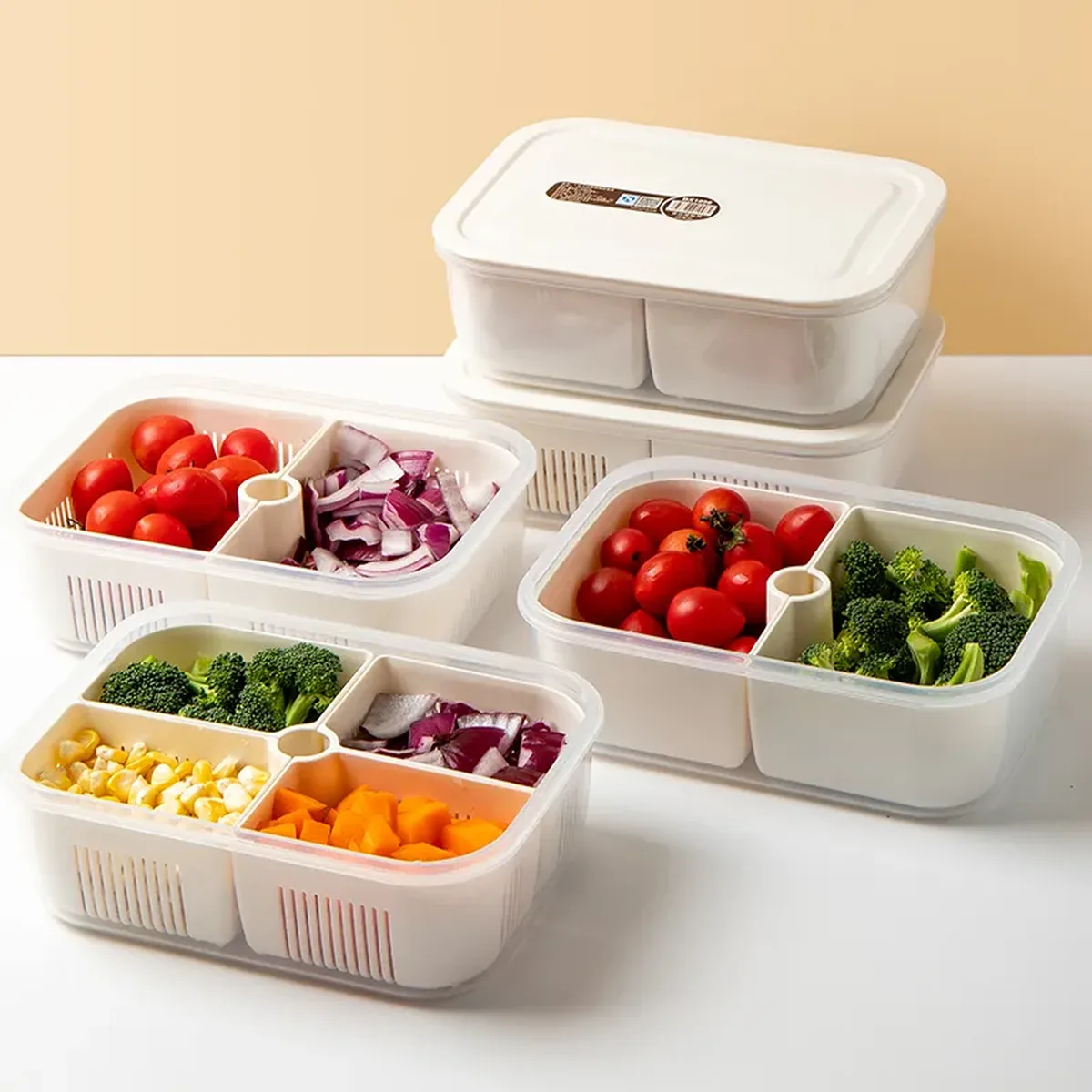
A factory quoting from a product photo is guessing, and two factories quoting from the same photo are guessing differently. Whether you are pricing food storage containers wholesale from China for a distributor range or building a private-label set for one retail chain, the same six lines decide whether the replies are comparable.
Six lines carry most of the weight:
- Capacity ladder. Which sizes you actually intend to sell, and in what ratio. A three-size ladder priced as a range is not a quote you can compare.
- Lid system. Snap-lock, screw band, clip-and-gasket, or a lid that is a separate purchased part. This single line changes both the mold and the unit price.
- Material by part. Body, lid and gasket named separately. "Food-grade PP" is a family name, not a grade.
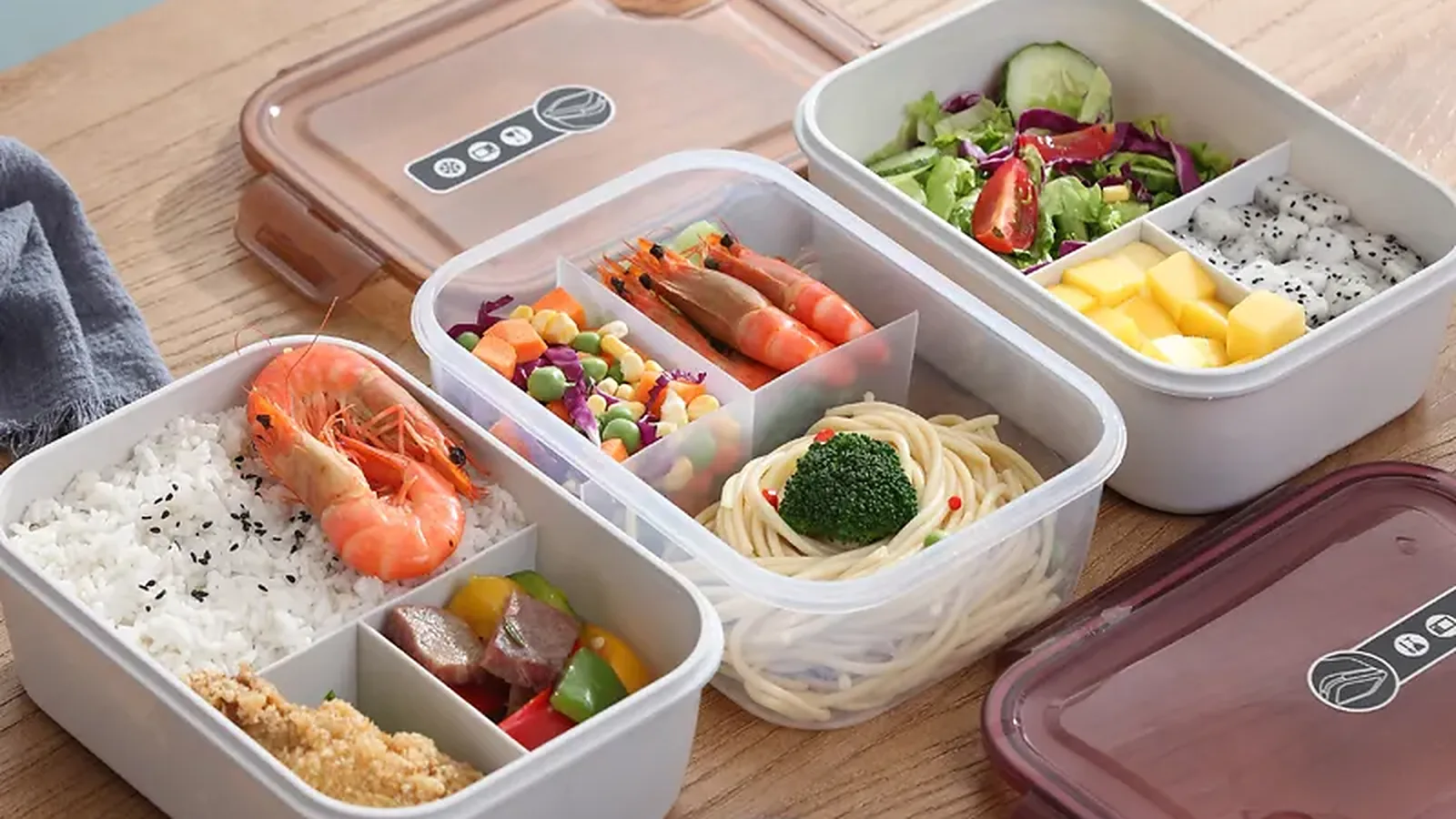
- Use conditions. Microwave reheating, freezer storage, dishwasher cycles, hot fill. These decide wall thickness, resin choice and which test reports you will need later.
- Market and channel. Destination country, retail or foodservice or e-commerce, shelf or pallet or parcel.
- Packaging format. Bulk carton, retail color box, shrink set, display tray. Packaging is where most first orders lose money, and it is decided before the RFQ, not after.
The first deliverable of your project is that one-page specification — something any candidate can price against the same assumptions.
If you are still choosing between candidates at this stage, the shortlisting questions are worth running first — our food storage container manufacturer guide lists the seven answers that separate a factory from a reseller.
What a comparable RFQ contains
An RFQ is only useful if every recipient answers the same questions in the same order. Send the identical document to all candidates and ask each of them to reply in one table, not in prose.
Twelve lines are enough for a first round:
- Model number if you are quoting an existing item, or a dimensioned sketch if you are not.
- The capacity ladder with target quantities per size.
- Material named by part: body, lid, gasket.
- Color reference, plus whether the color is standard or matched.
- Decoration method if any: in-mold label, heat transfer, silk screen, UV print.
- Packaging format and the retail unit count.
- Carton requirement: pieces per carton, carton dimensions, gross weight.
- Quantity per SKU, plus an annual forecast so the tooling decision can be discussed honestly.
- Minimum order quantity per model and per color, and whether that minimum can be spread across the size ladder.
- Lead time in working days, given separately for the pre-production sample, for mass production, and for the goods being ready for inspection.
- Destination port and Incoterm.
- Destination market and the document pack you will need.
Two things make the difference between a usable answer and a marketing reply. First, ask for the carton figures in the RFQ itself; a supplier who cannot give carton dimensions and pieces per carton has not quoted your product, only its unit price. Second, ask what is excluded — mold cost, sample cost, printing plates, packaging tooling, testing. Our walk-through on reading an injection mold quote covers how to line up two quotes that were built on different assumptions.
Read the carton data before you read the price
Freight is charged on volume and weight, so the carton figures decide more of your landed cost than a five-cent difference in unit price. Below are five food storage records from our own range, printed exactly as they sit in our product data, with the carton volume calculated from the stated dimensions.
Model | Capacity in record | Material | Pieces per carton | Carton L × W × H (cm) | Carton volume (m³) | Gross weight |
|---|---|---|---|---|---|---|
BX1094–BX1099 | 1.4 L | PP | 72 | 59.5 × 43.5 × 53.5 | 0.138 | not recorded |
BX1052 | not recorded | PP + silicone | 48 | 68 × 36 × 56.5 | 0.138 | 16.2 kg |
BX1053 | not recorded | PP + silicone | 24 | 61 × 30 × 57 | 0.104 | 12.4 kg |
3332 | not recorded | PP | 56 | 64 × 49 × 56 | 0.176 | 16.1 kg |
3334 | not recorded | PP | 80 | 59 × 56 × 65 | 0.215 | 14.7 kg |
Two honesty notes about that table, because you will meet both problems in your own RFQ replies. The BX1094 record carries no gross weight, so the figure is left blank rather than estimated — a supplier who fills a blank with a guess is telling you something about the rest of the sheet. And the 3332 and 3334 records each carry a second packing label alongside the piece count, which is a packaging-type note rather than a carton count; on a real order, confirm which number is the carton count before anyone quotes freight.
Now the number that is not on any quote: cubic centimeters of carton per piece. Divide the carton volume by the pieces inside it. BX1053, at 24 pieces in 0.104 m³, spends 4,346 cm³ of container space on every piece. 3334, at 80 pieces in 0.215 m³, spends 2,684 cm³. Same factory, same polymer, and one costs you 62 percent more freight space per unit before anything is loaded.
That is why carton engineering is worth arguing about with a factory, and why grammage and wall thickness matter beyond material cost: a thinner, lighter part stacks into a smaller carton and pays for itself twice.
Off-the-shelf model, modified mold, or new mold
There are three routes to a custom-looking container, and they cost very different amounts of time.
An existing model with your color and packaging is the fastest route and the right one for a first order. You are buying production capacity, not design work.
A modified mold covers what buyers usually actually want: a different divider, an added logo boss, a lid that takes a label window, a slight capacity change on an existing body. Modifications are cheaper than a new tool but they still need a drawing and a sign-off, and they can quietly change the seal.
A new mold makes sense when your annual volume amortizes the tool and when the geometry you need genuinely does not exist. Before any steel is cut, settle gate position, draft angle, parting line, and where the weld line will land on your logo — the four decisions our mold design review checklist puts in front of buyers. Also settle who owns the tool, who stores it, and what happens to it if you move suppliers. That clause costs nothing to negotiate at the start and everything to negotiate later.

Two sample rounds, two different sign-offs
Most sourcing problems that surface at inspection were created at sample approval, because the two rounds got treated as one.
Round one is a form sample. It normally comes off an existing mold and exists to answer one question: is this the format, size and lid system we want? Judge it in your hand, with your product inside it, and do not sign anything yet.
Round two is a production sample. It uses the actual mold, the actual color, the actual gasket and the actual packaging, and it is the sample you keep. Sign it against a written checklist — capacity, external dimensions, stack height, lid retention, gasket fit, color against the reference, retail packaging copy — and treat the signed piece as the production reference. Our golden sample write-up covers what makes that reference hold up when a second production run happens a year later.
Sample fees and courier charges are normal and usually creditable against the order; the points worth agreeing in writing are when the credit applies and who pays the courier both ways, which is what this note on sample fees sets out.
Quality gates between approval and mass production
A purchase order that says "quality as per approved sample" is not a quality clause. It needs to say what gets checked, how, how often, and what happens when a check fails.
The four gates worth naming in the order:
- Incoming material. Resin grade and supplier named on the purchase record, matched against the grade in your specification.
- First-article inspection. The first parts off the tool measured against the signed sample before the run continues.
- In-process. Cycle checks, color checks, weight checks per cavity at a stated frequency.
- Final inspection before packing. AQL sampling on the finished cartons, plus the functional tests that matter for your product.
For a container with a gasket, the functional test is the one to specify most carefully, because "leak-proof" is a claim and a test is a method. Our note on leak-proof seal structure and sample testing explains what a pressure or vacuum decay check actually demonstrates; the method itself is standardized in ASTM F2338, the vacuum decay standard for nondestructive leak detection.
The document pack to request before the PO
Food-contact documentation is where buyers most often accept a folder of certificates that do not name their product. The useful question is never "do you have certificates" but "which document names this resin, this part, this use and this market".
Ask for each of these, and expect the answers to be specific:
- A declaration of compliance that names the regulation, the materials and the intended use. For the European Union, the framework is Regulation (EC) No 1935/2004, with plastics covered by Regulation (EU) No 10/2011.
- A migration test report naming the finished article, the simulant, the time and temperature, and the market it was run for. EFSA's food contact materials hub is the reference point for how those assessments are framed in the EU.
- For the United States, the resin citation rather than a certificate. Polypropylene and other olefin polymers are covered by 21 CFR 177.1520; there is no such thing as an FDA-approved plastic, which is why our note on wording the compliance clause exists.
- System certificates if the factory claims them, checked for scope and validity — BRCGS publishes the standards behind the packing-site certificates you are most likely to be shown.
- A statement of the parts that are not in direct contact with food, if your container has clips, handles or an outer shell.
Two further pieces of reading are worth the time before you draft the clause: which compliance documents to request and the five-market document map that compares what the US, EU, Germany, Japan and China each expect. None of this is legal advice, and none of it substitutes for your own market's requirements — it is a checklist for the conversation.
Carton math and consolidation: what actually fills the container
Two planning volumes are enough for a first calculation: roughly 28 m³ of usable space in a 20'GP and roughly 68 m³ in a 40'HQ. These are planning numbers, not nominal capacity, and a forwarder will give you the exact figure for your loading plan.
Take the same five records and divide:
Model | cm³ per piece | Cartons per 20'GP | Pieces per 20'GP | Cartons per 40'HQ | Pieces per 40'HQ |
|---|---|---|---|---|---|
BX1094–BX1099 | 1,923 | 202 | 14,544 | 491 | 35,352 |
BX1052 | 2,882 | 202 | 9,696 | 491 | 23,568 |
BX1053 | 4,346 | 268 | 6,432 | 651 | 15,624 |
3332 | 3,136 | 159 | 8,904 | 387 | 21,672 |
3334 | 2,684 | 130 | 10,400 | 316 | 25,280 |
The interesting column is the second one. BX1053 puts 268 cartons into a 20'GP and BX1052 puts 202, yet they ship 6,432 and 9,696 pieces respectively, because the carton that looks more efficient per carton is carrying a heavier, bulkier piece.
Carton counts are not a proxy for volume efficiency. Pieces per cubic meter are.
Mixed loads follow the same arithmetic, done in the right order. Load 100 cartons of 3334 and you have used 21.48 m³ of a 28 m³ plan, leaving 6.52 m³ — enough for 62 cartons of BX1053, which takes the load to 27.94 m³, 9,488 pieces and 2,239 kg gross on carton weights, before pallets and dunnage. That is 99.8 percent of the plan on volume, and the 0.057 m³ left over is too small to hold another carton of either model. Floor-divide every step, because a partially filled carton is not a thing you can ship. Our notes on mixed container loading cover LCL and FCL decisions from the same arithmetic, and how MOQ is counted matters here too: a per-model, per-color minimum can decide your mix before the container does, so put that minimum in writing per model and per color and ask whether the ladder can share it.
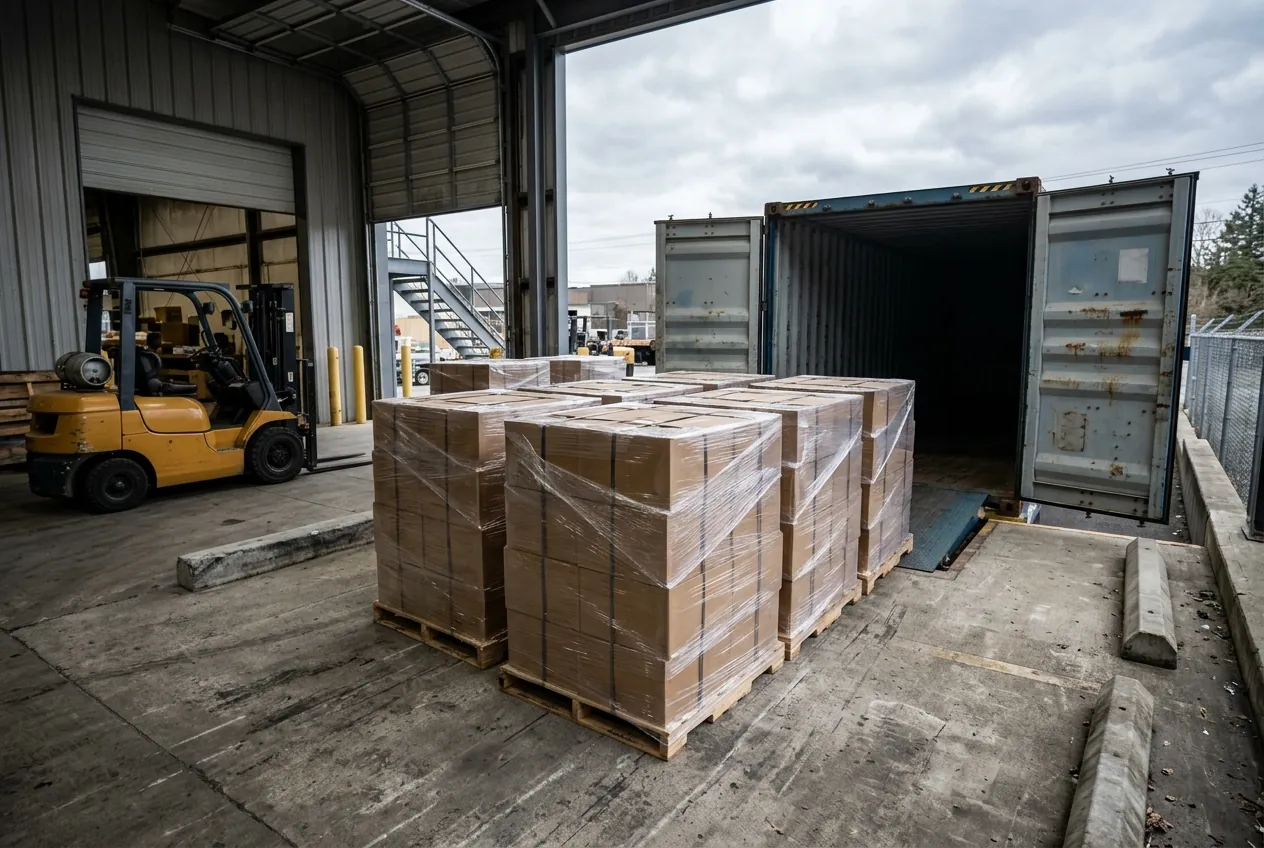
If your pieces are dense — glass inserts, stainless parts, heavy lids — the weight limit arrives before the volume limit, and the calculation flips. Ask the factory for both gross weight per carton and carton volume in the same reply, and run both divisions.
The hand-off: from deposit to booking
The last stretch of the project is administrative, and it is where first orders slip.
The sequence is short: proforma invoice and deposit, a pre-production meeting where the signed sample, the packaging artwork and the inspection standard are confirmed in one document, the production window, the inspection booking, then documents and the shipping booking. Each of those is a place where a week disappears if nobody owns it.
Three things are worth fixing in writing at hand-off, because they are the ones that get renegotiated by email afterward: the inspection standard and the sampling plan, the carton marks and shipping marks, and the list of documents the factory will issue. Payment structure belongs in the same conversation — our note on payment terms with a Chinese houseware factory explains why the trigger for the balance is worth arguing about more than the percentage.
Lead time belongs in that same document, and it is the one usually left verbal. Write it in working days, split into the pre-production sample, mass production and inspection readiness, and count it from the deposit rather than from the email that confirmed the order. A single date with no split is the one that slips, and it is also the one you cannot argue about later.
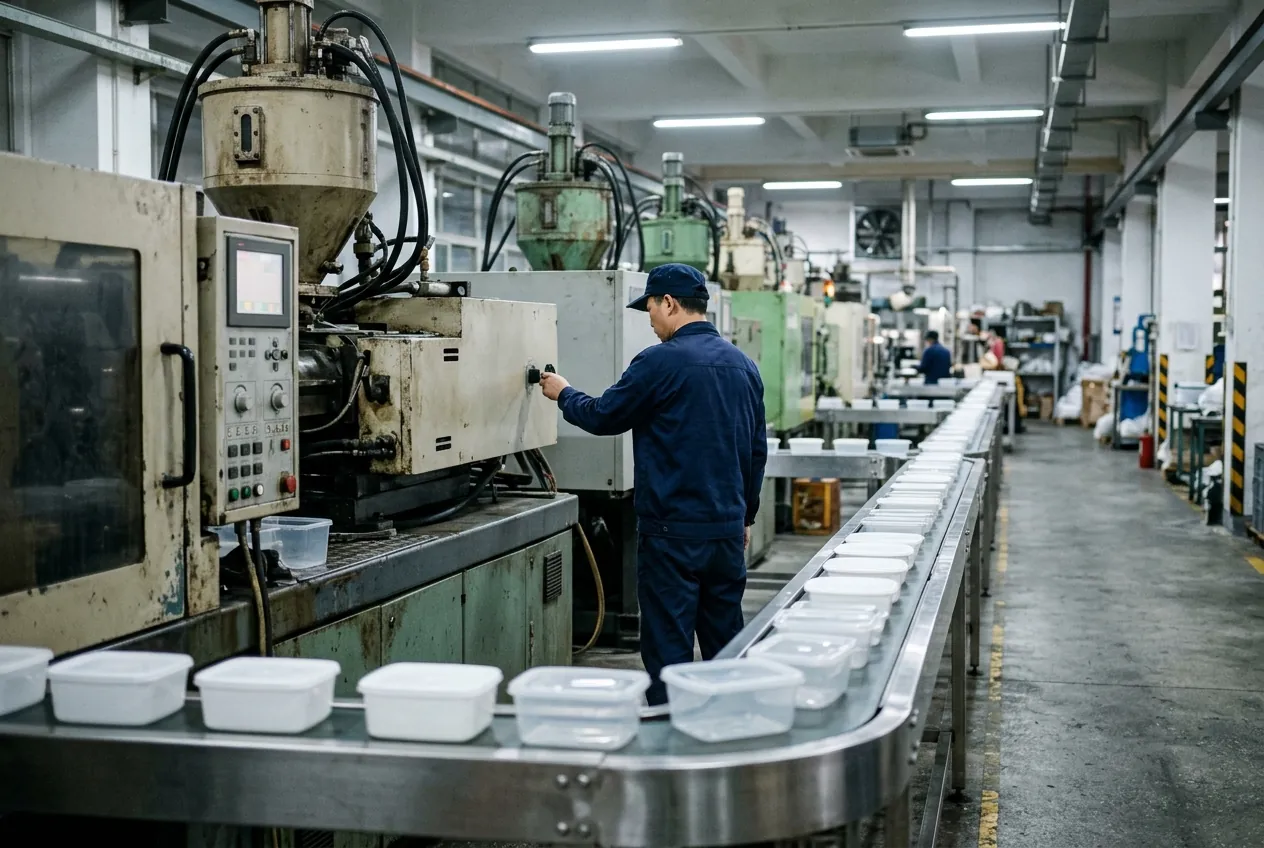
One caution that belongs in this section rather than the first: if the entity quoting you cannot answer questions about the tool, the inspection or the carton, you are probably talking to a trading company. That is not automatically disqualifying, but it changes who is accountable when something goes wrong, and the checks that separate a factory from a trading company are worth running before the deposit, not after.
A first-order checklist
If you take nothing else from this article, take the order of operations:
- Write the one-page spec, including use conditions and packaging format.
- Send an identical RFQ to every candidate, and require carton data, an MOQ per model and per color, and a lead time in working days in the reply.
- Compare quotes on cm³ per piece and gross weight per piece, not on unit price alone.
- Decide the route: existing model, modified mold, or new mold.
- Sign a form sample, then a production sample, against a written checklist.
- Name the four quality gates and the functional test in the PO appendix.
- Collect documents that name your resin, part, use and market.
- Floor-divide the container math, including the mixed-SKU case.
- Fix the inspection standard, carton marks and document list at hand-off.
- Book inspection before you book the vessel.
Xinghui Plastic Life runs these steps from a molding factory in Jieyang: 63 published product records, existing models, modification work and new tooling. The five carton sheets in this article are printed from that record set as they stand, which is why each of the five carries at least one not recorded cell rather than a tidy number. If you want to test the sequence on a real project, start from the food storage container range and send the spec through the procurement route — or browse the rest of the sourcing and OEM articles if you are still at the planning stage.
Continue reading
Related sourcing guidance
More practical context for your food storage container sourcing conversation.
Discuss your product range
Need help selecting or customising containers?
Share the product type, market and sourcing requirements with the Xinghui team.