
Sourcing & OEM
What Payment Terms Should You Expect From a Chinese Houseware Factory? Deposit, Balance and the Milestones They Attach To
Payment terms with Chinese suppliers are quoted as 30% deposit and 70% balance. The split is the easy part — the milestone behind each wire is the real term.
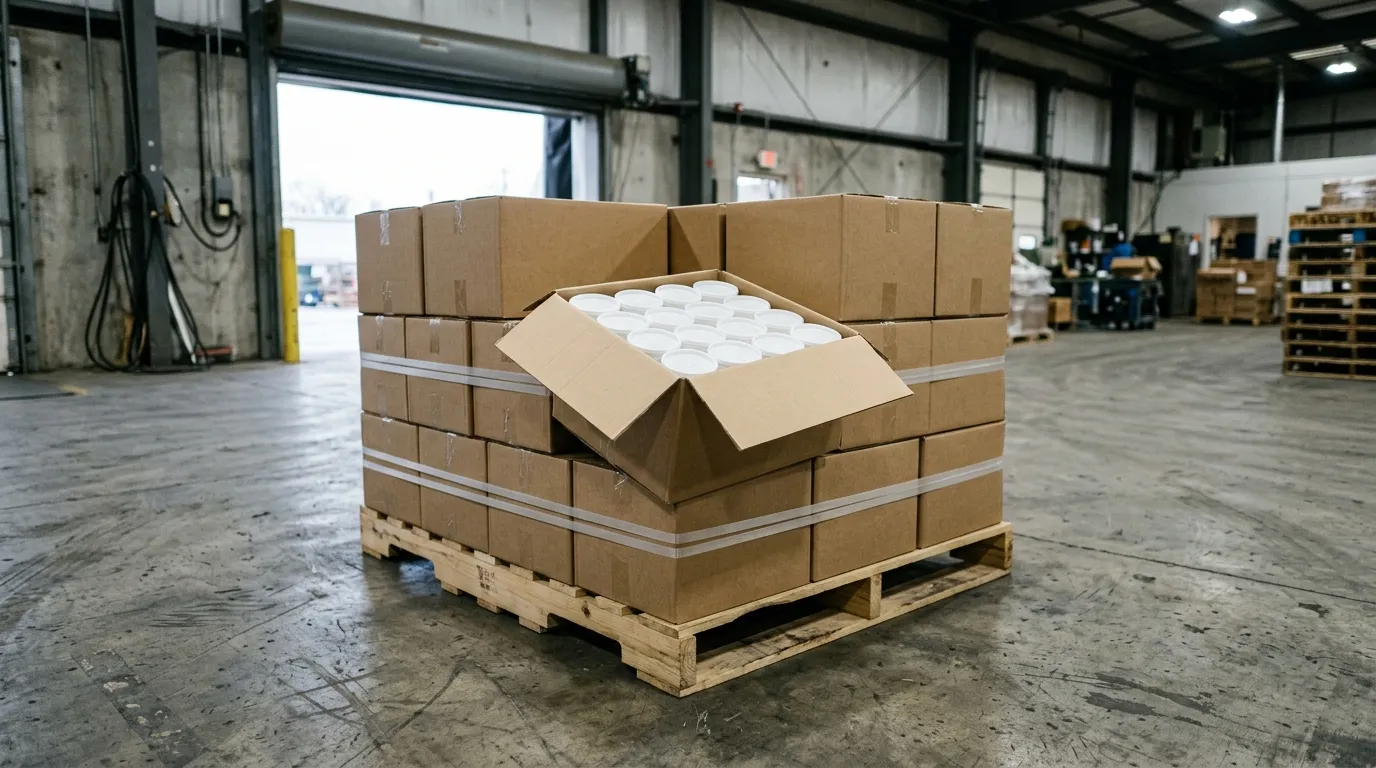
Payment terms with Chinese suppliers arrive in the same sentence as the price, usually as five words: 30 % deposit, 70 % before shipment — T/T, telegraphic transfer, 30/70. Buyers then spend two weeks arguing about the ratio. The ratio is the least important number on the page.
What decides whether your money is safe is the milestone — the thing that must physically exist before each wire leaves your account. A deposit released against a signed specification is a different transaction from a deposit released against a chat message saying "we will start soon". Same percentage, different business.
This page is written from the factory side of that table. Xinghui Plastic moulds reusable PP houseware in Jieyang, Guangdong — a 15,000 m² plant running more than 30 injection-moulding machines since 2000 — and supplies 304 stainless lunch boxes alongside the moulded range, as one material option rather than a moulded product. We are on the receiving end of these transfers several times a week. What follows is what those wires are actually attached to in a moulding order, and how a buyer turns "goods ready" into something countable.
Why a Chinese Factory Quotes Split Terms and Your Domestic Supplier Quotes Net 30
A domestic supplier who invoices you net 30 has a cheap way to enforce the debt: a local court, your credit file, and a relationship he expects to keep. A factory in Guangdong selling to a buyer in Ohio has none of those. Suing across a border costs more than most first orders are worth, so the only security a factory has is the money already in its account.
The asymmetry shows up in the numbers. A survey of more than 1,000 Chinese suppliers reported average payment terms of 76 days in 2024, up from 70 the year before — on books that are mostly domestic trade, where both sides can sue each other cheaply. You are not being singled out. You are outside the enforcement perimeter.
The US Commercial Service frames the same thing as a spectrum of payment risk and states the importer's position bluntly: for a buyer, any payment is a donation until the goods are received. Every structure below is an attempt to shrink the window in which that sentence is true.
Two consequences. Asking for net 30 on your first order marks you as someone who has not done this before; ask instead for staged evidence. And read the payment block as a signal — reading an injection moulding quote covers the lines around it, which matter just as much when you compare suppliers.
What the 30 % Deposit Actually Buys
Ask why a factory wants a deposit and balance payment rather than net 30, and "raw materials" is the standard answer — which hides the interesting part. In a moulding factory your deposit is spent inside the first ten days on things that are hard or impossible to resell:
- Resin. Polypropylene granulate is bought by the tonne against a production run. A partial run may mean a partial bag.
- Colour masterbatch. Your colour is a separate compound ordered in a minimum batch. If it is not a stock colour, that batch is yours.
- Print plates and film. A heat-transfer or silk-screen logo needs plates or screens cut for your artwork.
- Packaging. Printed cartons, sleeves and labels are ordered against your SKU, not against a catalogue.
- A slot on a machine. A plant with more than 30 presses still schedules them weeks ahead. Your deposit reserves the hours.
None of that is a hostage. It is money the factory has already committed on your behalf — which is why a deposit is normal, and why "fully refundable deposit" deserves a second question. The unspent resin may come back; the masterbatch will not.
So negotiate the schedule, not just the percentage. Ask what happens to the deposit if you cancel at three points: before material release, after material release, and after the first article is approved. A factory that answers that in writing has thought about it. One that cannot has not.
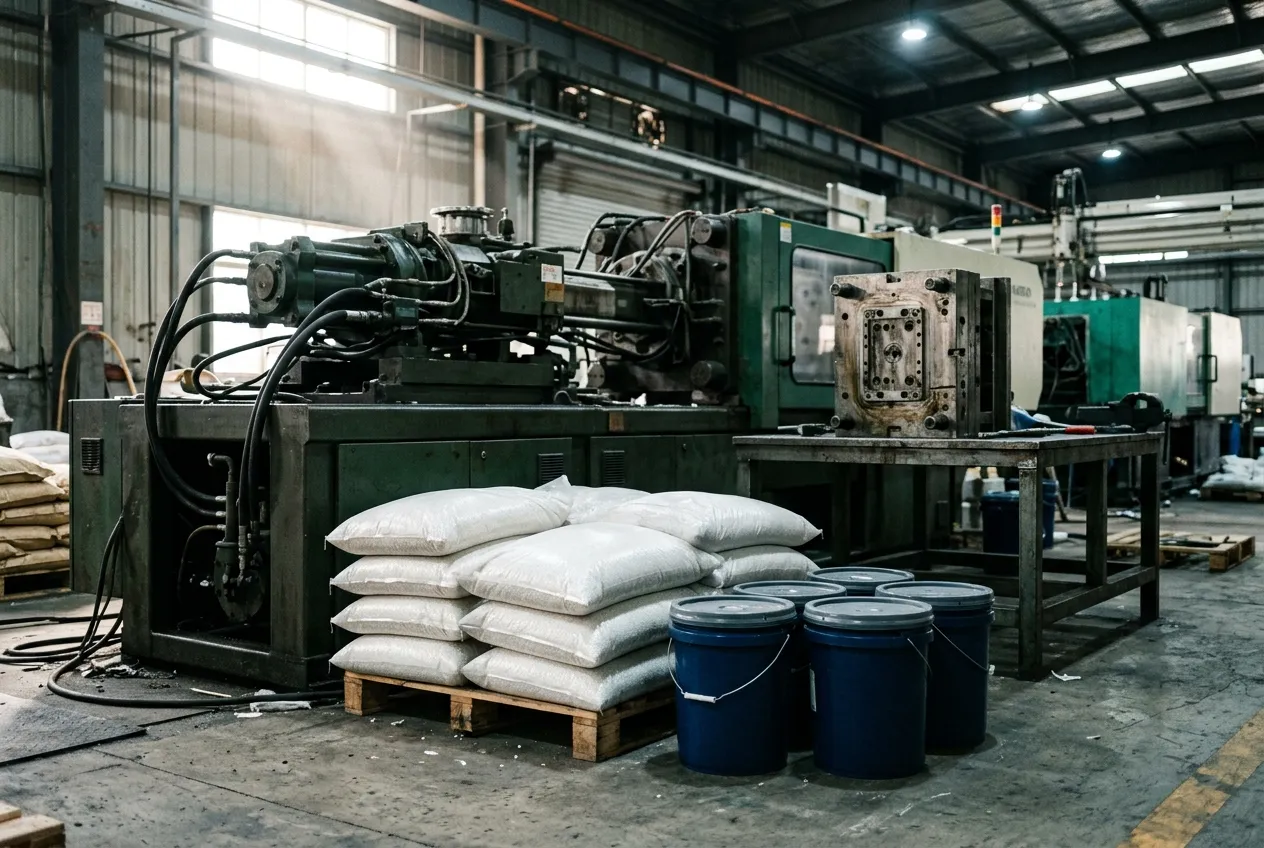
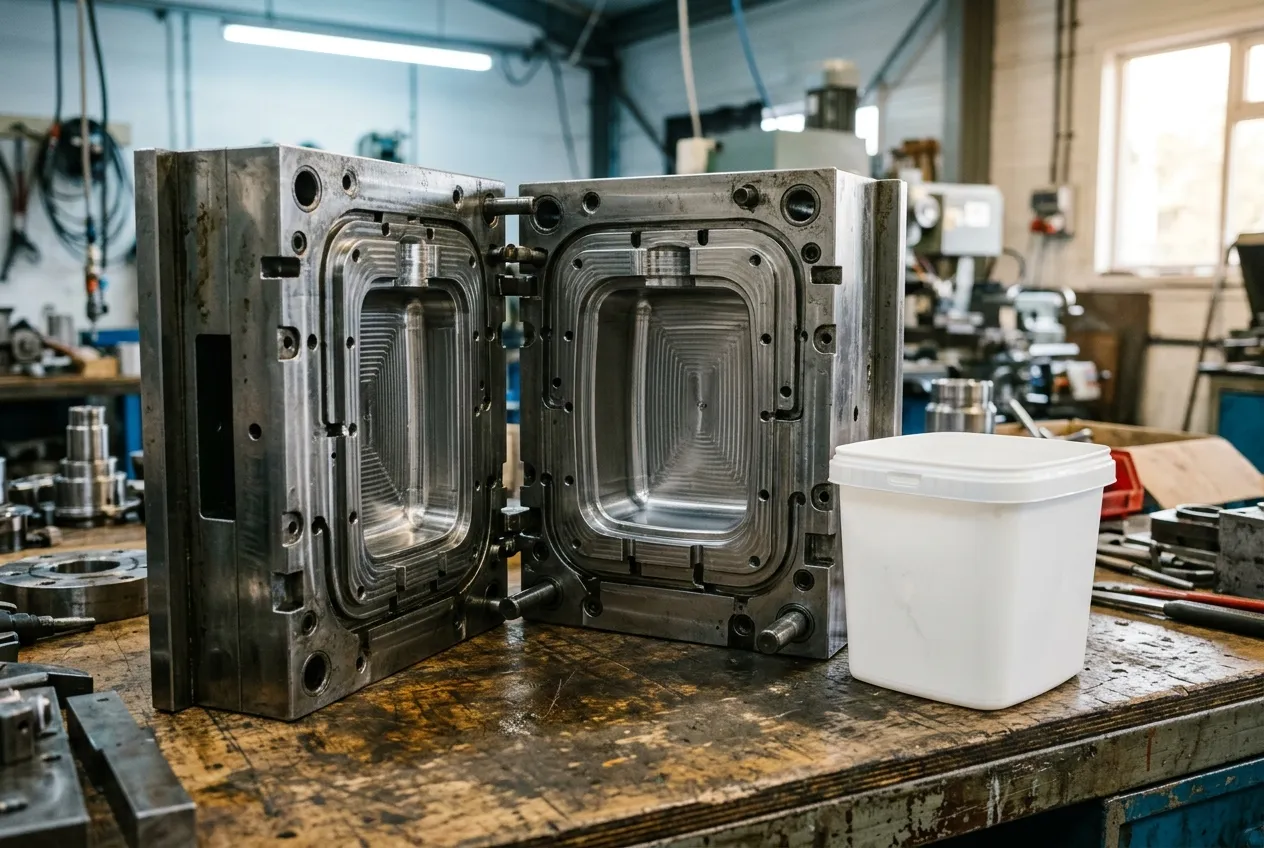
If the order needs a new mould rather than an existing one, the conversation splits in two — that is the subject of modifying an existing mould versus building a new one, because tooling money and production money behave differently when a project stops.
The Milestones a Moulding Order Actually Passes Through
Most payment disputes are not about percentages. Two people are using the same word — "finished", "ready", "approved" — for different states of the same order. The fix is a schedule in which every payment has a physical counterpart.
Milestone | What physically exists | Evidence to hold before paying | What it usually releases |
|---|---|---|---|
Specification and artwork frozen | Approved spec sheet, colour standard, artwork file with a revision number | Signed-off spec, colour chips | Nothing — and no deposit before this |
PI signed | Countersigned proforma invoice with bank details | PI plus written confirmation of the beneficiary | The deposit |
Material release | Resin lot on the floor, masterbatch matched to your standard | Photos with the lot label, colour chip comparison | Usually nothing — the deposit is already spent |
First article off the tool | A part moulded in production tooling, not a hand sample | Dimensional report, photos under agreed lighting, the part itself by courier | Tooling balance, or the middle tranche of 30/40/30 |
Mass production | Finished quantity off the line | Production reports, in-line QC records, sampling results | Nothing on its own |
Packing | Cartons sealed, labelled, counted against the packing list | Carton count, packing list, barcode and label check | Middle tranche, if the inspection is tied here |
Loading | Container stuffed, seal applied, B/L issued | Copy of the bill of lading with container and seal number | The balance |
The most useful line in that table is the fourth. A sample made before the order is not evidence of production quality: it may have come off a sample tool, been hand-finished, or been made by the one technician who is not on your run. A first article moulded in the actual tool and measured against the drawing is evidence. How we hold that reference through a run is described in how a golden sample survives mass production — and it is the milestone most worth naming in the contract.
Tooling Is a Separate Payment, and It Needs Its Own Paperwork
A new mould is a capital purchase, not a bigger order. It has its own price, its own lead time, and — the part buyers forget — its own ownership question.
Three things belong in writing before the first tooling wire:
- What the tooling payment covers. Steel, machining, polishing, trial shots, and whether sampling rounds are included or billed per round.
- Who owns the mould. If you paid for it, it is your asset. Say so, and say where it is stored, who maintains it, and what happens to it if you move the order.
- What the release condition is. A common and defensible split is part at kickoff and part at first-article approval — because the second payment is your only leverage over a tool that has not yet produced a good part.
A supplier that folds tooling silently into the 30 % deposit has hidden both numbers. Ask for it as a separate line even when the total is unchanged. And where the tool is a large commitment, verify the design before steel is cut: 3D-printed verification parts exist for exactly that.
Make "Goods Ready" a Number, Not an Adjective
Here is the part of payment terms that sourcing guides leave out, because sourcing guides do not run moulding machines: the same piece count is a different physical job depending on how the product packs. Five models from our own records, a 10,000-piece order of each.
Model | Pieces per carton | Cartons for 10,000 pcs | Carton size (cm) | Gross weight per carton | Total gross weight | Total volume |
|---|---|---|---|---|---|---|
BX1051 lunch box, 1.3 L | 72 | 139 | 62 × 47.5 × 58.5 | 14.3 kg | 1,987.7 kg | 23.95 m³ |
BX1052 round container | 48 | 209 | 68 × 36 × 56.5 | 16.2 kg | 3,385.8 kg | 28.91 m³ |
BX1053 airtight container | 24 | 417 | 61 × 30 × 57 | 12.4 kg | 5,170.8 kg | 43.50 m³ |
3332 rectangular container | 56 | 179 | 64 × 49 × 56 | 16.1 kg | 2,881.9 kg | 31.44 m³ |
3334 tall storage container | 80 | 125 | 59 × 56 × 65 | 14.7 kg | 1,837.5 kg | 26.85 m³ |
Figures as recorded in our product data. Gross weight is per carton as recorded and should be confirmed against the packing list for your own order; totals are arithmetic from those figures and exclude pallets and additional packing.
Read the carton column again. Ten thousand pieces is 125 cartons of the tall container and 417 of the airtight one — more than three times the handling, three times the sealing and labelling, and a container-fill problem on top. Your 70 % balance is the same percentage in both cases and releases against a very different amount of work.
That is why the balance clause should carry numbers. "Balance payable when goods ready" cannot be checked. "Balance payable when 417 cartons of 24 pieces are packed, labelled and counted against the final packing list" can be checked by anyone with a phone camera in ninety seconds.
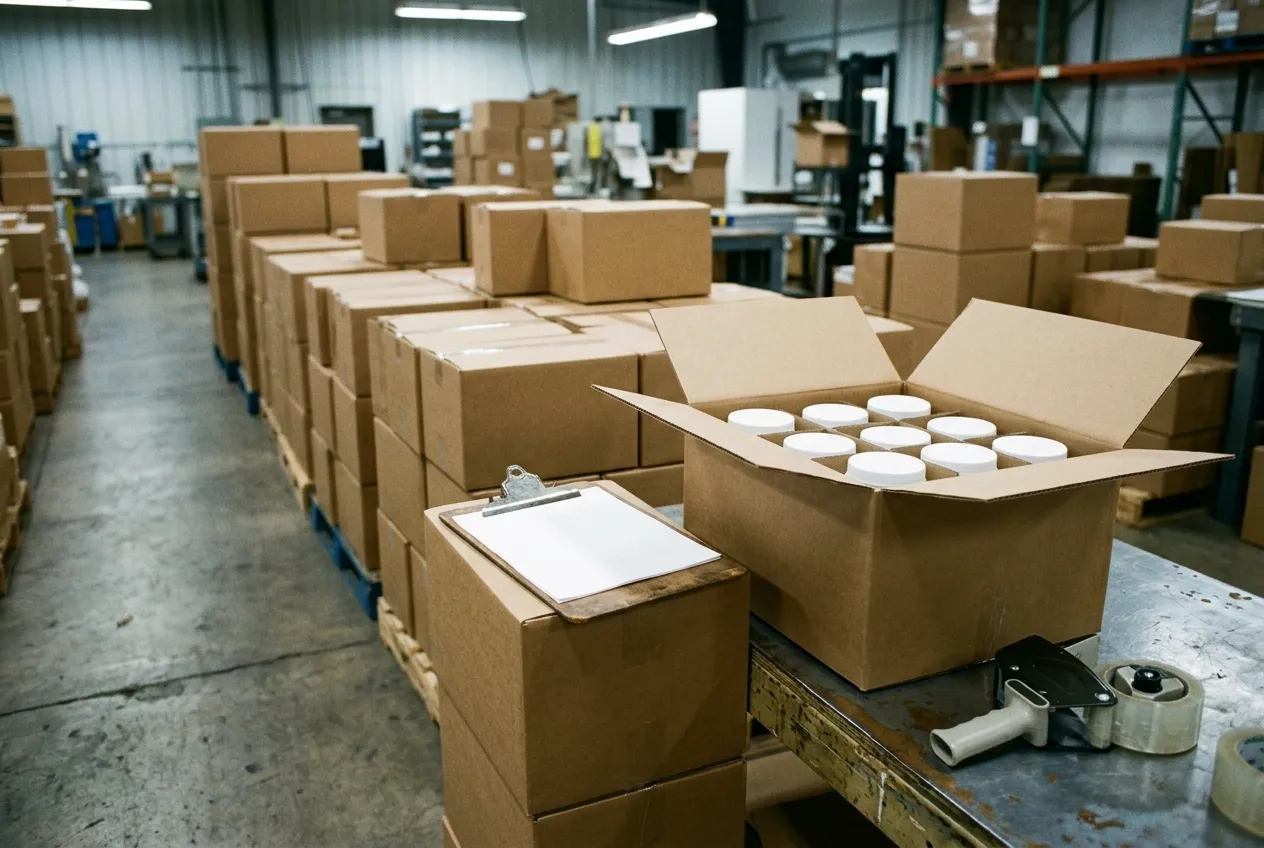
Packing is also the last quality gate: retail sleeves, barcodes and carton markings are the defects that survive production and reach a shelf, which is why retail packaging approval deserves its own sign-off rather than a photo at the end.
Two related traps on mixed orders. A deposit calculated on "the order" can hide the fact that one model in the mix carries most of the material cost, and how MOQ is counted per order, per colour or per model changes both the deposit base and what "complete" means. Where the product is bulky for its weight, volume rather than pieces is what the freight and the container booking pay for — which changes the number your balance is released against, not just the freight bill.
The Four Balance Triggers, Ranked by What They Protect
Everyone agrees the balance is paid "before shipment". That phrase covers four quite different arrangements, and the difference between them is the difference between leverage and hope.
Trigger | What you hold when you pay | What it does not protect | When it is reasonable |
|---|---|---|---|
Supplier says goods are ready | A message | Everything except the relationship | Never on a first order |
Pre-shipment inspection passed | An independent report against your spec and sampling plan | That the goods ever leave the country | First orders, new colours, new packaging |
Copy of the bill of lading | Proof the carrier has the cargo, with container and seal number | Quality — goods can be loaded and still be wrong | Repeat orders with a supplier you have run before |
Inspection passed and B/L copy, with telex release | Quality and shipment evidence together | Very little that money can protect | Any order you cannot afford to lose |
An inspection is the cheapest thing on that list relative to what it gates, and independent inspection firms work to two things you specify: a scope, and a sampling plan — in practice an AQL level (AQL 2.5 for major defects, 4.0 for minor is the usual starting point) at General Inspection Level II of ISO 2859-1. So the specification you send them is the specification that counts, and the AQL you write into the PO is the number they accept or reject against. Nobody inspects against "good quality", and nobody samples "a reasonable number of cartons".
The bill of lading deserves its own sentence, because it is where buyers get caught. Whoever holds the original set controls the cargo. If your terms say originals are released only after the balance clears, you pay before holding the document of title — acceptable if you also hold an inspection report. "Balance against bill of lading, copy with telex release" is the wording that keeps both halves; "goods ready" is the wording that keeps neither.
Clause that survives contact with a dispute: the balance falls due only when the agreed quantity is packed and counted against the final packing list, the agreed inspection has passed, and the supplier has provided a copy of the bill of lading with the container and seal number. A notice that production is complete does not, by itself, make the balance payable.
On a multi-container order the trigger should be per container, not per order. Mixed container loading makes this concrete: the second container often loads days after the first, and an order-level balance either pays for goods that are not packed or holds goods that have already sailed.

When 30/70 Is the Wrong Shape: 50/50, 30/40/30, L/C and Open Account
T/T on 30/70 payment terms is a starting point, not a law — the transfer method and the ratio are two separate choices, and only one of them is worth arguing about. Which structure fits depends on how much of your order is bespoke and how much you trust the counterparty.
Structure (T/T, L/C or open account) | Cash committed before goods exist | Main protection | Fits |
|---|---|---|---|
T/T, 30/70 before shipment | 30 % | Whatever inspection you perform | Standard products, repeat supplier |
T/T, 50/50 | 50 % | Very little extra | Heavy customisation, bespoke colour and packaging, short lead times |
T/T, 30/40/30 | 30 %, then 40 % | The 40 % is gated by a passed inspection | New supplier, order above your comfort level |
Letter of credit (L/C) | None until documents comply | A bank examines documents instead of trusting a buyer | Large orders, unfamiliar counterparty |
Open account (net 30/60) | None | Your supplier's trust in you | Earned over several clean orders, never requested on the first |
Escrow / platform assurance | Full amount, held by a third party | Platform dispute process | Small orders placed through a marketplace |
A letter of credit is the one structure whose protection is genuinely structural. As the US Commercial Service defines it, it is a bank's promise to pay against complying documents, and it is a contract separate from the sales contract — which is precisely why the bank does not care whether the containers are any good. Documents are examined against a rulebook, UCP 600, and a discrepancy is a rejection. L/Cs cost money to open, amend and advise, and they slow everything down; that cost is earned on large orders, not on a 3,000-piece trial.
Open account terms are not a negotiating position, they are a credit rating you have not earned yet. Factories extend them to buyers whose payment history they can predict. If a brand-new supplier offers net 60 on a first order without being asked, the useful question is not "how do I accept this" but "why is this being offered to a stranger" — choosing a supplier you can actually rely on covers the diligence that makes that judgement possible. Private-label programmes that run for years settle into a hybrid: deposit, inspection-gated middle payment, balance against documents, terms reviewed annually — usually once a category manager starts planning seasons rather than orders.
Before the First Wire: Five Checks That Cost Nothing
None of the structures above help if the money goes to the wrong account. These take an afternoon and prevent the only loss that is genuinely unrecoverable.
- The beneficiary name matches the company name on the business licence, character for character, including the Unified Social Credit Code. Ask for the licence scan and read it against the PI.
- The confirming call goes to a number you already had. Business email compromise works by intercepting a thread and changing the bank details in a PDF that looks like the last one. Confirm any change by voice, on a number from the licence or the website, never from the email that announced it.
- No personal accounts, and no unexplained third-party accounts. A factory invoicing from its own company and asking for payment to an individual is not a paperwork quirk.
- The PI is complete enough to be a contract: quantity, unit price, Incoterm and named port, lead time, payment schedule with milestones, bank details, validity, and who signs for the seller.
- The entity that invoices is the entity that manufactures — or the difference is disclosed and you have accepted it. A trading company is not a defect; an undisclosed one is.
Our own one-stop sourcing process runs the same checks in the order we do them, if you want to see the sequence from the other side of the table.
What to Write Into the PI and the Contract
These are commercial drafting points, not legal advice — have your own lawyer adapt them to your jurisdiction and the size of the order.
- Amount, currency and beneficiary, with the account name spelled exactly as on the licence.
- What each milestone means, measurably: carton count, pieces per carton, inspection standard, and which documents constitute "ready".
- Inspection rights: who inspects, against which specification revision, at which AQL level and inspection level — name them (AQL 2.5 for major defects, 4.0 for minor, at General Inspection Level II) rather than writing "standard sampling" — and what happens if it fails: rework, re-inspection, or cancellation with the deposit treatment you agreed.
- Late and partial shipment, including whether the balance releases per container.
- Who pays the wire charges. "OUR", "SHA" and "BEN" deliver three different net amounts to the factory; on a large order the difference is not trivial, and an underpaid invoice is an avoidable argument.
- How bank details may be changed: in writing, with a named signatory and a verification call.
- Governing law and forum. Where both parties are in contracting states of the CISG, it applies to the contract unless you exclude it — decide explicitly rather than discovering it later. Arbitration usually travels better than a court judgment across borders; CIETAC in China is the common venue on this side.
- The shipping documents: commercial invoice, packing list, B/L, plus whatever test or compliance documents your market requires. If the goods go to a marketplace warehouse, labelling and carton-marking belong in the same clause — see FBA and retail prep handled inside the factory.
Currency deserves a line of its own. Most Chinese export invoices are in USD; RMB settlement is possible and increasingly common, but it moves the transaction into a different reporting regime, and both banks will ask for a purpose code — the requirements come from the State Administration of Foreign Exchange. Agree the currency before you agree the price, and agree who supplies the codes.

The Payment Terms to Expect on a Second and Third Order
Terms are a function of history, so the first order is usually the worst one you will ever sign. What moves, and in what order:
- After one clean order: balance against a copy of the B/L becomes normal rather than negotiated.
- After two or three: the middle tranche appears — 30/40/30 becomes 20/80 with an inspection condition, which is more leverage for less cash.
- After a year of real forecasts: part of the volume may move to net 30, usually on repeat models rather than new tooling.
- Tooling never moves. A mould is a one-off capital item and stays separately paid, even in year five of a programme.
What earns those terms is unglamorous: pay on the date you promised, do not change the specification mid-run without accepting the cost, keep one point of contact instead of three, and give a forecast you intend to place. A factory with 30 presses schedules weeks ahead; a buyer whose forecast is real gets a better slot, and eventually a better deposit.
The short version: expect 30/70, argue about the trigger instead of the percentage, and make every milestone a document or a count. A factory that resists that is telling you something about how it expects the order to go.
If you want the deposit schedule we actually quote on a first order, our procurement process sets out what we ask for before quoting and what comes back with the price.
Continue reading
Related sourcing guidance
More practical context for your food storage container sourcing conversation.



Discuss your product range
Need help selecting or customising containers?
Share the product type, market and sourcing requirements with the Xinghui team.