
Sourcing & OEM
Airtight Container for Flour: Pantry Canister Niches Worth Private-Labelling — Flour, Coffee-Bean, Rice, Brown-Sugar and Cookie SKUs Ranked by Search Demand and Capacity Ladder
Five pantry canister niches ranked by measured search demand — flour, rice, coffee bean, brown sugar and cookie — and the capacity rung each has to clear.

An airtight container for flour is searched 33,100 times a month in the United States, according to DataForSEO's keyword data pulled for this page. Rice storage containers are searched 4,400 times. Coffee bean storage containers, 2,400. Brown sugar containers, 1,600. Cookie jar wholesale, twenty.
That ranking is the starting point of every private-label canister decision, and it is also the most misread list in the category — because the pages that rank for terms like these are shopping listicles written for somebody filling one kitchen shelf. A brand owner reading the same numbers is deciding where a pallet goes: which niche gets a mould, which gets a colour run, which gets its own carton, and which should wait a year. Those are different questions, and the answers do not follow the volume order quite as cleanly as it first appears.
This page works the list the way a buyer has to: what each niche's demand actually is, what that demand does to the canister itself, and what the factory's own recorded model families can carry today — including the places where the record is silent, which is information too.
Reading Consumer Demand as a Private-Labelling Shortlist
Start with what the results actually contain. The top ten results for the flour term are four editorial roundups, one retailer category page, three marketplace listings, a Reddit thread and a Pinterest pin — none a manufacturer, a sourcing guide or an MOQ explainer. The second query, for the commercial angle (private label airtight pantry canisters wholesale), returned no canister manufacturer's own page either: its page one is distributors, wholesale and foodservice suppliers, a reseller listing and one supplier directory of custom manufacturers. So the supply side of a category with roughly 41,500 measured searches a month is, on this evidence, invisible on page one.
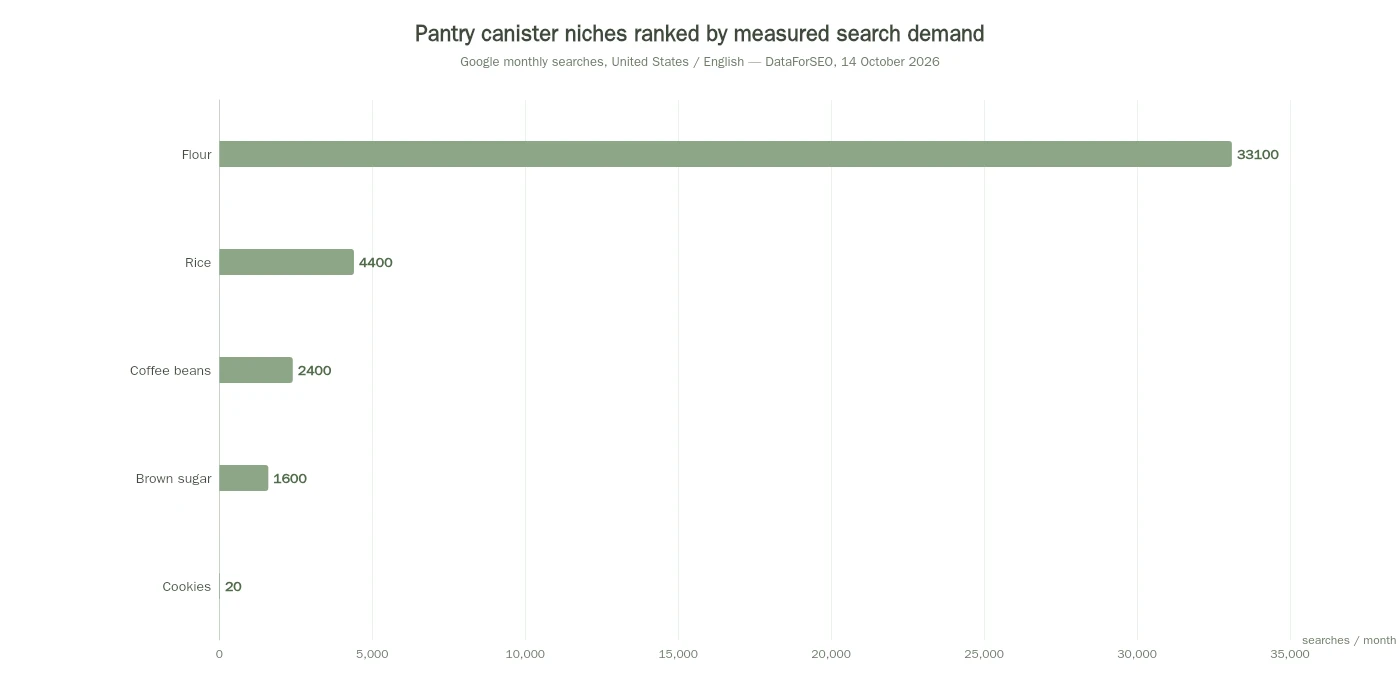
That gap is the opportunity, and it is also a warning. Consumer demand does not translate into wholesale orders by itself. Three filters stand between a search number and a private-label decision:
- Volume shape. A single head term carrying 33,100 searches is worth more than five terms carrying 1,600 each, because one page, one hero image and one keyword can capture it. Diffuse demand costs more to serve.
- What the contents do to the container. Flour is a fine powder that migrates into every sealing groove; coffee beans release gas for a week after roasting; brown sugar goes hard when it dries out; cookies break. Each behaviour points at a different lid geometry, and lid geometry is tooling, not a colour choice.
- Whether the capacity the searcher names lands on one container. The market asks in bags — a 5 lb bag of flour, a 25 lb bag, a 50 lb sack. Those quantities do not fit one moulded volume, and the gap between the rung the shopper wants and the rung the ladder carries is where private-label programmes get expensive.
A fourth filter — the one that decides whether the category is worth entering at all — is whether the buyer's customer will pay a premium for a canister rather than a bag with a clip. That is the brand's question, not the factory's, so this page keeps to the three that can be measured.
The working rule for a first canister programme: pick the niche with the demand, pick the body that already exists, and let the lid and the decoration carry the brand. Change one variable per order until the mould is paid for.
One further reading of the SERP is worth keeping in mind. Almost every one of the top ten is a single-answer page: one container recommended, one "our top pick", one category to browse — and the three exceptions (a marketplace search page, a forum thread, an image pin) are just as consumer-shaped. None is a comparison across niches: a shopper only ever needs one answer. A brand owner needs the comparison — five niches, five sets of constraints, one carton plan — and the demand behind private label food containers behaves differently from a shopping term: smaller, harder to measure, and the demand that actually turns into purchase orders. A manufacturer page earns its traffic by being the place where the comparison is already made.
The Five Niches Ranked by Measured Search Demand
The table below is the demand ranking as measured, not as estimated. Search volumes are Google, United States, English, pulled on 14 October 2026; the representative keyword column names the term each niche is really entered through.
Rank | Niche | Representative measured keyword | Searches / month | Keyword difficulty |
|---|---|---|---|---|
1 | Flour |
| 33,100 | 7 |
2 | Rice |
| 4,400 | 0 |
3 | Coffee beans |
| 2,400 | 5 |
4 | Brown sugar |
| 1,600 | 0 |
5 | Cookies |
| 20 | 0 |
Three things about that table matter more than the order.
Flour's head term alone carries more than seven times the searches of the next niche. The niche also carries a second term of its own — flour storage container at 2,900 searches a month — and a qualified variant, airtight glass container for flour, at 720. Taken together, flour accounts for roughly 36,720 measured searches against 8,420 for the other four niches combined, and if a programme only ever gets one canister mould, this is where most of that traffic lives.
Keyword difficulty across the set is 0–7, which means the ranking contest is not about authority. Nobody is holding these positions with a backlink wall. The pages that win are winning on fit: they answer a buying question in the first screen. That is a content problem, and it is solvable with specifications a manufacturer already has.
Cookie is last, and it is worth saying so. Twenty searches a month for the wholesale-facing term is not a niche, it is an afterthought attached to a biscuit tin. A cookie jar earns its place in an assortment because it fills a gift set, not because it has demand of its own.
What Each Niche Does to the Container
The container differences between these five niches are not cosmetic. Work through them and the ladder starts to explain itself.
Flour: what an airtight container for flour has to survive
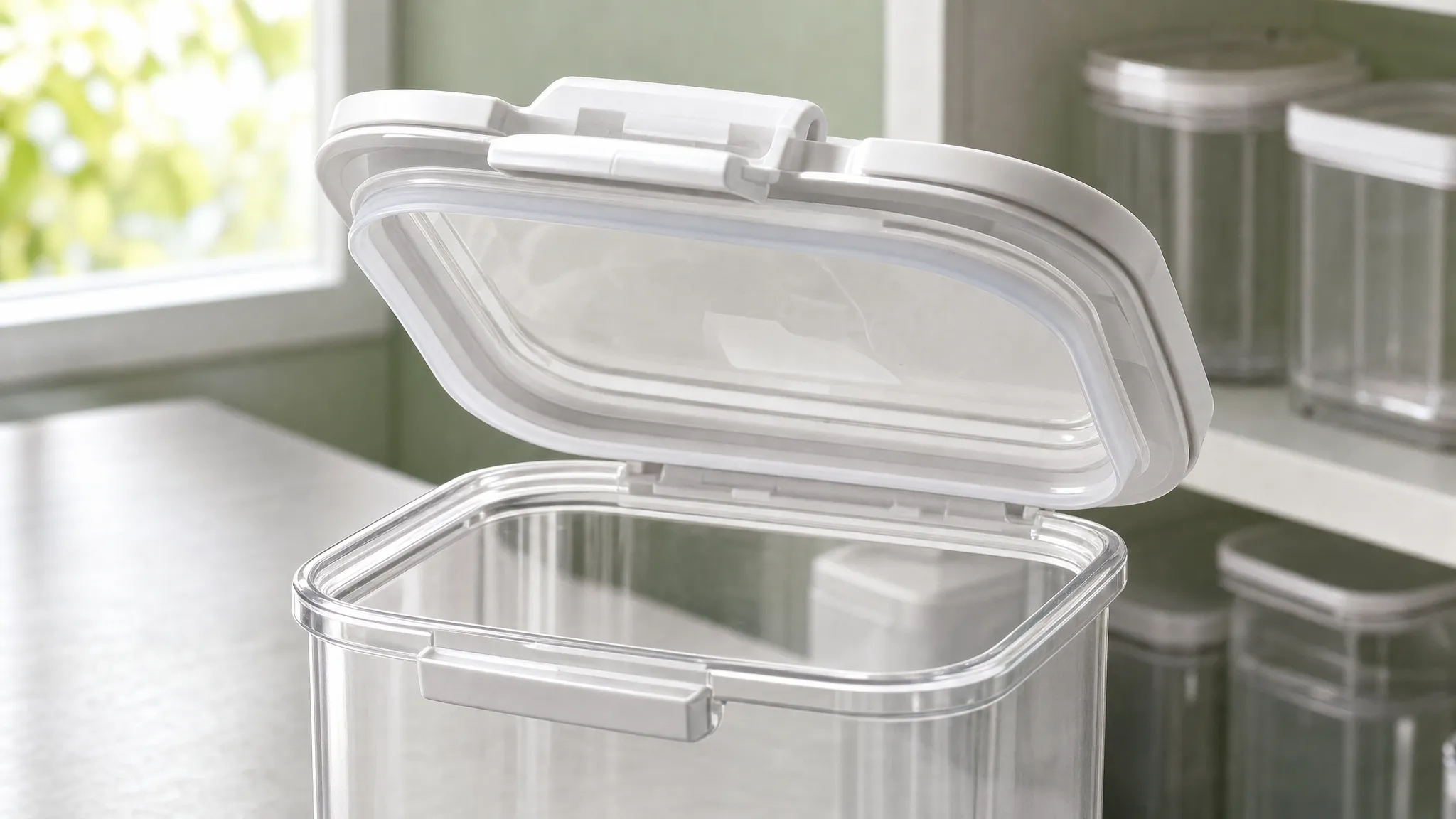
Flour is the niche that punishes a badly designed seal. The powder is fine enough to settle into the gasket groove and hold the lid fractionally open, so what looks like an airtight container in a photo may be a container that admits air after the fourth refill. Two design responses exist — a gasket that lifts out for cleaning, and a lid that seats on a chamfered rim rather than a flat lip — and both are visible in a sample you can hold, before any volume commitment.
The capacity conversation is dominated by bags. The measured long-tail includes airtight container for 5 lbs of flour and airtight container for 25 lbs of flour, and the related searches add 25 kg and 50 lb sacks. A 5 lb bag is the household unit that a canister must swallow whole, scoops and all; anything larger is a decision to store in multiples or to accept that the canister is a dispenser rather than a store.
The related searches split along that same line, which is a useful signal for a supplier: large airtight container for flour and airtight container for 5 lbs of flour are people buying a store, while the 25 lb and 50 lb phrasings are people with a second bag in the cupboard, usually baking in volume. A brand that tools for the small rung only is fishing in half the niche — and the half it misses is the half prepared to pay for capacity.
Coffee Bean: gas, opacity and the limits of "airtight"
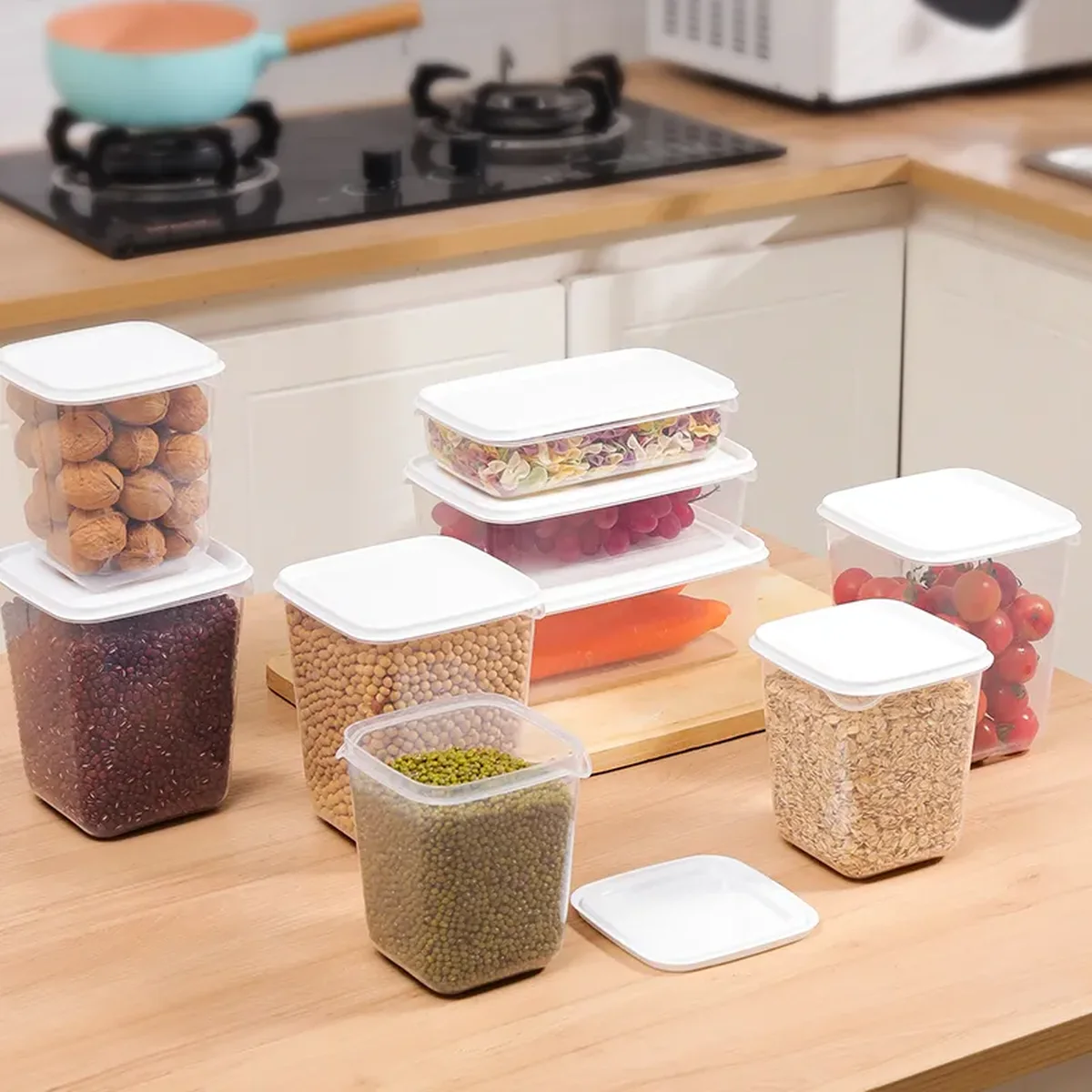
Roasted coffee releases carbon dioxide for days after roasting. A sealed canister holding fresh beans builds pressure, and the seal that survives a flour jar is not automatically the seal that survives a coffee jar — the lid needs either a one-way vent or enough gasket compliance to burp without unseating. Neither feature is visible in a lifestyle photograph, and both are visible in a sealed-bag test on a bench.
Coffee also argues for a different body: retail coffee bags are usually opaque because light degrades the aromatic oils, yet the pantry-canister category is overwhelmingly sold as clear plastic. A private-label coffee programme has to choose between shelf appeal (clear) and product protection (opaque), and the honest answer is that it is a merchandising decision with a substitution cost, not a technical one.
Worth knowing before that conversation starts: none of the recorded canister model families in the factory's product data carries a venting closure, and none states a pressure or degassing claim. For a brand entering the coffee niche that is not a dead end, it is a scope item — a venting lid is a new lid tool, not a new body, and the sensible first step is a sample with a high-compliance gasket tested the way a roaster tests a valve bag: fill it with fresh-roast beans, seal it, and see whether the lid lifts over a week. Do that before commissioning artwork, because the answer changes the artwork as well as the lid.
Rice: the forgiving niche, and the stacking one
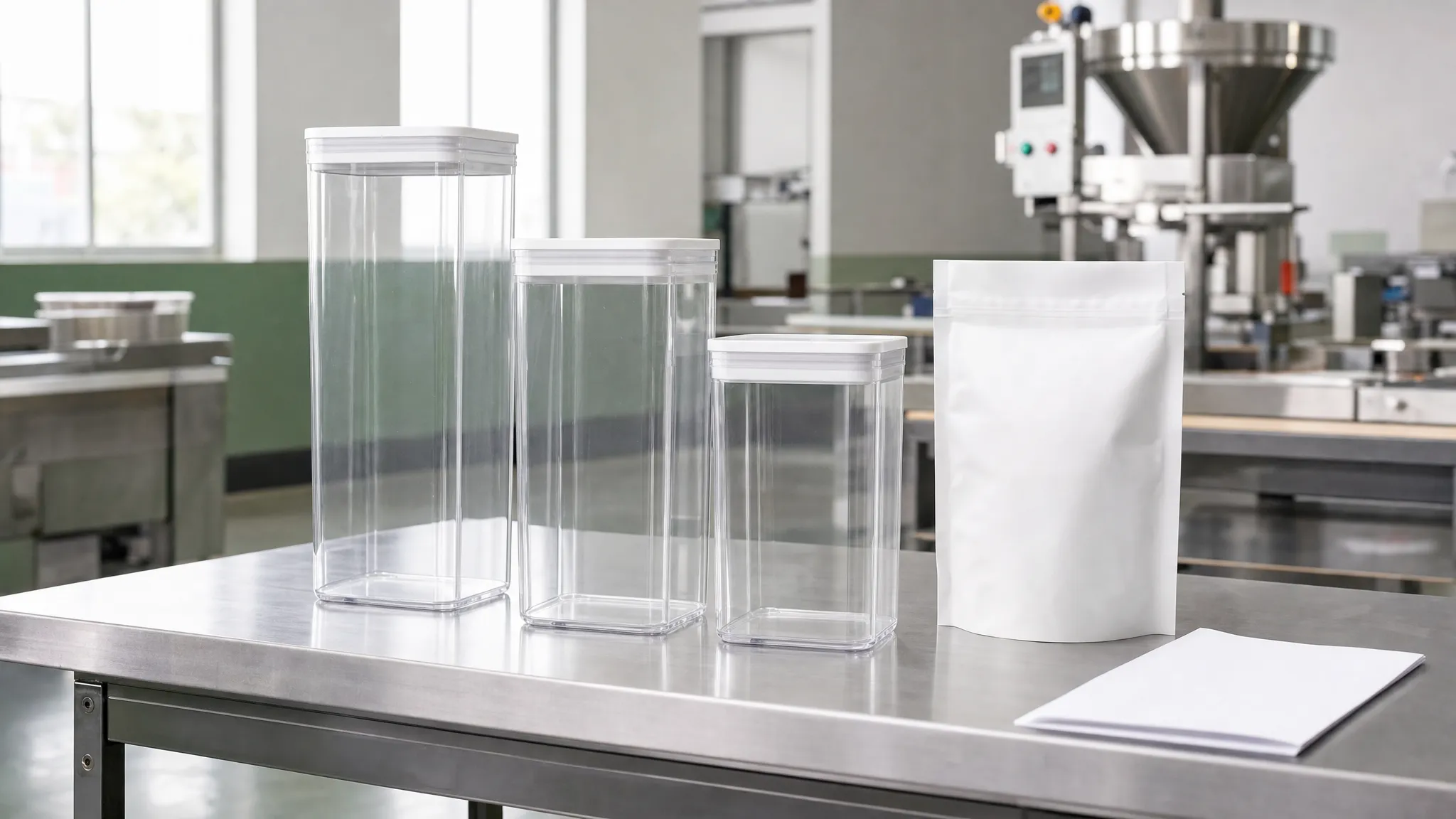
Rice is the least demanding of the five on sealing and the most demanding on structure. Grains are heavy: a full canister of rice is the single heaviest thing on the shelf, and stacking is how a household buys capacity. That makes wall thickness, base rigidity and lid-to-body stacking geometry the spec points that matter — the reason rice tends to be sold as a set of three descending sizes rather than one large jar.
Rice is also the niche that behaves most like flour, which matters for tooling: the same body can often serve both with a different lid decoration, and that reuse is worth more than either niche's volume on its own.
There is a second reason rice pairs well with flour on a first order. A set of three descending containers reads as value to the shopper, but it is a single body height programmed three ways on the mould — one tooling decision, three SKUs, one carton specification to agree. Any brand entering with a two-niche plan (also see the note on bulk ordering airtight containers) should ask the sample question in set terms: what a full lower container weighs, whether the lid of the lower one carries the upper one without rocking, and whether the nested empty set still fills the carton the same way. A stacking set that ships nested and arrives unstackable is the most common first-order surprise we see in this category.
Brown Sugar: the one that needs a different kind of seal
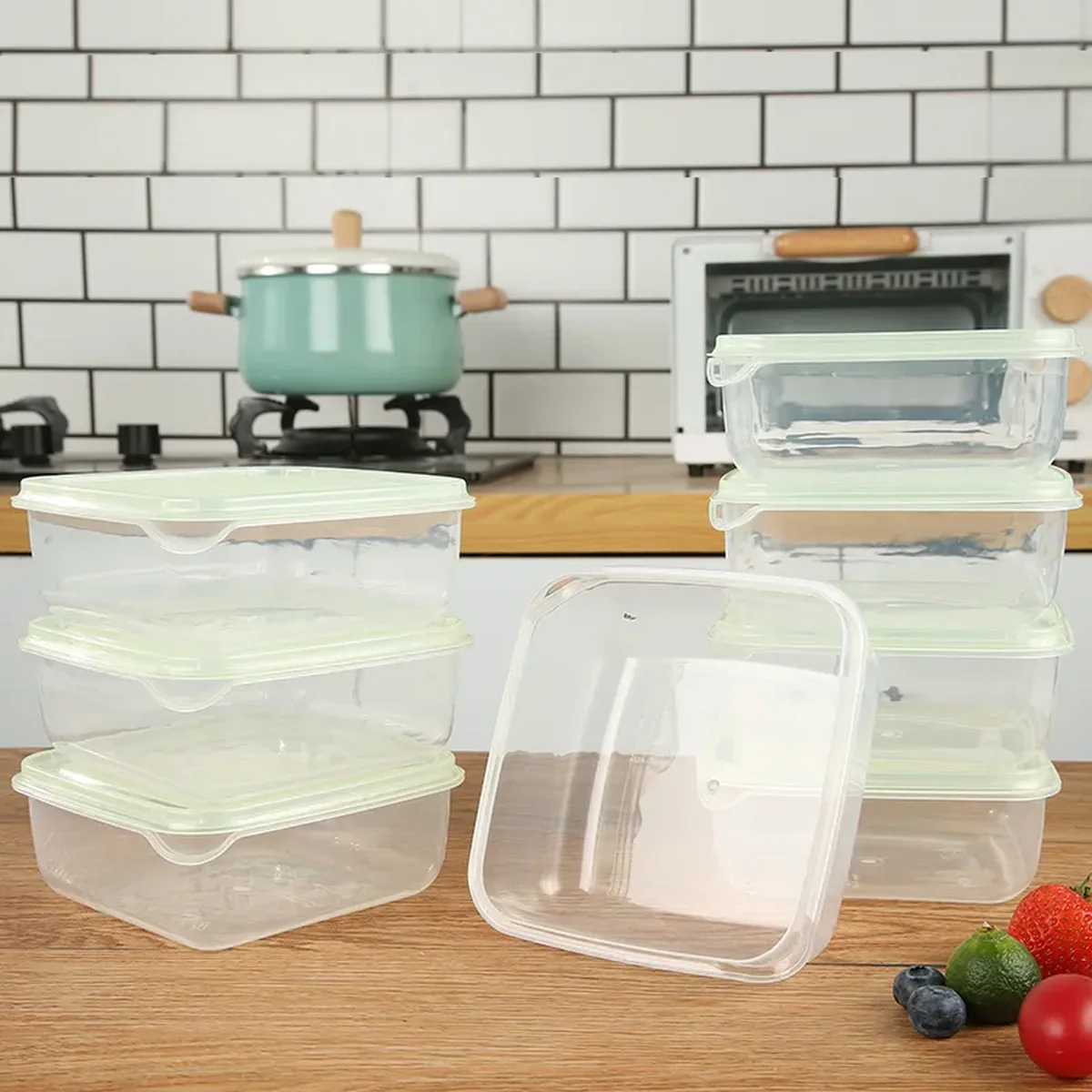
Brown sugar does not spoil, it dries — and the failure is visible and infuriating, a brick in a jar. Storage guidance for it points at a genuinely airtight closure plus a moisture reservoir, which is why so many brown-sugar containers on the market include a small terracotta or stone insert. Adding a third component to a container is a moulding decision with its own tooling cost, so a brand entering this niche should expect to pay for something that the flour and rice SKUs do not need.
The upside is that 1,600 searches a month with a difficulty of 0 is a cheap position, and brown sugar is usually bought as a companion piece to a flour canister, not instead of one.
Cookies: low demand, high fragility, gift-set economics
Cookies break, and a broken cookie is a returned product. A cookie jar therefore optimises for a wide opening and shallow stacking, which is nearly the opposite of the deep narrow canister built for rice. With 20 searches a month on the wholesale-facing term, the niche does not justify its own tooling. It justifies a slot in a gift set or a line extension, where the mould is shared and the artwork does the differentiating.
The Capacity Ladder: What the Factory Record Actually Carries
A capacity ladder is only useful if the rungs are real. The table below is transcribed from the recorded canister families in the factory's own product data. It carries them whether or not every cell is filled: the families whose record holds a carton figure sit beside the families a buyer will still ask about that hold none. Seven recorded families sit outside it by format, not by silence — the freezer lines (BX1094–BX1099, BX1131–BX1136), the borosilicate glass set (BX1021–BX1029) and the paper-box meal-prep and square sets (3320–3329, 3320–3323, 3323–3325, 3328–3329). No capacity, carton figure or unit weight has been estimated, and where the record holds no value the cell says not recorded rather than a plausible number. The record itself marks its units as needing confirmation — grammage as "confirm unit basis", box size and gross weight as "confirm packing scope", packing as "confirm unit/carton basis" — so every figure below is the recorded value pending your confirmation of what it covers.
Model family | Material (record) | Unit grammage (record) | Pieces / carton | Carton size × gross weight |
|---|---|---|---|---|
BX1044–BX1046 | PP + silicone | not recorded | not recorded | not recorded |
BX1047–BX1049 | PP + silicone | not recorded | not recorded | not recorded |
BX1041–BX1043 | PP + silicone | not recorded | not recorded | not recorded |
BX1052 | PP + silicone | 298 g | 48 pcs | 68 × 36 × 56.5 cm × 16.2 kg |
BX1053 | PP + silicone | 425 g | 24 pcs | 61 × 30 × 57 cm × 12.4 kg |
3040–3043 | PP | not recorded | OPP bag, count not recorded | not recorded |
3334 | PP | not recorded | 80 pcs (paper-based box also recorded) | 59 × 56 × 65 cm × 14.7 kg |
3332 | PP | not recorded | 56 pcs (paper-based box also recorded) | 64 × 49 × 56 cm × 16.1 kg |
3335–3338 | PP | not recorded | paper-based box, count not recorded | not recorded |
Read that table as a buyer and two things stand out. First, the rungs that hold a carton figure — the round canister set behind BX1052 and the three-piece airtight set behind BX1053 among them, plus 3334 and 3332 — are the ones a first order can be costed against today, because freight and warehouse planning both start from pieces per carton and carton weight. Second, the families with no carton record are not worse products; they are products whose carton configuration has not been fixed in the data, and asking for that configuration is a normal first email, not an unreasonable one.
The tall family 3334 — the product page marks it as a tall vertical format — is the second shape a pantry programme usually needs, and between it and the two round families with a carton record a programme can cover round for flour and rice, tall for coffee and pasta, without a new mould. The record states no cross-section shape for 3334, so if shape matters to your shelf plan, ask for the drawing rather than assuming one.
The unit grammage column is the quiet one. All else being equal — same packed volume — the heavier unit is the sturdier one, and the lighter one is the cheaper one to ship. A 425 g unit against a 298 g unit is a meaningful spread; neither is right or wrong until you know whether the brand is selling durability or price.
For comparison, the only two distinct products in this range whose specification record carries a Capacity value sit outside the canister families proper: a 1.4 L PP freezer and fridge box family (BX1094–BX1099, listed twice in the record) at 72 pcs per carton, and a borosilicate glass set quoted as a 320–1,040 ml range. Glass is the answer many buyers reach for after seeing the consumer SERP, where glass appears in the top three results — it is also breakage, freight weight and a different compliance pack, which is why the five-market food-contact document map is worth reading before the decision is made.
The last column deserves its own paragraph, because carton maths is where a capacity ladder turns into money. Compare the two recorded PP canister families: 48 pieces at 16.2 kg gross against 24 pieces at 12.4 kg gross. Divide those out: about 0.34 kg per piece in the 48-piece carton against 0.52 kg per piece in the 24-piece carton — about 50 % more weight to move per unit. Run that through an ocean container and the difference between a 24-piece and a 48-piece carton is not a rounding error; it decides which rungs of the ladder can be sold at a competitive landed cost and which ones only work at a premium retail price. Two practical consequences for a first order: ask for the packed carton dimensions of the exact model, not of "the range", and ask how a set is packed, because a nested set changes both the carton count and the gross weight in a way a single SKU never does.

Where Demand and the Ladder Disagree
Put the two halves together and the mismatch is specific.
The flour niche's long tail asks for a container that holds a 25 lb bag. Nothing in the recorded canister range states a capacity at all, which means the question cannot be answered from a table — it has to be answered by a sample, a ruler and a bag of flour. That is not a weakness of the data; it is what a specification conversation is for. The worst version of this niche is a brand that publishes a capacity claim it never tested, and then handles the returns.
The niche-level mismatch looks like this:
- Flour — highest demand, widest capacity spread, and the one niche where a custom body size is most likely to earn its tooling back. The starting point is the existing round set rather than a new mould; see Custom Food Storage Containers: What Can Change on an Existing Mold.
- Rice — tolerable on standard canister bodies, heavy contents doing the arguing. Sets reuse the same lid family, so the ladder is built by height rather than by mould.
- Coffee bean — needs a venting or high-compliance seal decision before artwork, so it is the last niche to start and the one most likely to need a new lid rather than a new body.
- Brown sugar — an accessory-driven niche; the third component is the cost.
- Cookie — shared-mould only.
One structural note that applies to all five: a set sells better than a single jar, but a set multiplies the carton maths. Nesting and stacking geometry decide whether three containers ship as three cartons or as one, and that decision is made in the same meeting as the capacity itself. The stacking, nesting and carton maths piece on this site works that arithmetic with its own freezer-line figures, in the same order this article has just used.
If the answer to the mismatch is a dedicated mould rather than a shared body, the next document is a mould quote, and how to read one covers what it contains, which parts you are paying for and what to settle before steel is cut.
There is a cheaper sequence worth running before that conversation, and it takes about a week. Buy the bag your customer buys — 5 lb, 25 lb, 50 lb — and pour it into a sample of the closest existing body, then measure what is left over, how the lid closes on a full container rather than an empty one, and where the scoop ends up. Two of the five niches will usually resolve themselves at this step, because the body already exists and the answer is a lid or a decoration. The ones that survive it are the genuinely custom cases, and those are the ones to take to mould development with a capacity on paper rather than a guess.
Scoping a First Order Across Two Niches
The realistic first order is not one niche. It is flour plus rice, or flour plus coffee, with a shared carton plan and a colour that covers both. Four things have to be settled before that order can be priced.
How the quantity is counted. A canister family is usually several models, and a mixed order splits across them. Whether the minimum applies per order, per colour or per model changes the shape of the whole buy, and the counting rule is worth getting in writing at the quotation stage rather than after artwork — Is MOQ Per Order, Per Colour or Per Model? walks through how the counting actually works.
What the sample is for. A first sample is not a beauty shot. It is the answer to four questions: does the lid seal after ten open-and-close cycles, does the gasket come out for cleaning, does the stacked unit stay stacked when the lower one is full, and does the empty unit survive the carton it is going to travel in. The page on seal structure and sample testing covers how to run those checks rather than describe them.
When production may start. The point at which a sample becomes the reference is a governance question, not a technical one, and in our experience it is the single most common source of disputes on a first canister order — a colour approved in a photo, a lid approved on a different model. The golden sample article on this site explains what gets signed and what stays open.
Which version of the factory you are dealing with. Sampler, moulder and exporter are not always the same organisation, and a canister programme with a colour-matched lid and a printed carton touches all three. Food Storage Container Manufacturer: four businesses wearing one name badge covers that.

The Documents to Request Per Niche
Nothing about a canister niche changes the compliance question, but each niche has a document that a buyer should hold before artwork is printed. These are questions to put to your supplier, not claims about any supplier's certificates.
- For all five: the supplier's food-contact documentation for the exact polymer and colourants used in the model you are buying, and confirmation that the gasket material is covered by the same pack. Polypropylene is regulated in the United States under 21 CFR 177.1520, olefin polymers, and the FDA's Food Ingredients & Packaging pages are the entry point to the food-contact framework the supplier's documents must answer to.
- For EU sales, coffee and brown sugar included: a Declaration of Compliance that names the regulation. Two texts govern it — Regulation (EC) No 1935/2004 on food-contact materials, and Regulation (EU) No 10/2011 on plastic materials and articles.
- For flour specifically: a statement of the closure's tested capacity in millilitres, since the retail shelf describes the same rung in quarts and cups; a note on how the sealing element is cleaned, because a flour-dusted gasket that cannot be removed is a customer complaint waiting to happen; and any migration test data the supplier holds for the powder-contact scenario.
- For coffee specifically: if a venting lid is proposed, the mechanical description of the vent and its effect on the airtight claim — the two features pull in opposite directions and the statement should say which one the product delivers.
- For any SKU that will carry a dishwasher or microwave claim: the test report behind that claim, per model and per colour, because a claim printed on a package is a claim the brand has to be able to evidence.
- For gift-set and cookie SKUs: the pack-out specification and anything printed on the container, so labels, barcodes and carton marks are reviewed together rather than one at a time.
The site's broader document map for food-contact compliance across five markets lists what each of those packs contains, market by market, and the materials and food safety section of the main site shows how the polymer and additive position is described for a specific product family.
One structural note on this section: none of the lists above names a certificate. That is deliberate. A canister programme buys a document trail — declaration, migration data, colourant statement — for the exact model and colour, and the trail belongs to the product you ordered, not to the supplier's brochure. When a supplier answers a document question with a company certificate, ask again for the model-level document.
Ranking the Niches for Your Own Brand
The short version of this page, in the order the decisions have to be made:
- Flour deserves the first mould or the first custom body. It carries the demand, it tolerates a shared lid, and a wide-mouth round canister is the least risky way to enter.
- Rice is the volume partner. Same body family, different height, heavier contents — sell it in a set.
- Coffee bean is the technical one. Decide the venting question before anything else, and expect it to touch the lid rather than the body.
- Brown sugar is an accessory SKU that rides behind flour. Budget for the third component.
- Cookie is a gift-set slot. Do not give it a mould.
Two things decide more than the ranking does: whether the capacity rung your customer names can be met without a new body, and whether the carton that rung produces still stacks and ships economically. Neither can be answered from a search dashboard. Both can be answered from a sample and a carton, which is why the numbers on this page are the beginning of the conversation rather than the end of it.
Run the worksheet in this order and the first order writes itself. Score each niche on three lines — monthly search volume, whether a recorded body already covers its capacity rung, and how many extra components the lid needs — then cross out any niche that scores badly on the second line, because a niche that needs new tooling is a different budget and a different year. What usually survives is flour plus one companion niche, one body height programmed two ways, one carton specification, one sample round. That is a first order a factory can quote accurately, and it is also the shape a retail buyer can range without being asked to carry four unproven SKUs.
If you are scoping a canister programme and want the recorded model families, their packing configurations and the sample path in one place, the sourcing guide for food storage containers is the shortest route in, and the airtight-versus-leakproof distinction is worth reading before you write either claim on a package.
Continue reading
Related sourcing guidance
More practical context for your food storage container sourcing conversation.

Discuss your product range
Need help selecting or customising containers?
Share the product type, market and sourcing requirements with the Xinghui team.