
Food Storage Guides
Freezer and Fridge Container Lines for Sellers: Stacking, Nesting and Carton Math That Decides Your Landed Cost per Unit
How stacking vs nesting and carton/pallet math decide landed cost per unit for your freezer and fridge container line. A model sellers can run today.
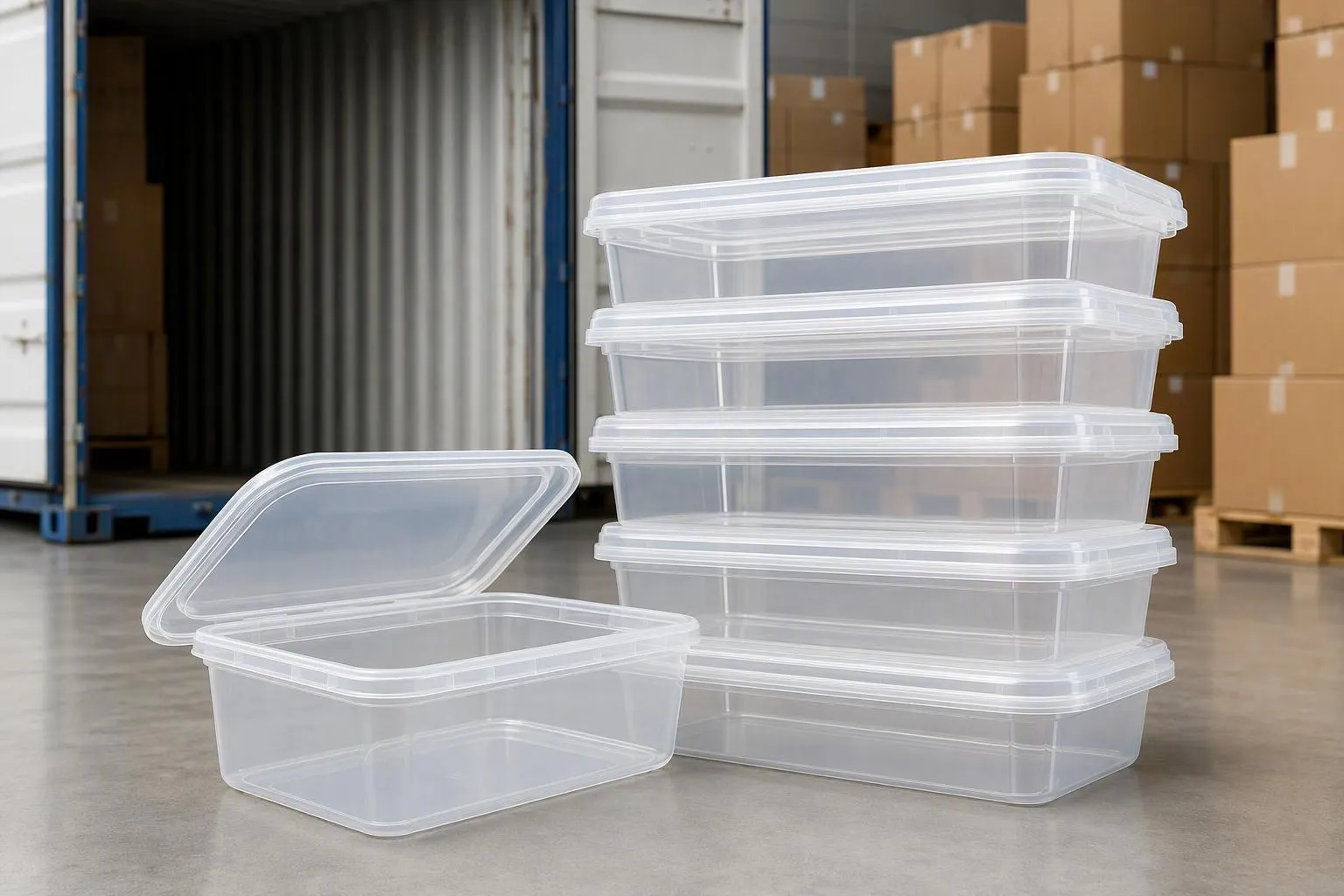
Every private label brand asks the same question before a container order: what is the cheapest unit price? That is the wrong first question. The price that matters is what each unit costs when it lands in your warehouse — after ocean freight, duties, customs, handling, and FBA prep are spread across however many pieces actually fit in the box, on the pallet, and in the container. Design a container line carelessly and a “cheap” unit quietly costs you more; design it well and the per-unit freight line shrinks before you spend a dollar on marketing.
This guide lays out the two decisions that dominate that math: stacking vs nesting as a design philosophy, and the carton and pallet math that decides how many units ship per shipment. If you run a fridge and freezer line for cross-border e-commerce, these choices set your landed cost per unit more than any single price negotiation.
Table of Contents
• The Landed-Cost Criteria Every Container Line Should Meet First
• Stacking vs Nesting: It Depends on How the Line Ships
• Fridge vs Freezer Lines: Designing Around Cold Use Define your red flags before you sign
• The Carton Math That Sets Your Freight per Unit
• Worked Scenario: One Design Choice, Different Landed Cost
• Cold-Compliance and Quality Guardrails
• How to Brief Your OEM to Lock the Savings
• FAQ
• Close the Stacking and Carton Loops Before You Order
The Landed-Cost Criteria Every Container Line Should Meet First
Landed cost is broader than the invoice line. A common planning definition restated by Endless Commerce’s landed-cost playbook (2026) is cost of goods plus inbound freight, duties and tariffs, packaging, and receiving and QC. For an overseas importer, the practical result is that total landed cost commonly runs roughly 1.3 to 1.6 times the factory gate price once freight (typically 5–20%) and duties (0–30%) are included.
Among those line items, the one your container design controls is the per-unit freight, and it is governed by a surprisingly small set of numbers:
• how many finished containers fit in one master carton,
• how many cartons fit on a pallet or across the container floor,
• and whether your cargo is billed on weight or on volume.
Before choosing a container shape or sealing system, engineers should hand you the carton CBM, the units per carton, and a loading plan. If they cannot, you are buying air. In the sourcing world, freight cost per unit is simply total shipping spend divided by sellable units — so every unit you fit per shipment lowers that number.
Key Takeaway: Landed cost is not unit price. Freight, duties, handling and FBA prep can push it to 1.3–1.6× the factory price, and your container’s stacking/nesting design and carton spec control the per-unit freight chunk of that.
Stacking vs Nesting: It Depends on How the Line Ships
The most important design fork is stacking versus nesting, and neither is universally better for an e-commerce brand. Container manufacturers commonly describe the trade-off this way: stackable designs make the most of vertical space when filled, while nestable designs shrink volume when empty .
• Stackable containers have reinforced rims and straight or minimally tapered sides that lock on top of one another when full or lidded. They fill cartons densely, stack high on a pallet, and are ideal for containers that leave the factory assembled .
• Nestable containers are tapered so empty bodies slide inside each other, cutting stored volume dramatically — reportedly up to 70% for empty stack height . This is a huge advantage when shipping or storing empty units, but the taper wastes cube when you want them stacked full.
For most private label importers the decisive fact is this: your product ships one-way and assembled . The inbound container is full lidded units, not empties on a return leg. When that is your pattern, dense stacking-style loading is your lever. This is why some packaging suppliers report that stackable, high-tolerance designs can fit up to roughly 30% more units into a standard 40-foot high-cube container by tightening the nesting gap and reinforcing the sidewalls. Whether you hit that magnitude depends on your sizes, but the direction is reliable: more units per container equals less freight per unit.
Nesting still matters for a seller in two situations: if you hold large volumes of empty stock or seasonal inventory in a warehouse, and if you run a returnable packaging loop. If neither applies, optimizing for inbound density should come first.
Fridge vs Freezer Lines: Designing Around Cold Use
Within a single line you often launch both fridge and freezer SKUs, and that split should shape the geometry. Cold storage changes the engineering priorities.
An effective refrigerator storage box line leans on a few traits that also make it ship well: rectangular footprints that pack flat in a carton and open cleanly on a fridge shelf, lidded designs with tight seals, and elevated or divided inserts for airflow. Fridge containers are reused frequently, so the stacking base and lid need to survive repeated opening and re-stacking — durability that also protects the pieces during transit.
Freezer containers carry a different set of demands. Polypropylene (PP) food-grade material holds up across wide temperature swings and is the common choice for freezer-to-microwave use; a ventilated or drain-tray insert helps frozen portions separate cleanly. For a private label launch, a stackable BPA-free freezer meal prep set is a strong starting SKU because the square, lidded format loads tightly and reads clearly to buyers. Importantly, the fridge and freezer SKUs should share a consistent outer footprint so their cartons standardize — that single choice cascades into simpler pallets and cleaner loading.
Pro Tip: If fridge and freezer SKUs share the same footprint, their cartons often standardize to 1–2 master sizes. That keeps pallets uniform and avoids the mismatched-carton gaps that eat container cube.
Define your red flags before you sign
• Nesting-only geometry on a full-ship line — the taper wastes the very cube you are paying freight on.
• Square “cube” cartons — near-cubic cartons can leave more interstitial voids in a 40HQ than better-proportioned rectangular cartons (see the math below).
• Unproven cold-seal claims — never rely on marketing; demand a rigid, tested seal for frozen/liquid contents.
• No carton/loading plan — a supplier who can’t state units per carton and carton CBM is exposing you to unknowable freight per unit.
The Carton Math That Sets Your Freight per Unit
Once the geometry works at cold use, the cost game moves to the carton and pallet. Here is the plain-prose math a sourcing manager can run today.
Units per carton. This is the integer packing of product into the master carton: how many fit across each dimension, rounded down, multiplied together. If a container is 20 cm long and the carton interior is 60 cm, you get three along that axis. The total is units per carton = (floor of carton length ÷ product length) × (floor of carton width ÷ product width) × (floor of carton height ÷ product height). Choose carton dimensions that are near-multiples of the product so you minimize void fill inside the carton.
Carton CBM. Convert the packed external carton to cubic metres with length × width × height. This is the number freight forwarders price on. Keep it to the final, externally packed carton — packaging bulk belongs in the price you pay.
Units per pallet (tier-and-height). As FBA pallet calculators describe , cartons per pallet is the smaller of footprint-fit times stack layers and the weight cap. Units per pallet is then units per carton times cartons per pallet. If 8 units fill a carton and 30 cartons stack a pallet, that is 240 units per pallet — and a $600 pallet-level move is $2.50 of freight per unit.
Dimensional weight. U.S. parcel and Amazon-compatible calculators bill on dimensional weight when it exceeds actual weight: length × width × height ÷ 139 (inches). Light, bulky plastic containers are exactly the cargo that hits a dimensional-weight floor, which is why reducing packed volume per carton matters even when the goods are light.
Container utilization. A 40-foot high-cube has internal dimensions of roughly 12.03 m × 2.35 m × 2.69 m and about 76 cubic metres of nominal volume . Practical planning targets around 85% utilization, leaving room for bracing and loading gaps. Load-planning data shows the payoff of geometry: one benchmark measured a 40 cm cube at only about 76% fill while well-proportioned rectangular cartons cleared 90% . Footprint matching — carton widths that pack cleanly across the ~2.35 m internal width — beats a “round number” carton size that leaves dead rows.
Worked Scenario: One Design Choice, Different Landed Cost
To make the math concrete, here is an illustrative planning example — not a freight quote, but a comparison framework you can re-run with your own carton sizes and freight rate. Assume a 40HQ ocean move at a flat USD 4,500 freight, no matter the design, so the only variable is how many units fit.
Design
Units per carton
Cartons per 40HQ
Units shipped
Freight per unit
Landing premium*
Nesting-taper (ships full)
12
420
5,040
$0.89
Higher
Stacking, square carton
18
420
7,560
$0.60
Mid
Stacking, rectangular footprint-optimized
24
420
10,080
$0.45
Lowest
*Freight only; landing premium = freight per unit relative to the densest design.
The takeaway is the range: per-unit inbound freight spreads from about $0.45 to $0.89 on the same container and same freight bill, purely from line design and carton spec. For a 10,000-unit purchase, that spread is roughly $4,400 — more than the per-piece “savings” most price negotiations deliver. This is why, when you consolidate a multi-size food storage line into one sourcing program, the suppliers who standardize cartons and share footprints consistently win on money-to-door, not just on FOB price.
Cold-Compliance and Quality Guardrails
Temperature-sensitive food contact is not a place to cut corners, and it is also an area where vague claims fail due diligence. Restrict marketing language to defensible statements and tie any safety claims to recognized food-contact standards. For food-grade storage containers, the relevant anchors include the U.S. FDA 21 CFR 177.1520 for olefin polymers, EU Regulation 10/2011 for plastic food-contact materials, German LFGB §§ 30/31, and China GB 4806.7-2023. If a supplier claims freezer or microwave safety, ask which standard governs and demand the test report — treat “food-grade” and “safe at cold temperatures” as claims to be evidenced, not adjectives to be assumed. A clean compliance story also keeps you out of FBA listing friction and bad reviews, which are costs that never show up in the carton math but land squarely on your margin.
How to Brief Your OEM to Lock the Savings
The cheapest way to capture these gains is to bake them into the brief you send a factory. A supplier that engineers food-grade custom containers with in-house mold and packaging design can typically rework the footprint, nesting gap, and carton spec before tooling — long before any container is molded. Ask for the following before you sign:
• A packing and loading spec — unit dimensions, units per carton, carton CBM, cartons per pallet, and a projected fill rate for your target container size.
• Footprint standardization — confirm fridge and freezer SKUs share an outer footprint so cartons and pallets stay uniform.
• Mold-level density review — ask whether the nesting gap and wall taper can be tightened to lift units per carton without losing rigidity.
• A test-fit or sample carton — dimensionally verify the packed carton before committing to a large run.
A good first move is to ask your account contact for a carton and loading optimization spec for your exact sizes, then run the per-unit freight math above before you compare quotes across factories.
FAQ
Is stacking or nesting better for a private label food container line? For a one-way inbound shipment of assembled, lidded containers, stacking-dense geometry is usually better because it fits more units per carton, pallet, and container — lowering freight per unit. Nesting shines when you hold or ship large volumes of empty containers, such as seasonal stock or returnable packaging loops.
What does “carton CBM” mean and why does it matter? Carton CBM (cubic metres) is the external length × width × height of the packed master carton. It is the unit freight forwarders price on, so a smaller packed volume per carton lowers your per-unit freight — especially for light, bulky plastic containers that are billed on volume.
How do I calculate freight cost per unit? Divide the total freight cost of the shipment by the number of sellable units it carries. Units per shipment equals units per carton times cartons per pallet (or per container), so improving either raises units shipped and lowers per-unit freight.
Why does dimensional weight matter for plastic containers? U.S. parcel and marketplace calculators bill the greater of actual or dimensional weight (length × width × height ÷ 139 in inches). Light, bulky containers often trigger dimensional weight, so shrinking packed carton volume can cut last-mile and inbound costs.
Can a food container still be called “freezer safe” without a test certificate? Be cautious. Claims about cold or microwave performance should be backed by a recognized standard and a test report. Rely on documented food-contact compliance (for example FDA 21 CFR 177.1520 or EU 10/2011) rather than marketing language.
Close the Stacking and Carton Loops Before You Order
Your fridge and freezer line is a margin driver, not just a set of SKUs. Choose stacking versus nesting for how the line actually ships, standardize footprints across fridge and freezer so cartons stay clean, and demand the carton and per-unit freight math from any OEM before you commit tooling. Suppliers willing to hand you those numbers — and engineer the mold and packing spec to improve them — are the ones that protect your landed cost per unit from the start.
If you are building or refreshing a cold-storage line, the fastest next step is to get a carton and loading spec and a line-planning conversation with a food-grade container engineer before you finalize your mold and MOQ.
Continue reading
Related sourcing guidance
More practical context for your food storage container sourcing conversation.


Discuss your product range
Need help selecting or customising containers?
Share the product type, market and sourcing requirements with the Xinghui team.