
Food Storage Guides
Meal Prep Containers: SKU Mix, Capacity Ladder & Packaging for a First Order
How to build a private label meal-prep container line for Amazon: SKU mix, capacity ladder, and FBA-ready retail packaging for a first order.
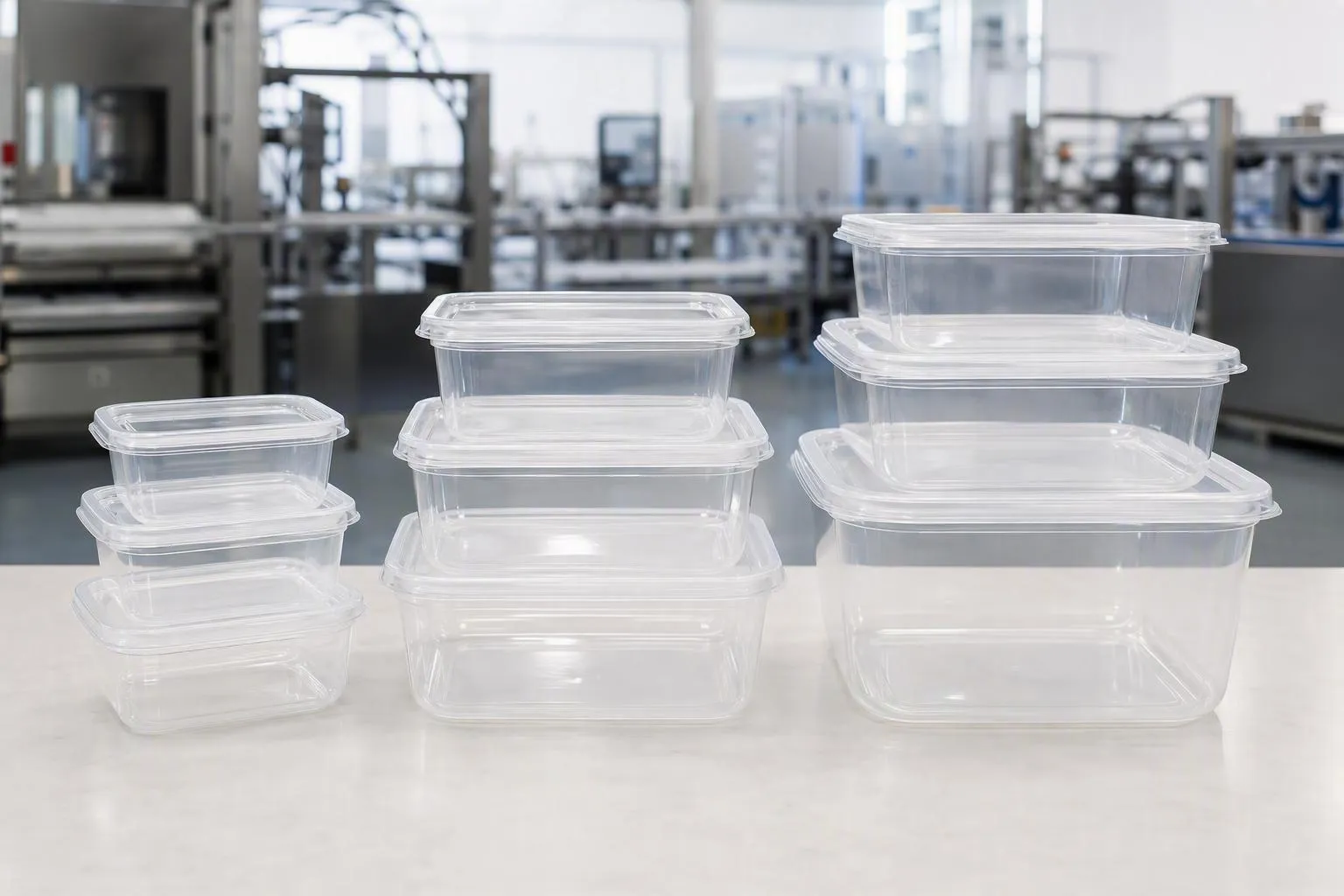
The meal-prep container category on Amazon is big, and it rewards brands that launch with a deliberate product architecture instead of a scattershot assortment. The brands that scale cleanly rarely start with ten SKUs. They start with a small, rational set — one hero size, one adjacent size, and one differentiated format — plus a retail package that survives fulfillment and scans correctly at the warehouse. This guide walks you through those three decisions for your first order of meal-prep containers : what SKU mix to order, how to build a capacity ladder , and how to spec meal-prep container retail packaging that is FBA-ready. Most current Amazon private label launch guidance points the same way: keep the first batch tight so each SKU can earn its place.
Key Takeaway : A successful first order of meal-prep containers comes down to three moves — pick one hero capacity, one adjacent size, and one differentiated format; map your capacity ladder to real meal-prep use cases; and design retail packaging with the FNSKU on a flat, visible panel.
Table of Contents
• Why Your First Order Should Be Narrow, Not Wide
• Building the SKU Mix: Hero, Secondary, and One Differentiated Variant
• The Capacity Ladder: Sizing to Meal-Prep Use Cases
• Retail Packaging for the First Order: FBA-Ready and Scan-Clean
• A Worked Example: Mapping the Mix to a Real Supplier’s Line
• Must-Haves vs. Red Flags: Your First-Order Evaluation Framework
• Your First-Order Sequence for a Meal-Prep Container Line
• FAQ
• Next Steps: Turn the Mix Into a First Order
Why Your First Order Should Be Narrow, Not Wide
The biggest inventory mistake new private-label sellers make is launching too many near-duplicate sizes at once. Each extra size is another SKU , which means another mold commitment, another packaging run, and another FNSKU to forecast. Amazon’s current private-label launch guidance is blunt about this: start with a few core SKUs, each serving a distinct shopper need, rather than a wide assortment that fragments demand and leaves you holding slow-moving stock.
Two or three SKUs is a defensible launch. The logic is simple: one SKU carries most of your volume, one adjacent size catches shoppers who size up or down, and one differentiated format — usually a multi-compartment version — only earns its place if it solves a clearly different problem, like separating a protein from two sides. If your differentiation is just “slightly bigger,” it is not differentiation; it is an extra mold with no reason to exist.
A lean first order also protects your cash. Most private-label launches start near 200–500 units total — enough to test demand without committing capital you cannot recover, as current Amazon private label launch guidance from GrowthJockey notes. Splitting that small batch across eight SKUs leaves every variant understocked and none statistically meaningful. Concentrate the mix instead.
Building the SKU Mix: Hero, Secondary, and One Differentiated Variant
Think of your SKU mix as roles, not just sizes. Assign each SKU a job before you write the PO.
The hero SKU is the size you expect to carry the majority of volume — the one that anchors your listing, your ad spend, and your brand’s visual identity. The secondary SKU is an adjacent size for shoppers who buy up or down. The differentiated variant is optional, and only worth its mold if it creates a real behavioral split — for example, a two-compartment version alongside a single-compartment hero, or a snap-lock leak-proof lid that justifies a price premium where standard lids cannot.
For meal-prep containers, the common high-visibility sizes on Amazon are roughly 16 oz, 24 oz, 32 oz, and 38 oz . Current launch guidance repeatedly lands on 24 oz as the best default hero : it maps to a standard lunch portion and shows up across most high-traffic listings. 32 oz is the natural secondary — a larger meal or batch-prep size with an obvious upsell story.
That gives you a clean launch architecture:
SKU role
Recommended capacity
Use case
First-order share
Hero SKU
24 oz (~700 ml)
Standard lunch portion
55–65%
Secondary SKU
32 oz (~950 ml)
Larger meal, batch prep
25–35%
Optional variant
2-compartment, ~24–32 oz
Protein + sides separation
5–10% each
Held for phase 2
16 oz and 38 oz
Snacks/sides; heavy/bulk
Launch later
A practical first-order allocation is 60 / 30 / 5 / 5 across hero, secondary, and two test variants — or 70 / 30 if you launch with just hero plus secondary. The exact percentages matter less than the principle: skew heavily toward the one SKU you expect to sell, keep the non-core sizes as small test buys, and reorder only the SKU that proves demand first.
Pro Tip : Use-case-driven SKUs beat volume-driven ones. A 32 oz single-compartment and a 32 oz two-compartment version give you a clearer behavioral split than a 32 oz and a 34 oz single-compartment — the latter are near-duplicates with no story to tell a buyer.
The Capacity Ladder: Sizing to Meal-Prep Use Cases
A capacity ladder is the way you order your sizes so shoppers can understand the line at a glance. The point is not to offer every capacity — it is to create clean choice architecture with small, medium, and large rungs that map to distinct meal-prep use cases.
The most common ladder in this category runs 16 oz → 24/28-32 oz → 38 oz :
Rung
Capacity
What it fits
Typical footprint
Small
16 oz (~470 ml)
Snacks, sides, salads, portion control
~7.5 × 5 × 1.8 in
Hero
24 oz (~700 ml)
Standard lunches, single main + side
~7.5–8.8 × 5–6 × 2 in
Large
32 oz (~950 ml)
Bigger meals, batch prep, bodybuilding
~8.7 × 6 × 1.8–2.1 in
X-Large
38 oz (~1125 ml)
Heavy meals, bulk prep, family portions
~8.9 × 6.1 × 2.1 in
Published manufacturer spec families confirm this shape. One bulk supplier lists its rectangular meal-prep line in 16, 24, 32, and 38 oz with nearly identical footprints — only the height changes as capacity grows, as shown in LR Packing’s wholesale meal-prep capacity table and a comparable 16/24/32/38 oz dimension chart . That uniformity matters for your supply chain, too, because one base platform across rungs lowers tooling and lets you consolidate into a single carton.
Whether to also offer multi-compartment versions is a ladder decision, not an afterthought. Two-compartment containers are popular for “main + side” meals, and three-compartment for “protein + two sides.” But each adds a mold. If your position is portion control or bento-style lunch separation, a two-compartment rung earns its place; if you are a straight bulk single-compartment line, hold it.
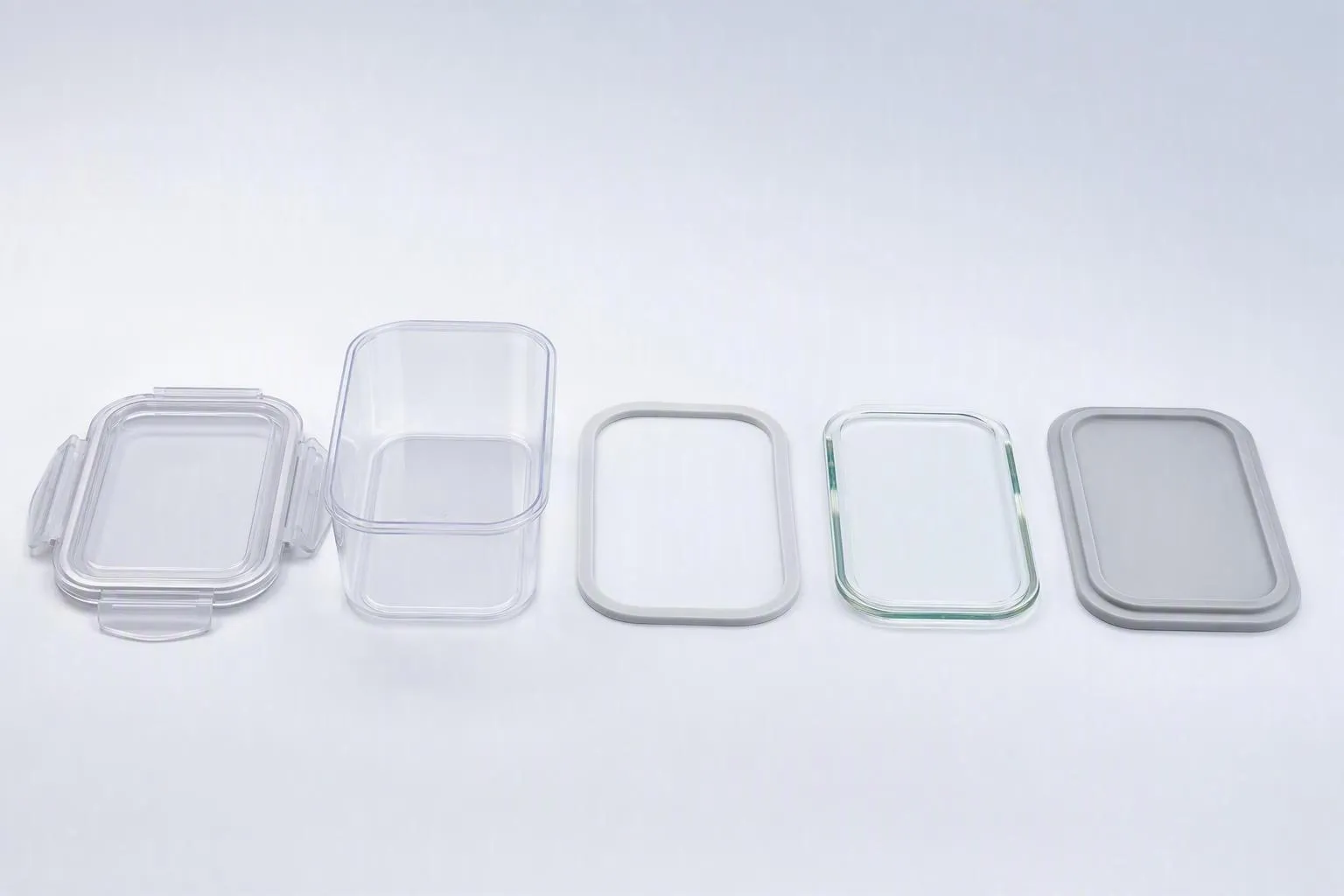
Material and lid structure are part of sizing, too. Most meal-prep containers are food-grade PP (polypropylene) with a snap-lock or gasket lid for a leak-proof seal. For the U.S., confirm the material meets FDA 21 CFR 177.1520 and the supplier can produce the certificate tied to that specific material and product — not a generic “food safe” statement. Microwave, dishwasher, and freezer claims must be tested and substantiated before you print them on the package.
Retail Packaging for the First Order: FBA-Ready and Scan-Clean
Packaging does three jobs for a meal-prep line: it protects the product in transit, it reads clearly on the shelf, and it meets Amazon’s labeling rules so the shipment is not rejected. For a first order, packaging is where FBA compliance is won or lost.
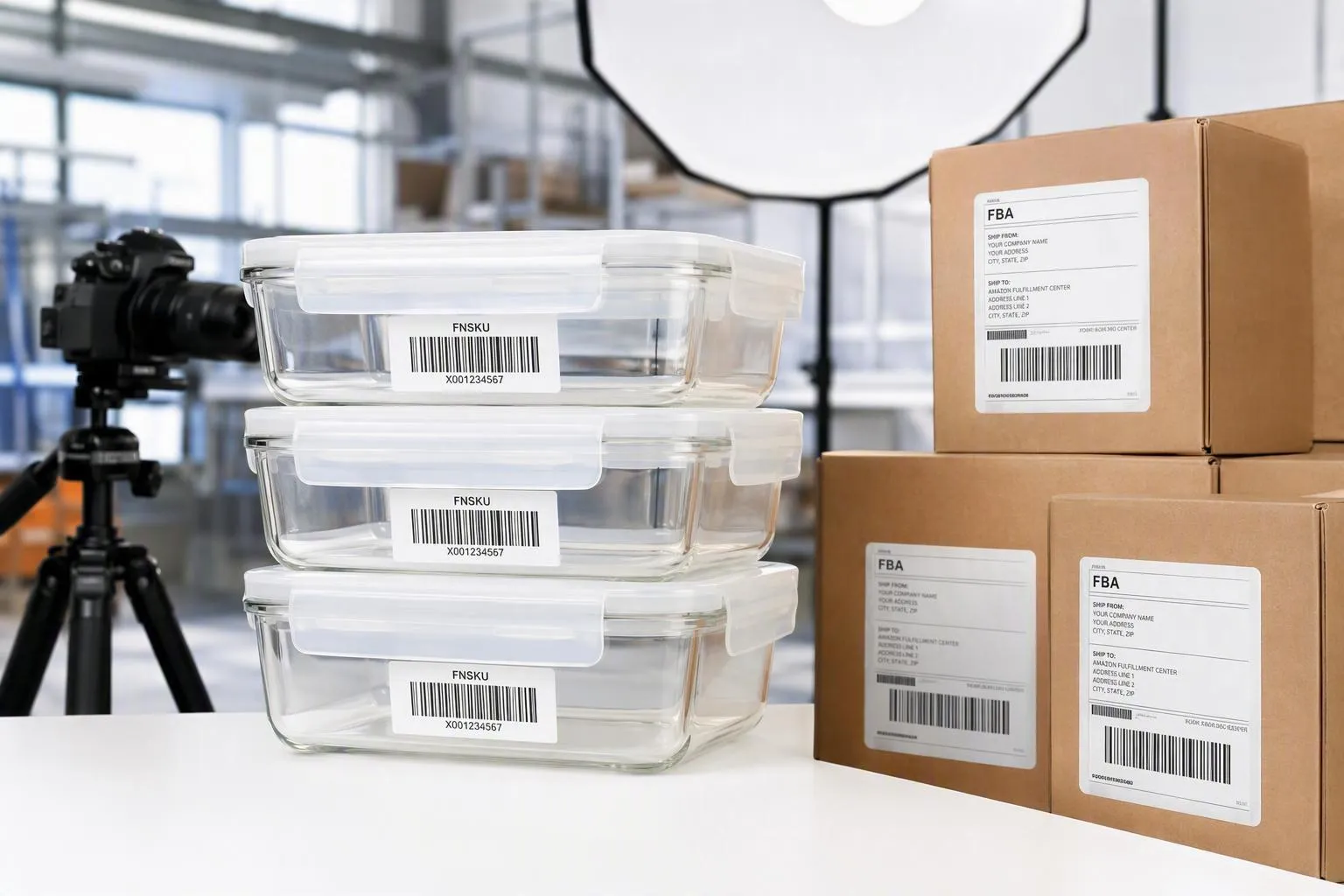
Belly band vs. printed retail box. A printed retail box is the safer choice for a first order. It gives you a dedicated front panel for the brand name, product name, net capacity, and key benefit, and it keeps the FNSKU on a flat, stable surface. A belly band can work, but only if it does not cover the barcode and stays flat during handling — bands shift, wrinkle, and loosen in transit, which makes scanning unreliable. Packaging specialists warn that a belly band must never cover the UPC or FNSKU . If the container itself has no large flat printable area, a box is the more robust option.
Where the FNSKU goes. Amazon requires one scannable barcode per sellable unit, placed on the largest flat exterior panel — not on a curve, corner, seam, or lid. Keep the label at least 0.25 inch away from package edges , put it on the outermost packaging layer, and cover any other visible barcode so the scanner sees exactly one code. FBA label-placement guidance reinforces this: flat, visible, stable, and no competing barcodes.
What belongs on the front panel. Keep the front panel clean: brand, product name, a clear descriptor, and the net contents/capacity . A buyer should be able to tell 24 oz from 32 oz at a glance. Reserve a clean area for the FNSKU on a flat side or back panel rather than crowding it into the main branding.
Dimensional weight and storage fees. Packaging size drives Amazon’s dimensional weight and monthly storage fees, which are based on the package’s volume class — not just its actual weight, as Amazon’s FBA packaging requirements make clear. A box that is larger than necessary inflates both landed cost and recurring storage. The right package is the smallest rigid one that still protects the product and meets labeling rules. Right-size the master carton too: sturdy, correct dimensions, minimal void fill, strong sealing, and the FNSKU visible on the outermost layer.
A worked packaging spec for one ASIN:
Element
Spec
Unit package
Printed retail box or polybag on flat printable area
Front panel
Brand, product name, net capacity (e.g., “24 oz / 700 ml”), key benefit
FNSKU
Flat exterior panel, ≥0.25 in from edge, cover other barcodes
Master carton
Right-sized, sturdy, ≥2 in cushioning, minimal void fill
Labeling
FNSKU on outermost layer; country of origin; safety icons only if tested
A Worked Example: Mapping the Mix to a Real Supplier’s Line
To make this concrete, consider how a first-order mix maps onto a meal-prep supplier’s existing range. A food-storage manufacturer like Xinghui Plastic Products publishes a meal-prep set line (PP+PET, models 3320–3329) with per-container capacities around 650, 800, 1200, 1300, and 2060 ml , microwave-safe and stackable, with free samples and sample/trial orders accepted below catalog MOQ. Its snap-lock custom food storage container series spans 400, 800, and 1400 ml with leak-proof, microwave-safe PP+silicone construction — a ready-made capacity ladder for a bento/salad position.
A brand launching a standard lunch line could pick one rung from that range as the hero, an adjacent rung as the secondary, and optionally add a two-compartment variant. Because a base platform (existing molds, no new tooling) carries the lowest MOQ and fastest lead time, this is where a first-order line gets built without overcommitting — and where the factory’s FBA carton prep and labeling services can handle the FNSKU placement and retail boxing directly. The evaluation framework below is what you use to decide whether any supplier’s range actually fits your plan.
Must-Haves vs. Red Flags: Your First-Order Evaluation Framework
Must-haves (walk away if missing):
• A written sample policy: free or credited-back, with lead time stated.
• Food-contact compliance certificates (FDA 21 CFR 177.1520; EU 10/2011; LFGB where needed).
• A golden/pre-production sample documented as the QC reference.
• State capacities in both metric (ml) and imperial (oz) so your listing is accurate.
• FBA prep capability (FNSKU, retail boxing/cartoining, labeling) if you sell on Amazon.
• A transparent quote showing per-unit price and MOQ per SKU.
Red flags:
• No willingness to provide a pre-production sample before bulk production.
• Vague or evasive answers on material compliance certificates.
• Mold/tooling costs quoted even for an existing base platform (stock product).
• Inconsistent or missing capacity/dimension data across SKUs.
• No path back to standard MOQ or reorder pricing on proven sell-through.
Your First-Order Sequence for a Meal-Prep Container Line
• Fix the SKU mix: one hero, one adjacent, one differentiated variant (optional).
• Set the capacity ladder: map each rung to a meal-prep use case with accurate ml/oz.
• Confirm food-grade material and lid structure (snap-lock/gasket) with compliance certificates.
• Order samples of the selected capacities; judge build and seal, not just price.
• Approve a pre-production sample with your branding and retail packaging.
• Finalize the retail package: printed box or clean belly band, FNSKU on a flat panel.
• Confirm FBA prep scope (FNSKU placement, carton specs, country of origin).
• Place the first order with a hero-skewed allocation (60/30/5/5).
• Run a pre-shipment inspection against the golden sample before shipping.
• Reorder only the SKU that proves demand , then expand the ladder.
FAQ
How many meal-prep container SKUs should I launch on Amazon? Start with two to three: one hero size, one adjacent size, and optionally one differentiated variant (multi-compartment or a premium lid). Launching every size equally fragments demand and increases inventory risk.
What is the best capacity for a meal-prep container first order? 24 oz is the most common default hero size, with 32 oz as the natural secondary. Hold 16 oz and 38 oz for phase 2 unless you are specifically targeting snacks/portion control or heavy/batch portions.
What is a capacity ladder? It is the way you order container sizes so shoppers can choose at a glance — typically small, medium, and large rungs (16 oz → 24/32 oz → 38 oz) that map to distinct meal-prep use cases and share a common base platform.
What is the difference between a belly band and a printed retail box? A printed box gives you a dedicated front panel and a stable FNSKU surface; a belly band is lighter but must never cover the barcode and can shift in transit. For a first FBA order, a printed box is usually the safer choice.
Where should the FNSKU label go on a meal-prep container package? On the largest flat exterior panel, at least 0.25 inch from the edges, not on curves, corners, seams, or lids. Cover any other visible barcode so each unit has exactly one scannable code.
How much should I order for a first meal-prep line? Most private-label launches start near 200–500 units total, skewed toward the hero SKU (roughly 60% hero, 30% secondary, 10% test variants). Reorder only the SKU that proves demand first.
Next Steps: Turn the Mix Into a First Order
The brands that scale in meal prep do not start wide — they start narrow and expand a proven ladder. Fix the SKU mix, size the capacity ladder to real use cases, and lock a retail package that scans clean at FBA. Once the first order sells through, you expand on evidence, not guesswork.
If you are sourcing meal prep containers and want a transparent read on capacities, MOQs, and retail/FBA packaging options, browse the wholesale food storage containers category or request a sample and a first-order quote for your line.
Continue reading
Related sourcing guidance
More practical context for your food storage container sourcing conversation.

Discuss your product range
Need help selecting or customising containers?
Share the product type, market and sourcing requirements with the Xinghui team.