
Food Storage Guides
Private Label Food Containers: Factory FBA Carton Prep, Labeling & Photography
In 2026 Amazon ended in-house FBA prep. See why food container factories should handle labeling, barcoding, photography, and carton prep.
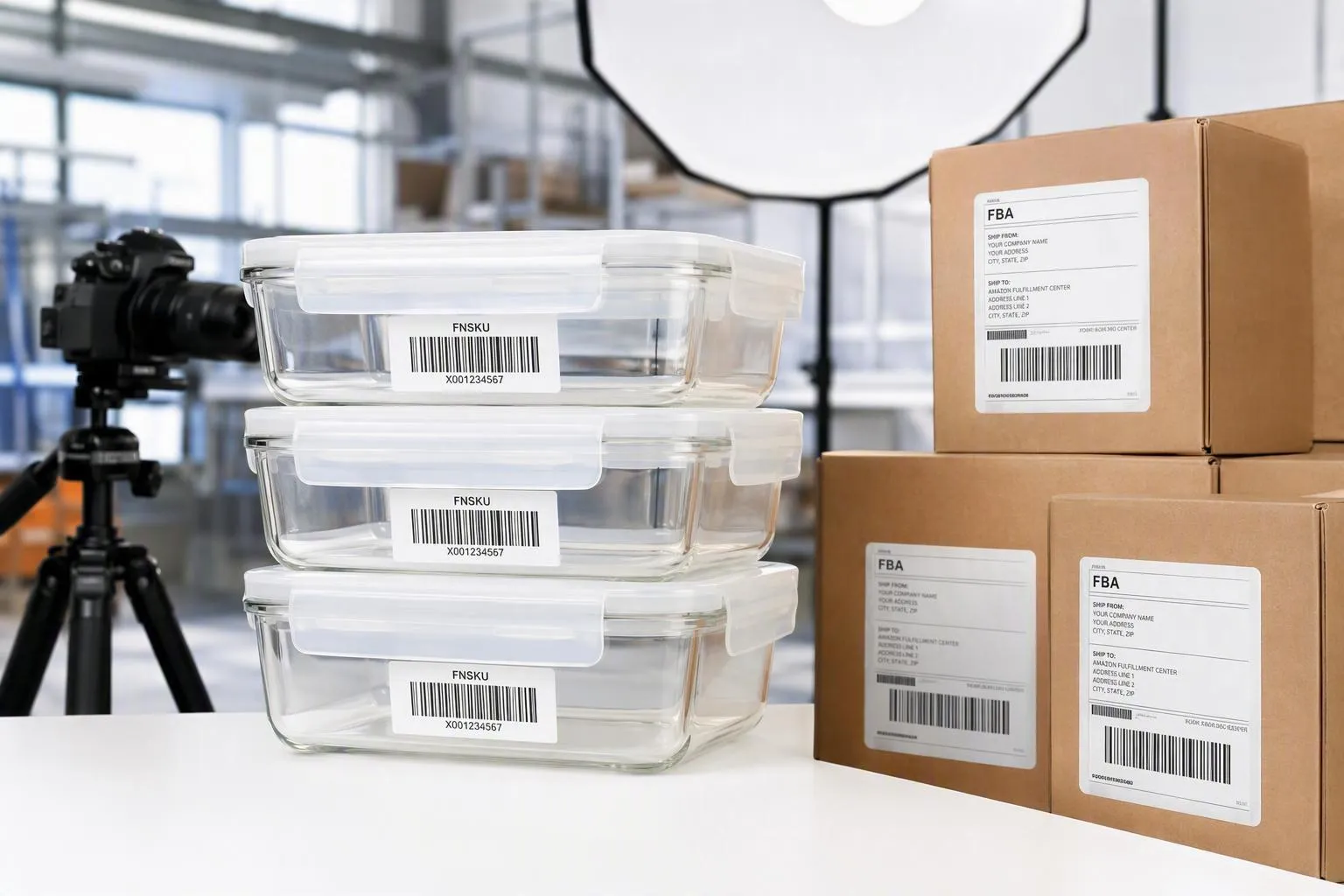
Amazon stopped offering its own FBA prep and labeling service in the United States on January 1, 2026. Every unit you send to a fulfillment center now has to arrive fully prepped, correctly labeled, and compliant — or it gets rejected, delayed, or hit with a growing pile of inbound fees. For private label food container sellers sourcing from a Chinese factory, that single change rewrites the sourcing conversation: the cheapest, lowest-risk place to get labeling, barcoding, product photography, and carton prep done is at the factory, before the goods ever leave.
This guide walks a sourcing manager through the four prep services worth requiring in-house — labeling, barcoding, product photography, and FBA carton prep — what compliant output actually looks like, and how to spot a factory that can’t deliver it.
Table of Contents
• Why Factory-Side FBA Prep Is Now the Default
• Labeling and Barcoding: Getting the Right Identifier on the Right Surface Which barcode: manufacturer barcode or FNSKU
• Print and placement specs that pass
• Country of origin and food-category labels
• Product Photography: Shoot It Once, at the Source
• FBA Carton Prep: Box ID Labels, Weight, and Pallet Rules
• How to Evaluate a Factory’s In-House Prep Capability
• Building the Requirement Into Your Sourcing Brief
• The Factory Prep Checklist to Send Before Your Next Order
Why Factory-Side FBA Prep Is Now the Default
For years, a common workaround was to ship into a US prep center and let someone there handle FNSKU stickers and polybagging. That option is disappearing. As Amazon’s FBA Prep Service notice makes clear, in-house prep and item labeling for US FBA shipments ended on January 1, 2026, and units must be prepped before they reach a fulfillment center.
The practical knock-on: any prep that used to happen stateside now happens either at a third-party facility you pay for, or back at origin. When the factory does it, inventory moves straight from production to export-ready packing and onto the truck — one chain instead of three handoffs. That removes a redundant shipping leg, shrinks the window between paying for goods and seeing them sellable on Amazon, and cuts the labor cost of a separate prep step.
There is a second clock running. As of March 31, 2026, stickerless commingled inventory is being phased out for resellers, pushing FNSKU labeling toward the default for those accounts. Between the end of in-house prep and the commingling change, private label units increasingly carry an FNSKU sticker — and that sticker is far cheaper and more accurate if applied at the factory where a consistent bench applies it to thousands of identical units.
Key Takeaway : Amazon no longer preps or labels US FBA inventory for you. Factory-side prep — labeling, barcoding, photography, and carton packing — is now the lowest-risk, lowest-labor path to a clean inbound shipment.
Labeling and Barcoding: Getting the Right Identifier on the Right Surface
Labeling is the highest-friction prep step, and the most common cause of inbound rejections. It comes down to two questions: which barcode, and where.
Which barcode: manufacturer barcode or FNSKU
The first decision is whether each unit scans with a manufacturer barcode (UPC/EAN) or an Amazon barcode. Amazon’s FBA barcode requirements draw a clear line: brand owners can keep using manufacturer barcodes without stickers, but resellers must use Amazon barcodes — the FNSKU, the X00-format label tied to your seller account — even when a manufacturer barcode is already on the product.
Most private label food container sellers are not enrolled brand-registry owners for every ASIN, which means FNSKU is the working default. The FNSKU is generated in Seller Central, then printed on a scannable label and applied to each unit.
Print and placement specs that pass
Amazon’s guidance on using Amazon barcodes is specific about how the label must look and sit:
• black ink on white, non-reflective, self-adhesive label stock
• printed at 300 DPI or higher so the code stays readable
• a 1 × 2 inch label as the practical minimum
• placed on a flat exterior surface — never on seams, corners, curves, lids, or package edges
• roughly a 0.25 inch quiet zone between the label edge and the package edge
• covering any other visible barcode so the receiving scanner reads the correct identifier
• remaining scannable after packing, rubbing, and transit
A factory with an in-house labeling line applies the same label, in the same spot, at the same print quality, across the entire batch. That consistency is exactly what reduces the “mixed barcode” and “unscannable label” rejections that plague hand-labeling. Industry guides such as CTM Labeling’s breakdown of FBA label requirements reinforce the same three components — FNSKU, product name, and condition — printed to the same specs.
Country of origin and food-category labels
Food containers that are shipped empty as reusable food storage still need country of origin marking and any marketplace-required compliance labels on the packaging. If a polybag or bag is part of the pack, a suffocation warning is required for openings 5 inches or larger, printed on the bag or a permanently affixed label. The important rule to remember: do not let the FNSKU or shipping labels cover up a compliance marking Amazon still needs to read.
Pro Tip : send the factory the final label PDF plus a written placement spec before production cartons seal. One clear instruction beats a batch of rework. Ask for a scan test on the first units and carton samples before the line runs at full speed.
Product Photography: Shoot It Once, at the Source
Product photography is not an Amazon prep requirement — but it is a factory task that pays off twice. If the factory photographs the actual production units in their final labeled, packaged state, you get listing assets and QC evidence from the same batch you are shipping, with no second production run or sample recall.
For a private label food container listing, the gallery should follow Amazon’s product image guide :
• Main image: pure white background (RGB 255, 255, 255), the actual product only, no text, logos, watermarks, props, or borders. The product should fill roughly 85% or more of the frame.
• Resolution: at least 1,000 px on the longest side to enable zoom; 2,000–3,000 px is the recommended sweet spot for sharp detail.
• Format: JPEG preferred; PNG and TIFF also accepted; 1:1 square is strongly recommended.
The rest of the gallery earns the sale. Secondary images carry the lifestyle scene — containers in a pantry, fridge, or meal-prep setting — plus detail shots of the lid seal and stacking, and infographic frames that spell out capacity, dimensions, airtight and leak-resistant claims, dishwasher/freezer/microwave compatibility, and “what’s included.” Text overlays are allowed on these non-main images, which is where the benefit messaging lives. Having the factory produce these images at the source means the photos reflect the real product finish and the exact label placement you are shipping — no surprises between the online photo and the box arriving at the buyer’s door.
FBA Carton Prep: Box ID Labels, Weight, and Pallet Rules
Carton prep is the most mechanical of the four services, but it is where a loose packing line causes real damage. Amazon’s shipping label requirements set the baseline:
• remove, cover, or render unreadable any old shipping-box barcodes on the outside of cartons before inbound
• apply a unique FBA box ID label to each shipping carton, printed from your shipment workflow
• when case-packs sit inside a larger carton, label the outer box only — inner case-packs need no separate carton label
• for palletized shipments, apply four pallet labels , one centered at the top of each side
• keep the box ID and carrier labels on a flat surface, uncovered and scannable
Two general FBA limits anchor the carton math: carton weight capped at 50 lb , and box dimensions at 25 inches per side as the standard general limit. A factory that knows its per-unit weight and carton fill can tell you exactly how many units fit per carton while staying under those caps.
This is where carton prep connects to landed cost. Units per carton multiplied by cartons per pallet decides freight efficiency and storage cost — worth running before you commit. A factory that packs to spec isn’t just avoiding rejections; it’s protecting your margin, and the carton math and landed cost behind it is worth modeling before you sign.
⚠️ Warning : a carton that is overweight or over a dimension cap is a rejection or a large-box surcharge risk. Confirm the factory’s carton fill math against your per-unit weight before the first production run, not after the goods are on a vessel.
How to Evaluate a Factory’s In-House Prep Capability
Use these as your must-have criteria when the factory claims to handle FBA prep. Treat each as a binary check, not a sales promise.
Prep service
What compliant output looks like
Red flag
FNSKU / barcode labeling
Black-on-white 300 DPI label, 1×2 in, flat surface, covers old barcode, scannable after packing
Factory asks you to label units yourself at origin
Compliance marking
Country of origin + any warning labels visible and not covered by FNSKU
Warning/compliance labels hidden under shipping labels
Product photography
White-bg 2000–3000 px main image + lifestyle/detail/infographic gallery of the real production batch
Only CAD renders or stock photos, no shot of actual units
Carton prep
Box ID on each carton, ≤50 lb, ≤25 in, pallet labels, old barcodes covered
No carton-fill math, no box ID workflow, unpriced packing
Documentation
Written packing declaration committing to FBA prep + food packaging compliance, batch scan records
No written declaration, no scan-test evidence
A factory that scores on all five rows is doing prep as a repeatable process, not as an afterthought. Ask for the compliance documents to request from the factory and for photographic proof of labeled units, warning labels, and carton labeling before the goods leave.
Building the Requirement Into Your Sourcing Brief
The cleanest way to lock this in is to make factory-side prep a written part of the sourcing agreement rather than a verbal promise. Specify the label file and placement, the scan-test requirement, the carton and pallet limits, and the photography deliverable — and make the packing declaration a condition of release for payment or shipment.
When a manufacturer handles the full loop — from food storage containers bulk for e-commerce sellers through compliant labeling, product photography, and FBA-ready carton prep — the sourcing equation becomes simpler. You are no longer assembling prep across three vendors and two continents. Instead, one factory that runs the whole private label and packaging chain in-house becomes a single control point for quality, compliance, labeling, imaging, and packing.
That consolidation is the real win behind “handled inside the factory.” It shortens your lead time, lowers your prep labor cost, and raises the odds that your first inbound shipment arrives ready to sell instead of ready to argue with a receiving clerk. When you require labeling, barcoding, product photography, and FBA carton prep at the factory, you trade a fragmented, error-prone prep chain for one controlled process — and you protect both your compliance record and your landed margin.
The Factory Prep Checklist to Send Before Your Next Order
• Confirm which barcode each SKU needs (manufacturer vs FNSKU) in Seller Central.
• Send the final FNSKU label PDF + exact placement spec before cartons seal.
• Require a 300 DPI, black-on-white, 1×2 in label on a flat surface, covering any old barcode.
• Verify country-of-origin and any polybag suffocation warnings are visible and not covered, following packaging tips for kitchen storage containers .
• Set carton ≤50 lb and ≤25 in per side; require box ID labels and pallet labels.
• Require a written packing declaration + batch scan records before release.
• Have the factory photograph the actual labeled, packaged production units for both listing and QC.
If your current factory hesitates on any of these, that is worth a conversation before your next container loads. If you are evaluating a new supplier, this checklist is your filter — and a factory that has been doing OEM/ODM food-container work for years, with an in-house labeling and photography capability, is the profile most likely to pass it.
Want help turning this prep checklist into a formal RFQ requirement or reviewing a factory’s packing declaration against it?
Talk to the Xinghui sourcing team to review your FBA prep specification, carton math, and photo brief before you commit to your next container.
Continue reading
Related sourcing guidance
More practical context for your food storage container sourcing conversation.

Discuss your product range
Need help selecting or customising containers?
Share the product type, market and sourcing requirements with the Xinghui team.