
Food Storage Guides
Non-PP Parts Compliance: Gasket, Base & Glass Evidence
Component-by-component compliance evidence for silicone gaskets, glass inserts and bases in food containers — FDA, EU 10/2011, LFGB & GB standards.
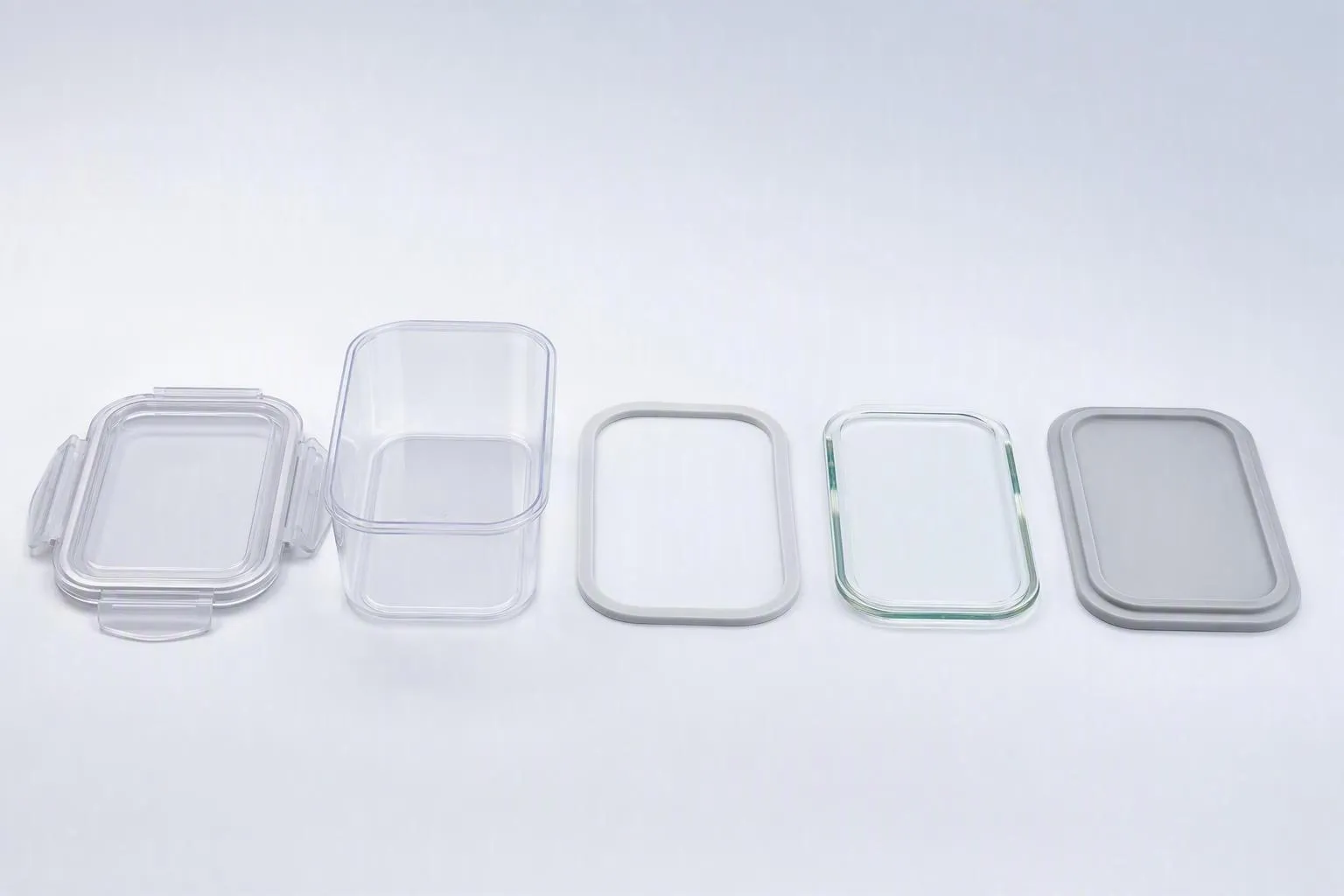
A polypropylene body that passes food-contact testing does not make the whole container compliant. Sourcing managers keep learning this the hard way: the listing passes review, then Amazon FBA or a customs broker asks for documentation on the other parts — the silicone gasket, the glass insert, the metal or composite base — and the file isn’t there. What looked like a compliance win turns into a suspension, a hold, or a chargeback.
The container you import is a multi-material system. Every part that touches food, or that sits between food and the outside world, carries its own regulatory basis. This buyer-guide walks through the non-PP components piece by piece — what standard applies, what the evidence should look like, and exactly which documents to demand from a factory before you commit to a mold and a PO.
Table of Contents
• Why the PP body alone is never enough
• The component-by-component non-PP compliance evidence map Silicone gaskets: know which rule actually applies
• Glass inserts: lead and cadmium release, not plastic migration
• Bases and alt-polymer parts: read the whole formulation
• The Declaration of Compliance for component assemblies
• What to demand from your factory: the six-part evidence file
• Must-haves vs red flags
• How to use these criteria in your next RFQ
• FAQ
Why the PP body alone is never enough
Food-contact compliance follows the substance, not the finished product name. An Amazon listing is granted based on the entire article, and marketplace food-contact guidance requires every component that contacts food to be documented. When your packaging or listing claims “food-grade,” “BPA-free,” or “leakproof,” the enforcer treats that claim as applying to every material in the build.
The practical consequence: a PP body tested under a single polymer rule does nothing for a silicone gasket that carries its own migration limits, a glass insert that must meet heavy-metal release thresholds, or a coated metal base that introduces a new surface chemistry. Each is a separate evaluation. A factory that hands over “the FDA report” with no component map has, in reality, handed you very little.
The component-by-component non-PP compliance evidence map
The core of a sourcing decision is a matrix: for each non-PP part, which standard governs it in the market you ship to, and what report proves it. The table below is the working version — treat it as the spine of your RFQ.
Component
US (FDA)
EU / UK (10/2011 + 1935/2004)
Germany (LFGB)
China (GB 4806 series)
Japan (Food Sanitation Act)
Silicone / rubber gasket
21 CFR 177.2600 (rubber, repeated use); extraction evidence
Silicone/rubber generally outside 10/2011; a plastic gasket layer in a closure is covered
§§30/31 + BfR Recommendation XV; migration, VOM, peroxide, sensory
GB 4806.11 (rubber)
Positive-list conformity + migration data for the exact compound
Glass insert / lid
Intended-contact substance + coating review; Pb/Cd release data
Council Directive 84/500/EEC (Pb/Cd); ISO 6486-1 method
Heavy-metal release + sensory
GB 4806.5 (Pb ≤1.5 mg/L, Cd ≤0.5 mg/L, small hollow articles)
Food-contact conformity for glass + decoration
Metal base
Alloy identification + coatings (e.g., 21 CFR 175.300 for coatings)
CoE metals guideline; substance-specific conformity
Metal composition + extractable heavy metals + sensory
GB 4806.9 (composition + heavy-metal migration)
Conformity file for alloy + surface treatment
Alt-polymer base (TPE/ABS/Tritan)
Component-specific basis; FCN/TOR if no CFR coverage
10/2011 — OML ≤10 mg/dm², SMLs per substance; DoC required
§30/31 + applicable BfR rec; migration + sensory
GB 4806.7 (plastics)
Positive-list conformity for resin + additives
Three nuances in that table are worth spelling out, because they trip up buyers who rely on a single “it’s certified” statement.
Silicone gaskets: know which rule actually applies
For gaskets and seals, the US route runs through FDA 21 CFR 177.2600, “Rubber articles intended for repeated use” . It lists the permitted ingredients and sets extraction limits for aqueous and fatty foods — for aqueous contact, total extractables must not exceed 20 mg per square inch after a 7-hour water reflux, then 1 mg per square inch in the following 2 hours. Compliance can rest on a formulation review plus extraction data; it is not a “certificate” in the EU sense.
In the EU, the Commission Regulation (EU) No 10/2011 on plastic food-contact materials draws a careful line. Silicone and rubber as such fall outside its scope. The exception that matters for containers: if a gasket in a cap or closure is a plastic layer or coating, that layer is within the Plastics Regulation. So you cannot assume a silicone seal is “EU 10/2011 certified” the way a plastic body is — the supplier should state the correct basis, and if the gasket is a plastic sealing layer, the 10/2011 route (with its overall and specific migration limits) applies to that layer.
For the German market a silicone gasket is typically assessed under LFGB §§30/31 with BfR Recommendation XV for silicones , covering overall migration, volatile organic matter, peroxide value, and sensory odor/taste transfer. On the China side, GB 4806.11 governs rubber. Japan expects a food-contact conformity package tied to the exact compound and intended use.
Glass inserts: lead and cadmium release, not plastic migration
Glass does not behave like a polymer, so applying a plastic-style overall-migration screen is the wrong mental model. The controlling risk for a glass insert or lid is the release of heavy metals from the glass body and any decoration. Under the China national standard GB 4806.5 (glass articles) , a small hollow article such as a food-container jar keeps lead release at or below 1.5 mg/L and cadmium at or below 0.5 mg/L, tested with the specified methods. In the EU, reusable glassware with lead-cadmium release falls under Council Directive 84/500/EEC and is tested by the ISO 6486-1 method, and any color decoration near the rim earns its own scrutiny.
Bases and alt-polymer parts: read the whole formulation
A metal or composite base brings its own chemistry — alloy composition, plating, coatings, and any liner. The evidence has to follow the surface that touches food. For a stainless or plated base bound for China, GB 4806.9 covers composition and heavy-metal migration; for the EU, the Council of Europe metals guideline and substance-specific conformity apply, and if a coating contacts food it needs its own authorisation. An alternative-polymer base such as TPE or Tritan reverts to the plastic route — under 10/2011 in the EU, with the overall migration limit of 10 mg/dm² and per-substance limits, plus a Declaration of Compliance.
The Declaration of Compliance for component assemblies
For plastic food-contact articles, the EU is explicit: a written Declaration of Compliance is mandatory at every marketing stage other than retail, including intermediate stages and the substances used to make them. Article 15 of Regulation (EU) No 10/2011 sets this out, and Annex IV specifies what the document must contain: the identity and address of the issuing operator and of the manufacturer or importer, a clear identification of the material, article, or component, the date, a statement of conformity with 10/2011 and Regulation (EC) No 1935/2004, and any restrictions on food type, temperature, or contact time. Where a gasket, base, or insert belongs to a plastic assembly, the DoC ties that component to its plastic authorisation.
The US has no single EU-style statutory form. Instead, the FDA’s component-framework guidance is built around establishing a regulatory basis for each component — its identity, specifications, and the limitations on its conditions of use. In practice buyers still receive a supplier Declaration of Compliance, but the value of that document depends on it being per-component and specific, not a blanket “complies with FDA” line.
What to demand from your factory: the six-part evidence file
When you qualify an OEM/ODM partner, ask for a full compliance file for the non-PP parts — the discipline many suppliers skip, and the reason most non-PP parts compliance reviews stall. A serious supplier should be able to produce all six pieces without hesitation:
• Bill of materials / component map. The exact gasket grade, glass type, base alloy or polymer, plus every additive, coating, ink, adhesive, and any recycled content. If a supplier cannot name each non-PP part, you cannot verify it.
• Supplier declarations. A statement from each raw-material vendor identifying the exact formulation and the intended food-contact use. This is where “food-grade” claims stop being conversational and become documented.
• Regulatory basis per component, per market. The specific 21 CFR section (or FCN/TOR), the 10/2011 route with limits, the LFGB/BfR basis, the GB 4806 sub-standard. A single global “certified” claim is a red flag; a market-by-market basis is the real thing.
• Test reports for the exact component. Not a “similar” material or an unverified PDF. The report should name the accredited lab, cite the method, show a sample ID that matches your SKU, carry a date, and state pass/fail.
• Traceability. Evidence linking the tested samples to the actual shipped lots — batch numbers, production dates, and records. This is what makes “will bulk match the sample?” answerable.
• Change control. Documents covering any change to formulation, supplier, curing system, coating, or process. A gasket that passed last year fails nothing this year if the vendor quietly switched from a platinum-cured to a peroxide-cured silicone.
If you want a ready-made template for requesting these tiers, our food container factory compliance documents guide breaks the full package into the mandatory US food-contact declarations, accredited third-party reports, and traceability files.
Must-haves vs red flags
Turn that list into a decision framework with a simple test: does the supplier hand you components-and-conditions-specific evidence, or a generic certificate?
Must-haves
• A named non-PP component map with grades and additives.
• A per-component regulatory basis that names the exact standard for your target market.
• Accredited-third-party test reports tied to the exact SKU and batch.
• A Declaration of Compliance that names the component and its use conditions.
• Traceability and change-control records that stay live across production runs.
• Claims (“food-grade,” “BPA-free,” “dishwasher-safe,” “leakproof”) matched to the test that supports them.
Red flags
• “It’s all FDA approved” with no component-level breakdown.
• A single consolidated report described as covering “the container” without per-part detail.
• A gasket or sealing material reference with no test of its own — this is the single most common gap.
• Glass components with no lead-cadmium release data.
• No traceability between the certificate and your PO.
• Any pushback when you ask for the original PDF rather than a screenshot.
A factory that treats non-PP compliance as a routine part of the file — rather than a request that needs escalation — is the one worth shortlisting. That is the standard we hold at Xinghui Plastic Products : the same OEM/ODM food-storage line we run across FDA, SGS, and LFGB baselines treats gasket, base, and insert documentation as part of the standard deliverable, not an add-on.
How to use these criteria in your next RFQ
Add the component table from this guide to your RFQ as a blank matrix and ask the factory to fill in the standard, the report number, the lab, and the date for each non-PP part, per target market. If they name a standard that does not match the component (for example, an EU 10/2011 claim on a silicone gasket), probe it — the correct basis matters. Then pair each claim with the original third-party report and the traceability that links it to your lot. You will end up with a defensible file your brand, your importer, and the marketplace can all rely on. For a wider view of the certifications to weigh across categories, the 7 essential certifications for plastic food storage containers and our five-market compliance map are good complements to this component-level deep dive.
FAQ
Does a single FDA report cover the gasket and the glass insert too? Not reliably. FDA evaluates a food-contact material component by component. A PP-body-only report says nothing about a silicone gasket (21 CFR 177.2600) or a glass insert (lead-cadmium evaluation). Demand per-component evidence.
Is a silicone gasket “EU 10/2011 certified”? Usually not directly — silicone and rubber fall outside 10/2011’s scope. A plastic layer forming a gasket in a closure is inside it. Ask the supplier for the correct basis: 10/2011 for a plastic sealing layer, or the appropriate EU/national silicone or rubber route for a silicone seal.
What tests does a glass insert need? Lead and cadmium release, per GB 4806.5 in China and EU 84/500/EEC in the EU, using the ISO 6486-1 method. Plastic-style overall migration is the wrong test for glass.
What is a Declaration of Compliance and when is it required? Under EU 10/2011, a written DoC is mandatory at marketing stages other than retail and must meet Annex IV content. In the US there is no single statutory form, but a defensible per-component regulatory basis fulfils the same intent.
What is the most common compliance gap when importing multi-material containers? The silicone gasket. Buyers test (or inherit a claim about) the PP body, then miss the sealing material, which has its own migration and sensory requirements — and it is the part that leaks, stains, or carries odour in use.
Key Takeaway : Food-contact compliance is per component, per market. Before you commit to a mold, demand a six-part evidence file — component map, supplier declarations, per-component regulatory basis, exact-component test reports, traceability, and change control — and let the presence of that file separate a serious OEM/ODM partner from a “certified” hand-wave.
Continue reading
Related sourcing guidance
More practical context for your food storage container sourcing conversation.

Discuss your product range
Need help selecting or customising containers?
Share the product type, market and sourcing requirements with the Xinghui team.