
Food Storage Guides
Food Contact Compliance for Plastic Containers: 5-Market Map
Master food contact regulations for reusable plastic containers across US, EU, Germany, Japan & China. Includes FDA, LFGB, EU 10/2011 & GB standards.
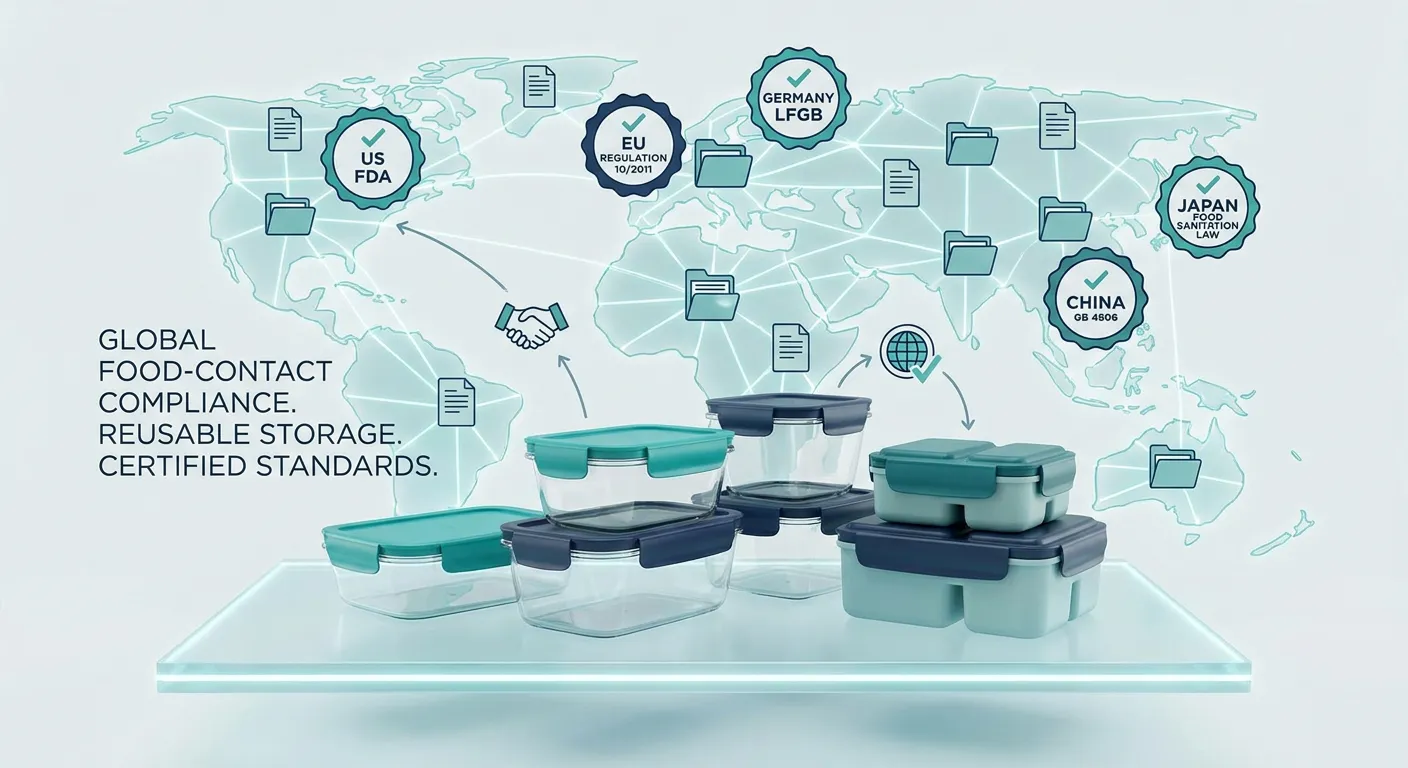
Key Takeaways : United States : Compliance under FDA 21 CFR 177.1520 mandates resin extractable limits (n-hexane and xylene fractions for PP/HDPE), CONEG heavy metal limits (< 100 ppm), and a valid Resin Letter of Guarantee (LoG). European Union : Regulation (EU) No 10/2011 sets an Overall Migration Limit (OML) of 10 mg/dm² and requires 3-pass consecutive migration testing for repeated-use containers, backed by a formal Declaration of Compliance (DoC) per Annex IV. Germany : LFGB §§ 30 & 31 demand strict DIN 10955 organoleptic sensory testing (odor and taste transfer score ≤ 2.5/4.0), alongside Polycyclic Aromatic Hydrocarbons (PAH) screening. Japan : Article 18 of the Food Sanitation Act enforces a mandatory MHLW Positive List System for synthetic resins and additives, alongside strict evaporation residue testing across four food simulants. China : GB 4806.7-2023 regulates plastic articles alongside GB 9685-2016 for additives, requiring KMnO4 consumption testing, Chinese-language DoCs, and mandatory “食品接触用” (Food Contact Use) product labeling.
Expanding a private label kitchenware or home storage brand across international borders presents lucrative opportunities on Amazon FBA, Shopify DTC, and retail channels. However, cross-border e-commerce sellers frequently face sudden customs holds, inventory rejections, or listing suspensions due to non-compliant food-contact materials (FCM).
Reusable plastic containers—such as meal prep bento boxes, food storage tubs, and airtight kitchen canisters—are subjected to rigorous chemical migration, heavy metal, and sensory testing before entering consumer markets. A material safety certificate accepted in the United States does not automatically grant customs clearance in Germany or Japan.
To help sourcing directors, brand managers, and e-commerce founders safeguard their supply chains, this document map outlines the exact legal frameworks, testing parameters, and required compliance documentation across the world’s five largest retail markets.
Table of Contents
• 1. United States: FDA 21 CFR 177.1520 & Environmental Toxin Standards Regulatory Core: Olefin Polymers & Additives
• Heavy Metals and State-Level Rules
• Required Document Package for US Imports
• 2. European Union: Regulation (EU) No 10/2011 & Repeated-Use Rules Chemical Migration Testing: OML and SML
• The 3-Pass Migration Rule for Reusable Containers
• Required Document Package for EU Clearance
• 3. Germany: LFGB §§ 30/31 & Organoleptic Sensory Testing Key Differential Requirement: Organoleptic Testing (DIN 10955)
• Polycyclic Aromatic Hydrocarbons (PAH) and Bleeding Tests
• Required Document Package for German Distribution
• 4. Japan: Food Sanitation Act Article 18 & Positive List System The MHLW Positive List System
• Physical and Chemical Testing Standards
• Required Document Package for Japanese Import Notification
• 5. China: GB 4806.7-2023 & GB 9685-2016 Additive Standards Core Standards Framework
• Mandatory Physical and Chemical Testing
• Mandatory Chinese Labeling and Declaration
• 6. Five-Market Compliance Comparison Matrix
• 7. Operational Workflow for Sourcing & Amazon FBA Audit Readiness Step 1: Pre-Production Resin Verification
• Step 2: 72-Hour Rapid Sample Proofing
• Step 3: Accredited Laboratory Testing
• Step 4: Factory Declaration of Compliance (DoC) Issuance
• Frequently Asked Questions (FAQ) Can a single lab test report cover both US FDA and European LFGB compliance?
• What causes reusable plastic food containers to fail German LFGB organoleptic testing?
• What happens if an Amazon seller fails to provide a Declaration of Compliance (DoC) during an FBA audit?
• Does Japan accept European EU 10/2011 test reports for customs clearance?
• Next Steps for Private Label Brands
1. United States: FDA 21 CFR 177.1520 & Environmental Toxin Standards
In the United States, the Food and Drug Administration (FDA) regulates food contact substances (FCS) under Title 21 of the Code of Federal Regulations (21 CFR Parts 170–189). Reusable plastic food containers fall under indirect food additives regulations, where compliance begins at the raw resin level.
Regulatory Core: Olefin Polymers & Additives
The majority of reusable plastic containers are molded from polypropylene (PP), high-density polyethylene (HDPE), or specialty copolymers. These materials are governed by 21 CFR 177.1520 (Olefin Polymers) .
• Resin Extraction Limits : PP homopolymers and copolymers must pass laboratory extractable testing using specified food simulants: n-Hexane Extractable Fraction : Maximum 6.4% by weight at 50°C for unmodified PP homopolymers.
• Xylene Soluble Fraction : Maximum 9.8% by weight at 25°C.
• Colorants and Pigments : Masterbatches and color pigments added during injection molding must comply strictly with 21 CFR 178.3297 (Colorants for Polymers) .
Raw Resin Selection (21 CFR 177.1520)
Pigments & Additives Check (21 CFR 178.3297)
Heavy Metal Screening (CONEG / TPCH < 100 ppm)
Prop 65 Chemical Audit (BPA / Phthalate Free)
Finished Container Approval & CoA
Heavy Metals and State-Level Rules
Beyond federal FDA oversight, importers must satisfy environmental toxicity standards:
• CONEG / TPCH Heavy Metal Limits : Total concentration of Lead (Pb), Cadmium (Cd), Mercury (Hg), and Hexavalent Chromium (Cr VI) in packaging and finished containers must not exceed 100 ppm combined .
• California Proposition 65 : Requires explicit warning labels unless product testing proves zero exposure to Bisphenol A (BPA) and restricted phthalates (DEHP, DBP, BBP, DINP).
Required Document Package for US Imports
When importing into the US or submitting documentation for Amazon US listing reviews, sellers must possess:
• Resin Manufacturer Letter of Guarantee (LoG) : Issued by the resin producer (e.g., LyondellBasell, Sabic) confirming compliance with 21 CFR 177.1520.
• Third-Party 21 CFR Extractables Test Report : Issued by an ISO 17025 accredited laboratory (e.g., SGS, Intertek, TÜV) verifying extractable limits under the intended food contact temperature.
• Certificate of Analysis (CoA) : Batch-level verification from the manufacturer.
For comprehensive regulatory guidelines, review the official FDA 21 CFR food contact framework .
2. European Union: Regulation (EU) No 10/2011 & Repeated-Use Rules
The European Union operates one of the world’s most detailed harmonization frameworks for food contact materials. All materials must comply with Framework Regulation (EC) No 1935/2004, Good Manufacturing Practice (EC) No 2023/2006, and specific plastic measures.
Chemical Migration Testing: OML and SML
Plastic containers entering the EU single market must meet two distinct migration thresholds set out in Commission Regulation (EU) No 10/2011 :
• Overall Migration Limit (OML) : Measures the total quantity of non-volatile substances transferred from the plastic into food. The universal limit is 10 mg/dm² of food contact surface area (or 60 mg/kg of food simulant).
• Specific Migration Limits (SML) : Restricts individual toxic substances that pose health risks. Key restricted substances include: Heavy Metals : Barium (1.0 mg/kg), Cobalt (0.05 mg/kg), Copper (5.0 mg/kg), Iron (48.0 mg/kg), Lithium (0.6 mg/kg), Manganese (0.6 mg/kg), Zinc (5.0 mg/kg), Nickel (0.02 mg/kg), and Antimony (0.04 mg/kg).
• Primary Aromatic Amines (PAA) : Combined total must not exceed 0.01 mg/kg .
• Bisphenol A (BPA) : SML restricted to 0.05 mg/kg , with stricter total bans active across infant and food-contact categories.
The 3-Pass Migration Rule for Reusable Containers
A critical testing pitfall for cross-border sellers is failing to apply repeated-use testing protocols. Because reusable food containers are designed for repeated wash and wear cycles, EU 10/2011 dictates that migration testing must be conducted three consecutive times on the exact same sample using identical food simulants (such as 3% Acetic Acid, 10% Ethanol, or Vegetable Oil).
Pass 1 Migration Test (Sample A) → Record Migration Value
Pass 2 Migration Test (Sample A) → Record Migration Value
Pass 3 Migration Test (Sample A) → Final Value MUST be ≤ Pass 2 AND ≤ Legal SML/OML
Compliance is determined by the third migration pass . If the migration value increases between the second and third passes, the product fails automatically, indicating material instability or degradation.
Required Document Package for EU Clearance
Under Article 15 and Annex IV of Regulation (EU) No 10/2011, suppliers must issue a formal Declaration of Compliance (DoC) . A compliant EU DoC must state:
• Identity and address of the manufacturer or importer issuing the declaration.
• Chemical identity of materials and confirmation that raw resins meet EU positive lists.
• Confirmation that overall and specific migration limits are respected based on lab testing or mathematical modeling.
• Clear operational constraints (e.g., suitable food types, temperature limits, heating duration, contact surface-to-volume ratio).
Refer directly to the legal text of EU Regulation 10/2011 for plastic food contact materials when structuring technical dossiers.
3. Germany: LFGB §§ 30/31 & Organoleptic Sensory Testing
While Germany operates within the EU framework, its domestic market enforcement under the German Food, Commodities and Feed Code— Lebensmittel-, Bedarfsgegenstände- und Futtermittelgesetzbuch (LFGB) —is significantly stricter than standard EU baseline requirements.
Key Differential Requirement: Organoleptic Testing (DIN 10955)
German customs authorities and retail inspectors prioritize sensory organoleptic testing. Under LFGB Section 31 , food contact materials must not transfer any perceptible odor or taste to food.
• Test Protocol (DIN 10955) : The container is filled with deionized water or food simulants and held at specified temperature conditions (e.g., 2 hours at 70°C for microwave containers, or 24 hours at 40°C for general storage).
• Sensory Evaluation Scale : A trained panel evaluates sensory transfer on an intensity scale: 0 : No perceptible difference in taste/odor.
• 1 : Just perceptible difference (hard to define).
• 2 : Moderate difference.
• 3 : Marked difference.
• 4 : Strong difference.
• Pass Threshold : A score above 2.5 (or above 2.0 under strict retailer guidelines) results in an immediate failure, rendering the product unmarketable in Germany regardless of chemical migration compliance.
Polycyclic Aromatic Hydrocarbons (PAH) and Bleeding Tests
Germany also enforces stringent chemical purity controls on plastic formulations:
• PAH Screening : Evaluates 15 restricted carcinogenic polycyclic aromatic hydrocarbons (AfPS GS 2019:01 PAK criteria).
• Colorfastness (Bleeding Test) : Ensures synthetic dyes or masterbatch pigments do not leach into food items during storage.
Required Document Package for German Distribution
• LFGB Declaration of Conformity : Written declaration explicitly referencing LFGB Sections 30 and 31 alongside EU 10/2011.
• DIN 10955 Sensory Test Report : Official lab certificate confirming acceptable odor and taste transfer scores.
• Traceable Technical Documentation : Complete lab migration reports and raw material specifications.
Examine the statutory framework under German LFGB §§ 30 and 31 compliance standards for detailed operational mandates.
4. Japan: Food Sanitation Act Article 18 & Positive List System
Japan regulates food contact packaging under Article 18 of the Food Sanitation Act (Act No. 233 of 1947) , overseen by the Ministry of Health, Labour and Welfare (MHLW).
The MHLW Positive List System
Japan fully implemented a mandatory Positive List System for Synthetic Resins . Under this regime, only base polymers, monomers, and additives that are explicitly published on the MHLW Positive List tables are authorized for manufacturing food contact containers.
• Base Polymers : Resins are categorized into distinct risk classes (e.g., Polyolefins like PP/PE, Polyester, Polystyrene).
• Additives : Antioxidants, plasticizers, lubricants, and colorants are subjected to strict maximum composition limits (% by weight) based on resin category and temperature exposure.
• Unlisted Substances : Prohibited unless protected behind a proven non-migration functional barrier (migration < 0.01 mg/kg).
Chemical Formulation Check
Base Resin Listed on MHLW Table 1?
Additives Listed on MHLW Table 2?
Migration & Residue Lab Testing (Evaporation & KMnO4)
Quarantine Station Inspection Certificate
Physical and Chemical Testing Standards
Japan enforces distinct wet-chemistry laboratory testing methods for synthetic resin articles:
• Heavy Metal Test : Total heavy metals calculated as Lead (Pb) must not exceed 100 ppm .
• Evaporation Residue Test : Measures total extractable matter after exposure to four distinct food simulants (Water, 4% Acetic Acid, 20% Ethanol, and n-Heptane). Typical residue limits are ≤ 30 ppm .
• Potassium Permanganate (KMnO4) Consumption : Measures easily oxidizable organic substances migrating into water. Limit is ≤ 10 ppm .
Required Document Package for Japanese Import Notification
When shipping food containers into Japan, importers must submit documentation to the Ministry Quarantine Station:
• Material Formulation & Positive List Certificate : Supplier statement demonstrating that every polymer and additive aligns with MHLW Positive List IDs.
• Japan Food Sanitation Act Test Report : Conducted by an MHLW-registered laboratory.
• Import Notification Form (Shokuhin To届け) : Cleared prior to customs release.
Consult official directives via the Japan Food Sanitation Act positive list framework .
5. China: GB 4806.7-2023 & GB 9685-2016 Additive Standards
China enforces a comprehensive national food safety standard system (Guobiao / GB standards) governed by the State Administration for Market Regulation (SAMR) and the National Health Commission (NHC).
Core Standards Framework
Food contact plastic containers sold within mainland China or manufactured for domestic retail must comply with a two-tier rule structure:
• GB 4806.1-2016 : General safety requirements for all food contact materials.
• GB 4806.7-2023 : National Food Safety Standard for Plastic Materials and Products for Food Contact (replacing older 2016 resin and article standards).
• GB 9685-2016 : Standard for Uses of Additives in Food Contact Materials and Articles.
Mandatory Physical and Chemical Testing
GB 4806.7-2023 mandates comprehensive finished-article testing parameters:
• Overall Migration Limit : ≤ 10 mg/dm² .
• Potassium Permanganate Consumption : ≤ 10 mg/kg .
• Heavy Metals (as Pb) : ≤ 1 mg/kg .
• Specific Migration Limits (SML / SML(T)) : Explicit restrictions on residual monomers, plasticizers (such as DEHP, DBP), and heavy metals.
• Sensory Inspection : Normal appearance without odor, discoloration, or foreign impurities.
Mandatory Chinese Labeling and Declaration
Article 8 of GB 4806.1-2016 enforces strict traceability and labeling rules directly on packaging:
• Product Designation : Must clearly state “食品接触用” (For Food Contact Use) or feature the official Chinese food contact symbol (fork and spoon).
• Material Identification : Must state the exact resin name (e.g., “PP” or “Polypropylene”).
• Standard Reference : Must print the standard code GB 4806.7-2023 .
• Chinese Declaration of Compliance (DoC) : Must accompany every commercial stage, detailing compliance with GB 9685 additive restrictions.
Review exact testing protocols under the China GB 4806.7-2023 plastic food contact standard .
6. Five-Market Compliance Comparison Matrix
To streamline cross-border supply chain planning, the following matrix compares the core compliance requirements across all five markets:
Compliance Dimension
United States (FDA)
European Union (EU)
Germany (LFGB)
Japan (MHLW)
China (GB Standards)
Primary Legislation
21 CFR Parts 170–189
Regulation (EU) No 10/2011
LFGB §§ 30 & 31
Food Sanitation Act Art. 18
GB 4806.7-2023
Material Control Basis
CFR Resin Rules (21 CFR 177.1520)
EU Union Positive List
EU 10/2011 + BfR Recs
MHLW Positive List System
GB 4806.7 + GB 9685 List
Overall Migration Limit
Extractable fractions (hexane/xylene)
10 mg/dm² (or 60 mg/kg)
10 mg/dm²
Evaporation residue ≤ 30 ppm
10 mg/dm²
Repeated-Use Testing
Single extractables evaluation
3 consecutive passes
3 consecutive passes
Single simulant extraction
Single or repeated simulant pass
Sensory / Odor Rules
General FDA non-adulteration
Article 3 EC 1935/2004
DIN 10955 score ≤ 2.5/4.0
General sensory check
Clean appearance & zero odor
Heavy Metal Limits
CONEG < 100 ppm total
Individual SMLs (9 metals)
SMLs + PAH screening
Pb ≤ 100 ppm
Pb ≤ 1 mg/kg
Mandatory Document
Resin Letter of Guarantee (LoG)
Declaration of Compliance (DoC)
LFGB DoC + Sensory Report
Positive List Certificate
Chinese GB DoC + Label
7. Operational Workflow for Sourcing & Amazon FBA Audit Readiness
To protect private label brands from costly compliance failures, sourcing managers should implement a 5-step factory compliance verification workflow before issuing purchase orders:
• Resin & Additive Audit → 2. Sample Proofing → 3. Accredited Lab Testing → 4. DoC Issuance → 5. FBA Document Vault
Step 1: Pre-Production Resin Verification
Request full raw material specifications from your manufacturing partner before tooling begins. Ensure the factory utilizes 100% virgin, food-grade resins without unverified post-consumer recycled (PCR) scrap or non-compliant fillers.
Step 2: 72-Hour Rapid Sample Proofing
Work with experienced OEM/ODM factories capable of delivering rapid physical samples. Conduct preliminary physical inspections for molding defects, flash, structural durability, and seal integrity before committing to high-volume production runs.
Step 3: Accredited Laboratory Testing
Send finished container samples to an ISO 17025 accredited laboratory (such as SGS, Intertek, or TÜV) to execute destination-specific testing:
• Request 3-pass repeated migration if targeting the EU or Germany.
• Request DIN 10955 organoleptic sensory testing if targeting the German market.
• Request 21 CFR 177.1520 hexane/xylene extractable testing for US customs clearance.
Step 4: Factory Declaration of Compliance (DoC) Issuance
Ensure your factory supplier issues an official, signed Declaration of Compliance linking the exact purchase order, product item numbers, raw material batch codes, and corresponding lab test report IDs.
As a leading certified OEM/ODM food storage container manufacturer , Jieyang Xinghui Plasticware Factory draws on over 30 years of specialized manufacturing experience. Operating full-scale in-house mold tooling, 2D/3D design, and high-capacity injection molding, Xinghui provides cross-border private label brands with complete, batch-traceable FDA, LFGB, and SGS compliance documentation packages to ensure frictionless global export.
For a deeper dive into food container certification frameworks, explore the essential food storage container certifications guide .
Frequently Asked Questions (FAQ)
Can a single lab test report cover both US FDA and European LFGB compliance?
No. While raw materials may meet basic food-grade criteria in both regions, testing methodologies differ fundamentally. US FDA 21 CFR 177.1520 relies on solvent extraction limits (n-hexane and xylene), whereas European LFGB and EU 10/2011 require simulant-based overall migration limits (10 mg/dm²), 3-pass repeated migration protocols, and DIN 10955 organoleptic sensory testing. A complete multi-market strategy requires dedicated testing modules for each target market.
What causes reusable plastic food containers to fail German LFGB organoleptic testing?
Organoleptic test failures (DIN 10955 score > 2.5) are typically caused by volatile organic compounds (VOCs) leaching from low-grade masterbatch color pigments, improper mold release agents, incomplete polymer curing, or non-food-grade plasticizers. Working with manufacturers that utilize certified 100% BPA-free virgin resins and high-grade pigments eliminates volatile odor transfer.
What happens if an Amazon seller fails to provide a Declaration of Compliance (DoC) during an FBA audit?
Amazon routinely conducts compliance audits on kitchenware and food storage listings. If a seller fails to submit a valid, factory-matched Declaration of Compliance and an ISO 17025 lab test report within the mandated timeframe (typically 14–30 days), Amazon may suppress the listing, seize FBA inventory, or withhold account disbursements.
Does Japan accept European EU 10/2011 test reports for customs clearance?
Japan does not automatically accept EU 10/2011 reports. Importers entering Japan must prove that every resin and additive is registered under the MHLW Positive List System and submit test reports satisfying Japan Food Sanitation Act Article 18 parameters (evaporation residue across four simulants and KMnO4 consumption).
Next Steps for Private Label Brands
Ensuring 100% food-contact compliance across global markets requires a proactive, document-backed supply chain strategy. Whether you are launching a custom-designed bento box on Amazon US or expanding an airtight container line into Germany and Japan, establishing factory-level regulatory compliance before mass production is the ultimate risk-mitigation strategy.
Ready to scale your private-label plasticware line with factory-direct compliance guarantees? Contact the technical sourcing team at Xinghui Plastic Products to request certified product spec sheets, rapid 72-hour sample proofing, and comprehensive OEM/ODM manufacturing support.
Continue reading
Related sourcing guidance
More practical context for your food storage container sourcing conversation.

Discuss your product range
Need help selecting or customising containers?
Share the product type, market and sourcing requirements with the Xinghui team.