
Sourcing & OEM
Mixed-Container Loading for Importers: Combining Lunch Boxes, Canisters and Drip Trays in One LCL or FCL Without Paying for Air
An LCL vs FCL decision worked from real carton sizes and weights: what mixed lunch boxes, canisters and drip trays occupy, and how to compute the break-even.
The LCL vs FCL comparison arrives at an importer's desk as a price question, and for a mixed houseware order the price question is the second one to answer. The first is what your cartons actually occupy — because that number decides which of the two prices applies to you, and no freight quotation can tell you what it is.
Every ranking page for this decision says roughly the same thing: take a full container load once your cargo passes somewhere between 13 and 15 cubic metres, take less than container load below it, and expect LCL to cost more per cubic metre, move slower and pass through more hands. All of that is true, and none of it helps you, because this is a category where a carton of lunch boxes and a carton of drip trays can hold similar volume and still behave completely differently when somebody starts stacking them into a steel box.
So this page works the decision the way a buyer has to work it. It uses the recorded carton sizes and gross weights of three product lines — 304 stainless and PP lunch boxes, airtight canisters, and PP drip trays — to show how the break-even between the two modes is worked out from your own two numbers, how much of a container's published volume is unreachable no matter how you plan, and what to ask a supplier for before you book a sailing. Every carton dimension, weight and piece count below comes from the supplier's own product records. Where a record is silent, the table says so rather than filling the cell with a plausible figure, and that silence is itself something to take into the first email.
What the Freight Pages Agree On, and What They Leave Out
Definitions first, briefly, because they matter to what follows. Less than container load means your goods share a container with other shippers' goods and are consolidated at a container freight station; full container load means one container is yours from the loading dock to the destination port. The trade-off the ranking pages describe is real: LCL is billed on the space you use, so it suits smaller shipments; FCL is billed per container, so it gets cheaper per cubic metre as the container fills.
What is missing is the arithmetic. In all five of the top-ranking pages for this query the word carton does not appear, nor does packing list, nor a break-even volume. The reason is structural rather than lazy: these are written by forwarders and carriers, who know rates and schedules but never see your goods. They can tell you that FCL beats LCL above a threshold. They cannot tell you what your threshold is, because they do not have your carton dimensions.
You do, or you can. The rest of this page is the version of that trade-off that a supplier's product record makes possible.
Why a Houseware Container Is Always a Volume Decision
Here is the test that reorganises the whole question. Take a container's rated payload and divide it by its nominal internal volume. A carrier's own specification for a 20 ft general-purpose container — internal space of 5,900 × 2,352 × 2,393 mm, published capacity 33.2 m³, maximum payload 30,200 kg — works out at roughly 910 kg of cargo per cubic metre of space. The same arithmetic on a 40 ft high cube, at 76.4 m³ and a 28,200 kg payload, gives about 369 kg per cubic metre.
Now compare that with the packed density of everything in the record. Thirty-two carton configurations carry both a carton size and a gross weight, and across all of them density runs from 68 kg per cubic metre — a tall storage-container family whose carton is large and light — to 275 kg per cubic metre for a compact ice-cube-tray carton. The fifteen houseware families charted below, which are the ones this page is about, sit between 73 and 223.
Nothing in the record reaches the weight ceiling of even the least forgiving container. The densest carton in the whole record, at 275 kg per cubic metre, still sits about a quarter below a 40 ft high cube's 369; on a 20 ft container, the heaviest carton in the sixteen families below runs at 223 against a limit of 910.
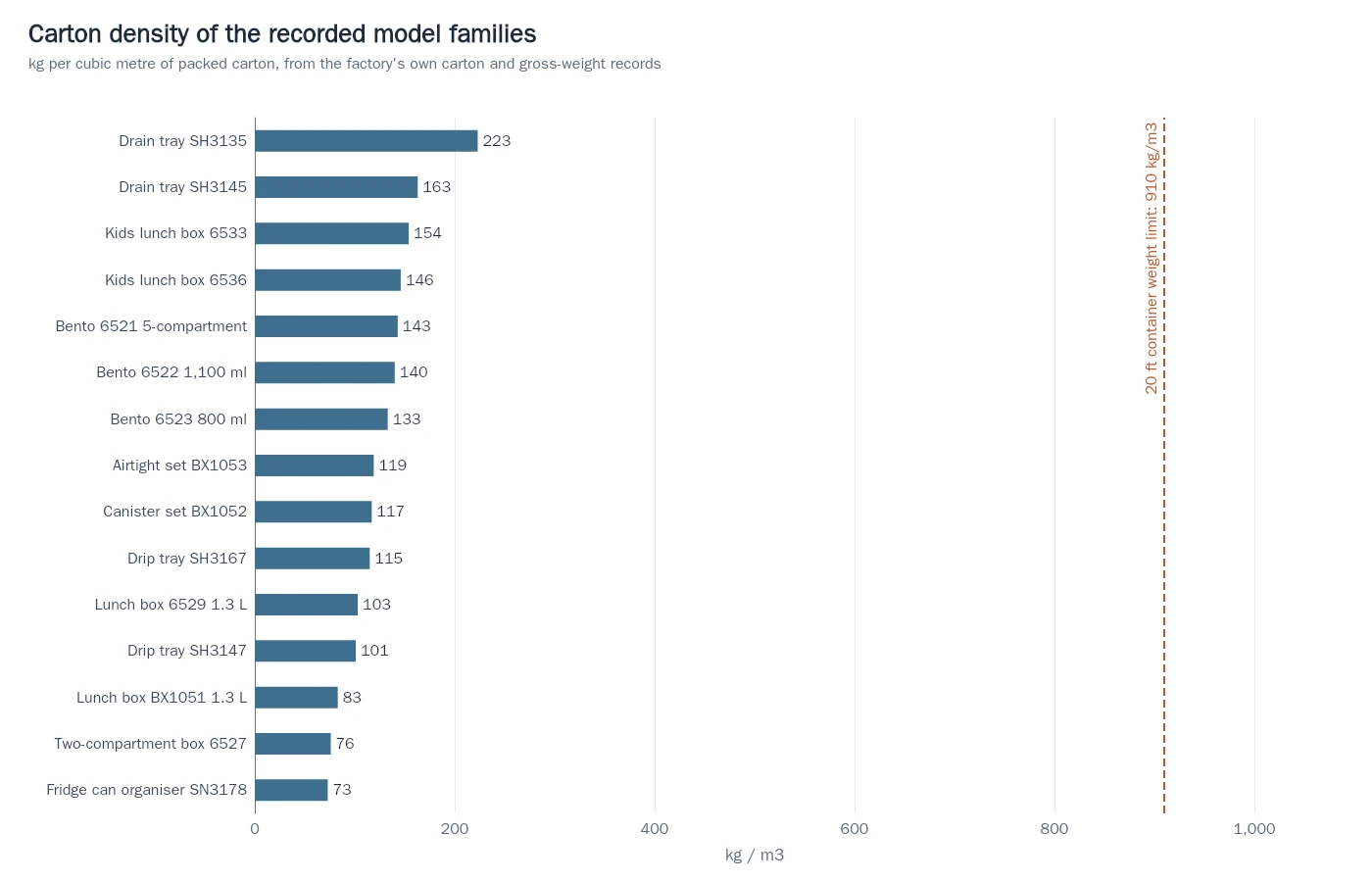
Three consequences follow, and they are the reason a mixed houseware order behaves differently from the freight-page generalities.
You will never fill a container by weight. The heaviest carton in the record is 19.5 kg; the lightest is 8.2 kg. You could load the recorded cartons until the container was physically full and still be carrying a small fraction of the payload. A houseware container is a box of air with plastic in it. Plan it as volume, and never let a weight figure talk you into a bigger box than you need.
LCL bills you on the same basis, so the comparison is apples to apples. Freight is quoted per weight-or-measure, and the carrier takes whichever is greater. At 73 to 223 kg per cubic metre, a cubic metre of houseware weighs between a tenth and a quarter of a tonne. The measure always wins. So LCL against FCL is a straight cubic-metre comparison, which is why the 13-to-15 m³ rule of thumb exists at all — and also why it is only a rule of thumb: it assumes an average density and an average carton, and neither of those survives contact with a mixed order.
The rule of thumb tells you nothing about your order. Whether your shipment lands just under or well over the threshold depends on how many cartons of each line you are combining, and the cartons do not all hold the same volume. That is the next two sections.
What a Mixed Order Actually Contains
A mixed container from a houseware factory is rarely one product. It is a lunch-box line, a storage line and a kitchen line, ordered together because one container and one set of export documents is cheaper than three — the shape of the problem the sourcing guide for food storage containers sets out from the range end rather than the shipping end. The table below is the recorded carton data for those families, transcribed as it stands in the supplier's product records — carton size in centimetres, carton volume in cubic metres, gross carton weight, and pieces per carton where the record carries a count.
Model family | Carton, cm | Carton, m³ | Gross weight | Pieces per carton |
|---|---|---|---|---|
BX1051 lunch box, 1.3 L | 62 × 47.5 × 58.5 | 0.172 | 14.3 kg | 72 pcs |
6521 bento, 5 compartments | 47 × 31 × 73 | 0.106 | 15.2 kg | 18 pcs |
6522 bento, 1,100 ml | 54 × 32 × 60 | 0.104 | 14.5 kg | 24 pcs |
6523 bento, 800 ml | 54 × 32 × 50 | 0.086 | 11.5 kg | 24 pcs |
6529 lunch box, 1,300 ml | 51 × 46 × 62 | 0.145 | 15.0 kg | 48 pcs |
6527 two-compartment box | 51 × 46 × 62 | 0.145 | 11.0 kg | 24 pcs |
6533 kids lunch box | 50 × 36 × 47 | 0.085 | 13.0 kg | 24 pcs |
6536 kids lunch box | 47 × 34 × 47 | 0.075 | 11.0 kg | 24 pcs |
BX1052 canister set | 68 × 36 × 56.5 | 0.138 | 16.2 kg | 48 pcs |
BX1053 airtight set | 61 × 30 × 57 | 0.104 | 12.4 kg | 24 pcs |
BX1094–BX1099 freezer box | 59.5 × 43.5 × 53.5 | 0.138 | not recorded | 72 pcs |
SH3147 drip tray | 66.5 × 50.5 × 44 | 0.148 | 14.9 kg | count not recorded |
SH3167 drip tray | 66.5 × 50.5 × 44 | 0.148 | 17.0 kg | count not recorded |
SH3135 drain tray | 46 × 40 × 45 | 0.083 | 18.5 kg | count not recorded |
SH3145 drain tray | 54 × 38.5 × 46.5 | 0.097 | 15.8 kg | count not recorded |
SN3178 fridge-can organiser | 61 × 39 × 47 | 0.112 | 8.2 kg | count not recorded |
Read the last two columns together and the shape of a mixed order appears. Two families can share a carton volume and still differ in packed weight by more than a third — 6527 and 6529 both ship in a 51 × 46 × 62 cm carton, at 11.0 kg and 15.0 kg. Which is the sturdier product is a conversation for the sample round; which one you are paying to move is answered right there.
The lunch-box line
Lunch boxes are the line that punishes a careless pack-out, because they are bulky for their weight and often moulded with a lid that does not tolerate being laid flat. The recorded BX1051 carton carries 72 pieces of the 1.3 L PP lunch box at 14.3 kg gross, and the bento and kids' families carry their own counts in the same field — 18 pieces for the five-compartment 6521, 48 for the 1,300 ml 6529, and 24 for each of the others. The five families whose record carries no count at all — the four trays and the fridge-can organiser — are marked that way in the table rather than filled with a plausible number.
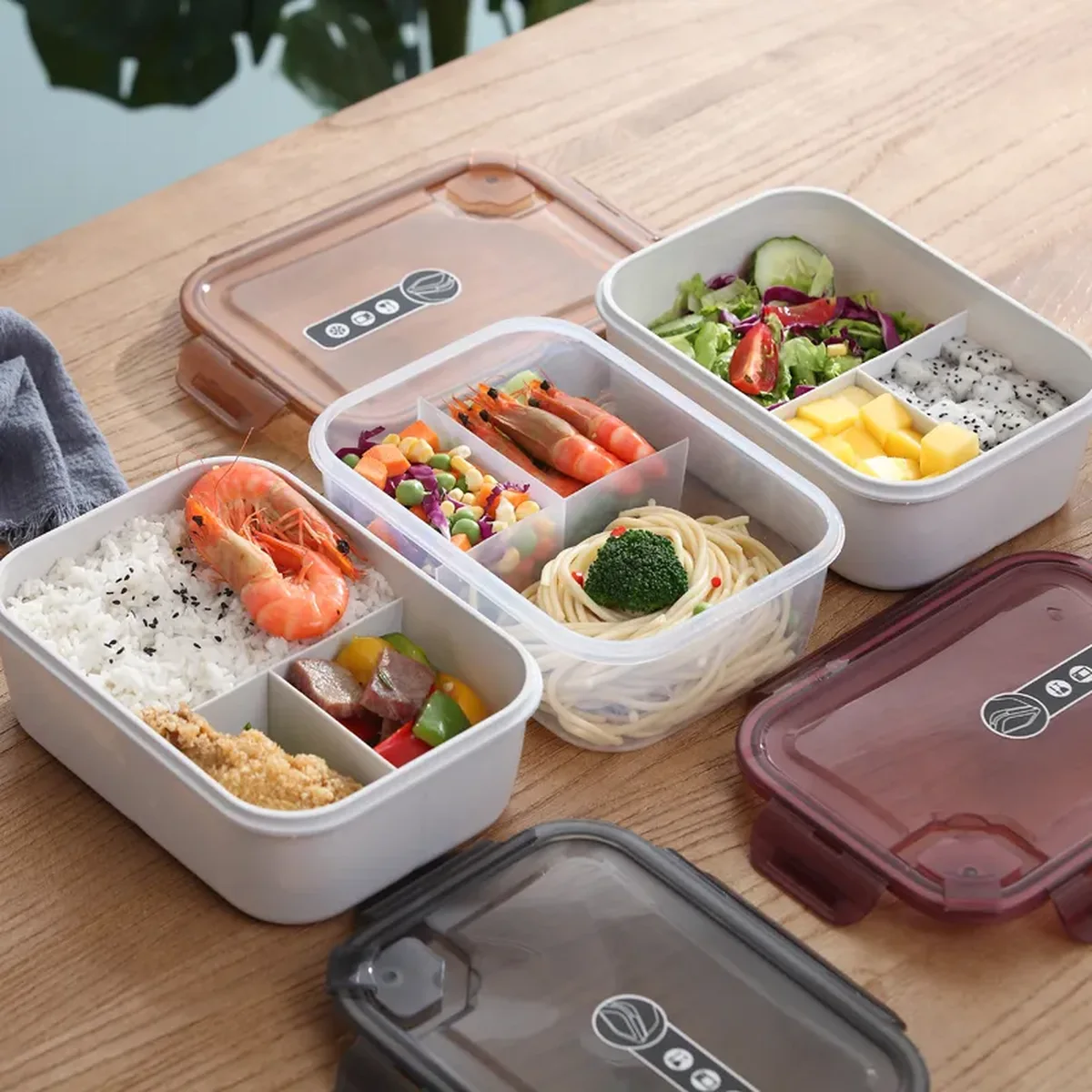
The lunch box range on the main site covers both the PP and the 304 stainless bento formats. The point for container planning is that their cartons are wide and shallow relative to their contents, which is exactly the geometry that wastes space when a container is being filled to the ceiling — a subject the SKU mix and capacity ladder piece works through for another family in the same range.
The canister line
Storage containers are the heaviest per piece in the recorded set — the record's own grammage runs 425 g for the BX1053 set and 298 g for BX1052, against 182 g for the BX1051 lunch box — because the cartons hold sets rather than singles. BX1052 ships 48 pieces per carton at 16.2 kg gross; BX1053 ships 24 pieces at 12.4 kg; the freezer family BX1094–BX1099 ships 72 pieces per carton but the record stops short of a gross weight, so its density cannot be computed from the record at all — a question for the first email, not a gap to be filled by assumption.
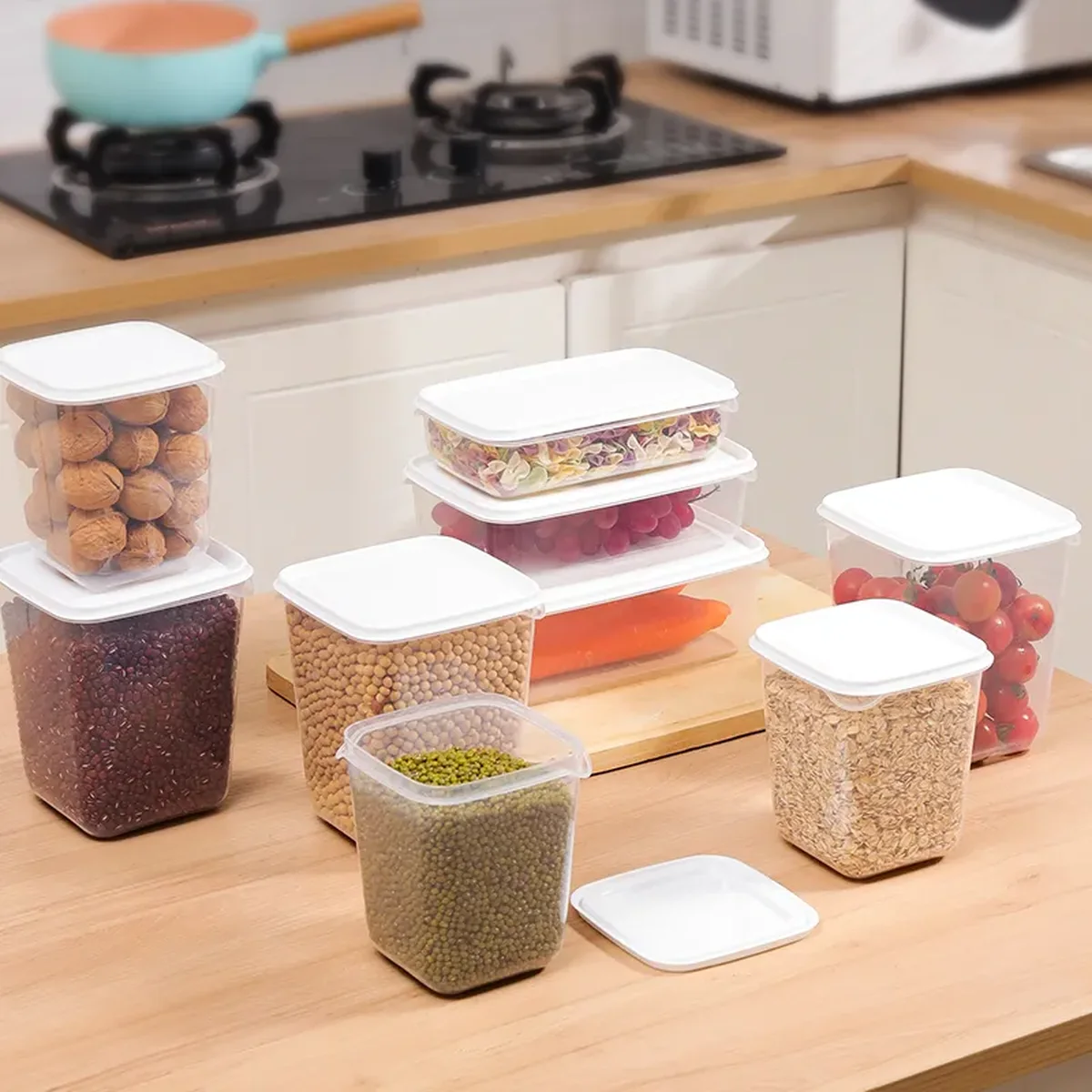
A canister set is also the line where the carton and the product disagree about the best orientation: the set stacks in use, but it ships nested, and a nested set is shorter and denser than the same set assembled. Ask for the packed height of a nested set, not the height of the canister, and confirm it against the kitchen storage container range page for the family you are considering. Which canister formats are worth a private-label programme in the first place is a demand question rather than a packing one, and the pantry canister niche ranking is where that half of the decision sits.
The drip-tray line
Drip trays are the extreme case in the range, and the useful one for illustrating the whole argument. A tray is flat and wide, so its carton is flat and wide, so a pallet of them is mostly air. The recorded SH3167 carton is 66.5 × 50.5 × 44 cm at 17.0 kg gross; SH3147 uses the same carton at 14.9 kg; the SH3135 family is the densest carton among the sixteen families tabled here, at 18.5 kg in a 46 × 40 × 45 cm box. The densest carton in the whole record is not in this range at all: a 52 × 28 × 33 cm carton holding a BH4439B ice-cube tray, 13.2 kg gross, works out at 275 kg per cubic metre.
That flatness has a container consequence you can see in the next section: a flat carton stacks well in height but badly in length, and the volume it wastes is decided by the container's internal length, not by its capacity figure.
The Floor Plan Decides, Not the Volume
Divide a container's nominal volume by a carton's volume and you get a number that looks like the answer and is not. It is the number of cartons whose combined volume equals the container's capacity, assuming the cartons could be poured in. Cartons are rigid, so the real answer comes from dividing the container's internal dimensions by the carton's, in three axes, and keeping only the whole cartons that fit.
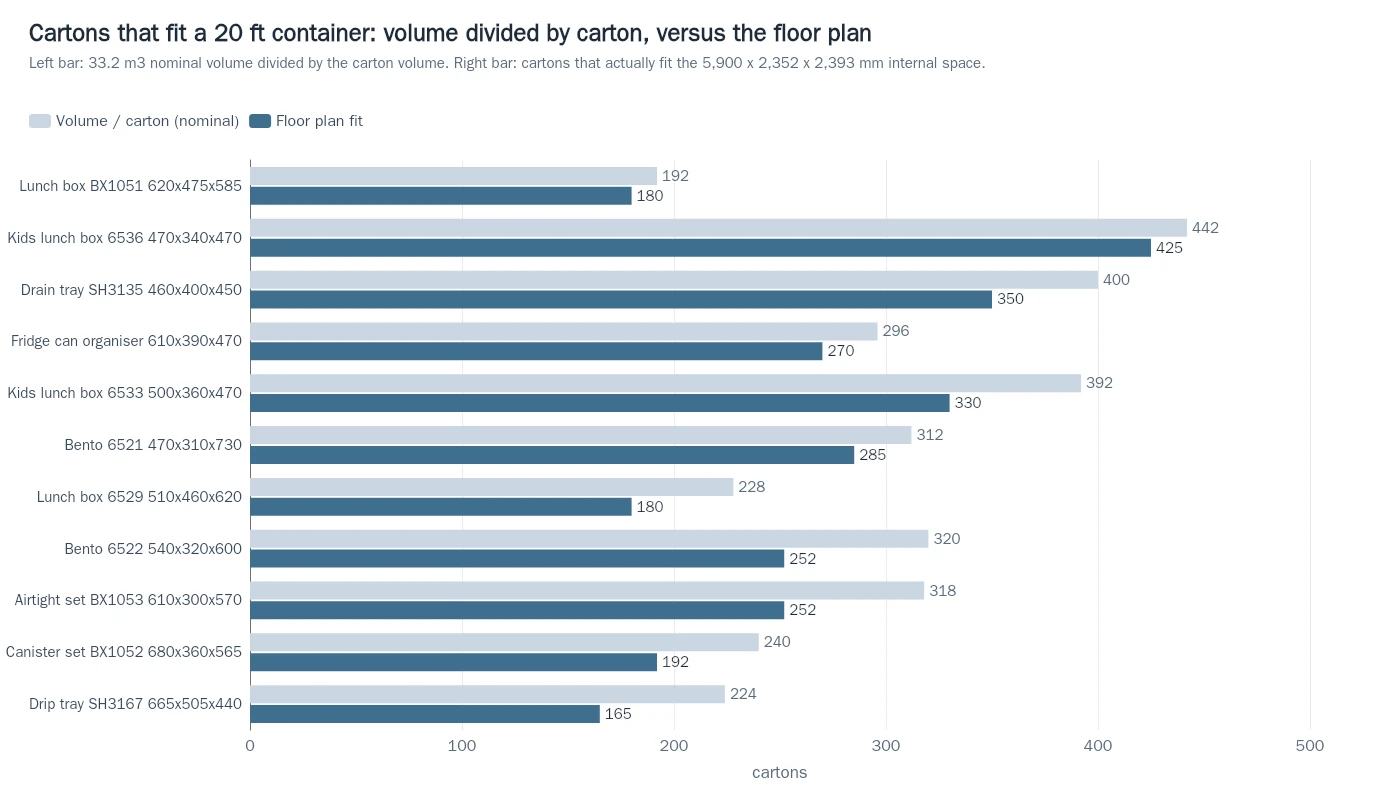
In a 20 ft general-purpose container with the published internal dimensions of 5,900 × 2,352 × 2,393 mm, the gap between the two answers runs from small to severe:
Model family | Carton, mm | By volume | By floor plan | Share of nominal |
|---|---|---|---|---|
BX1051 lunch box, 1.3 L | 620 × 475 × 585 | 192 | 180 | 93.4 % |
6536 kids lunch box | 470 × 340 × 470 | 442 | 425 | 96.1 % |
6533 kids lunch box | 500 × 360 × 470 | 392 | 330 | 84.1 % |
6521 bento, 5 compartments | 470 × 310 × 730 | 312 | 285 | 91.3 % |
6522 bento, 1,100 ml | 540 × 320 × 600 | 320 | 252 | 78.7 % |
6529 lunch box, 1,300 ml | 510 × 460 × 620 | 228 | 180 | 78.9 % |
BX1052 canister set | 680 × 360 × 565 | 240 | 192 | 80.0 % |
BX1053 airtight set | 610 × 300 × 570 | 318 | 252 | 79.2 % |
SH3167 drip tray | 665 × 505 × 440 | 224 | 165 | 73.4 % |
SH3135 drain tray | 460 × 400 × 450 | 400 | 350 | 87.3 % |
SN3178 fridge-can organiser | 610 × 390 × 470 | 296 | 270 | 90.9 % |
Two families with almost identical carton volumes land a long way apart on that table. 6521 and 6522 both hold about 0.10 to 0.11 m³ per carton, yet one reaches 91.3 per cent of the nominal volume and the other 78.7 per cent. The difference is the carton's proportions: a 47 × 31 cm footprint tiles a container floor efficiently, a 54 × 32 cm footprint leaves a wider strip of unusable floor and air above the last stack.
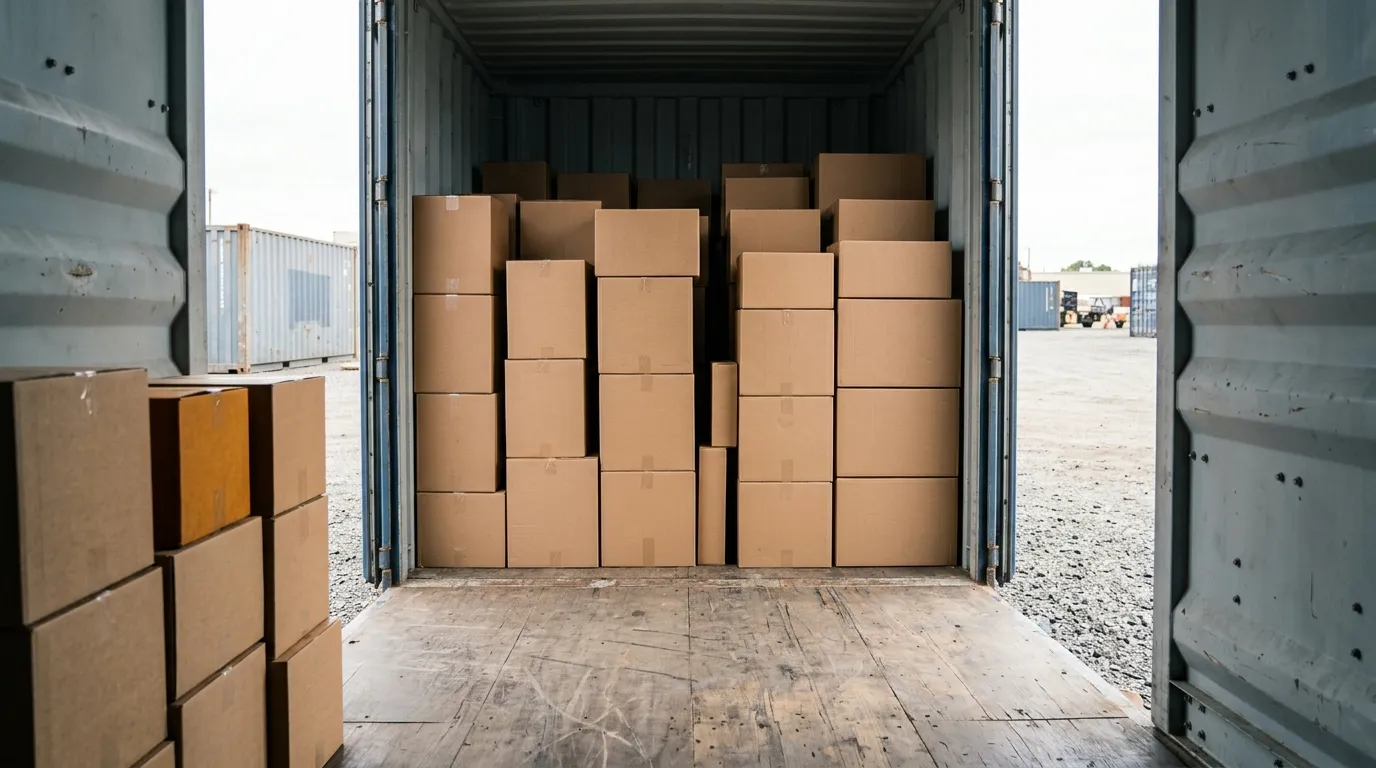
That is what a mixed order looks like before anyone optimises it: columns of different heights, gaps at the sides, and a floor plan that no single carton fits perfectly because there is no single carton. The practical instruction is not "pack tighter". It is "compute twice": once with the volume, once with the floor plan, and treat the floor-plan number as the one your landed cost is built on. Three further qualifications apply to it, and each is a question to put in writing.
- Orientation is a packaging decision, not a maths decision. The best configuration often requires turning a carton on its side. Whether you may depends on what is inside — a sealed canister set usually tolerates it, a box of loose lids may not — so it is agreed with the supplier rather than assumed by the forwarder.
- Floor loading and palletising are different plans with different fills. Floor loading reaches the numbers above. Palletising trades some of that volume for handling speed at the destination and protection from point loading, and a pallet footprint wastes more of a container floor than most first-time importers expect. Decide which you are buying before you ask for a plan.
- Every figure in this section is nominal. The carrier's own specification marks its dimensions as nominal figures subject to production tolerance, and it cites ISO 668 minimum internal dimensions that are slightly smaller than the nominal ones — 5,898 mm against 5,900 mm in length, for example. A plan that fills a container to the last centimetre has no tolerance left for the container you are actually given. Ask for a plan that leaves a working margin.
The Break-Even, in Your Own Two Numbers
With the volume known, the mode choice reduces to one line of arithmetic. LCL is billed per cubic metre (or per tonne, whichever is greater — for houseware, the cubic metre). FCL is a flat charge for the container, whatever is inside it. So the volume at which the two modes cost the same is:
break-even volume = all-in FCL charge ÷ LCL charge per cubic metre
You cannot get that number from this page, and you should be suspicious of any page that offers one, because both charges move with the trade lane, the season and the carrier. What you can take away is that the comparison is only meaningful when both sides are quoted on the same basis — all-in, door to door — because LCL carries per-shipment costs that do not scale with volume at all. Consolidation and deconsolidation at the freight stations at each end, documentation, a customs entry on each side, and the local delivery are charged per shipment. That is why the LCL per-cubic-metre figure falls sharply as the shipment grows: the fixed costs spread out, and once they have spread far enough, the flat container charge wins.
Three points of diligence belong in the same email as the quote.
Know who is consolidating. When your goods share a container, an intermediary is issuing you a bill of lading for a shipment it never physically owns, because its job is to consolidate shipments from several exporters into one box. In the United States trades that intermediary is an ocean transportation intermediary, and the Federal Maritime Commission's ocean transportation intermediaries page is where the licensing and bonding requirements for those parties are set out. Ask for the licence or registration number rather than assuming the platform that sold you the quote is the party carrying the liability.
Confirm what the minimum charge buys. Quotes for LCL shipping from China carry a minimum billable volume, and it is not the same thing as the minimum shipment a carrier will accept. Ask what the minimum is, what happens to the charge if your measured volume comes in under it, and whether measurement is by the consolidator or independently.
Price the air option honestly, or not at all. Air freight is billed on chargeable weight — the greater of actual weight and volume converted at a divisor that is a contract term, not a constant. On houseware at 73 to 223 kg per cubic metre, the volume almost always governs, so the divisor your forwarder applies decides the bill. For a shipment that has to move because a retail window is closing, the comparison is not LCL against FCL at all; it is LCL against a chargeable-weight calculation, and the two are not comparable until that divisor is on the table.
Where a Mixed Order Quietly Loses the Volume It Paid For
The sections above get you a number. These are the ways a mixed order gives part of it back, all of them visible in the recorded data.
A set is not a single unit, and its carton is not its stack. A three-piece canister set ships nested, which is shorter than the assembled set — BX1053 is recorded at 24 pieces per carton and 12.4 kg, while the larger BX1052 set runs 48 pieces at 16.2 kg. Two similar-looking programmes, two very different cartons. Stacking, nesting and the carton arithmetic is worth reading before you agree the pack-out, because the nested height is what your container plan is actually built from.
The piece count is not the shipment. A mixed order is counted in cartons, and eleven of the sixteen recorded families carry a piece count in their carton record at all. If your purchase order is written in units rather than cartons — a figure in the tens of thousands for a lunch-box line is ordinary — convert it before you talk to anyone about mode, and ask the supplier for the five counts that are still missing. Whether MOQ is counted per order, per colour or per model decides the same conversation from the other end, and getting both answers in writing prevents the most common first-order surprise: a container plan that no longer matches the order that was actually placed.
A mixed SKU list multiplies the carton marks and the paperwork. Six lines in one container means six sets of carton marks, and often six label artworks, all of which have to be right before the first carton is sealed. The FBA prep, labelling and photography piece covers what has to be signed off, and if any of the lines are being packed for a fulfilment centre rather than a warehouse, that review belongs in the same round as the loading plan.
The seal is the thing the volume plan assumes. A carton that has to be stacked five high is a carton whose lid must not pop under load. This is not a container question, it is a sample question, and it is answered with a full carton, not an empty one — the seal structure and sample testing method covers how to run it. The signed reference for that sample is what the golden sample process is for.
What to Ask the Factory Before You Book the Sailing
Cut the request list down and it fits in one email. Ask for these six things per model, in writing, and the mode decision answers itself.
- Packed carton dimensions in centimetres, per model, as packed — not the carton of the range, and not the assembled product size.
- Gross carton weight, per model, with a note of what the figure includes (product, retail box, carton, divider). The record itself flags carton weight and carton size as scope-dependent, which is a hint to confirm the basis rather than to trust the first number.
- Pieces per carton, per model, and how a set is counted — one set as one piece, or the component pieces.
- Whether the carton may be laid on its side or on its end for loading, and which orientation is the reference.
- How a nested set is packed, including the packed height and whether the set ships nested or assembled.
- A packing list with the fields filled in — carton count per model, gross weight, and the carton marks — plus a sample loading plan that leaves a working margin in it, so the marks and the plan can be reviewed together.
If any line in the order will carry a food-contact or use claim on its packaging, the document pack belongs in the same request: the supplier's food-contact documentation for the exact polymer and colourants in the model and colour being bought, and a declaration of compliance that names the regulation where one applies. Polypropylene is regulated in the United States under 21 CFR 177.1520, olefin polymers, and the FDA's Food Ingredients & Packaging pages are the entry point to the framework those documents have to answer to; for the European Union, Regulation (EU) No 10/2011 is the text a plastic declaration is written against. These are questions to put to a supplier, not claims about any supplier's certificates, and the document map for a food container order lists what each pack contains. For container dimensions used as constraints, the carrier's own specification is the right source — the Hapag-Lloyd container specification is the one this page's figures come from.
The Worksheet, in the Order the Decisions Have to Be Made
- Convert the order to cartons. Units ÷ pieces per carton, per model. Get the missing piece counts.
- Compute carton volume and density. Length × width × height in metres, and gross weight ÷ that volume. Anything between 70 and 230 kg per cubic metre is normal for this category and means weight will not decide anything.
- Total the volume, then run the floor plan. Multiply cartons by carton volume for a first figure, then do the three-axis division against the container's internal dimensions. The second number is smaller, and it is the one to plan on.
- Price both modes all-in. LCL per cubic metre plus the per-shipment costs at each end, against the flat FCL charge. Compare like with like or the answer is noise.
- Run the volume against the break-even. If your total sits near it, the deciding factor is the fixed cost stack, not the cargo.
- Fix the sample and the pack-out before the container is booked. Orientation, nested height, carton marks and seal performance, all against a signed reference.
Run those six and the mode is not a judgement call any more; it is subtraction. That is the whole reason the carton record matters more than the freight quotation on a mixed order: the quotation prices your shipment, and the carton record defines it.
If the order is a mix of these lines and you want the recorded carton figures per model — dimensions, gross weights and piece counts as they stand — they sit on the product pages for the lunch box range, the kitchen storage containers and the drip tray line, and a mixed order with a loading plan attached is what the procurement and shipment planning service exists for.
Continue reading
Related sourcing guidance
More practical context for your food storage container sourcing conversation.


Discuss your product range
Need help selecting or customising containers?
Share the product type, market and sourcing requirements with the Xinghui team.