
Food Storage Containers
Retail Packaging for a Private-Label Food-Storage Set: Hangtag, Multi-Language Label, Retail Barcode and the Artwork Approval Loop
How the packaging side of a private-label food-storage set gets approved: hangtag versus label, language areas, retail barcode ownership, carton marks.
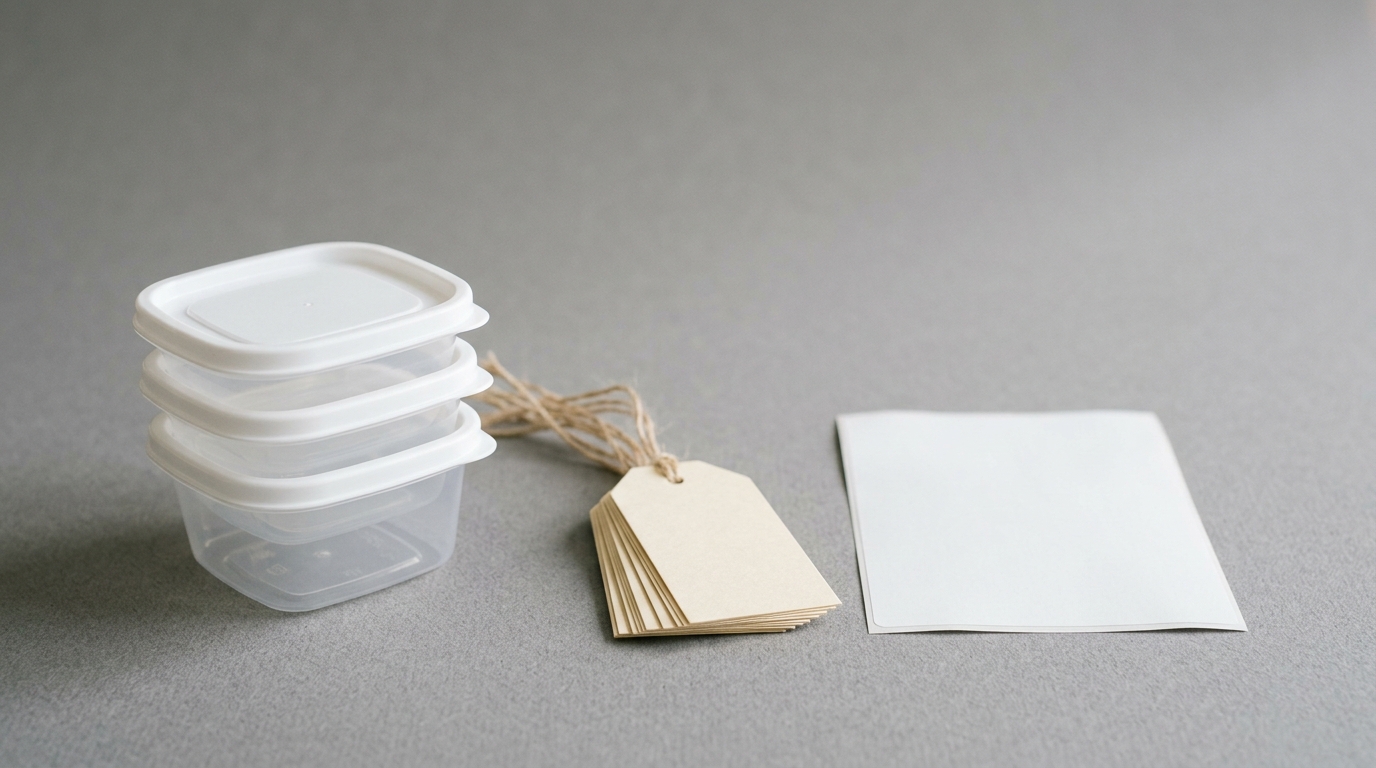
Private label packaging is usually planned as a design task and then executed as a print order, and those two views are where programmes go wrong. On a food-storage set the design question is small — a hangtag or a label, a few languages, a barcode — while the execution question is the one that sets the timeline: which of those decisions has to be settled, in what order, before a print plate is cut and the packing line is asked to stop.
The cost of getting the order wrong is not the label. It is the round trip. A pressure-sensitive label costs a few cents; re-cutting the plate, re-printing the carton and re-running the line because the artwork moved after approval costs weeks, and it costs them at the point where the order has to ship for a retail window. Almost every packaging failure a brand owner experiences on a first private-label order is a sequencing failure, not a printing failure.
So this page works the packaging side the way the decisions actually have to be made. It starts from what a factory's own product record does and does not tell you about the pack, uses the recorded packing data behind 63 food-storage and houseware models to show the difference between a retail pack and a carton count, and then walks the three artwork routes, the surface each of them has to survive on, the language and barcode decisions, the master carton nobody reviews, and the approval loop itself — in the order it has to happen, with the artefact that closes each step.
The Only Thing a Product Record Cannot Do for You
Start with what the record already gives you. A factory that publishes carton sizes, gross weights and capacities has handed you most of the physical constraints of your retail packaging programme before you have asked a single question. What it has not given you is the retail pack, and the reason is worth understanding before you write the brief: in a factory product record, the packing field is usually doing two different jobs at once.
Across the 63 product records behind our houseware lines, nine leave the packing field empty, twenty-nine name a packaging format and give no piece count at all, and twenty-five carry a numeric piece count; two of the twenty-nine read simply "Carton". Counted across all 63 records, the formats are recorded in the language of the packing line rather than the language of retail: OPP Packing appears fourteen times, OPP Bag eleven times, Color Carton four times, "Paper bid" four times, "Paper-based bidding" four times and "OPP Bag + Color Carton" four times, with "Carton" twice and one instance each of Kraft Paper Box and Color Box Packing. Of those, "OPP Bag + Color Carton" is the only wording in the data that names both an inner bag and a printed carton — the closest thing the records hold to a retail pack, and it sits on four lunch-box models. Several records carry two values in the same field, an inner format and a carton count stacked in one cell. The chart below counts only the twenty-nine records that name a format and give no count, so its integers sit below those totals.
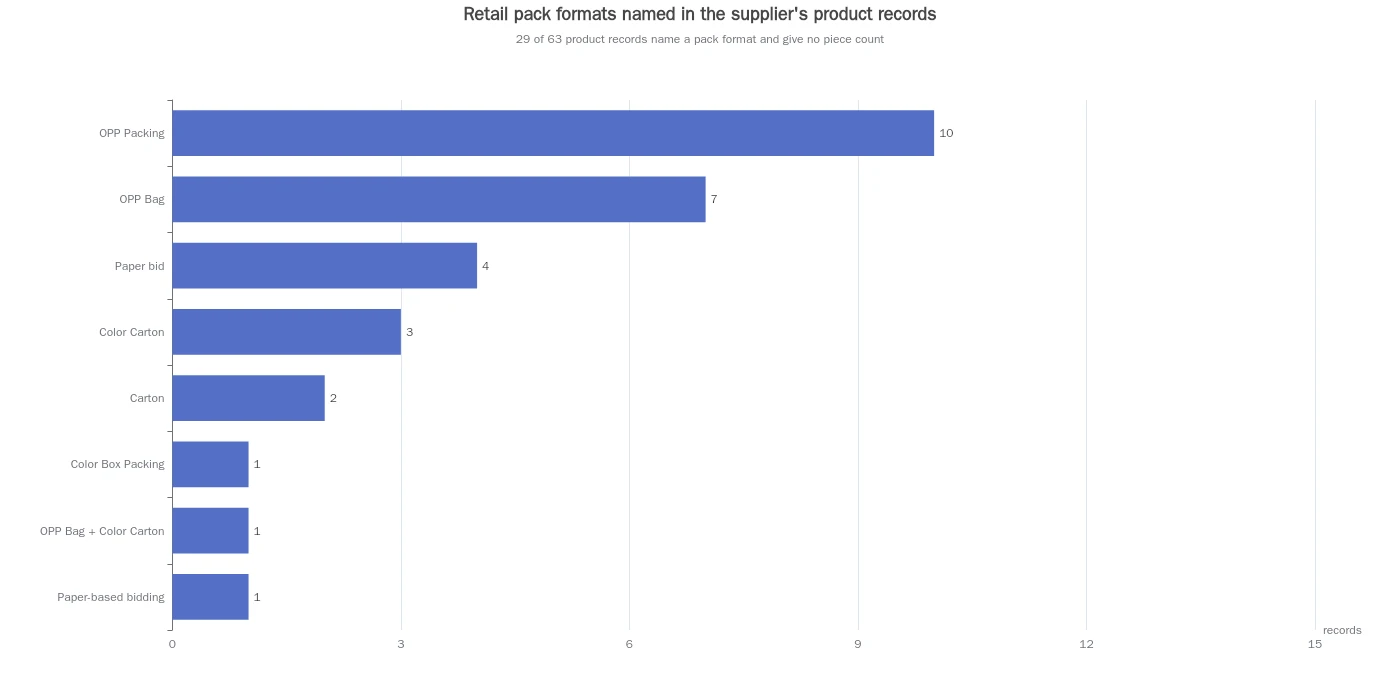
That is not sloppiness. It is the field answering whichever question the person filling it happened to have. "OPP Bag" is an answer about what the goods are bagged in on the line. "72pcs" is an answer about how many units go in a carton. For a wholesale order they are interchangeable. For a private-label programme they are not, because the bag is the thing sitting on a shelf and the count is the thing sitting on a pallet — and a private-label order needs both to be stated, per model, in writing.
The practical consequence is that your packaging brief should not be written as a blank sheet. It should be written as a delta against the pack the record already describes. If the record says OPP Bag and the brand needs a folding carton with a window, the brief is "change the inner pack from an OPP bag to a printed carton, per model, with the carton flat size confirmed" — one instruction, one approval, one cost line. If the brief instead says "retail packaging, please advise", the factory has to guess which of nine recorded formats you meant, and the guess gets made somewhere between the quotation and the tooling.
Two columns of the same record carry the constraints that will decide what your retail pack can physically be. The table below is the recorded data for the families a private-label storage programme most often starts from, transcribed as the records stand, including the cells the records leave blank.
Model | Material as recorded | Capacity as recorded | Pack format named in the record | Pieces per carton | Master carton, cm | Gross carton weight |
|---|---|---|---|---|---|---|
BX1051 lunch box | PP+Silicone | 1.3 L | not recorded | 72 | 62 × 47.5 × 58.5 | 14.3 kg |
BX1052 canister set | PP+Silicone | not recorded | not recorded | 48 | 68 × 36 × 56.5 | 16.2 kg |
BX1053 airtight set | PP+Silicone | not recorded | not recorded | 24 | 61 × 30 × 57 | 12.4 kg |
BX1094–BX1099 freezer set | PP | 1.4 L | not recorded | 72 | 59.5 × 43.5 × 53.5 | not recorded |
3332 kitchen container | PP | not recorded | Paper-based bidding | 56 | 64 × 49 × 56 | 16.1 kg |
3334 tall container | PP | not recorded | Paper-based bidding | 80 | 59 × 56 × 65 | 14.7 kg |
6521 bento, 5 compartments | PP+silicone+stainless steel 304 | 1,400 ml | OPP Bag + Color Carton | 18 | 47 × 31 × 73 | 15.2 kg |
6522 bento | PP+silicone+stainless steel 304 | 1,100 ml | OPP Bag + Color Carton | 24 | 54 × 32 × 60 | 14.5 kg |
6523 bento | PP+silicone+stainless steel 304 | 800 ml | OPP Bag + Color Carton | 24 | 54 × 32 × 50 | 11.5 kg |
6527 two-compartment box | PP+silicone+stainless steel | 1,300 ml | OPP Bag | 24 | 51 × 46 × 62 | 11.0 kg |
6529 lunch box | PP+silicone | 1,300 ml | OPP Bag | 48 | 51 × 46 × 62 | 15.0 kg |
6533 kids lunch box | PP+silicone+stainless steel | 1,100 ml | OPP Bag | 24 | 50 × 36 × 47 | 13.0 kg |
6536 kids lunch box | PP+silicone+stainless steel | 1,100 ml | OPP Bag | 24 | 47 × 34 × 47 | 11.0 kg |
XS3625 soap dish | PP | not recorded | not recorded | 240 | 57 × 45.5 × 46 | 18.3 kg |
8842 soap dish | HIPS | not recorded | not recorded | 160 | 70 × 33 × 44 | 16.5 kg |
8843 soap dish | HIPS | not recorded | not recorded | 80 | 71 × 38 × 49 | 18.8 kg |
SH3175 storage rack | PP+ABS | not recorded | OPP Packing | 16 | 53 × 43 × 71 | 17.5 kg |
BX1069 ramen bowl | PP+Silicone | 1,200 ml | Kraft Paper Box | 60 | not recorded | not recorded |
BX1021–BX1029 glass set | High Borosilicate Glass+Plastic | 320–1,040 ml | Color Box Packing | not recorded | not recorded | not recorded |
6639 insulated lunch box | PP+silicone+stainless steel 304 | not recorded | Color Carton | not recorded | not recorded | not recorded |
SH3185 glass pitcher | PP+Glass | 2,200 ml | 1 pc in a box, 24 pcs/ctn | 24 | 62.5 × 39 × 74 | 13.0 kg |
SH3167 drip tray | plastic(PP) | not recorded | OPP Packing | not recorded | 66.5 × 50.5 × 44 | 17.0 kg |
SN3178 fridge-can organiser | plastic(PP)+silicone | not recorded | OPP Packing | not recorded | 61 × 39 × 47 | 8.2 kg |
BH4439B ice-cube tray | PP lid + PP & TPE inner grid + PS bottom | not recorded | OPP Packing | 180 | 52 × 28 × 33 | 13.2 kg |
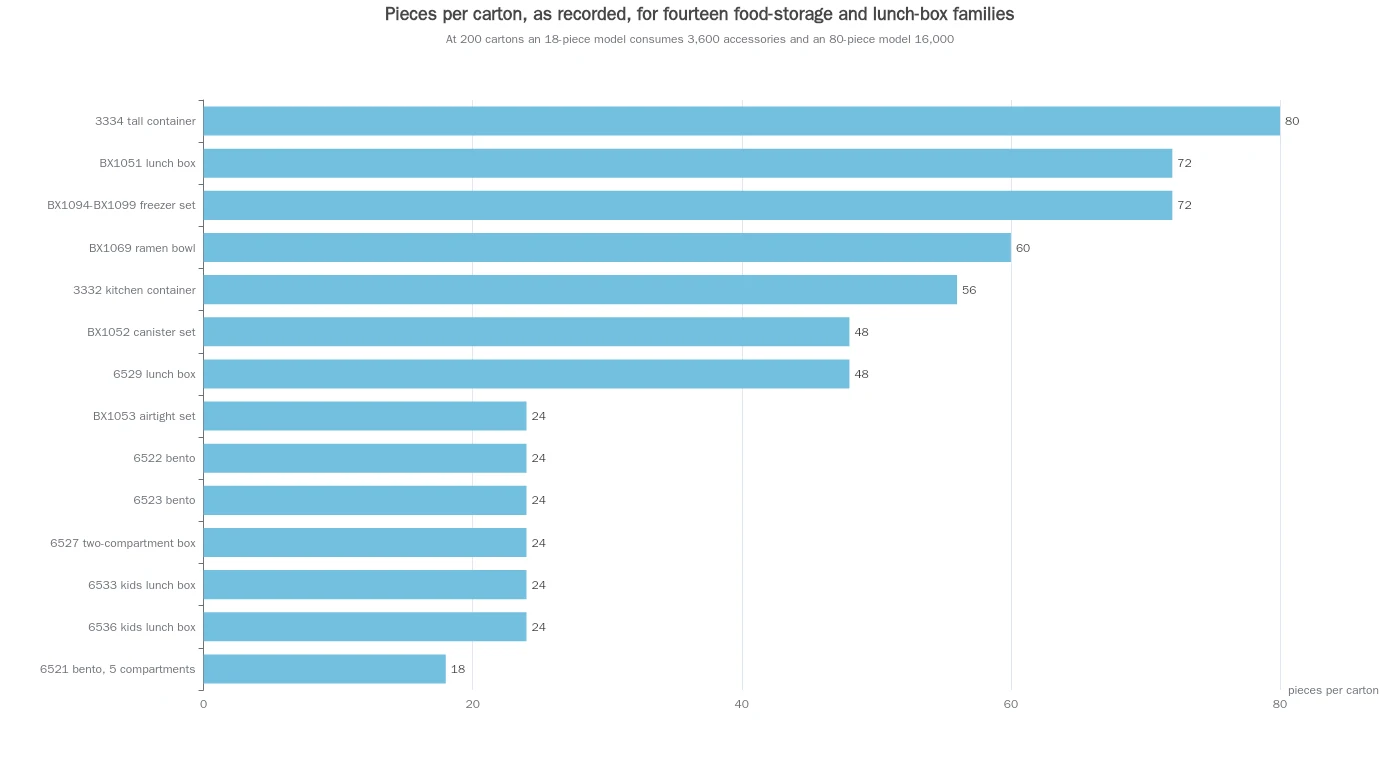
Read the pieces-per-carton column and the format column together and the shape of a private-label brief appears. Twenty-four pieces per carton means twenty-four retail packs, and therefore twenty-four retail cartons, twenty-four hangtags or twenty-four applied labels, per master carton. At two hundred cartons that is nearly five thousand of a component nobody costed in the first email. Getting the number wrong in either direction is worse than getting it approximately right: under-order and the last cartons ship unlabelled, over-order and you pay to store printed artwork for a model you may not repeat.
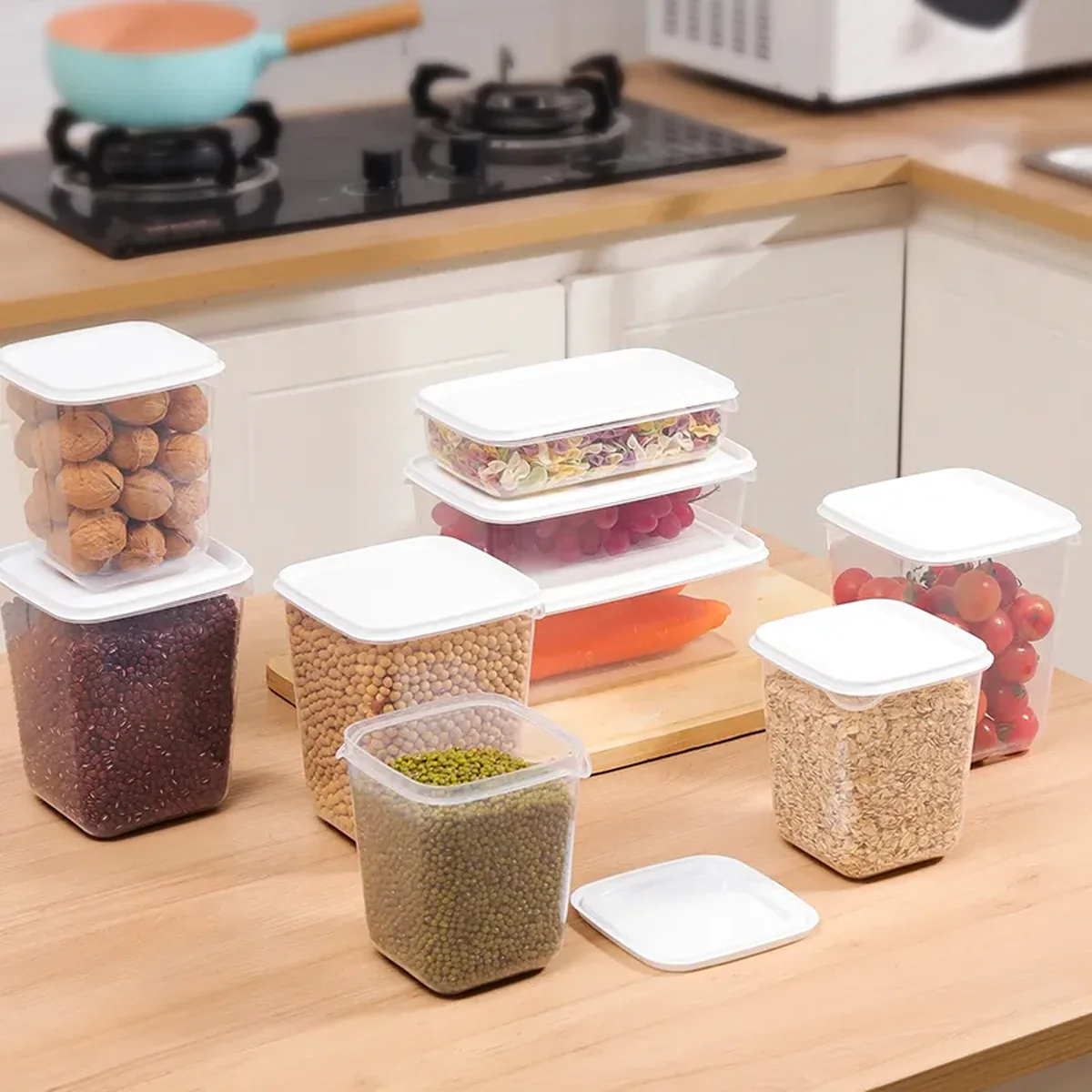
The kitchen storage container range is where those canister and tall-container families sit as ranges rather than as records, and the packaging tips for kitchen storage containers piece covers what changes on the consumer side once the pack is decided.
Three Routes for Private Label Packaging Artwork: Hangtag, Label or Print in the Mould
Every private-label set lands on one of three routes, and the routes differ less in how they look than in what each one locks up. A product hang tag is a loose component. A pressure-sensitive label is a component bonded to a surface. Print in the mould or on the part is a change to the product itself. That last distinction is the one that decides your options later, because a printed part is a tooling decision, and tooling decisions are the slow ones.

Route | Where the artwork lives | Who applies it | What it locks up | What it cannot do | What changes if you revise it |
|---|---|---|---|---|---|
Paper hangtag | A loose tag on twine or a plastic loop | Hand-applied, usually after moulding and before bagging | An accessory order, a tag stock, a print run | Cannot carry a scannable retail barcode reliably, because a hanging tag is not a fixed surface | Reprint the tags; the product is untouched |
Pressure-sensitive label | Bonded to a flat or gently curved face of the part or its lid | In-line applicator or by hand, depending on the line | Label stock, adhesive for the substrate, an application station | Cannot wrap a compound curve without wrinkling, and will not hold on a silicone or TPE face | Reprint the labels; the product is untouched |
Print on the part (pad, silk screen, heat transfer) or in the mould (in-mould label, moulded-in mark) | Inked onto a moulded surface after moulding, or fused with the part in the tool | A print station with a fixture per model, or nobody — an in-mould mark arrives with the part | A print fixture per model per colour, plus ink and cure, or a mould insert or a new tool | Cannot be revised after production: printed parts are scrap or seconds, and an in-mould mark cannot be changed without changing the tool | Reprint the fixture's output; or a new insert or tool, and a new sampling round |
The table is the argument for keeping the brand mark and the barcode apart. Put the brand mark on the part only when the volume justifies a dedicated tool, because that is the only route where a change of mind becomes a change of mould. Put the variable, market-specific and legally-loaded material — the barcode, the language block, the importer line, the capacity statement — on a component that can be reprinted on its own, because those are the elements most likely to change between the first order and the third.
Two physical constraints cut across all three routes and are worth confirming before the brief goes out. The first is nesting. A canister set ships nested, which is shorter and denser than the same set assembled, and an accessory that sits inside or between nested parts can change the packed height — the stacking and nesting arithmetic is where that interacts with your carton. Ask for the packed height with the accessory present, not the height of the part alone. On a compartment lunch box the dividers and the lid are part of the pack the tag has to live alongside, not free space beside it.
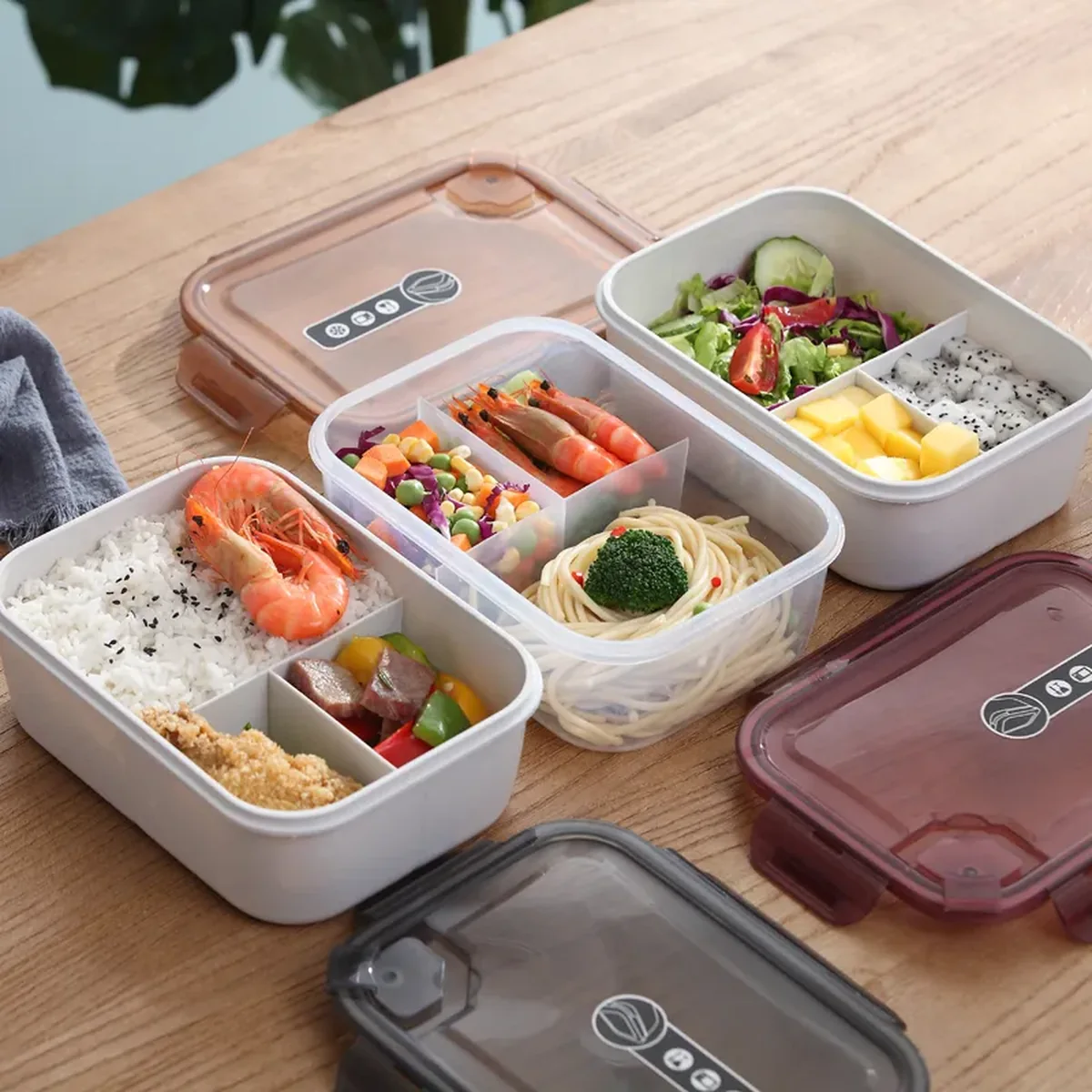
The second is that the accessory has to survive the pack. A tag applied before the set is bagged sits inside the bag; a tag applied after sits outside it and takes the handling. Which one you get depends on the line, and the answer belongs in the same written brief as the label, alongside whatever else has to be reviewed before the first carton is sealed — the labelling, carton prep and product photography sequence runs through that review for marketplace-bound orders. If the product carries a use claim, the tag is also where the claim wording is fixed, and a claim on printed material is part of the product specification rather than a design nicety — the seal structure and sample testing method is how the underlying performance gets established before anything is printed.
The Surface Decides What the Artwork Can Be
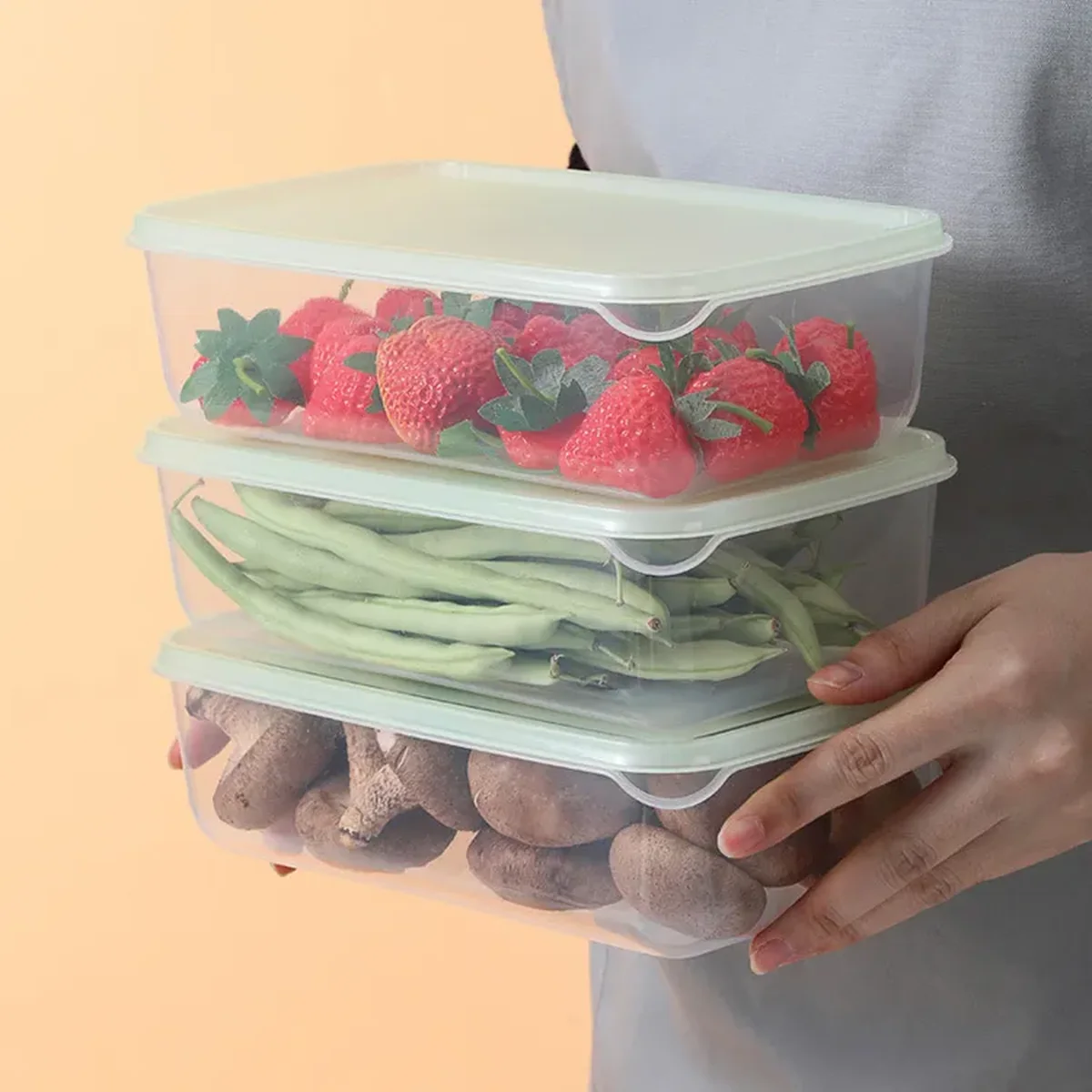
Artwork is approved as a design and printed onto a material, and the material has the final say. This is where a packaging plan written for one product line quietly fails on the next, because a set is rarely one material. The 62 material fields in the product records group into nine families, and the largest by a wide margin is polypropylene — alone or with a silicone seal — with a smaller group running a 304 stainless insert and a handful carrying glass, PS or HIPS components.
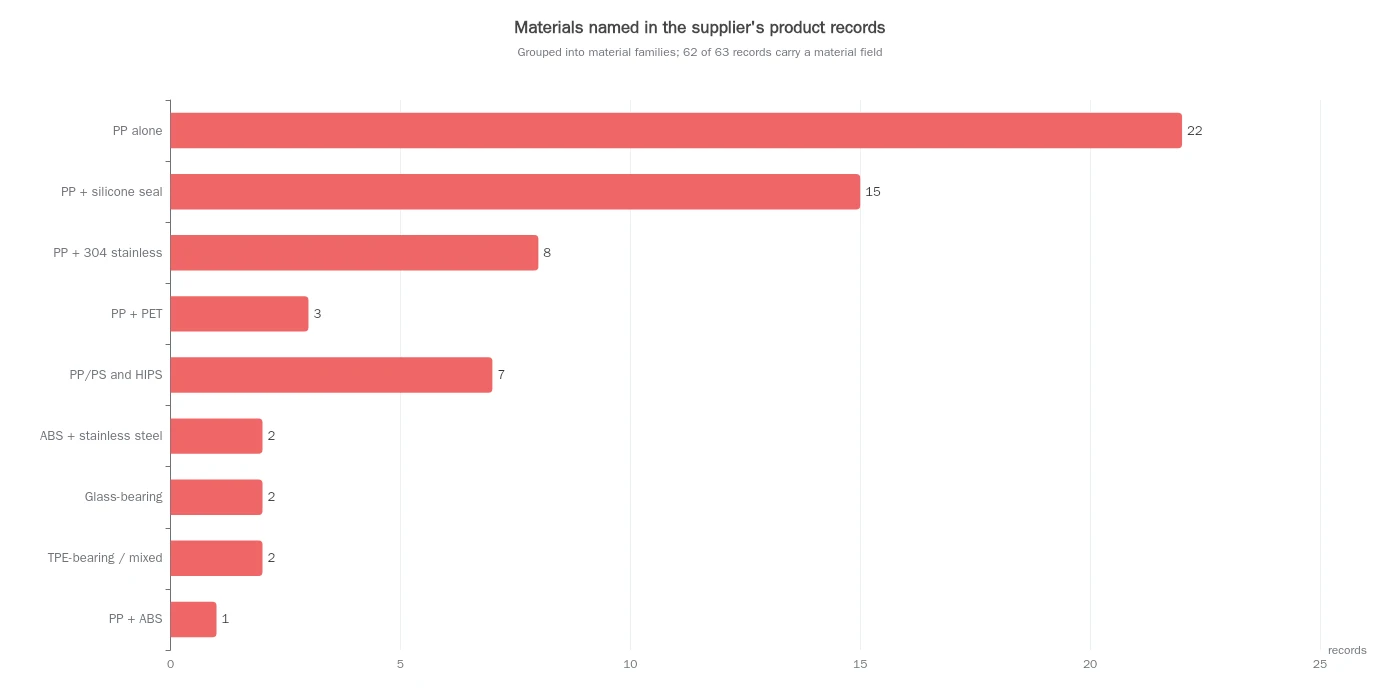
Material, as the records word it | Where it appears on a set | What the artwork has to do about it | What to confirm in the brief |
|---|---|---|---|
PP alone | Bodies, lids, trays, single-piece containers | Takes a label or a pad-print well; a low-energy surface, so adhesive choice is a real decision, not a default | Which face is flat enough for the label, and whether the label sits across a mould seam |
PP + silicone seal | The gasket inside a lid or the seal ring on a canister | The seal is not a print surface and will reject most adhesives; branding has to sit on the PP part or on a loose tag | Whether the gasket is fitted before or after the label station |
PP + 304 stainless insert | An inner tray, a divider or a lunch-box compartment | The metal takes print with the right pre-treatment, but a label on a metal face can lift at the edge where the part flexes | Whether the printed element is on the metal or on the PP surrounding it |
PP + PET, PP + PS, HIPS | Glossy, rigid bodies and lids on storage and houseware lines | Gloss surfaces hold a label well but show any trapped air; a clear label over a gloss body shows the substrate through it | Whether the label is clear or opaque, decided against the actual body, not a swatch |
ABS + stainless steel | Racks and shelves | Same metal caveat as above, on a part that is often packed assembled rather than nested | Whether an assembled pack changes the carton size |
Glass-bearing | Glass pitchers and glass storage sets recorded with a plastic lid | Glass is a good label surface with a glass-specific adhesive; many glass programmes ship with a printed sleeve or box instead | Whether the artwork is on the glass or on the box, and who prints the box |
TPE-bearing or mixed multi-polymer | Ice-cube trays and organisers with a TPE grid | Same low-energy problem as silicone on the elastomer, none of it on the rigid part | Which polymer each graphic element actually lands on |
The one-line version: decide the label's substrate and the surface it lands on in the same sentence. A colour approved on a coated paper hangtag is not the colour you get on a translucent PP lid, and a label approved on a flat body panel is not the label that survives a flexible stainless insert. This is also the point where the packaging decision reaches back into the product: if the answer to "which face is flat enough" is "none", the options are a hangtag or a mould change, and a mould decision is a different conversation with a different lead time — what can change on an existing mould sets out where that line sits, and reading an injection mould quote is where the cost of crossing it becomes visible.
How Many Languages, and on Which Piece of the Pack
Multi-language labels are normally costed as a printing expense. They are more usefully costed as a multiplication of the approval loop. One SKU in three languages is not one artwork printed three times; it is three artworks to proof, three revision histories to keep straight, three text blocks to check against the source copy, and three chances that a correction lands on the wrong file. The plate cost is the small number. The approval capacity is the large one.
The first decision is not how many languages but where each language block lives, because the pack has three or four printed surfaces and they are not interchangeable. The table below is the working allocation, and the two right-hand columns are the ones that cause the delays.
Information element | On the retail unit | On the inner pack | On the master carton | Who has to supply the text | What is late if it is not ready at the brief |
|---|---|---|---|---|---|
Brand and product name | Yes, required | Usually | Usually | The brand owner | Nothing downstream starts |
Capacity or net content statement | Yes, required | No | Optional | The brand, from the confirmed capacity | The unit artwork cannot be finalised |
Material identification | Yes, where the market or the retailer asks for it | No | No | The factory, from the bill of materials | The material line changes and the artwork is re-proofed |
Care and use symbols | Yes, required | No | No | The brand, against the confirmed material set | Symbols get chosen per material, so this waits on the material decision |
Country of origin | Yes, where the market requires marking | No | Yes, on the shipping container marking | The factory, with the brand confirming how it is worded | Carton printing waits, and the carton is the longer lead |
Importer or distributor line | Yes, where the market requires it | No | Optional | The brand's own legal entity details | The unit artwork cannot be finalised |
Retail barcode | Yes, required | No | A separate carton-level code | The brand, from its own GS1 prefix | See the next section |
Batch, date or traceability code | No, unless the retailer asks | No | Yes, as a variable field | The factory | Nothing, if it is a variable print field rather than pre-printed |
Carton quantity and gross weight | No | No | Yes | The factory, from the packing list | The carton mark proof slips to the end of the line |
Two points in that table are worth pulling out. The language block is where the market's own requirements act on the artwork, and the rule most often misapplied here is a food-law rule rather than a packaging rule: the language obligation people quote comes from Regulation (EU) No 1169/2011 and its subject is information about food, not the printed matter on an empty storage container. Assuming a container label inherits a food label's language and content requirements is one of the reliable ways to stall an artwork review — the reviewer is waiting for food information that the product record does not contain, because it is not a food label.
The second is that the carton carries the longest-lead print. Flexographic carton printing and pre-printed cartons are ordered against a confirmed text block, and that block is the last thing to be finalised because it depends on the packing list. If the carton text is treated as an afterthought, the carton becomes the critical path. The SKU mix and capacity ladder piece shows how the same multiplication bites on the product side of a first retail order, and the count that drives which SKUs get their own artwork in the first place is the same count that decides how MOQ is counted per colour or per model.
The Barcode Is Yours, Not the Factory's
A retail barcode is not a graphic the printer can generate. A GTIN is allocated to the brand owner, because the identifier belongs to whoever is selling the product: GS1 issues the number through a company prefix assigned to the business that registers for it, and a factory cannot legitimately supply a code for a product that is not its own. GS1's Global Trade Item Number page is the reference for what the number identifies, and its barcode guidance covers how a business obtains a prefix in the first place. Practically, if the brand's barcode has not been allocated before the artwork is laid out, the artwork is not ready — a placeholder barcode is how a first print run gets thrown away.
The technical rules are the printer's and the retailer's, not the designer's: bar height, quiet zones, colour contrast and the amount of curvature a symbol can tolerate are specified, and the GS1 barcode standards page is the entry point to the core document that defines them. Two consequences reach the artwork directly. First, barcode placement is a design decision with a hard constraint — the symbol needs a clean, flat-enough panel with clear space either side of it, and on a set with curved canister walls that panel may only exist on the lid or on a carton, which is why barcode placement is settled before the layout rather than after. Second, the carton code is a different code: the unit carries the retail GTIN, and a shipping carton is a logistic unit, which GS1 identifies with its own key rather than a copy of the unit's number.
This is also where claim wording and the barcode meet. If the label carries a use claim, the claim is a product specification with a document behind it, and the claim wording and the contract clauses that should attach to it are worth settling in the same round as the barcode, because both are printed once and read forever.
The Master Carton Carries a Second Label Nobody Reviews
The unit label gets a review. The carton mark usually does not, and the carton is the piece read by two audiences the brand owner never meets: the warehouse that receives it and the customs authority that clears it. It is a separate print, on a separate substrate, against a separate approval — which is exactly why it slips.
For a US import, the marking rule is not a retailer preference. The country-of-origin marking requirements come from section 304 of the Tariff Act of 1930 and are implemented in 19 CFR Part 134, where the same part defines "country of origin" and identifies the "ultimate purchaser" as generally the last person in the United States to receive the article in the form in which it was imported. Those definitions matter to the artwork because they determine where a marking has to be legible: a marking aimed at the wrong party in the chain does not satisfy the purpose the rule is written for.
What belongs in the master carton markings is therefore a short list — a shipment mark, the model or SKU, the quantity, the gross weight, a batch code, the origin marking and any handling pictograms the route requires — and it is worth confirming the whole list against the packing list rather than the artwork file. The document map for a food container order is the page that pairs each block of that list with the document that substantiates it.
The documents that travel with the label, not on it
One thing that should never move onto the carton or the unit label is a compliance claim. Food-contact compliance is documented, not printed, and the documents are asked for by name. In the United States, the framework is the FDA's oversight of substances that come into contact with food, including materials in containers that store food, with the specific basis for polypropylene set out in the olefin polymers section of the food-contact regulation at 21 CFR 177.1520. In the European Union the framework sits in Regulation (EC) No 1935/2004 and the plastics-specific measure in Regulation (EU) No 10/2011. Those are the texts a declaration is written against, and they are the ones to put in the brief as the reference for whichever documentation the buyer intends to hold — as questions to the factory, not as claims about anyone's certificates.
The Approval Loop, in the Order It Must Happen
Here is the packaging artwork approval loop as it has to run, with the artefact that closes each step. Skip a step and the cost reappears later at a multiple.
Step | What is being decided | What closes the step |
|---|---|---|
1 | The packaging brief: retail pack per model, accessory, application point, market set | A written brief that names each model and each pack format, as a delta against the recorded pack |
2 | The physical container for the artwork: tag size, label size, the face it lands on, the dieline | A dieline or flat layout per format, agreed rather than assumed |
3 | The artwork layout: brand, capacity, material, care symbols, language block, barcode panel | A flat layout with a revision block and a date |
4 | Colour and legibility on the real substrate | A physical proof on the production stock and the production print method |
5 | Corrections, and what "corrected" means | A revised proof with the revision number incremented, not a new file with the same name |
6 | The barcode and the carton text | A scan-tested symbol, and a carton mark proof reviewed against the packing list |
7 | The first-off from the production run | A first-off sample compared against the approved proof under the same light |
8 | Release to production | A signed, dated, version-numbered reference that the purchase order cites |
Three of those steps earn their keep because they are the three that people get wrong.
Approving colour on a screen. A layout reviewed as a PDF is reviewed in transmitted light on a backlit panel; the same ink on a translucent PP body is seen in reflected light on a surface that lets light through. The two are not comparable, and no amount of careful hex-value checking closes the gap. Step 4 exists to make the substrate part of the approval.

Approving the unit and forgetting the carton. The carton mark is a second print with its own proof, and it is the one carrying the quantity, the weight and the origin marking. Reviewing them together is cheaper than reviewing them one at a time, and it is the only way the packing list and the artwork can be checked against each other.
Approving a version instead of a revision. "The label" is not an approvable object; a numbered revision is. If the proof does not carry a revision number and a date, and the purchase order does not cite them, the factory will print the revision it already has — which is a defensible outcome from the factory's side and an unwelcome one from the brand's. This is the same discipline the golden sample applies to the product, applied to the print.
The loop also has a physical tail that is not part of the artwork review but sits on the same schedule: the pack has to survive the pallet. Whatever the printed component is, it has to tolerate being stacked, and the whole pack has to fit the carton dimensions the record already fixes.
What Goes in the Packaging Brief
Cut the list down and it fits on one page. Ask for these per model, in writing, and the two questions that stall most packaging programmes — which pack format, and who owns the barcode — answer themselves.
- The current pack format per model, as it appears in the factory's record, and confirmation of what each recorded format actually is.
- Pieces per carton per model, with the basis stated: does a set count as one piece or as its components?
- The flat sizes available for a tag or a label, per model, with the face each would be applied to and whether that face crosses a mould seam.
- The packed height with the accessory in place, per model, against the recorded carton size.
- The application point on the line: applied in-line or by hand, before or after bagging, and before or after nesting.
- Which artwork elements will be pre-printed and which will be variable, because that decides which ones can change without a reprint.
- Whether the carton is pre-printed or printed in the factory, and the lead time attached to each.
- A carton mark proof reviewed against the packing list, plus the sample of the printed component on the production stock.
The sourcing guide for food storage containers puts this brief in the wider order sequence, from range selection through to the shipping documents, and the private-label food packaging route on the main site is where we set a programme up with the label, the packaging and the brand configuration agreed as one package — see the private-label service route for how that package is assembled.
The reason to run the brief this way is not tidiness. On a private-label set, the product is settled by the tooling and the packaging is the part still open to decision — which means the packaging is where the schedule is won or lost. Every element that can be reprinted on its own should be, and every element that cannot should be decided once, early, with the proof that carries its revision number on file.
Continue reading
Related sourcing guidance
More practical context for your food storage container sourcing conversation.
Discuss your product range
Need help selecting or customising containers?
Share the product type, market and sourcing requirements with the Xinghui team.