
Food Storage Containers
Bulk Tall Food Storage Container
Bulk tall food storage containers from a Jieyang PP supplier: 1,170 ml and 1,900 ml models 3335–3338, plus the carton and compliance data worth requesting.
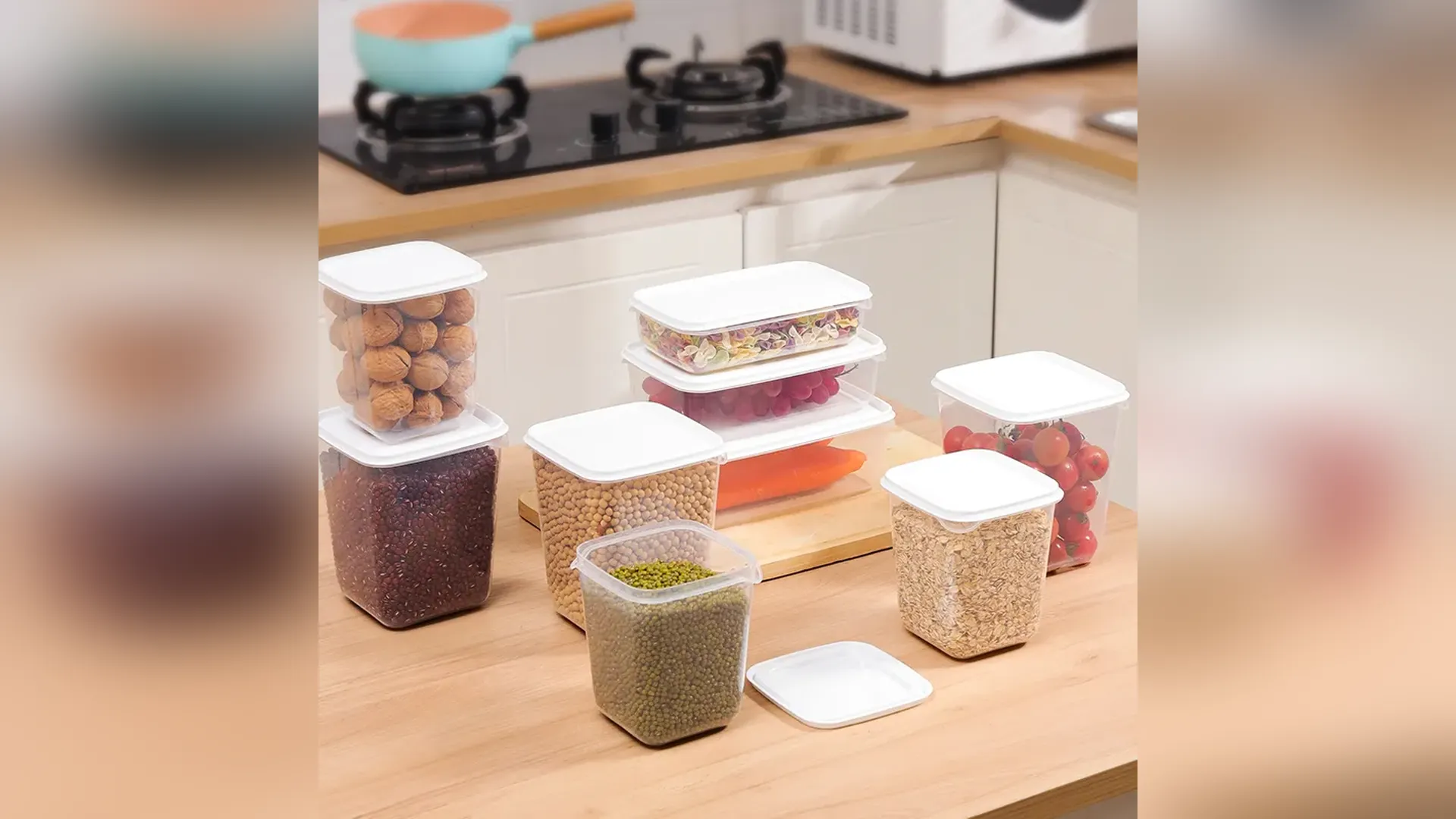
What Wholesale Buyers Mean by a "Tall" Food Storage Container
A buyer looking for a tall food storage container supplier is rarely shopping for a pantry set. The brief is geometric: keep the countertop footprint of a mid-size box, add usable height, and a fixed shelf or planogram then holds more volume per square metre of retail space. That one decision cascades into the fill weight you plan, the case pack you negotiate, the pallet height you pay for and the cube your forwarder quotes.
Two unrelated products answer the words "tall food storage container" in search results. One is the rigid kitchen and pantry container this page is about. The other is the ocean shipping container, which is why so many people searching for bulk storage wind up on pages about 20-foot boxes and extra-tall ISO equipment. Nothing here applies to freight equipment. Everything here applies to polypropylene containers for dry goods, grains, pasta, coffee beans, nuts and pet food, bought by the carton rather than by the piece.
There is also a frustrating gap in the middle of that market. Consumer retail pages describe a tall container in adjectives, and industrial catalogues list it in a grid of thumbnails. Almost nothing in between tells a buyer what the specification actually is and which numbers the factory can and cannot put in writing. So that is the shape of this page: the recorded specification of one real tall line, the capacity maths behind it, the carton fields to demand, and the documents worth asking for before a first purchase order. Where a number is not published for this line, the page says so instead of filling the space.
Why Buyers Deal With a Food Storage Container Supplier, Not a Distributor or Marketplace
Marketplaces and national distributors are the right answer for a first demand test. No tooling decision, no sampling step, no container-load maths, no customs file — you buy fifty pieces and see whether they sell. That route stops being the cheapest one the moment a private label, a specific body colour or a particular pack format enters the brief, because at that point you are not buying stock, you are commissioning it.
Three things genuinely change when the buyer goes to the plant.
What can be changed. Colour, size, logo and packaging are settable variables at the moulding and packing stages. A distributor can only sell what is already boxed and labelled, which is why so many "custom" listings turn out to mean a printed sticker on an imported carton.
What can be verified. A factory can produce the material declaration, the migration test reports and the packing list for the specific production run you are buying. A reseller forwards whatever its importer passed down, often without the model-level detail that a retail compliance team asks for.
What can be planned. Case pack, carton dimensions and loading quantity are decided where the goods are packed. Once your volumes justify a container, that planning is where the money is, and it cannot be done from a warehouse.
The same shift applies when comparing a factory against a generic bulk supplier: airtight bulk container buying walkthrough works through what changes when a bulk pantry order is specified rather than browsed. The trade-offs are real — a factory order normally brings a sampling step and a longer lead time — so the honest split is quantities and timelines: small and immediate goes to a reseller, a programme or a repeat container load goes to the plant.
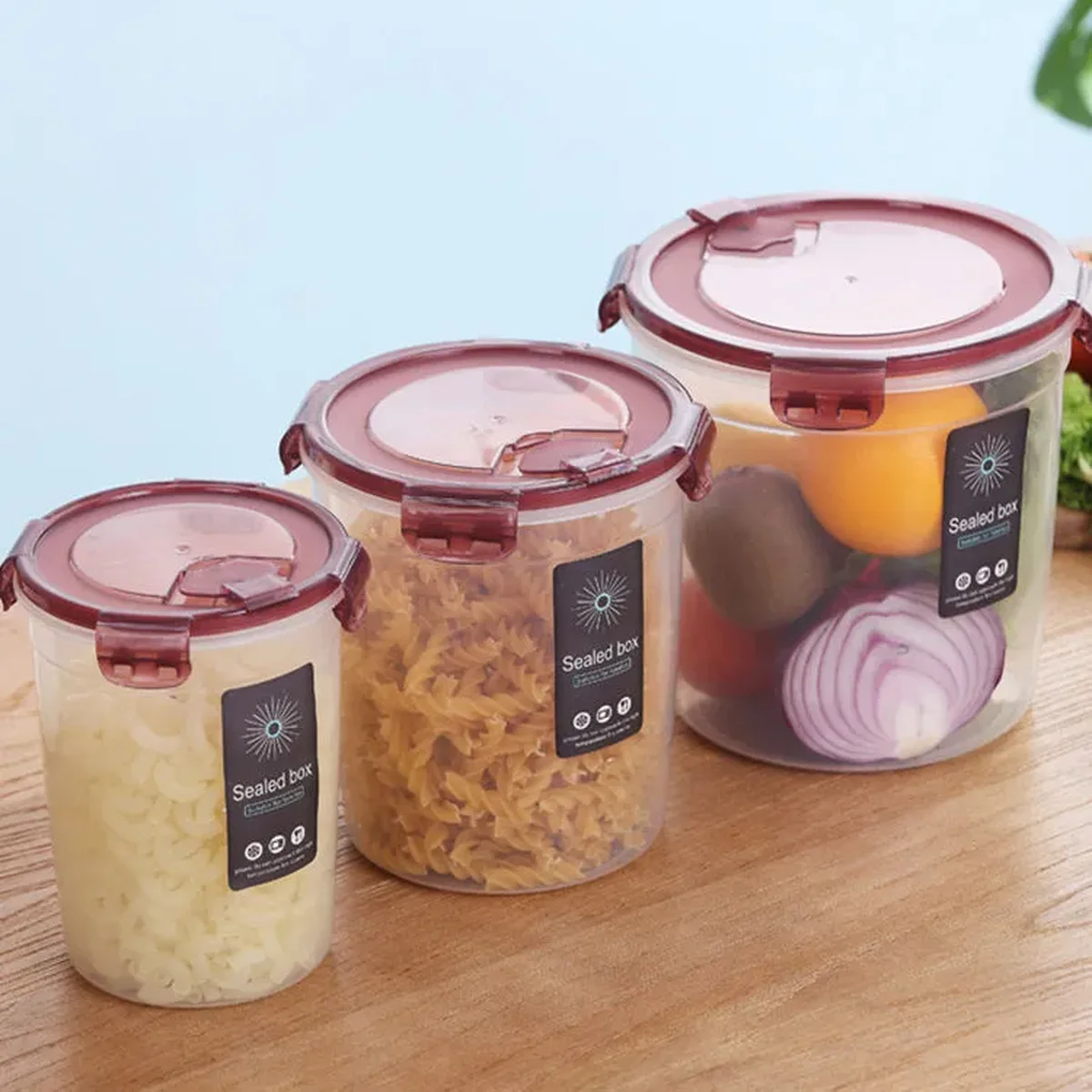
A neighbouring container family from the same plant: round snap-lock models in PP with a transparent body.
The 3335–3338 Line: Tall Square PP Containers at 1,170 ml and 1,900 ml
The tall square line on this site is recorded as models 3335–3338: a polypropylene body moulded with a clear wall and a white lid. The two capacities, 1,170 ml and 1,900 ml, come from the family's own printed packaging rather than from a published specification row, which is exactly the gap buyers run into on this kind of line. Everything below is what can be stood behind today, and where a field is unconfirmed, the table says so.
Parameter | Value recorded for this line |
|---|---|
Models | 3335–3338 |
Material | PP (polypropylene) |
Colour | White lid + transparent body |
Capacities | 1,170 ml and 1,900 ml (stated on this family's printed packaging) |
Lid | PP lid; closure to be confirmed on an approved sample |
Intended use | Dry-food storage: grains, pasta, coffee beans, pet food |
OEM / ODM | Available |
Customisation | Colour / size / logo / package |
Carton data | Not published for this line — see the carton section |
The same parameters appear on the packaging of the tall square box in this family. Its printed product-information block lists the material as PP, a pack line of 1,900 ml × 1 plus 1,170 ml × 1, a use-temperature range of −20 °C to 110 °C, a five-year shelf life, the product standard GB/T 32094-2015, and the food-contact standards GB 4806.1, GB 4806.6 and GB 4806.7, with country of origin shown as China.
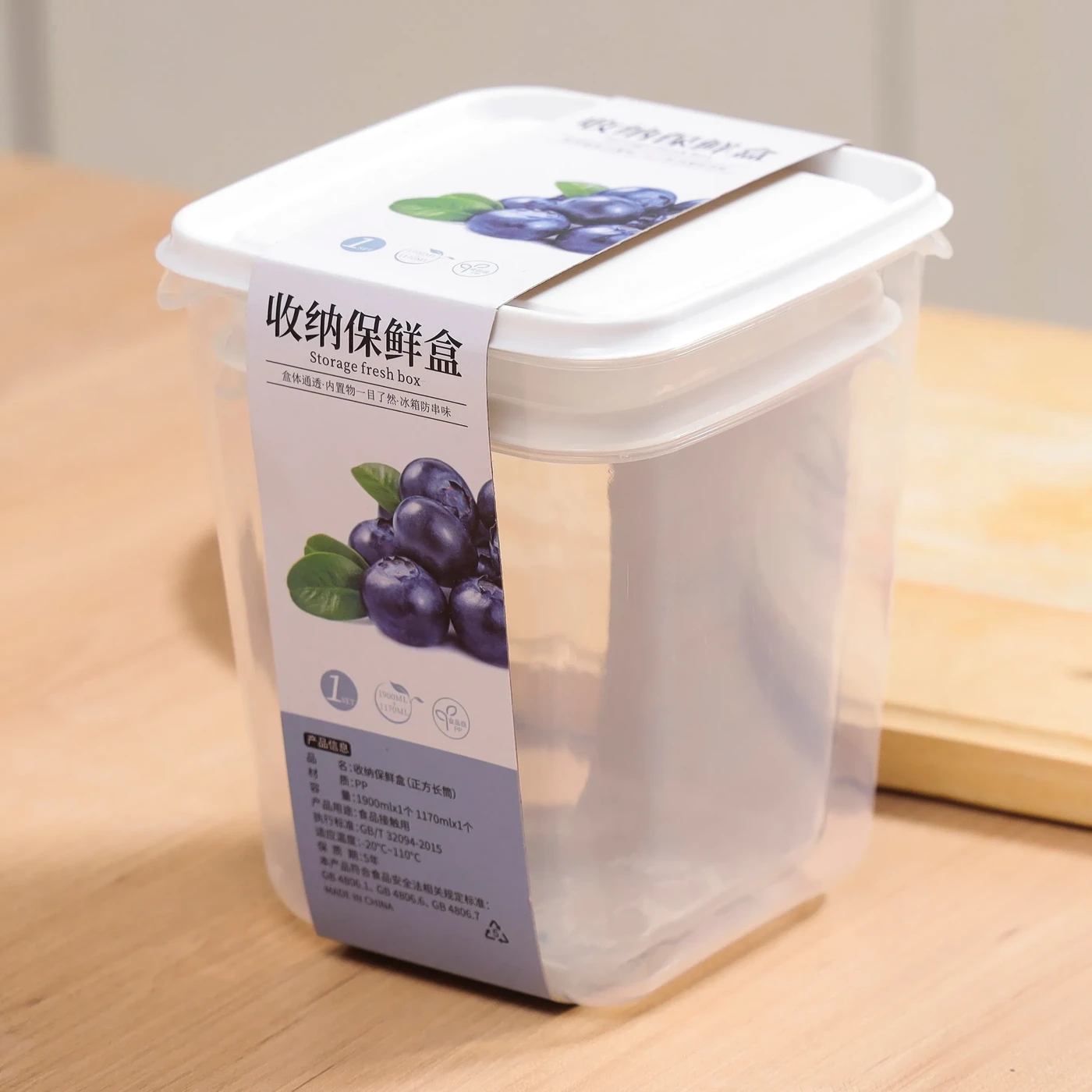
The capacity pair and standards on this family's own packaging — the level of detail a specification table should reproduce.
Read that label the way a buyer should: as the manufacturer's own statement of what the product is, not as a substitute for test reports. Section 9 of this page covers which documents behind those printed standards are worth requesting, and for which market.
Capacity and Footprint: What 1,170 ml and 1,900 ml Hold in Practice
Capacity on a tall container is a fill-line decision before it is a number. The two sizes on this line convert to 1.17 L (about 39.6 US fl oz) and 1.9 L (about 64.2 US fl oz). Bought as a pair they give a brand two shelf positions — an everyday size and a family size — and the family's printed label packs the pair together as a two-piece set (1,900 ml × 1 plus 1,170 ml × 1 each).
What actually goes in each size depends on bulk density, and this is where buyers get burned by arithmetic. Dry goods are sold by weight and stored by volume, and the ratio between them moves a long way across the category: a 1,900 ml container holds a different weight of rice than of pasta or coffee beans. Converting a capacity into a fill weight on paper is a guess. Weighing the product on an approved sample is a number. A responsible specification sheet states the capacity and leaves the fill weight to your own product test.
Two practical notes that come up in every sampling round. First, plan a fill level below the rim so the lid closes on the seal rather than on the contents; a container filled to the brim will not hold its seal in transit. Second, confirm the geometric relationship between the tall body and the shelf or carton you have in mind — the whole point of a tall format is height, and height is what runs out first in a retail planogram, a warehouse bay or a carton.
If you are building a capacity ladder across several sizes rather than two, that is a range-planning exercise with its own method, covered in the site's guide to SKU mix and capacity ladders for a first order.
Carton Data and Case Packs: What to Ask For, and What This Line Publishes
Carton data is where supplier pages go quiet, and this line is no exception: the product record carries no units-per-carton, gross-weight or carton-dimension row for models 3335–3338 — the only packing entry it holds reads "paper-based bidding". Inventing a figure would be worse than leaving it blank, because a pack count is what your forwarder prices and your customer's receiving team counts.
What a buyer can do is ask for the packing list and know exactly what a complete one contains:
- Units per carton, and whether the carton is a shipper or a retail-ready display
- Carton dimensions in centimetres, and the carton's cubic measurement
- Gross weight and net weight per carton
- Loading quantity for 20 ft and 40 ft HQ equipment, palletised and floor-loaded
- The Incoterm the quotation is built on — EXW, FOB or CIF changes the landed number more than most buyers expect
The rule to carry into every enquiry: no pack figure travels between models. If a quotation shows a per-carton count for 3335–3338, ask which production run it came from and get it in writing.
To show the shape of that answer rather than an empty promise, here is carton data the same plant does publish for neighbouring food-container lines. These are recorded values from the product records, and the source itself flags packing scope as something to confirm per order.
Line | Model | Material | Carton (L × W × H) | Gross weight | Per carton |
|---|---|---|---|---|---|
Tall kitchen container | 3334 | PP | 59 × 56 × 65 cm | 14.7 kg | 80 pcs |
Kitchen / frozen food container | 3332 | PP | 64 × 49 × 56 cm | 16.1 kg | 56 pcs |
Round storage container set | BX1052 | PP + silicone | 68 × 36 × 56.5 cm | 16.2 kg | 48 pcs (298 g unit) |
Airtight round container | BX1053 | PP + silicone | 61 × 30 × 57 cm | 12.4 kg | 24 pcs (425 g unit) |
Freezer / meal-prep container | BX1094–BX1099 | PP | 59.5 × 43.5 × 53.5 cm | — | 72 pcs |
Two lessons sit in that table before 3335–3338 is ever quoted. Per-carton counts across one plant's food-container family swing from 24 to 80 pieces, so a pack figure from one line tells you nothing about another — never let a pack number travel from one model to the next in a quotation. And gross weight plus carton dimensions are the two fields that decide freight, so a quote without them is not yet a landed-cost estimate. The site's own walkthrough of stacking, nesting and carton arithmetic goes further into how pack geometry affects a container plan.
Airtight and Stackable on a Tall Profile
Height makes sealing harder. A taller wall has more surface to flex under load, a longer rim to keep true, and more leverage on the lid once the container is full — which is why two containers of the same capacity can behave very differently in transit depending on how the lid interface is built.
Three things are worth settling on a sample rather than on a drawing.
The lid interface. Either the lid seals against the body wall, or a gasket sits inside the lid and compresses against the rim. Both are legitimate; they fail differently. The interference type depends on moulding tolerance, the gasket type on the gasket material and its compression set over time.
The claim you intend to print. "Airtight" and "leak-proof" are not synonyms, and buyers who treat them as one get caught at retail. The phrases that circulate online — airtight bulk food storage containers, bulk food storage containers with lids — describe a closure requirement, not a tested property. The difference between the two claims, and how to test for each, is set out in this site's comparison of airtight and leak-proof container construction.
The test method. A seal that holds against dust and humidity is a different requirement from one that survives an inverted fill test, and a warehouse test is a different requirement again. If you need the stronger claim, ask for the seal structure and the sample test procedure, not just an assurance — the site documents how that test is normally run in seal structure and sample testing.
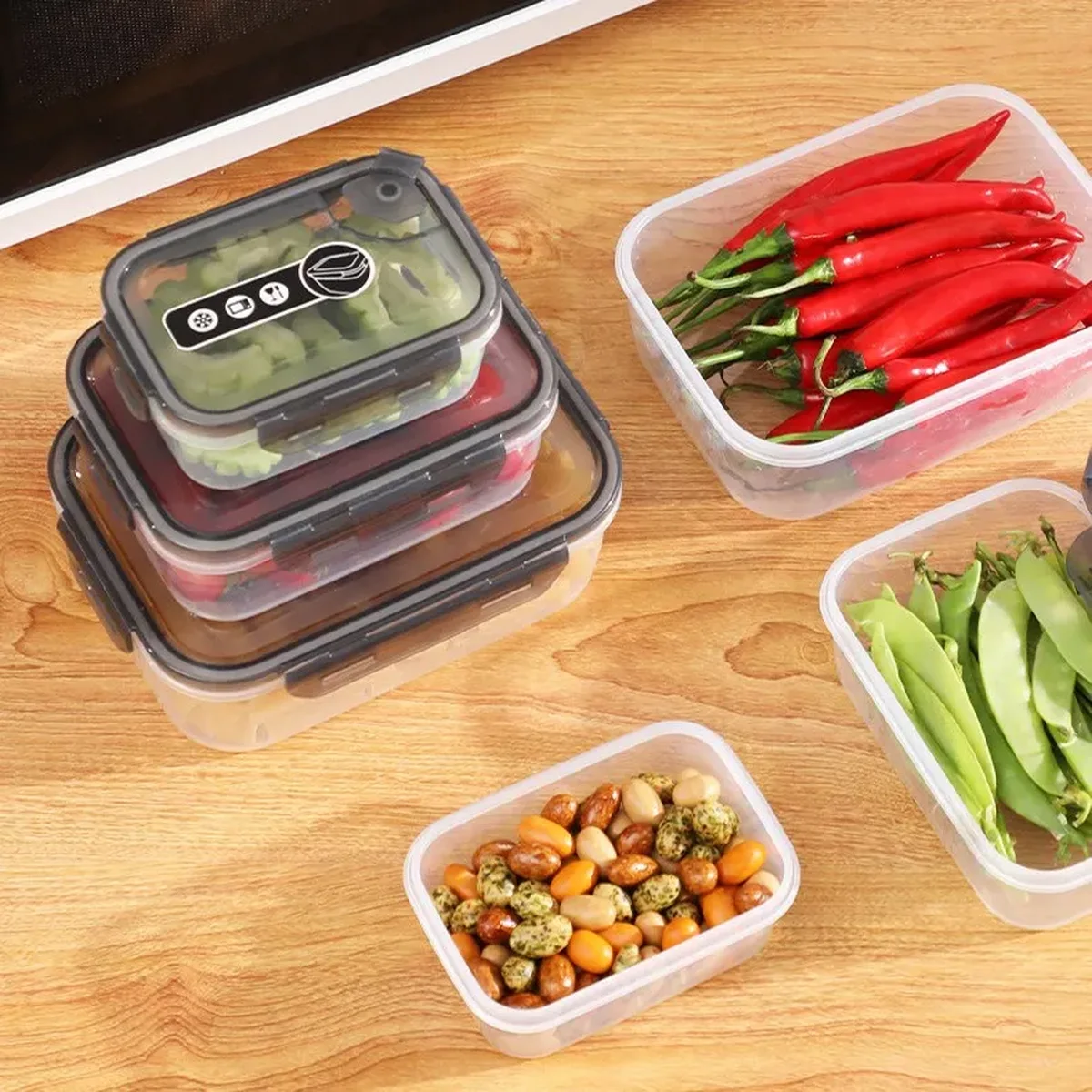
A sibling snap-lock model whose lid construction differs from the tall square line's: a rimmed snap-lock lid rather than the tall square closure.
Stackability is the second half of the tall-container case, and it is usually what the format was chosen for. Confirm the stacked height before you plan a planogram: two containers that stack cleanly may still add more shelf height together than your fixture allows, especially once the lid is on.
Range Planning: Nesting, Stacking and How the Two Sizes Sit Together
A two-capacity range is deliberately small, and that is the point for a first order. It gives a brand a size step without doubling tooling, artwork or packing complexity. Whether the pair should grow into three or four sizes depends on your channel: a supermarket range wants a clear size ladder, while an e-commerce listing often performs better with fewer, better-explained options.
A terminology caution that costs buyers time in factory conversations: stacking and nesting are different properties. Stacking means one filled container sits on the closed lid of another. Nesting means an empty container drops inside another for empty transit and storage. A tall format usually stacks; it rarely nests, because its height comes from a straight wall. If you need both, that is a mould-design input to raise before tooling, not a packing detail to fix afterwards.
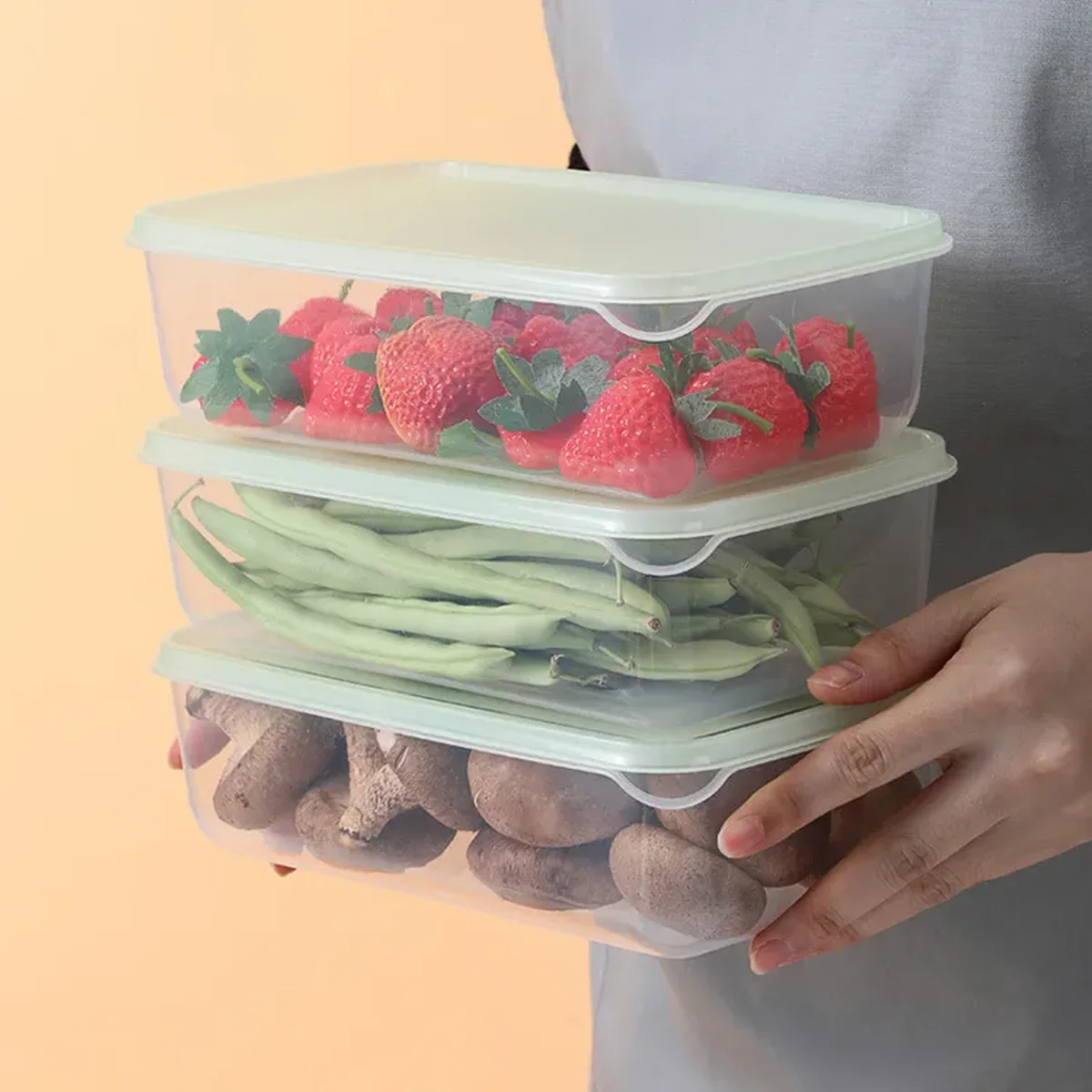
Stacking, as distinct from nesting: filled containers sitting on closed lids, food visible through the transparent body.
OEM and Customisation on an Existing Mould
OEM and ODM are both recorded as available on this line, and the settable variables are colour, size, logo and package. On an existing mould, the practical split looks like this:
- Colour and decoration are routine. Body tint, lid colour and a printed or applied logo can be changed without touching the tool, subject to minimum run sizes and to the food-contact status of the material and ink involved.
- Packaging and labelling is where retail programmes live: retail-ready cartons, barcodes, artwork, and the prep steps an e-commerce customer needs. The site's own account of FBA prep, labelling and product photography handled inside the factory describes what that involves.
- Size changes are the expensive variable. Moving a body dimension almost always means a new mould and a tooling decision, which is a different conversation from a colour change. This site's guide to modifying an existing mould versus cutting a new one is the right starting point for that decision.

The plant behind this line, in Jieyang, Guangdong — where moulding, decoration and packing are handled under one roof.
Food-Contact Documents to Request With a Bulk Order
Nothing on this page is a compliance claim. What follows is the buyer-side document list, because the paperwork is where a cheap quotation usually reveals itself.
Different markets ask the same question through different paperwork. Three columns are enough to see what to request, and where to check the reference yourself.
Market | What governs it | What to request |
|---|---|---|
United States | Polypropylene is an olefin polymer, and food-contact use of olefin polymers is covered by 21 CFR 177.1520, which also lists the permitted optional adjuvant substances. The FDA inventory of effective food-contact substance notifications is the public clearance record | The resin or compound grade the line runs on, and a written statement against that section for those production materials |
European Union | Plastic materials intended to come into contact with food sit under Regulation (EU) No 10/2011, and the Commission's food contact materials portal sets out the framework | The Declaration of Compliance and the migration test reports behind it, in the language the market requires, for the specific production materials — not a generic certificate from another product |
China | The packaging on this line prints GB 4806.1, GB 4806.6 and GB 4806.7 as its food-contact standards, with GB/T 32094-2015 as the product standard; the national standards portal is where those references can be checked | The current test report behind each printed number, with its date and the model it applies to |
Three habits make that document set work. Request the reports per model and per material, not per supplier. Check the date and the version — a compliance file that fails on age is not a compliance file in most retail systems. And if your customer demands third-party verification, raise it before sampling: factory audits, inspection reports and material safety data sheets are all requestable items, and the site keeps a working factory compliance document checklist for exactly that stage of a project.
Buyer Questions Before You Request a Quotation
What is the minimum order for models 3335–3338? No minimum is published for this line. Minimums are set per model and per packing route, so the useful approach is to send your target annual volume with the enquiry and get the quantity in writing alongside the pack format.
Are the two capacities sold as a pair? The tall square box in this family carries a retail pack line of 1,900 ml × 1 plus 1,170 ml × 1, so a pair pack exists within the family. Confirm whether your order is the pair, or single capacities, before artwork is finalised.
Can the carton carry our artwork? Packaging is a settable variable on this line. Send artwork and the market's labelling requirements, and confirm the carton construction at sampling.
Is the container microwave or dishwasher safe? Treat this as a claim question, not a product question. The packaging states a use-temperature range of −20 °C to 110 °C, but a "microwave safe" claim printed on retail packaging needs a test report supporting the exact wording your market allows. Ask for the report before the artwork goes to print; the site's list of certifications buyers ask food-container factories for is a practical reference for which report matches which claim.
Can the containers go into the freezer or the fridge? The packaging states a use-temperature range of −20 °C to 110 °C, which is what cold storage has to sit inside. A frozen-storage claim, and the "freezer safe" wording some retailers want printed on the pack, still needs the test report behind that wording — the same rule as the microwave claim above. Confirm seal behaviour at low temperature on a filled sample, because that is where a lid that is tight at room temperature can let go.
Where can I buy wholesale storage containers in small quantities? If you need a few dozen pieces, stay with a marketplace or a domestic distributor — that is the honest answer. Factory ordering becomes the cheaper route once volumes reach carton and container quantities, and the cost of the sampling step is spread across a programme rather than a test.
Where to Start With This Line
Start with the two numbers. If your product fits a 1,170 ml or 1,900 ml tall square container, the product line page for models 3335–3338 is the next step — its published record carries the model range, material and colour, so ask for a current data sheet with the two capacities confirmed before artwork is planned.
The food storage containers topic hub collects the rest of the container writing on this site. To get a quotation that can actually be compared, send five things with the enquiry: the target market and its labelling language, the target annual volume, the capacity or capacities you want, the pack format you intend to sell in, and the Incoterm you are buying on. Those five inputs decide the tooling question, the carton sheet and the document set, and with them the answer is a specification rather than a price list.
Continue reading
Related sourcing guidance
More practical context for your food storage container sourcing conversation.
Discuss your product range
Need help selecting or customising containers?
Share the product type, market and sourcing requirements with the Xinghui team.