
Food Storage Guides
Microwave-Safe Food Containers: 3 Clauses to Cut Risk
Turn "microwave-safe" into verified specs and three contract clauses that shift warping, gasket, and print-migration risk to your factory.
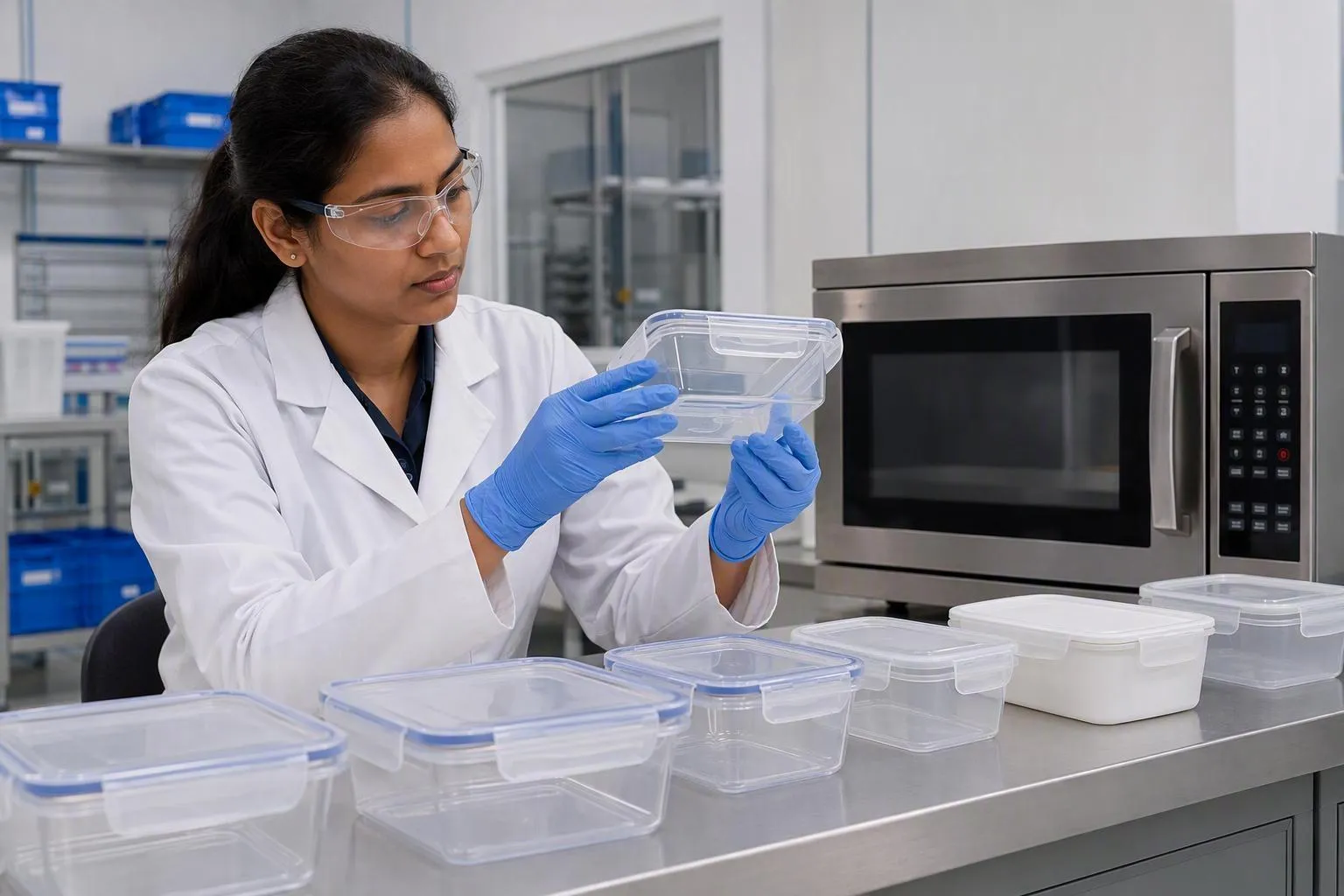
A container labeled “microwave-safe” shipped from your factory arrives, sells well for three weeks, and then the reviews start. The base warps on the second reheat. The silicone gasket rings out of the lid after steam pressure builds. The logo on the lid bleeds onto the food surface. Each complaint is a return, a chargeback, and a step toward a listing suspension. And because you own the brand, you absorb every dollar of it.
Here is the uncomfortable detail most private-label buyers miss: “microwave-safe” is a tested claim under specific conditions, not a guarantee of how the container will behave in a real kitchen. The plastic, the lid geometry, the print, and the reuse pattern all change the outcome. That is manageable, but only if the responsibility for it is written into your contract before the mold ever runs.
Table of Contents
• Key takeaways
• Why “microwave-safe” fails in a real kitchen
• Failure one: warping
• Failure two: gasket and lid deformation
• Failure three: print and label migration
• What “microwave-safe” must actually prove in writing
• The three contract clauses that move the risk to the factory Clause 1: specification and acceptance
• Clause 2: quality, testing, and continuous supply
• Clause 3: responsibility, warranty, and liability
• FAQ
• Next steps
Key takeaways
• “Microwave-safe” means the container passed a heat-resistance test under declared conditions. It does not mean it is immune to warping, seal deformation, or ink migration during repeated home use.
• The three failures that generate the most returns are warping, gasket and lid deformation from trapped steam, and food-contact print or label migration. Each has a specific root cause and a specific test that would have caught it.
• One short paragraph in your agreement will not protect you. You need three working clauses: one that ties the term to verified technical data, one that makes production testing continuous, and one that moves the liability for field failures to the factory.
• Require the numbers, not the adjective. HDT, wall-thickness tolerance, vent design, thermal-cycle count, and migration limits are what make “microwave-safe” verifiable.
Why “microwave-safe” fails in a real kitchen
Microwave energy couples to water, fat, and salt inside the food, not to the plastic itself. Most food-grade polymers are fairly transparent to the radiation, which is why manufacturers can label PP containers at all. The problem is what happens next. Hot food, sauces, and grease transfer heat back into the container walls, and that heat is rarely uniform. Hot spots near oily or sugary food can run well above the safe threshold while the rest of the wall stays cool. Science Insights explained this plainly : plastic does not generally melt from the microwave energy itself, it deforms when the heated contents push the material past its limit.
Three failure modes account for nearly all of the microwave complaints on private-label food storage listings. Understand each root cause, and you know exactly which test to demand.
Failure one: warping
Warping is a thermal-stress and material-margin problem. When uneven heat softens a wall that is too thin or a design without reinforcing geometry, the container bows, sags, or loses its flat base. Polypropylene (resin code 5) is the usual microwave-suitable resin for good reason. A typical PP grade carries a heat distortion temperature of roughly 125 °C under the ASTM D648 test at 0.455 MPa, and it is widely used for microwave-safe ware because it tolerates the temperatures reached during reheating. Containers made from PET (code 1) or polystyrene (code 6) are a different story; both distort and can release substances under microwave heat, which is why responsible spec sheets exclude them from microwave claims.
The catch is that the resin alone does not decide the outcome. A thin sidewall, a sharp corner, or a sink mark from poor mold fill can put a “microwave-safe” label under stress the moment real food is loaded. Over time, repeated cycles and surface scratches eat into the remaining margin. The container that passed on day one may warp on the thirtieth use. That is why wall thickness and geometry belong in your specification, not just the material grade.
Failure two: gasket and lid deformation
Lid and gasket failure is a pressure problem layered on top of a heat problem. Water in the food turns to steam inside a closed container, and trapped vapor raises the internal pressure. A physics-level explanation of why lids deform notes that a sealed lid is compressed during heating and can be left permanently warped or concave after cooling. The lid, especially a thin one carrying an elastomeric gasket, is mechanically the lightest part of the assembly, so it is the first to surrender.
Two design decisions determine whether your gasket survives. The first is venting. A vented lid or comparable steam-release feature lets pressure escape without splatter, food projection, or lid blow-off. The second is the gasket and lid material and geometry under repeated hot and cold cycles. If the seal ring deforms, your container stops being airtight, which kills the core value proposition of a food storage product. A lid that reseals poorly after the first microwave use generates returns even when the base is fine.
Failure three: print and label migration
Migration is the failure most buyers never see coming, because the container can look and function perfectly while the printed logo transfers into the food. Heat, moisture, and repeated use accelerate the movement of additives, inks, and residual low-molecular-weight compounds from the plastic or the decorative layer into the food. The risk climbs when the surface is scratched, aged, or overheated.
The regulatory picture is specific. 21 CFR 177.1520 is the FDA rule covering olefin polymers like polypropylene and polyethylene used in food-contact articles, but it is a polymer rule, not a microwave-print rule. As a packaging-law firm explained , the FDA has not issued a specific regulation for microwave use of packaging; suitability rests on the materials, the intended-use conditions, and the supplier’s documentation. In the EU, printed and coated plastics fall under Regulation (EU) No 10/2011 , which sets an overall migration limit of 10 mg per dm² and a generic specific migration limit of 60 mg per kg. Printing inks themselves have no standalone harmonized EU rule, so their safety is assessed as part of the finished printed article under worst-case conditions. For microwave use, the EN 14233 method measures the interface temperature reached in the microwave and maps it to equivalent oven test conditions, so your factory’s migration evidence must reflect realistic heating, not room temperature.
What “microwave-safe” must actually prove in writing
Before you can write a contract clause, you need to know what the evidence looks like. A factory that genuinely validates a microwave-safe claim can hand you a document package that covers each of these:
Validation
What to require
Pass signal
Material grade
Resin name and code (e.g. PP, code 5) plus food-contact compliance of additives and colorants
Approved food-contact grade, no PET/PS for microwave
Heat resistance
Heat distortion temperature (HDT) with test method, load, and specimen thickness
HDT comfortably above the declared use temperature
Wall thickness
Nominal thickness and tolerance at base, sidewall, rim, and closure
No out-of-tolerance thin spots or sink marks
Lid and vent design
Validated steam-release path, closure fit before and after heating
No lid blow-off, no lost reseal, no food projection
Migration
Overall and specific migration under worst-case heating conditions
Meets FDA conditions / EU OML 10 mg/dm², SML 60 mg/kg
Thermal cycling
Repeated hot and cold cycles, including freezer-to-microwave if claimed
No crack, no seal failure, no permanent deformation
Leak and integrity
Leak test before and after heating
No leaks when full, inverted, or tilted
Independent QA guidance makes the point well. A packaging-industry framework on the seven tests that matter insists that a microwave-safe claim belongs to the complete food-and-package system, not to a resin name or a single water test. The finished, filled pack under your declared heating instruction is the object that needs validation. That is the standard to hold a factory to.
Food-grade polypropylene is the right starting material for this product class, and the best suppliers start there with virgin, food-contact resin. But the words on the label are only as good as the data behind them. That is where the contract comes in.
The three contract clauses that move the risk to the factory
A handshake and a purchase order will not survive a chargeback. Move the risk with three clauses that are specific, testable, and enforceable. Each one answers the question a sourcing manager actually asks: what happens, and who pays, when the container fails in the field.
Clause 1: specification and acceptance
Write the microwave claim into the technical specification, not into a marketing paragraph. Define the exact use case: food type, fill level, wattage, heating time, rest period, and whether the container is single-use or reusable. Then state the acceptance criteria as numbers.
Require the factory to provide the HDT test report for the production resin and the finished article, with the test method, specimen thickness, load, and pass-fail result stated. Set a nominal wall thickness and an allowable tolerance for every critical zone, and add a reject rule for any localized thinning or sink mark that affects heating or strength. Require a validated vent design that functions without splatter or gasket displacement. Finally, define the exact thermal-cycle protocol: the number of cycles, the temperature endpoints, the dwell times, and whether the test runs empty, filled, or sealed.
The clause should say what failure looks like if none of this is met: the lot does not pass, and the label cannot be used until the data exists. Without this clause, “microwave-safe” is just packaging copy that happened to survive one lab session.
Clause 2: quality, testing, and continuous supply
A passing sample proves little if production drifts. Clause 2 makes the testing continuous and ties every production lot to the approved specification. Two mechanisms do the heavy lifting.
The first is a sampling and acceptance plan. Define an acceptable quality level for the properties that matter, clear reject rules for warping, gasket failure, and print defects, and require records that tie each lot back to a specific test result. The second is change control. Your factory must notify you in writing before it changes the resin grade, the mold, the wall thickness, the lid geometry, the vent design, or any print and colorant system. A resin switch that looks identical but runs hotter is exactly how a brand discovers a new failure mode after the container is already on a shelf.
This clause also carries the compliance evidence. Require the migration reports and any market-specific documentation at or before first production, and again when a material or process change occurs. In practice this means the FDA conditions that apply to microwave containers, migration data under the EU 10/2011 framework for European sales, and the relevant food-contact documents for other target markets.
A supplier’s capability claims matter less than its paperwork trail. When a factory documents its QC across design, mold development, and mass production , it is telling you which subset of failures it can actually prove it does not have.
Clause 3: responsibility, warranty, and liability
Clause 3 decides who pays when something still slips through. Without it, a field failure lands on you by default, because the brand owns the listing and the customer relationship. Draft it to do three things.
First, define the warranty in terms of the specification in Clause 1. The factory warrants that each lot conforms to the declared microwave-performance and migration requirements, and that the label claim is supported by the test evidence. Second, state the remedy for a breach: replacement of the nonconforming units, credit, or a responsibility for the documented costs of returns and chargebacks tied to the proven defect. Third, allocate compliance responsibility. If a failure traces to the material, the print system, or the manufacturing process, the factory bears it; if it traces to the buyer’s packaging instruction or a use condition outside the declared spec, you bear it. That division is fair and, more importantly, it is enforceable.
This is the clause that turns a quality partner from a vendor into a fellow risk-holder. A factory confident in its material and process controls will agree to it. One relying on vague assurances will resist.
FAQ
Does “microwave-safe” mean a container is safe for all microwave use? No. It means the container passed a heat-resistance test under declared conditions: a specific food, wattage, time, and closure state. Reheating oily food longer than declared, sealing the lid, or using it beyond its rated temperature can still cause failure.
Why does my container warp only after several uses? Warping is a cumulative thermal-stress problem. Repeated cycles, scratches, and aging reduce the material’s margin before distortion, so a container that passed on day one can warp on later uses.
Why did the lid collapse or the gasket pop out? Trapped steam raised the internal pressure while heat softened the thin lid and elastomeric gasket. A properly vented lid is the fix; a sealed container is the cause.
Can printed logos migrate into my food? Yes. Heat and moisture accelerate the movement of inks and additives, especially on scratched or aged surfaces. Compliance is assessed on the finished, printed article under worst-case heating, which is why migration testing matters.
Which resin is the right one for microwave-safe food storage? Polypropylene, resin code 5, is the common microwave-suitable food-grade choice. PET and polystyrene should be excluded from microwave claims.
What documents should I request from a factory? An HDT report, wall-thickness and dimensional data, vent-design validation, a thermal-cycle test protocol and results, migration reports under the relevant FDA or EU conditions, and a change-control commitment.
Next steps
The difference between a cheap failure and a manageable one is a specification written in numbers and a contract that says who owns the risk. Start your next sourcing conversation by asking for the testing evidence, not the marketing claim.
For a deeper view of how microwave-safe claims are handled in a real product line, read how a manufacturer treats microwave-safe PP meal-prep containers , including lid and heating guidance. When you are ready to compare suppliers on the strength of their spec and QC documentation, look for a partner that builds food storage containers from virgin food-grade polypropylene and will put the testing in writing.
Ask your factory for the three clauses and the document package above. If the supplier can produce them, the “microwave-safe” label becomes an asset. If it cannot, the label is a risk you should not carry.
Continue reading
Related sourcing guidance
More practical context for your food storage container sourcing conversation.

Discuss your product range
Need help selecting or customising containers?
Share the product type, market and sourcing requirements with the Xinghui team.