
Sourcing & OEM
Lunch Box Factory or Trading Company? How Importers Verify a Chinese Supplier
A lunch box quote can come from the plant that molds it or a reseller selling the same output. Four checks — license, tooling, cartons, documents — decide.
Two quotes for the same 1.3 L three-compartment lunch box — model BX1051 in our own range — land on the same afternoon. One is 4 % cheaper. Both suppliers show a factory gate on their website, both will send a video within the hour, and both will sign a proforma invoice tomorrow.
One of them owns the mold.
That sentence is the subject of this page, and it is not a morality tale. A trading company is a legitimate business performing a real service, and some of the best purchasing decisions we have watched were placed through one. What ruins orders is narrower than that: dealing with a reseller who told you he was the plant, at a price that assumed he was the plant, on documents that name neither.
There is no shortage of advice on how to tell if a supplier is a factory or trading company. Almost all of it stops at the business license — a good first move and a poor last one. A license proves what a company may legally do, not what it currently does, and a reseller can forward a PDF as easily as a plant can. The sequence below is ordered by how hard each step is to fake. The last step is arithmetic on packing data, and it is the only one on the list that a company without a shop floor cannot pass by preparing harder.
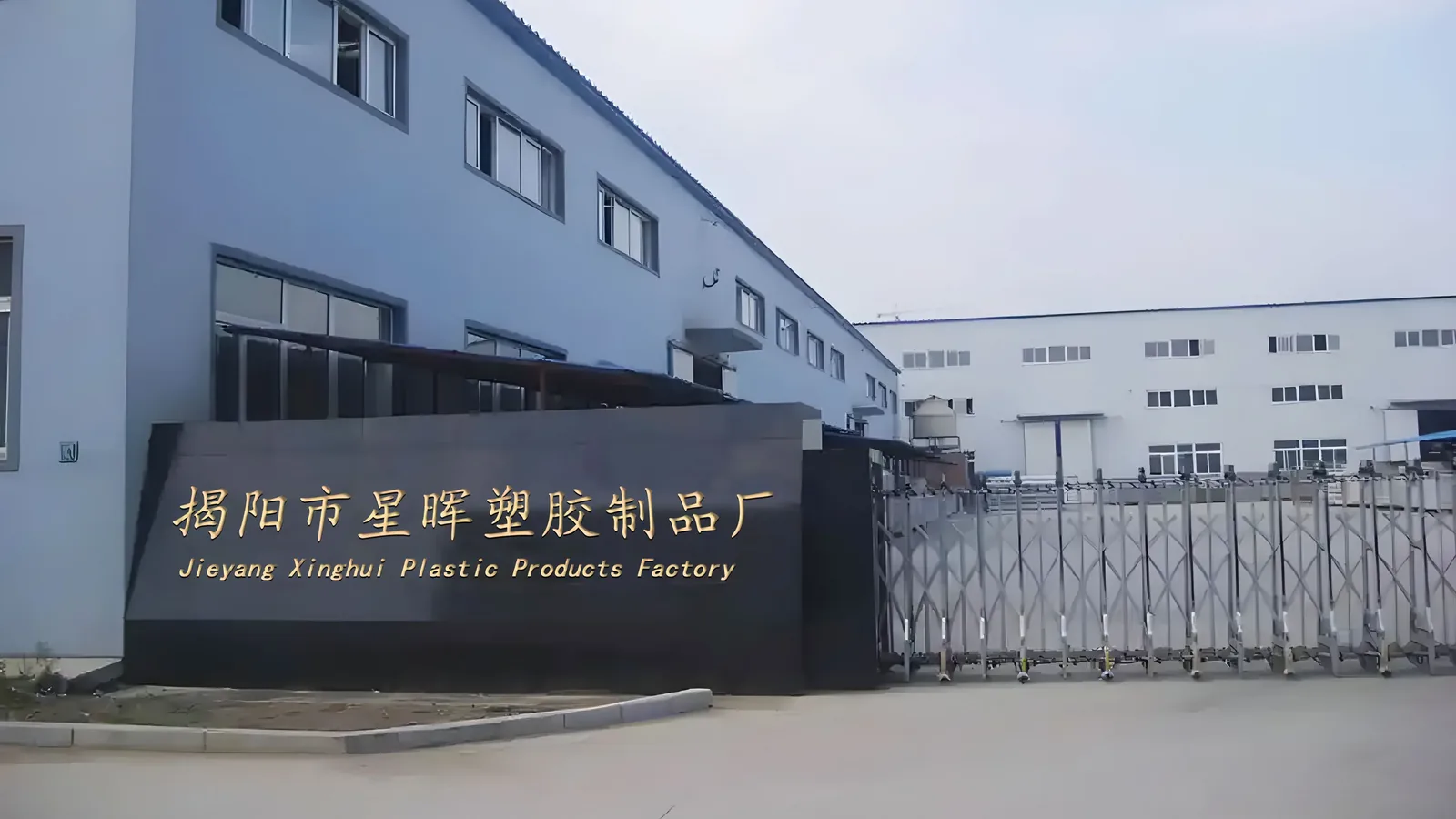
Xinghui Plastic molds PP houseware in Jieyang, Guangdong, on a site whose published capability is more than 30 injection-molding machines and 15,000 m² of floor, with mold development handled in-house rather than bought in. We are the factory in this comparison, so read the parts where a factory can lose with some suspicion — and run the same checks on us.
What the Answer Actually Changes in Your Order
Buyers ask the factory vs trading company question as though it were about honesty. It is about four items that reach your P&L — and a fifth that decides who pays when something goes wrong.
The price layer. A reseller's margin sits inside the unit price, and it is invisible: you cannot audit it, you cannot negotiate against it, and you cannot tell whether the 4 % you saved last quarter was a real concession or a smaller commission. On a container of lunch boxes that margin is worth real money, and on a first trial order it is often worth paying — you just want to know which one you are paying.
The tool. In molded houseware the mold is frequently the largest single line in the project and the only asset that outlives the order. If the seller did not pay for it, someone else did, and that someone decides where it lives when the relationship ends. A buyer who discovers in year three that his mold is held by a company he never contracted with has learned this the expensive way.
Who answers for a defect. Not the same thing as who apologizes. When 400 lids arrive with a short shot on the hinge, the question is which entity is legally the seller, which entity your inspection report is addressed to, and which entity a claim is enforceable against. That is a contract question, and it is decided by the name on the invoice, not by the name on the website.
The paperwork. Food-contact documents are issued against a company, a site and a product. A test report for your resin is useful. A test report for someone else's resin, forwarded by a reseller, tells you what the resin should do and nothing about what arrived in your cartons.
One more consequence sits outside the transaction. The importer of record answers for the entry: US Customs and Border Protection places a duty of reasonable care on the importer, not on the foreign supplier, and "my supplier confirmed it" has never been a defense in a penalty case. You are the party with a legal address in the destination market. That is why the identification work lands on your desk rather than your agent's — the same reason choosing a supplier you can actually rely on is a diligence exercise rather than a vibe check.
How to Tell If a Supplier Is a Factory or Trading Company: The License Test and Its Limits
Ask for the China business license scan and read four fields: the company name, the 18-character Unified Social Credit Code, the registered address, and the business scope.
The scope field is the one that earns its reputation. Chinese registrations use activity verbs, and they are not marketing copy — they define what the entity may invoice for and what the tax authorities expect it to do:
- Manufacturing verbs: 生产 (produce), 制造 (manufacture), 加工 (process or fabricate), 组装 (assemble), each followed by a product class — 塑料制品, plastic products, for instance.
- Trading verbs: 销售 (sell), 批发 (wholesale), 零售 (retail), 贸易 (trade), 进出口 (import and export).
A scope carrying only trading verbs means the entity is not registered to manufacture. That is the single strongest free signal available, and it costs five minutes: look the credit code up in China's National Enterprise Credit Information Publicity System, where the registration is public, official and not editable by the supplier.
Then stop, because the license has three limits that the sourcing blogs leave out.
A factory also registers sales scope. Almost every manufacturer carries 销售 alongside 生产, because it sells its own output. Finding sales verbs in a scope proves nothing; finding only sales verbs proves a great deal.
Registration is capacity, not equipment. A company can be registered to produce plastic products and currently run two machines and a subcontractor. Conversely, a legitimate factory that expanded fast may be mid-way through updating a registration. The license tells you what the entity is allowed to be. It does not tell you what is standing on the floor this month.
The seller is often not the registrant. Groups commonly sell through a sister trading company, and 委托加工 — commissioned processing — is a normal arrangement under which a registered trader contracts a plant to make goods to its specification. Neither is fraud. Both are things you should be told, in writing, before you wire a deposit.
Which produces the check that actually matters, and it is not the license at all: three names must match. The name on the license, the seller and beneficiary name on the proforma invoice, and the name on the company chop that signs it. When all three agree, you are dealing with one identifiable entity. When they diverge, the divergence is the finding — ask for the relationship in writing, and read the answer for whether the production site is named.
Send this as three lines, not a paragraph: "Please send your business license scan. Please confirm which of 生产, 制造 and 加工 appear in your registered business scope. Please confirm the exact legal entity name that will appear as seller on the proforma invoice and as beneficiary on the bank transfer." A factory answers in one reply. A reseller answers the first two and goes quiet on the third, or sends a license whose name does not match the invoice.
The address is worth one glance and no more. An industrial-zone address in a plastics cluster like Jieyang, Taizhou or Shantou is consistent with a plant; an office tower in a city center is consistent with a sales office, which every large factory has and every trader also has. Treat it as a hint that shapes your next question, not as evidence. What a Chinese manufacturer's own site and capability record look like is the other half of the picture — the part a license cannot show.
Four Questions That Only a Shop Floor Can Answer
Identity questions get you a legal entity. These four get you a building, and they are where the trading company vs manufacturer distinction actually settles — not in the paperwork, which anyone can forward. Ask them in this order, because each one narrows who could plausibly be answering.
1. Who owns the mold, and where is it stored? For a standard catalog lunch box the answer is "we do, it is in our rack, and you are buying parts off it." For a custom project the answer should be "you do, once the tooling invoice is paid." Ask what happens to the tool if you move production, who maintains it, and whether it can be shipped to another molder. A seller who cannot answer has never been in the room when that conversation happens — and in molded houseware it happens constantly, which is why modifying an existing mold versus cutting a new one is a decision buyers revisit every couple of years.
2. How many cavities does the tool have, and which press does it run in? A three-compartment 1.3 L box like BX1051 is not made one at a time; it comes off a multi-cavity tool in a machine sized to the projected area and shot weight. The number of cavities decides your unit price, your cycle time and your capacity. It is also a number nobody memorizes from a brochure. Listen for "two cavities in a 250-ton press" versus "it depends on the mold." The first is a person looking at a tool list. The second is a person looking at a price list.
3. What was in the last first-article report for this model? A first-article inspection measures the parts molded in the production tool against the drawing: dimensions, wall thickness, the critical fits, and which cavities were sampled. Ask for the report for the model you are buying, not a generic quality certificate. If the answer is a photo of a sample on a desk, you have learned something useful about what "quality control" means there.
4. Where are the print plates, and who paid for them? Heat-transfer film, screen frames and print plates are made against your artwork and are useless to anyone else. If they sit at a third party the seller does not control, your reorder has a dependency you did not choose — and the artwork file itself becomes a switching risk.
A note on how to read the answers, because the popular version of this advice is wrong. "Let me check with the factory" is not the tell. A factory salesperson also has to check; the tool list is not in his head. The tell is what comes back: a number with a unit attached, or a rounded adjective. "About twenty machines." "Around twenty cavities." "Roughly fifteen kilos a carton." Rounded answers to questions that have exact answers are the signature of somebody relaying a description rather than reading a record. What the numbers should look like, and how to check them, is the next section — and it is also why reading an injection molding quote line by line tells you more about a supplier than an hour of conversation.
The Carton Table: Arithmetic a Reseller Cannot Improvise
Every molded product carries a packing record: how many pieces go in a carton, the carton's outside dimensions, and the gross weight when it is sealed. These are not marketing numbers. They are measured every time a shipment is packed, they are printed on the packing list, and they are the basis on which your freight forwarder books space. A plant has them for every model it runs. A reseller has them for the models he has shipped, and guesses for the rest.
Here are seven lunch box models from our own product records, with the figures as recorded.
Model | Material | Capacity | Pieces per carton | Carton size (cm) | Gross weight per carton |
|---|---|---|---|---|---|
6529 | PP + silicone | 1,300 ml | 48 | 51 × 46 × 62 | 15.0 kg |
6527 | PP + silicone + stainless | 1,300 ml | 24 | 51 × 46 × 62 | 11.0 kg |
6522 | PP + silicone + 304 stainless | 1,100 ml | 24 | 54 × 32 × 60 | 14.5 kg |
6533 | PP + silicone + stainless | 1,100 ml | 24 | 50 × 36 × 47 | 13.0 kg |
6536 | PP + silicone + stainless | 1,100 ml | 24 | 47 × 34 × 47 | 11.0 kg |
6521 | PP + silicone + 304 stainless | 1,400 ml | 18 | 47 × 31 × 73 | 15.2 kg |
6523 | PP + silicone + 304 stainless | 800 ml | 24 | 54 × 32 × 50 | 11.5 kg |
Figures as recorded in our product data. Gross weight is per carton as recorded and its basis should be confirmed against the packing list for your own order; the arithmetic below excludes pallets and any additional retail packing.
Two observations follow from that table, and both explain why the numbers have to be measured rather than assumed.
Same capacity, three different cartons. Models 6522, 6533 and 6536 are all 1,100 ml stainless-lined lunch boxes, all packed 24 to a carton, and their cartons are 0.1037 m³, 0.0846 m³ and 0.0751 m³ respectively — a 38 % spread in shipped volume for the same piece count. The difference is the shape of the box and the way the lid nests. Nobody derives that at a desk.
Same carton, double the pieces. Model 6529 packs 48 pieces into the identical 51 × 46 × 62 carton that holds 24 of model 6527. Same carton, half the cartons per order, half the container volume. A supplier who quotes "24 per carton" for both has not looked at both.
Now the reconciliation, which is the part you can do on a kitchen table. Where the unit weight is also recorded, net weight must come out of pieces × unit weight, and gross weight must exceed it by the packing materials:
Model | Pieces per carton | Unit weight | Net weight per carton | Gross weight per carton | Packing overhead |
|---|---|---|---|---|---|
BX1051 | 72 | 182 g | 13.10 kg | 14.3 kg | 1.20 kg — 8.4 % |
BX1052 | 48 | 298 g | 14.30 kg | 16.2 kg | 1.90 kg — 11.7 % |
BX1053 | 24 | 425 g | 10.20 kg | 12.4 kg | 2.20 kg — 17.7 % |
An 8 % overhead and a 17.7 % overhead are both real. The carton, the dividers, the inner bags and the number of pieces per carton all move the ratio, and the ratio is not constant across a range — which is exactly why a supplier quoting one flat "add about 5 % for packing" on every model is estimating, not measuring.
Ask for the record on three models you were quoted, plus one model the supplier does not list. The three should reconcile, and they should not all look alike. The fourth answer is the interesting one: a factory says "that is not our mold, we would have to quote it and confirm the carton with the tooling," and a reseller either invents a carton size or discovers, mid-sentence, that he is not sure who makes it.
The container arithmetic finishes the job. Ten thousand pieces of model 6529 is 209 cartons — 10,032 pieces, rounded up to cover the order — about 30 m³, which is past the 28 m³ line the chart below draws for a 20-foot container, so that order books as a 40-footer or a mixed load. Ten thousand pieces of model 6521 is 556 cartons, about 59 m³, just over the 58 m³ line for a 40-footer, which makes it a full container of its own. Same category, same ten thousand pieces, twice the container space. Anybody quoting you an FCL plan without these four numbers is quoting a habit.
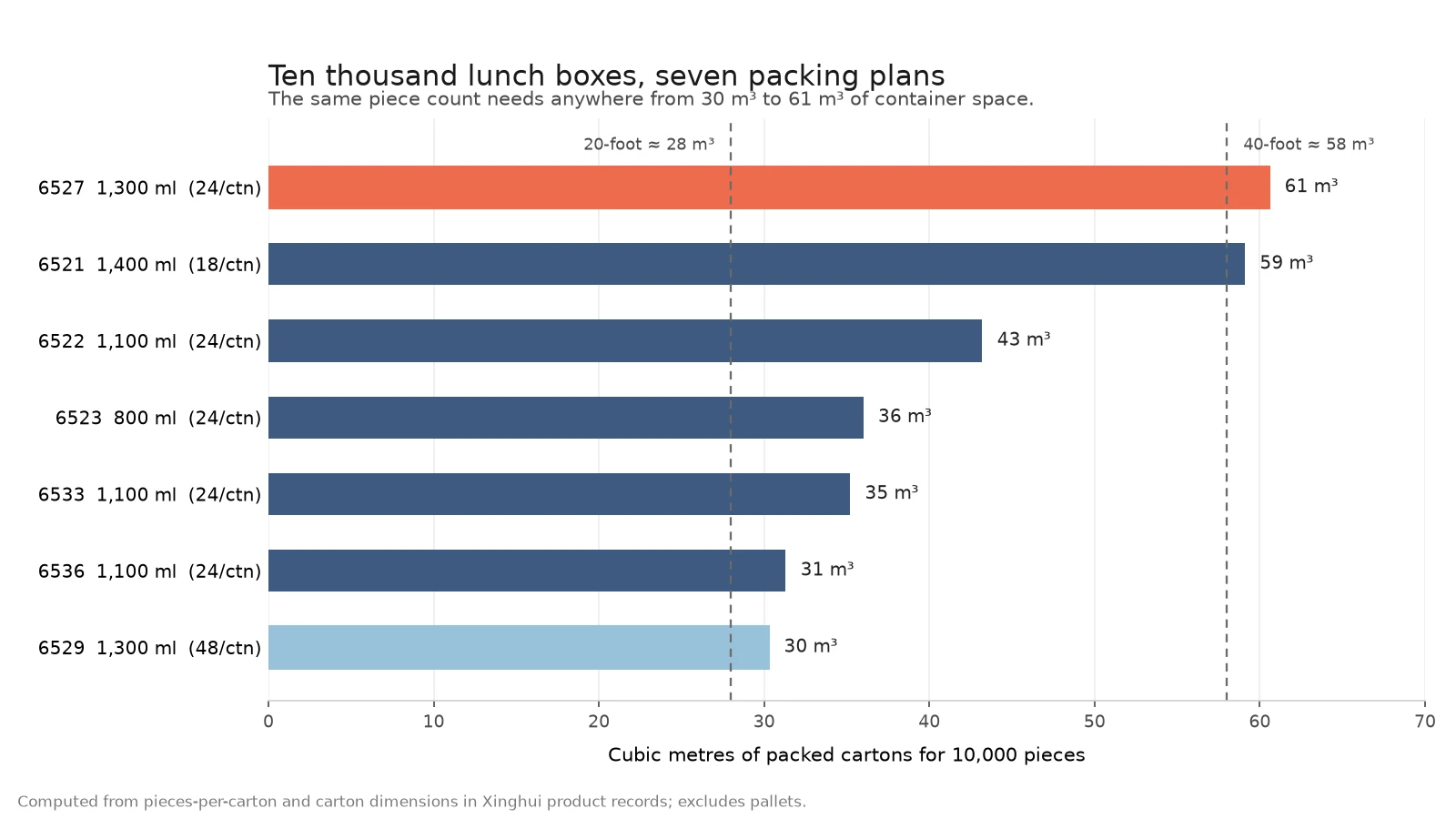
Plot the same order at the same quantity across the range and the spread is the argument for asking. The bars are not ordered by capacity, because volume is a function of how the box packs, not how much it holds. A supplier who cannot tell you which of those bars your order sits on cannot tell you what your freight will cost either.
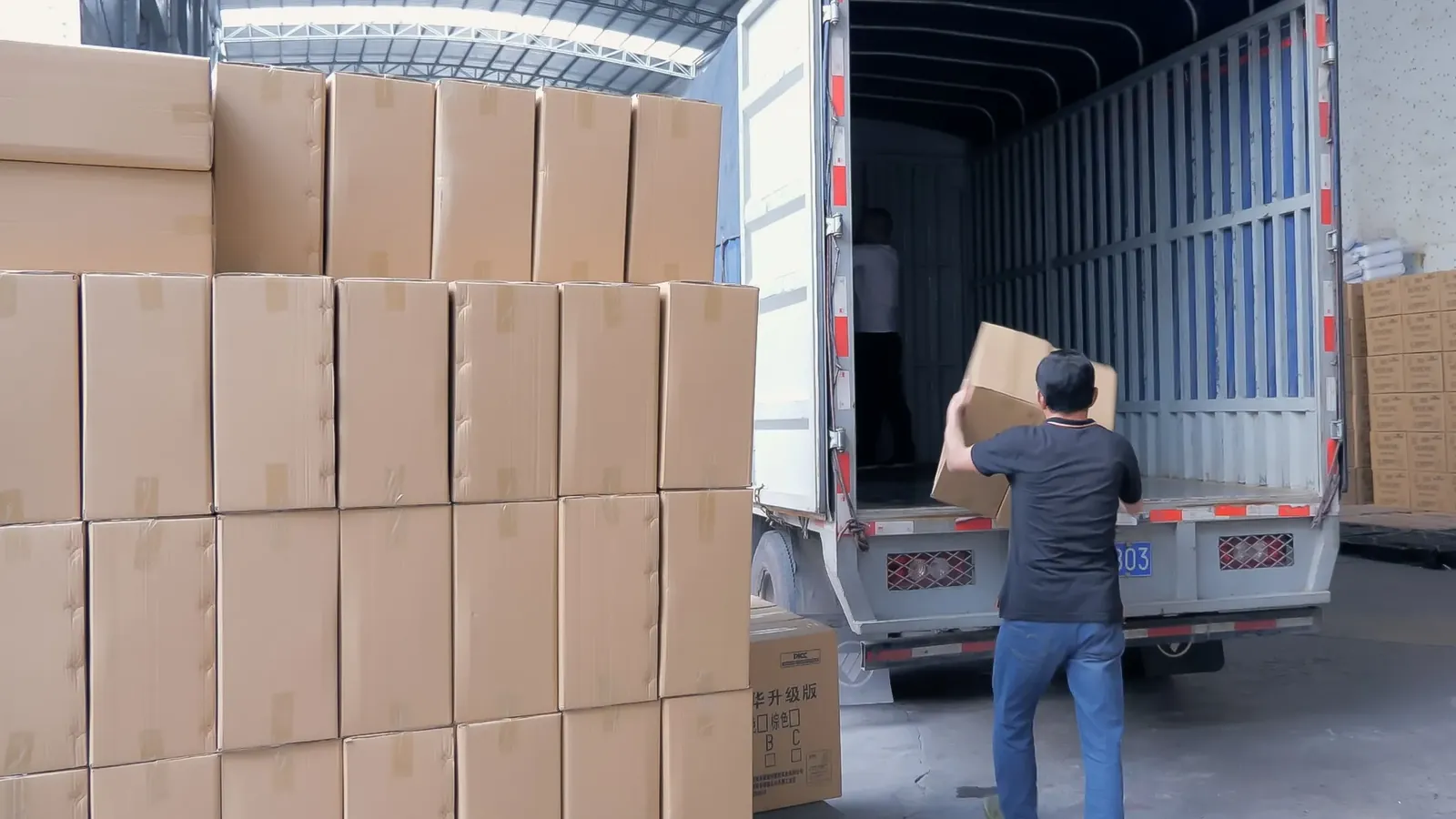
That is the point at which a packing record stops being paperwork and becomes how you check a lunch box shipment: the count on the carton, the label on the carton, and the weight on the carton are three independent statements that either agree or do not.
A Twenty-Minute Live Call, Not a Video
Every supplier will send a video. It is worth as much as a brochure, because it was chosen, edited and possibly filmed at somebody else's plant. What you want instead is a live, unscripted walk through the injection molding factory that is supposedly making your part, on WeChat or WhatsApp, with the camera pointed at things the person walking cannot control.
Ask for three specific acts, in this order:
- Read the model number stamped on the mold. Every production tool carries an identification number on the plate. If the seller is holding the tool, he can walk to it and read it out. This one request settles more than any questionnaire.
- Open a sealed carton from a finished pallet and read the label aloud — model, quantity, your SKU or theirs. A pallet of packed cartons with a legible label means the packing stage exists as a stage, not as a photo.
- Point the camera at the press tonnage plate of the machine running your part, then pan down the line so you can see how many machines are in the bay.
Two things to accept in advance. A factory will not film another customer's branded packaging, and asking it to is a mark against you, not against them. And a plant with 30-odd machines is not quiet: if the call is silent, the call is not in a molding hall.
Where the stakes justify it, an independent factory audit does the same job with a report attached, and it is the only evidence that survives a dispute three years later. What an audit proves is physical existence, capacity and the state of quality control on the day of the visit. What it does not prove is that your specific order will be run on those machines — for that you need the first-article report and the golden sample the run is checked against, both of which travel with the order rather than with the audit.
Whose Name Is on the Document
Compliance documents are where the factory-versus-trader question stops being commercial and becomes something a customs officer or a retailer's QA team will ask about. The rule is simple: every document is issued to somebody, and that somebody should be the entity selling you the goods, for the site that makes them. We are not going to claim any certification for ourselves in this article — the checks below apply to us exactly as they apply to the next supplier you email.
Document | Whose name should be on it | What a mismatch means |
|---|---|---|
Business license | The entity named as seller on the PI and as beneficiary on the wire | A different entity is receiving your money than the one you contracted |
ISO 9001 certificate | The manufacturing site, with a scope that mentions production of your product class | A certificate for a sales office, or a scope covering "trade of" rather than "manufacture of," certifies the wrong activity |
Food-contact test report | The applicant who commissioned the test, plus a sample description and photo matching your part | Anyone can forward a report; the applicant name and the sample photo say who tested what |
Declaration of compliance (EU) | The manufacturer or business operator that made the article, addressed to you as the party placing it on the EU market, referencing the substances, migration limits and test conditions | A one-page declaration with no grade, no test conditions and no reference number is a template |
Artwork and label approval | Your brand, signed off by you, held under a control that names who may print | Plates held by a party you did not choose become a switching cost later |
ISO 9001 deserves its own line because it is the certificate most often forwarded and least often checked. Accredited certificates can be validated in IAF CertSearch by certificate number: you get the issuer, the validity dates, the certified scope and the site address. Two details matter more than the certificate's existence — whether the address on it is a plant or an office, and whether the scope says manufacture or trade.
For the material itself, the US route for polypropylene food-contact articles runs through the food-additive regulations: 21 CFR 177.1520 covers olefin polymers and sets the specifications a resin must meet. Ask which section of that part your resin grade is supported under, and expect the answer to come with a resin datasheet rather than an adjective. In the EU, Regulation (EC) No 1935/2004 is the framework: Article 16 requires a written declaration of compliance for food-contact materials, Article 17 requires traceability, and good manufacturing practice is set by a separate regulation. A supplier who has done this before will know which document answers which article.
None of that is legal advice, and none of it is a substitute for your own regulatory review for your market. It is the list of documents to request, in the order a QA team will ask for them — the same list covered in more depth in which compliance documents to request from a food container factory and what each certificate actually certifies.
When the Trading Company Is the Better Answer
Here is the part that a factory is not supposed to write.
A good trading company is the correct purchase in at least four situations:
- You are building a mixed container of six product lines and want one packing list, one set of documents and one point of contact — a job that a single-category plant cannot do, as combining product lines into one container makes plain.
- You need a 300-piece trial below any factory's minimum, where an agent aggregating several lines is the only route that exists; note that MOQ is counted per order, per color or per model and the counting method is what decides whether a trial is possible at all.
- You are entering a category with no supplier relationships, and the coordination work is worth more than the margin you give up.
- You are buying a category the agent has run for a decade, and you would not know a good plant from a bad one on a walk-through.
There is also the hybrid that dominates Chinese export manufacturing and confuses every checklist: 工贸一体, a factory group that sells through its own trading arm. The legal seller is a trading company; the plant is theirs. This is not a trick, and the identification work is the same — you simply want the plant named in writing.
What protects you in any of these arrangements is not the label but the paper:
Name the production site in the PO, limit subcontracting to that site unless you approve a change in writing, keep your inspection access, and require notice before any transfer of production. If the seller is aggregating, ask for the factory price and the commission to be shown as two lines rather than one blended number. A reseller who agrees to that is charging you for coordination, which is a service. A reseller who refuses is charging you for opacity, which is not.
What you should not accept is the middle state: factory prices at the top of the quote, a reseller's answers in the middle, and neither party's name on the documents at the bottom. That is the arrangement the checks in this article exist to catch, and it is far more common than outright misrepresentation.
A One-Week Verification Sequence
Run in this order. Each step is cheap and each one narrows the next. Together they are how you verify a Chinese supplier in a week, with no auditor and no fee.
Day | Step | What you get | Effort |
|---|---|---|---|
1 | Request the license scan and the three-line scope question | The legal entity and its registered activities | 5 minutes |
1 | Match license name, PI seller and wire beneficiary | One name, or a documented explanation | 10 minutes |
2 | Ask the four shop-floor questions in writing | Cavity count, press size, mold ownership, first-article report | 30 minutes |
3 | Ask for cartons and weights on three quoted models plus one unlisted model | Packing records that either reconcile or do not | 20 minutes |
4 | Live walk-through, camera on the mold number and a sealed carton | A building, a tool and a packing line, in real time | 20 minutes |
5 | Collect the document pack and validate the ISO certificate number | Named documents for a named site | 1 hour |
The whole sequence costs a working week and no fees. If it ends with one entity whose license, invoice and documents agree, a mold you can identify, and carton figures that reconcile with a container plan, then whether that entity calls itself a factory or a trading company has stopped being an interesting question — you know who is making your lunch boxes and what the boxes weigh.
If you would rather start from our side of the table, our procurement process sets out what we ask before quoting. What comes back with a quote is the specification sheet with carton data, the tooling line quoted separately from the parts, the sample plan, and the business license — the same four things this page tells you to demand from anyone.
Continue reading
Related sourcing guidance
More practical context for your food storage container sourcing conversation.

Discuss your product range
Need help selecting or customising containers?
Share the product type, market and sourcing requirements with the Xinghui team.