
Sourcing & OEM
Liquid Silicone Injection vs Compression-Moulded Seals: What Changes for Gasket Fit and for Your Tooling Bill
Liquid silicone injection molding and compression molding make the same gasket two ways. What changes is tool cost, cycle time, flash, squeeze and volume.
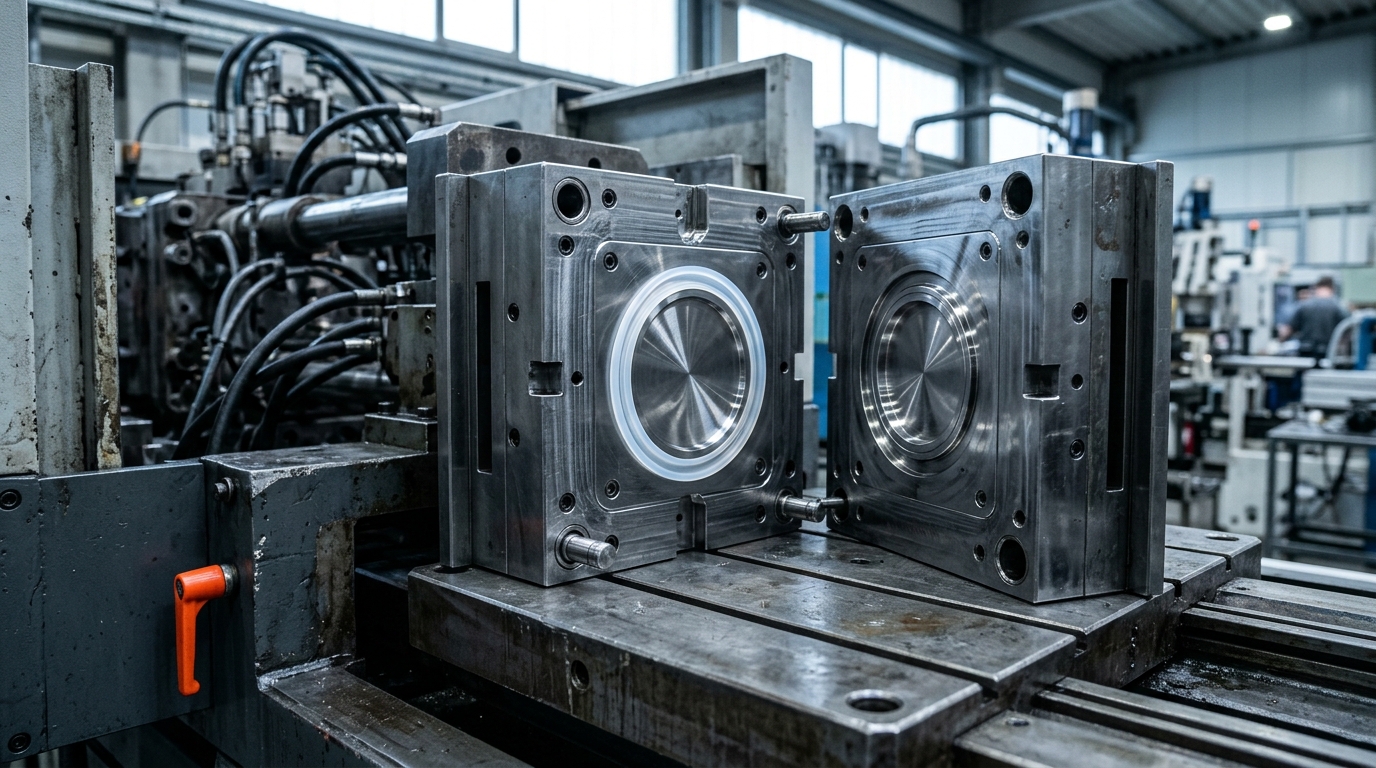
A gasket is the cheapest part on a lunch box and the only part that decides whether the box is worth shipping. It is also the part whose manufacturing process buyers almost never choose deliberately. They inherit it: one supplier quotes a mold, another quotes a mold, and the gasket comes along with whichever container quote wins.
That inheritance is where the money goes wrong. Liquid silicone rubber (LSR) injection molding and silicone compression molding produce the same geometry and, at the sealing face, often a part you cannot tell apart with your fingers. What separates them is not quality. It is where the cost sits: in the tool, in the cycle, in the labor per part, or in the flash.
Two quotes with two tooling lines are not a price difference. They are two different bets about your annual volume, and only one of them is sized for yours.
This page takes the decision apart in the order a sourcing manager actually meets it — what the gasket has to do, what each process does to the part, what each one costs to tool, and the volume at which the expensive tool becomes the cheap one. It is written from the buyer's side of the table by Xinghui Plastic, an injection-molding factory in Jieyang, Guangdong, whose food containers seal on a silicone gasket. Most of the pages ranking for "liquid silicone injection molding" are written by people who want to sell you the process; this one is written by someone who has to specify the part, and who has watched a tooling bill land on a product that did not need it.
Every figure below is either a physical property of the process or arithmetic you can rerun against your own quotes. No prices are printed, because a mold price without a drawing attached is a number with no meaning.
Why the Gasket, Not the Container, Is the Part That Leaks
A container is one molding with one tolerance chain: wall, rim, lid seat. A gasket is a second part, molded on a different machine from a different material, then dropped into a groove that was cut to a third tolerance. Three chains meet at the sealing face, and that meeting point is where lids fail.
The failure modes are physical and they repeat:
- Under-squeeze. The groove is too deep for the cord section, the gasket never gets compressed enough to close the gap, and the box weeps at the first tilt.
- Over-squeeze. The lid needs a shoulder to click, the gasket takes a permanent set, and by the tenth wash it has stopped pushing back.
- Flash on the sealing face. A thin fin of silicone crosses the land the gasket is supposed to seal against. It looks like a design error to the user and it behaves like one.
None of those are container problems. All three are decided by how the gasket was molded, and each of them lands differently depending on whether the part came out of an injection tool or a compression press. The distinction between airtight and leakproof matters here too — a gasket can hold pressure and still let air through, which is why the two terms are tested differently. If you are still at the stage of deciding how much sealing your product needs, seal structure and sample testing is the better starting point than a tooling quote.
Two Processes, One Part: What Actually Differs on the Floor
Liquid silicone injection molding and compression molding both cure silicone in a heated steel cavity. Everything that follows — cost, tolerance, color, volume — comes from how the material arrives.
Liquid silicone injection. The compound ships as two liquids, typically in pails or drums, one of them carrying the platinum catalyst. A metering unit pumps both, mixes them at a defined ratio, and injects the mix into a hot mold — commonly somewhere between 150 °C and 200 °C. Cure happens in seconds inside the closed cavity, because addition-cure silicone sets fast when it is hot. The shot is metered volumetrically, so the amount of material in the cavity is the same on shot 1 and shot 40,000. The same process runs in cleanroom cells for medical work; that is a cell and documentation difference, not a different molding principle, and it is the reason so much of the writing about LSR reads like a medical-device page.
Compression molding. The compound ships as a high-consistency rubber (HCR) — a gum that gets milled into sheets and cut into preforms by weight. One preform goes into each cavity, by hand, and the press closes on it. Cure takes minutes rather than seconds, under heat and pressure. The preform weight and the hand placement are the two variables the mold cannot control, and excess material escapes at the parting line as flash, which is trimmed afterward.
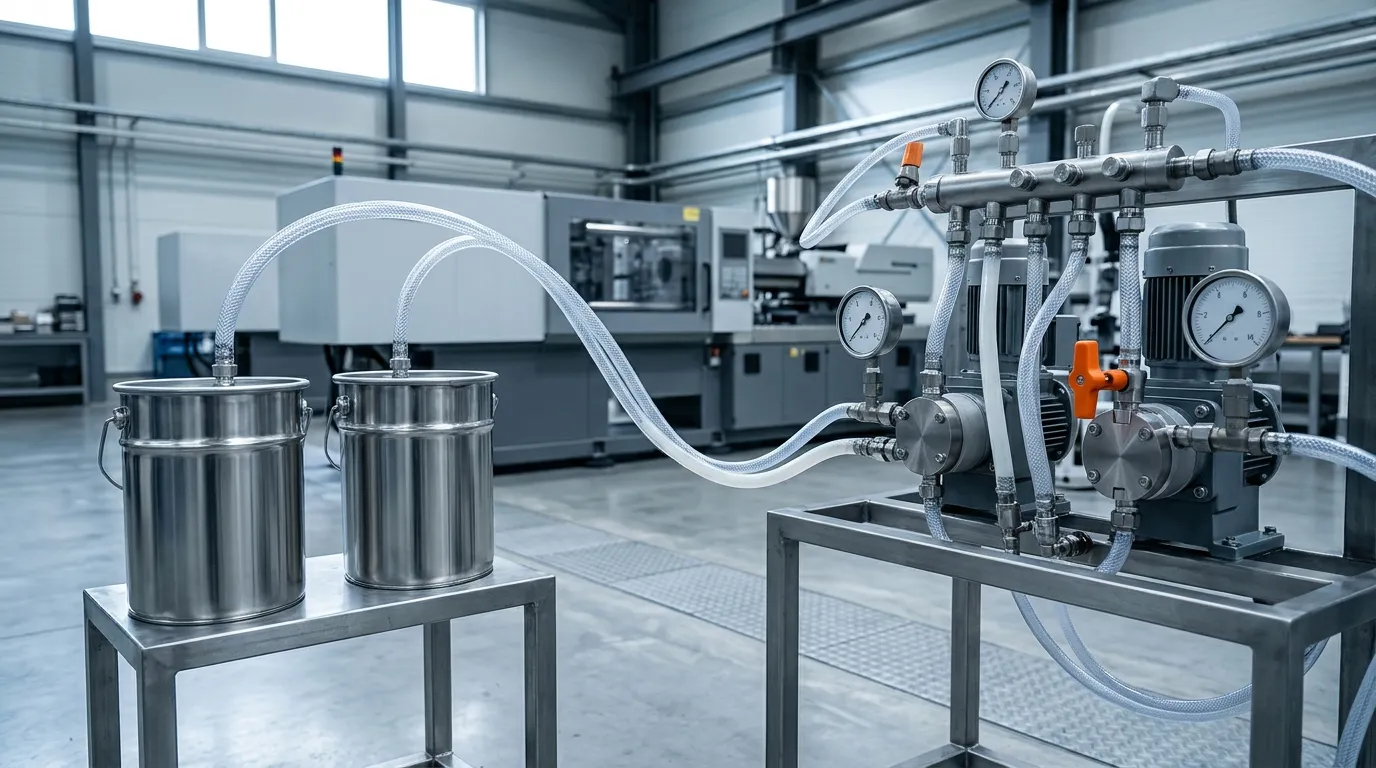
The differences that matter for a gasket, and the rest of this page prices each one:
Parameter | Liquid silicone injection (LSR) | Compression molding (HCR) |
|---|---|---|
Material form | Two pumpable liquids, platinum-cure | Gum, milled to sheet, cut to preforms |
How the shot is defined | Metered by volume at the mixing head | Weighed preform, placed by hand, one per cavity |
Cure | Seconds, inside a closed, heated cavity | Minutes, under press pressure |
Typical cycle | Roughly 30–120 s depending on section thickness | Roughly 3–10 min depending on thickness |
Cavitation | High counts are normal; the tool is the constraint | Counts limited by press platen area and handling time |
Flash | Thin gate vestige at a controlled location | Ring of flash at the parting line, trimmed after |
Dimensional repeatability | Cavity-to-cavity variation is small; the steel decides | Preform weight and flash land add variation |
Color change | Purge and clean the metering line; machine time | Clean the mill and the press; cheaper at small lots |
Hardness range | Wide, but compound availability narrows it | Wide, and small custom batches are practical |
Bonded/insert parts | Overmolding onto a substrate is routine | Possible, but placement is manual |
Tool complexity | Cold runner, shut-off faces, vacuum, controls | Cavity plate, flash land, ejector, heated platen |

Read that table one more time with a purchase order in mind. Nothing in it says one process makes a better gasket. Four things in it decide whether your tooling bill is proportional to your business: how many cavities you can afford, how long each cycle takes, how repeatable the sealing face is, and what a second color costs.
What Liquid Silicone Injection Molding Actually Changes at the Sealing Face
The sealing face is the one surface where a few hundredths of a millimeter changes whether the product works. Liquid silicone injection molding changes that surface in three ways, and all three come from the same cause: the cavity is filled by a metered volume and closed on steel.
The groove fill is repeatable. Because the shot weight is set by the pump rather than by a hand cutting a preform, the amount of material in the groove is the same part to part. On a compression-molded gasket, preform weight varies within a tolerance band; that variation lands directly in cord height, which is the dimension your squeeze calculation depends on.
The flash lives somewhere you can control. LSR tools are built with shut-off faces that close metal on metal, so excess material escapes at a gate vestige in a known spot rather than as a ring around the part. You can specify where that vestige goes — and keep it off the sealing land. Compression tools vent at the parting line by design, all the way around the perimeter, so the trim operation has to be good on every part.

The cavity count stops being a handling problem. A compression press needs a person or a robot to place one preform per cavity per cycle. An LSR tool at 32 cavities still needs one operator, because nobody is loading it. That is a labor-structure difference, not a labor-rate difference, and it is why the injection premium starts to look reasonable at volumes where the handling minutes per part stop being trivial.
Where the injection route does not help: the gasket still has to be designed right. A perfect tool will produce a perfectly repeatable gasket that leaks, if the groove is too deep. Why reusable containers leak is mostly a story about geometry and less about molding quality than suppliers imply.
The Tooling Bill: What You Are Buying When You Buy a Mold
A mold quotation is a price for a set of decisions. The total tells you almost nothing; the lines tell you what you are getting. For a gasket, the lines that move are these:
- Cavities. Each cavity is steel, machining time, and a shut-off face that has to seal. Cost per cavity falls as the count rises, but total cost rises faster than linearly for LSR because every added cavity needs its own feed and venting.
- Steel and heat treatment. A gasket cavity with a thin cord section and tight shut-offs is unforgiving of soft steel. This is where a cheap quote quietly saves money.
- Runner system. An LSR tool usually needs a cold deck or cold runner so the compound does not cure in the feed. That is a substantial fixed cost inside the tool, and it exists whether you order 2 cavities or 32.
- Vacuum and venting. Air trapped in a closed cavity becomes a void or a burn. LSR tools commonly pull vacuum; compression tools vent through the flash land instead.
- Ejection. A soft ring does not push out like a rigid box. Ejection design is part of the tool price, and a bad one shows up as torn parts at T1.
- Trial and sample. How many T1 iterations are included, and what counts as an extra one.
None of that is specific to gaskets, but the proportions are. A compression tool for the same ring is a cavity plate, a flash land, an ejector and a heated platen: no cold deck, no metering interface, no vacuum system. Its cost tracks cavity count almost linearly, because each added cavity is a pocket rather than a fed and sealed pocket.
The injection tool is expensive at two cavities and cheap per part at thirty-two. The compression tool is cheap at two cavities and stays cheap at twenty-four. That crossover is the entire decision.
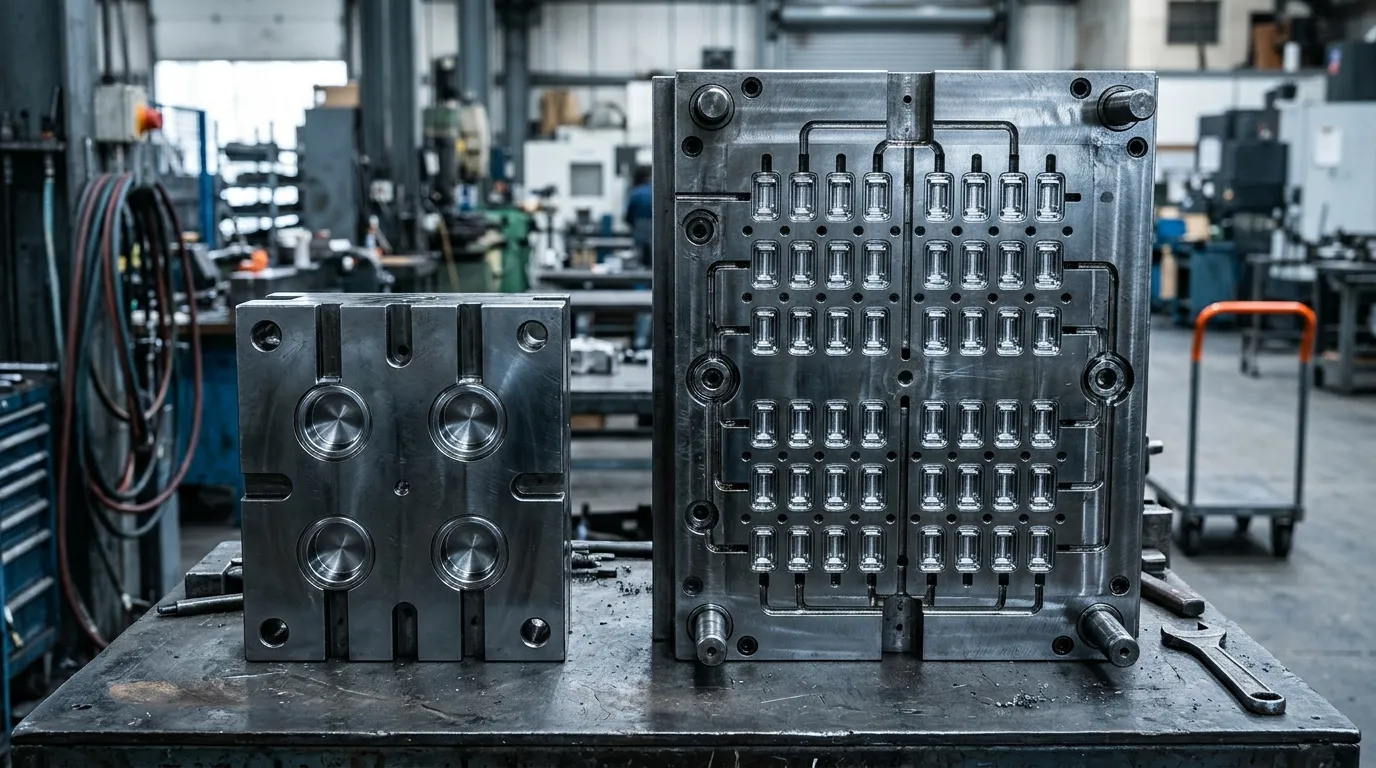
Three commercial terms belong in the same conversation, because they are what you actually own afterward: whether the tool is yours or the supplier's, what shot count it is warranted for, and what a replacement cavity insert costs. How to read an injection mold quote goes through those lines one at a time. If you are still deciding whether this gasket needs a new tool at all, modifying an existing mold versus cutting a new one is the cheaper question to answer first. And if the groove geometry is still moving, a printed prototype can settle some of it before steel is cut — provided you know which of the gasket's dimensions a printed part can and cannot prove. Our own mold development process is written up on the main site if you want to see what the tooling stage looks like from the factory side.
Cycle Time, Cavitation and the Volume Where the Tool Pays Back
Two numbers turn a process comparison into a volume comparison: how many parts come out of the tool per hour, and how much more the tool costs. Together they give you the cost per part at any volume you care to name.
Parts per hour is just cycle time and cavities:
Process | Cavities | Cycle time | Parts per hour | Press-hours for 100,000 pcs |
|---|---|---|---|---|
LSR injection | 8 | 60 s | 480 | 208 |
LSR injection | 16 | 60 s | 960 | 104 |
LSR injection | 32 | 60 s | 1,920 | 52 |
Compression | 8 | 5 min | 96 | 1,042 |
Compression | 16 | 5 min | 192 | 521 |
Compression | 24 | 5 min | 288 | 347 |
The table is arithmetic, not a quotation: 3,600 divided by the cycle in seconds gives shots per hour, multiplied by cavities gives parts per hour. Substitute your own molders' cycle times — they will differ with section thickness and with how hot the tool runs — and the shape of the answer does not change. At equal cavity count, compression needs roughly five times the press time. At equal press time, compression needs roughly five times the cavities.
Now the money. Let the injection tool cost Ti, the compression tool Tc, and the per-part prices pi and pc. The cumulative quantity at which the tooling premium is recovered is:
N* = (Ti − Tc) ÷ (pc − pi)
Divide N* by your annual volume and you have the payback in years. If that number is longer than the product life, the cheaper tool is the correct tool, and no amount of process enthusiasm changes it.
Three conditions make that comparison honest, and buyers get all three wrong routinely:
- The piece prices must be quoted at the same annual volume. A per-part price is a function of setup amortization; comparing a 50,000-piece price against a 500,000-piece price measures the volume, not the process.
- The same packaging, the same incoterm, the same inspection level. Deflashing is a real operation on compression parts. If one quote includes it and the other does not, you are comparing two supply chains.
- The cavity counts must be the ones you would actually buy. Comparing a 32-cavity LSR tool against a 4-cavity compression tool is comparing a decision to a placeholder.
Do that arithmetic and one pattern shows up often enough to plan around: below roughly 25,000 pieces a year, compression usually wins on total cost. Above roughly 100,000, injection wins unless the part is very large or very hard to feed. In between, it depends on cavity count and on how many colors you need — which is why the next two sections are about tolerance and color rather than about speed.
Tolerance, Flash and What "Fit" Means on a Drawing
A gasket drawing that says "±0.2 mm" in the title block is asking for a fight. Molded rubber does not have one tolerance; it has a tolerance per dimension, and the tolerance depends on what constrains that dimension.
ISO 3302-1:2014 for molded rubber products is built around exactly that idea — it sets tolerance classes rather than one blanket figure, and it distinguishes dimensions fixed by the mold from dimensions affected by how the mold closes. For a gasket, that split is the whole game:
- The groove depth and cord section are mold-bound. They come off the cavity steel, and both processes hold them well.
- The cord height and the sealing land are affected by the closing line, preform weight and flash. This is where compression molding gives up ground, because the flash land is a designed leak path for material and a variable thickness for you.
- The overall diameter and flatness are the dimensions buyers over-specify. They matter for assembly, not for sealing.

So specify per dimension: name the tolerance class where a class applies, put the critical sealing dimensions on their own line, and write the flash limit as a maximum thickness at a named location rather than as a general note. Then forbid flash on the sealing land by name. A molder who can meet that sentence will tell you so before cutting steel; one who cannot will agree to it anyway and argue at T1.

Hardness, Color and the Options That Do Not Survive a Small Order
Hardness is quoted in Shore A, measured under ASTM D2240, and for lid gaskets the working band is roughly 30 to 70. Softer compounds conform to a rough rim and seal at lower closing force, but they take compression set sooner and are easier to extrude out of the groove. Harder compounds hold their section and resist set, but they need more force to seal and make the lid harder to close. Most food-container gaskets land in the middle of that band, and the ±5 tolerance on the hardness callout is not a formality — a gasket on the soft end of one batch and the hard end of the next is a different product.
Color is where compression molding quietly wins, and where buyers get trapped in injection programs.
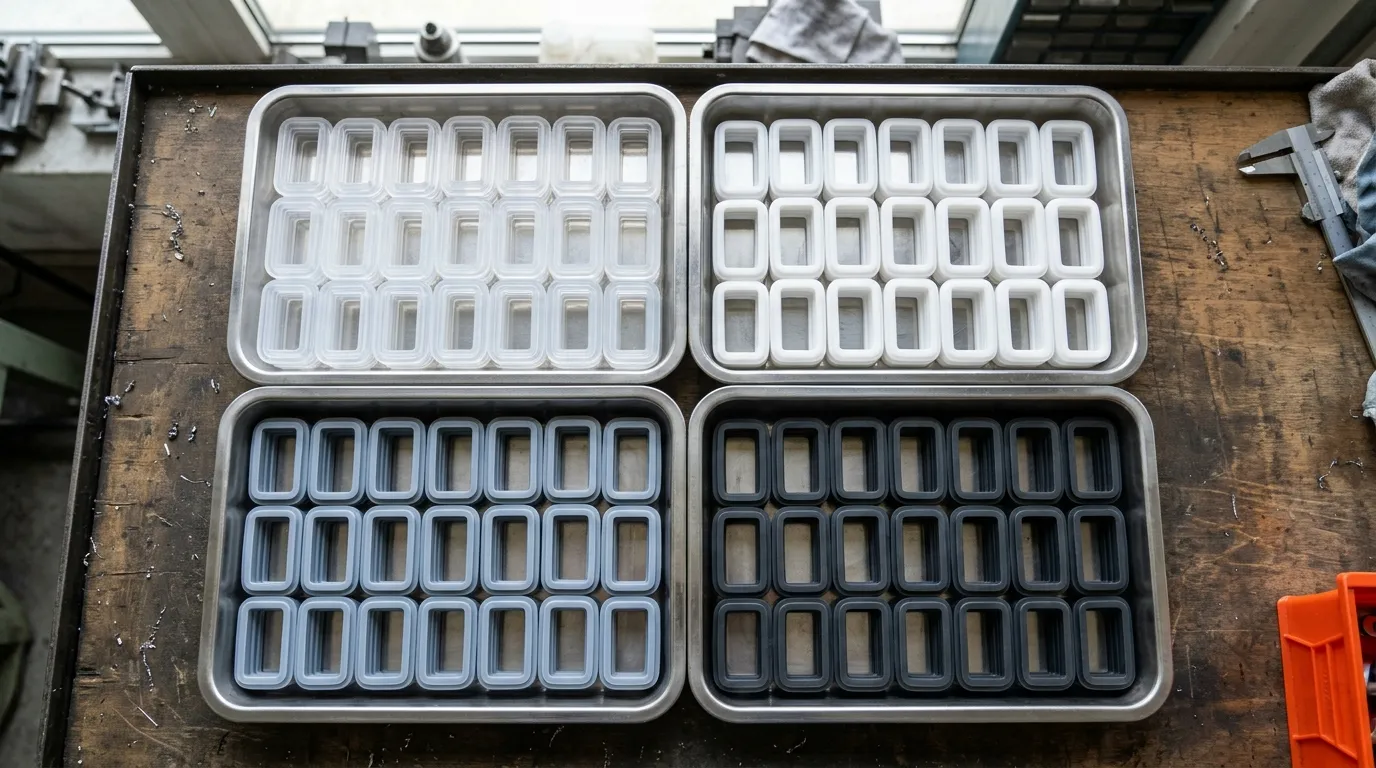
In an LSR line, a color change means purging and cleaning the metering head and the feed line. That is machine time, and it is charged to the batch whether the batch is 5,000 pieces or 50,000. In a compression cell, a color change is a mill cleanup and a new sheet — cheap enough that small color batches are normal. If your program is four colors of translucent gasket at 8,000 pieces each, compression is not the compromise; it is the rational choice, and an injection quote will look absurd next to it.
The reverse trap is easier to fall into. A single translucent color at 400,000 pieces a year is an injection part, and specifying it as compression because the tool was cheaper at the start is a decision that costs money every month for the life of the program. Note also that the gasket is not the container: the PP body and lid carry their own material and color rules, covered in PP and PS containers and what each material tolerates.
The Minimum Economic Volume, Stated as a Rule You Can Argue With
Every factory has a version of this rule and most of them state it as a preference. Here it is as a boundary instead: the volume at which liquid silicone injection molding stops being the expensive option. The caveat travels with it — this is a rule of thumb for a gasket in the 60–200 mm size range, and three factors move the boundary.
Annual volume (pcs) | Rational process | Why |
|---|---|---|
Under ~10,000 | Compression | Tool is cheap, handling cost is small in absolute terms, color and hardness flexibility is free |
~10,000–25,000 | Compression, unless tolerance or color count says otherwise | Injection premium cannot amortize unless the per-part saving is large |
~25,000–100,000 | Run both quotes; decide on cavity count | The crossover lives here, and it is decided by part size and how many colors you carry |
Over ~100,000 | LSR injection | Labor per part and press time dominate; the tool premium amortizes inside a year or two |
Three things move the boundary:
- Part size and weight. A large gasket needs a large press either way, but LSR needs a machine sized for the shot. Small parts favor injection; big, thick sections erode its cycle advantage.
- Tolerance at the sealing face. If the sealing dimension is critical and the groove is shallow, injection's repeatability is worth paying for earlier than the volume table suggests.
- Color and hardness count. Every extra color or hardness in the program pushes the boundary upward, because changeover cost lands on the small batches.
Where this meets commercial practice: minimum order quantities are usually counted per model and per color, not per order, and the same counting logic that makes a 4-color program expensive is explained in how MOQ is counted on a mixed order. A gasket program with four colors has four minimums even if it has one part number.
What to Put on the Drawing Before Either Process Is Quoted
A mold quote against an incomplete drawing is a price for a part nobody is going to make. These are the lines that have to exist first, in the order a molder reads them:
Line on the drawing | What to write | Why it decides fit |
|---|---|---|
Groove section | Depth, width, corner radii, with the mating rim dimension referenced | Sets the squeeze; the only dimension the seal actually depends on |
Cord section | Diameter or profile, with tolerance | Determines fill and the compression force available |
Squeeze | The percentage of section compression you require, stated explicitly | Removes the argument about who chose the groove depth |
Hardness | Shore A nominal ±5, test method named | Soft/hard drift changes closing force and set behavior |
Tolerance class | Per-dimension class, sealing dimensions called out separately | One title-block tolerance guarantees a T1 argument |
Flash limit | Maximum thickness at a named location; "no flash on sealing land" | Flash on the land is a leak path that looks like a design fault |
Material grade | Silicone grade reference, cure system, and the food-contact basis | Determines which compliance documents are even possible |
Surface | Finish requirement on the sealing land only | Over-specifying finish raises tool cost for no sealing benefit |
Color | Chip or reference, and the color's own minimum quantity | Color drives the changeover economics |
Packaging | Bag count, orientation, whether parts ship on trays | Soft rings deform in bulk; packing is a quality control |
Approval sample | What a golden sample is, and who signs it | The reference for every later argument about "within spec" |
Nothing on that list is exotic. What is unusual is having all eleven before the first quote, which is why two suppliers can quote the same gasket at prices that differ by a factor and both be honest.
The Food-Contact Papers a Silicone Gasket Should Arrive With
The gasket is a separate part with a separate material, so the container's paperwork does not cover it. A PP container declaration says nothing about the silicone ring inside it — a gap worth understanding before a retailer finds it, and the reason non-PP parts like gaskets, glass inserts and bases are treated as their own compliance object.
Five documents to request, and what each one actually proves:
- A material declaration of compliance, naming the specific silicone grade and the regulation it is assessed against. In the EU the framework is Regulation (EC) No 1935/2004, which requires that food-contact materials not transfer constituents in quantities that endanger health, and that they be traceable. A declaration is how a supplier evidences that; it is a supplier statement, not a test.
- A migration or extraction test report from an accredited lab, naming the simulants, temperatures and durations used. This is the evidence behind the declaration. Without the test conditions printed on it, a report proves very little.
- For the US market, a statement of compliance with 21 CFR 177.2600, the FDA regulation covering rubber articles intended for repeated use. Read the scope: it covers the rubber article, so ask which of your parts it is being applied to.
- For Germany, a BfR Recommendation XV statement and, commonly, an LFGB test report. BfR XV is a recommendation rather than a statute, but European retailers ask for it by name, and what an LFGB certificate actually covers is worth reading before you accept one as a substitute for the other.
- For China, the rubber part of the GB 4806 series, if the goods are also sold domestically.
For a market-by-market view of which document each destination expects, the five-market compliance map lays them side by side. Ask any supplier — including us — for the declaration and the test report as a pair. A declaration without a test report behind it is a sentence, and a test report without a declaration naming your grade is a report about somebody else's material.
Questions Buyers Ask Before Signing a Tool
Who owns the tool, and what happens at the end of the program?
Ask explicitly. Tool ownership, and the right to move the tool to another molder, is worth more than a few percent on the piece price — and it is the clause buyers read a year too late. If the answer is "the factory owns it", price the alternative before you sign.
What is the tool warranted for, in shots?
A shot-count warranty is the only meaningful tool-life number. Ask what happens at 60% of that count if a cavity insert cracks, who pays for the repair, and whether a spare insert can be ordered with the original tool. For a 32-cavity tool, one bad cavity is a 3% capacity loss forever if nobody planned for it.
What do I get at T1, and what am I allowed to reject?
T1 is where tolerance and flash become visible. Ask for a dimensional report on the sealing dimensions, a flash measurement at the named location, and enough parts to run your own leak test. Then decide what a golden sample is and sign it — the golden sample is what governs mass production, not the drawing, once the two disagree.
Where This Leaves the Two-Quote Decision
Run it in this order and the process question answers itself:
- Write the eleven lines above. Without them, neither quote means anything.
- Get both quotes at the same annual volume, same packaging, same inspection level.
- Compute
N* = (Ti − Tc) ÷ (pc − pi)and divide by your annual volume. Under two years, the injection tool is doing its job. Over the product life, it is not. - Check the three modifiers: sealing-face tolerance, color count, part size. Any one of them can move the answer a band.
- Settle ownership, shot-count warranty and T1 acceptance before steel is cut.
Most gasket programs we see land in the middle band of the volume table, with two quotes that differ by a tooling premium and a piece price that almost pays it back. That is the normal case, and it is why the arithmetic matters more than the process argument.
If you are sourcing containers with gaskets — lunch boxes, bento sets, snap-lock storage — the gasket decision arrives attached to a container decision, and the two are usually cheaper to solve together than apart. Our lunch box range shows the groove geometries we already tool for, and the sourcing and OEM section collects the rest of the purchase-side questions in this series. Send a drawing with the eleven lines on it and you will get an answer about the gasket, not about the machine.
Continue reading
Related sourcing guidance
More practical context for your food storage container sourcing conversation.


Discuss your product range
Need help selecting or customising containers?
Share the product type, market and sourcing requirements with the Xinghui team.