
Compliance & Food Safety
PP vs PS for Reusable Food Containers: How Resin Choice Changes Unit Cost, Drop Resistance and Compliance
PP and PS both go into food-contact containers, but they behave nothing alike in a reusable one. How the resin moves unit cost, drop resistance and documents.
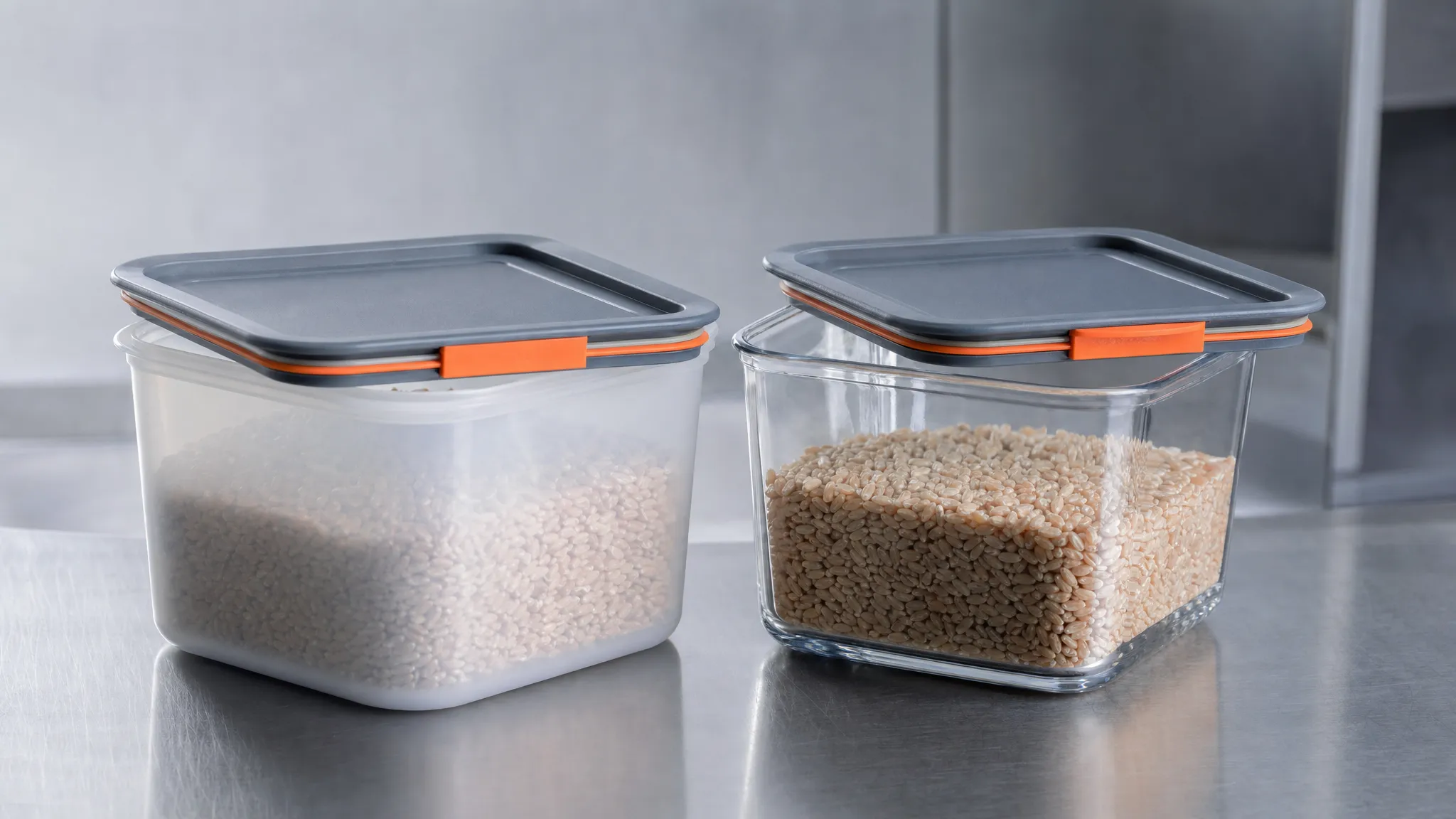
"Food grade plastic" is a category, not a material. The moment your brief names PP or PS for a reusable container, four things stop being interchangeable: what the resin looks like, how it behaves when dropped, what it costs once packed, and which food-contact documents the factory can put against it.
Where we stand matters for how you weigh the rest. This is Xinghui Plastic, an injection-moulding plant in Jieyang, Guangdong — the site states it was established in 2000, covers 15,000 m² and runs 30+ injection-moulding machines — and the reusable food containers we run are polypropylene. That is a commercial interest, which is why the sections below say plainly where polystyrene is the better answer.
Everything here is a property you can check on a datasheet or a carton figure from our own published product records. No prices, no certification numbers, no legal advice — compliance is a list of documents to request and read against your own product.
PP and PS Are Not Two Grades of the Same Thing
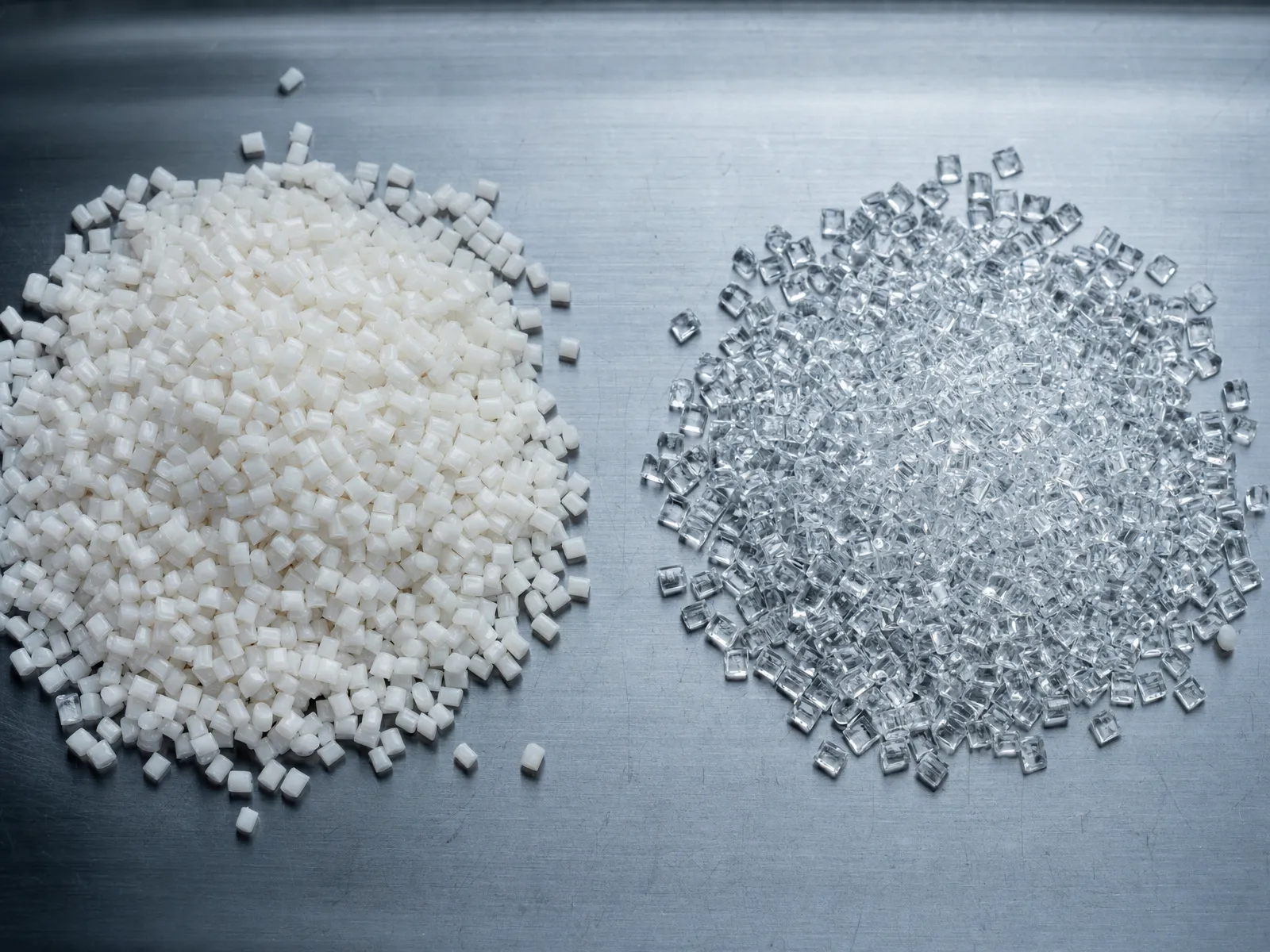
Polypropylene (PP) is semi-crystalline (Polypropylene). Its chains fold into ordered regions with a real softening point — around 160–170 °C — which gives a polymer that is tough, springy and slightly hazy: it bends before it breaks, which is why a PP lid can carry a living hinge flexed thousands of times without cracking.
Polystyrene (PS) is amorphous (Polystyrene). Its chains are disordered, so there is no crystalline melting point at all; its defining number is the glass transition temperature, around 90–100 °C, and the polymer behaves like a stiff glass. That stiffness is what makes it clear and dimensionally crisp — and what makes it brittle.
Two labels travel with the resin: PP carries resin identification code 5 and PS carries 6 (5 = polypropylene, 6 = polystyrene), from the system developed in 1988 by the Plastics Industry Association's predecessor and specified today by ASTM D7611. The code is what a recycler, a retailer's compliance team and a market regulator each read to route the item, but it does not tell you the wall thickness, the grade or the service temperature; for that you go to the datasheet. Our notes on which plastics are safe for food storage and on PP specifically set out that narrower question.
The Comparison Table Buyers Should Actually Use
Most PP-vs-PS pages compare sheet properties or labware. This is the same comparison written for a reusable container that has to survive a kitchen.
Line | PP (polypropylene) | PS (polystyrene) |
|---|---|---|
Resin identification code | 5 | 6 |
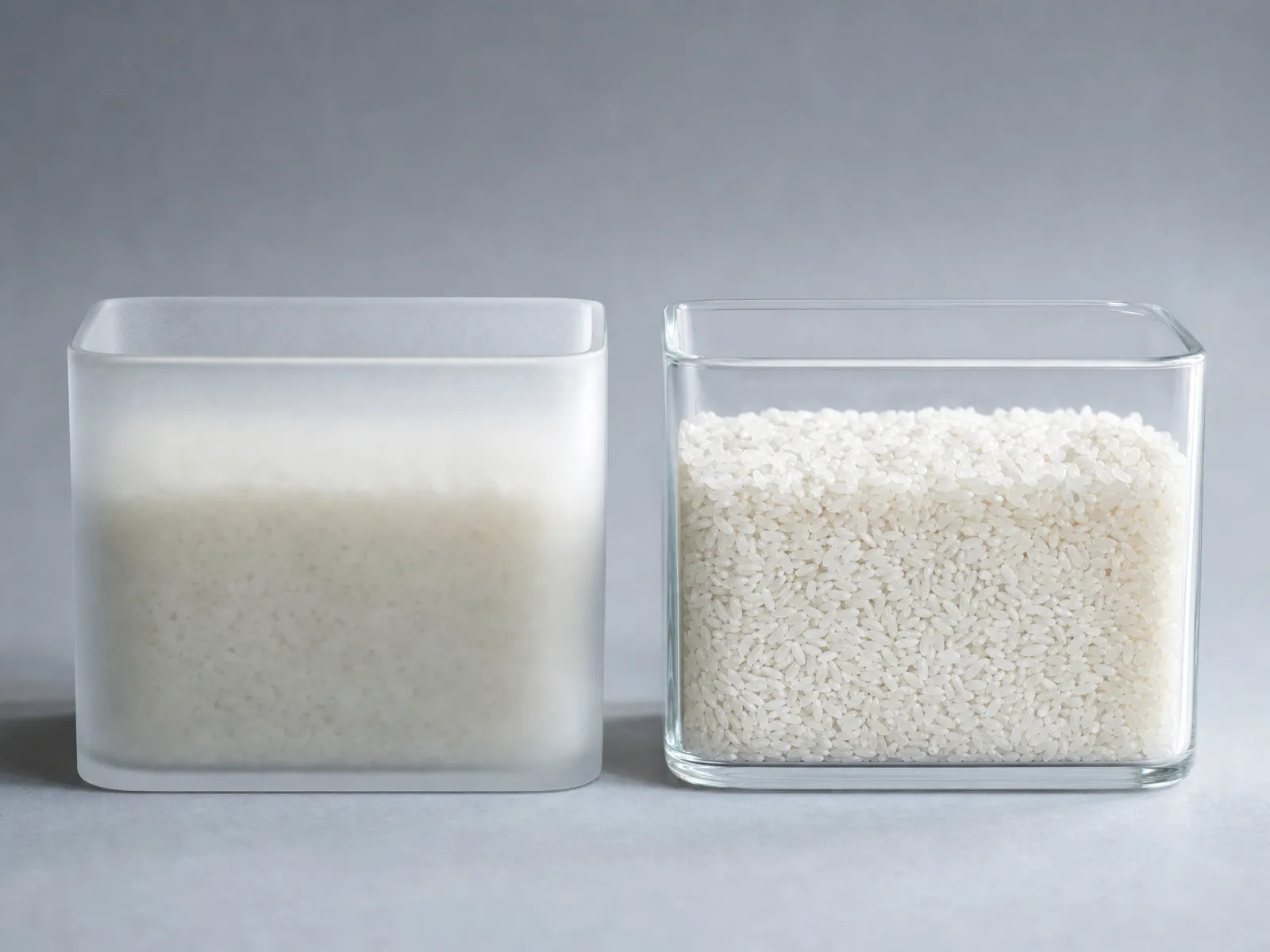
Typical clarity | Translucent and milky; hazy unless a clarified, nucleated grade is specified | Optically clear in general-purpose PS (GPPS); opaque white or pigmented in high-impact PS (HIPS) |
Temperature — and which number is on the label | Melting point roughly 160–170 °C; continuous service temperature around 100 °C, which carries hot fill and dishwasher cycles | No true melting point; its defining number is the glass transition temperature (~90–100 °C), and its continuous service temperature is far lower — typically 65–85 °C. The processing figure is not the one a buyer needs |
Drop and impact behaviour | Tough: flexes on a knock without cracking; tolerates a lid opened and closed thousands of times | Stiff and brittle: absorbs little energy and fails by cracking — usually from a sharp edge, a cold tin or a hard floor |
Main unit-cost drivers | Resin price, wall thickness, cycle time, clarity grade, and the scrap/regrind assumption inside the part price | A lower resin price per kilogram, offset by higher density and by the stiffer walls a brittle part needs |
Typical suitable applications | Reusable food containers, lunch boxes, freezer boxes, snap-lock lids, hinges — anything reused and washed | Clear display and portion containers, disposables and decorative items, tissue boxes, soap dishes |
Food-contact documents to request | The olefin-polymer route: the grade's food-contact status plus a migration report on the finished article | The polystyrene route: the grade's status under the polystyrene provisions plus migration data on the finished article |
Industry-typical published values for the two polymer families — the continuous-service-temperature bands included; they are family-level figures, not grade-specific ones. Not a substitute for the datasheet for the exact grade and finished part.
The resin you choose moves clarity, failure mode, cost driver and paperwork together.
Clarity: Where PS Wins on Day One
If clarity is the product, PS is the honest answer. GPPS is one of the clearest commodity plastics, and no standard PP grade reaches the same optical clarity without paying for a clarified grade.
That matters commercially: a clear container sells contents, and a clear wall is a shelf decision before it is a materials decision. Our glass-versus-plastic lunch box note weighs glass against PP, Tritan and PET; placing PS between glass on clarity and PP on toughness is this article's own read, not that note's conclusion.
The cost of that clarity is the same property that produces it. A stiff, glass-like polymer has almost no give, so a clear PS container dropped onto a tiled floor tends to crack along a corner, while a translucent PP container of the same wall tends to scuff and bounce. If the SKU is a display container the customer carries home and reuses, clarity bought at the price of brittleness is a returns problem; if it is a retail pack for a single serving, the trade is usually right. HIPS — PS with rubber particles dispersed through it — is the middle path: opaque rather than clear, which is why it appears in coloured cases.
Drop Resistance: The Property That Ends a Retail Programme
Drop resistance is where the two resins separate most sharply.
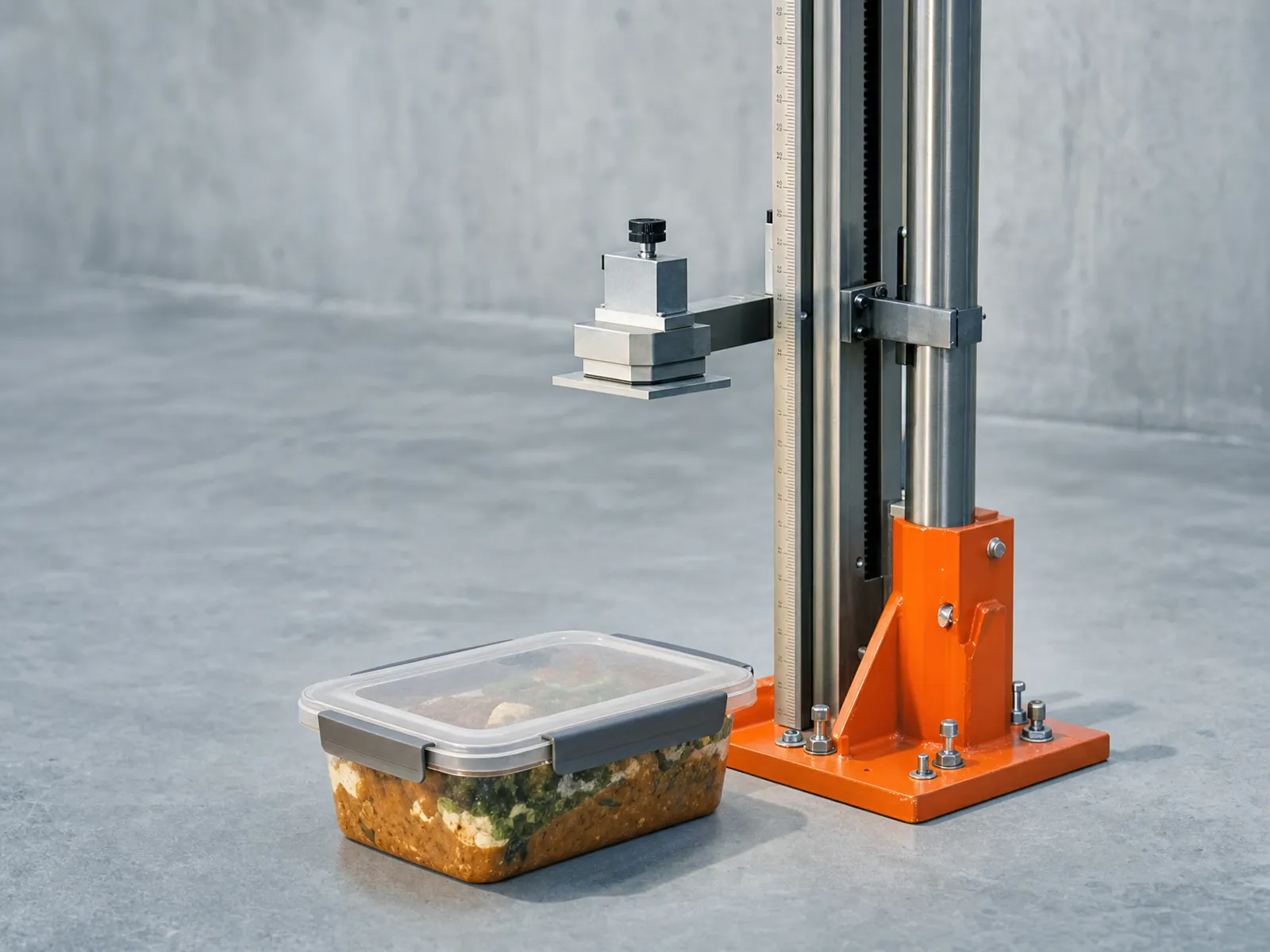
The failure mode is different. PP is tough: hit it and it flexes, then returns; a crack needs a notch, a stress concentration or a repeat cycle. PS is stiff and brittle: hit it and the energy has nowhere to go, so it propagates a crack. The datasheet line for this is impact strength — an Izod or Charpy figure — and it is what to compare across two candidate grades. A retailer's return rate lives in that difference, because the damaging event is rarely the first use: it is the tin dropped on the kitchen floor, or the pallet knocked at the cold-chain end.
The temperature that matters is the service temperature, not the processing temperature. A comparison that quotes "melting point" is usually quoting how hot the polymer must be to be moulded — the processing temperature — and presenting it as though it described the finished container. What a buyer needs is the maximum continuous service temperature (and, for a load-bearing part, the heat deflection temperature): the point at which a filled container in a hot car, a microwave or a hot-fill line starts to lose its shape. For orientation, PP's sits around 100 °C and general-purpose PS in a 65–85 °C band. The two families are processed in overlapping temperature windows, which is exactly why the processing figure alone misleads.
Drop behaviour is not only the resin. Wall thickness, corner radii, ribbing and lid design all decide whether a fall ends in a scuff or a crack — the same resin can be specified to fail or to survive, which is why a drop test belongs in sample approval rather than in an argument. The method is ASTM D5276, Standard Test Method for Drop Test of Loaded Containers by Free Fall; the sample discipline behind a seal or latch claim is in our leak-proof seal note, and the incoming-batch checks are in our how to check lunch box quality piece.
How Resin Choice Moves Unit Cost
The claim that PS is cheaper than PP is true and useless, because it names the wrong line. Unit cost is the sum of five terms, and the resin price per kilogram is only the first.
- Resin price per kilogram. PS is generally the cheaper polymer at the resin gate — the number the comparison pages stop at.
- Density. PS is denser, so an identical moulded volume produces a heavier part. Resin is bought by weight, so a heavier part spends the cheaper polymer's advantage before it reaches the packing line.
- Wall and stiffness. PS is stiffer, so some walls can be thinner — a real saving — but a brittle part often needs the opposite, which is why these two are asked together.
- Cycle time and shrinkage. A stiffer, denser polymer cools and ejects differently, moving machine-hour cost in either direction; mould shrinkage moves again with the grade, showing up as out-of-tolerance parts or as a tool cut to the wrong number. Ask for cycle time at your cavity count, and for the shrinkage figure the tool was cut to.
- Scrap and regrind. Every part price contains a scrap assumption and a decision about whether sprues and rejects are re-fed — worth more on a brittle polymer than a tough one.
The comparison to build is a break-even calculation, not a price list: quote the part in both resins at the same cavity count, wall and packing basis, then divide the tooling difference by the part-cost difference. Our how to read an injection mould quote walk-through sets out the same normalisation discipline, and the note on how colouring methods behave in the mould covers the colour route itself — the separate input that makes a clear or white SKU its own quotation line.
Carton and Freight: The Cost Line That Moves With the Resin
The term buyers leave out of the resin comparison is freight, and freight is set by the carton. Real carton data from our own published product records:
Model | Product | Carton (cm) | pcs / carton | Carton volume (computed) | Gross weight |
|---|---|---|---|---|---|
BX1094–BX1099 | 1.4 L freezer storage box, PP | 59.5 × 43.5 × 53.5 | 72 | 0.1385 CBM | — |
3332 | Kitchen and frozen container, PP | 64 × 49 × 56 | 56 | 0.1756 CBM | 16.1 kg |
3334 | Tall storage container, PP | 59 × 56 × 65 | 80 | 0.2148 CBM | 14.7 kg |
BX1051 | 1.3 L lunch box, PP + silicone, 182 g unit | 62 × 47.5 × 58.5 | 72 | 0.1723 CBM | 14.3 kg |
Two derived numbers fall out, and both belong in your cost comparison.
Carton litres per piece. Divide carton volume by piece count: the 1.4 L freezer box takes about 1.9 litres of carton space per container (138.5 L ÷ 72), the 3332 line about 3.1 litres each (175.6 L ÷ 56), the 3334 line about 2.7 litres (214.8 L ÷ 80) and the lunch box about 2.4 litres (172.3 L ÷ 72) — roughly a 63% spread in the freight volume you are buying for the same rough product class. Illustrative arithmetic on our own cartons — palletising and the forwarder's stow decide the real container count.
Packed weight per piece. 16.1 kg over 56 pieces is about 288 g of packed weight per container, 14.7 kg over 80 pieces about 184 g, and 14.3 kg over 72 pieces about 199 g.
Both numbers are where a density difference stops being academic. A denser polymer makes a heavier container, and one that nests badly buys less product per container. A part priced two cents lower that ships at 3.1 litres of carton per piece can lose to one priced two cents higher at 1.9 litres on a single 40-foot container, before anyone discusses the resin. The geometry is in our stacking, nesting and carton maths note and our tall storage box guide.
Compliance Moves With the Resin: The Documents Change
Food-contact compliance is not a plastic-versus-plastic verdict; it is a document set that follows the polymer, the grade and the finished article. Read this as a map of what to request.
United States. Food-contact plastics are regulated through the food-additive route administered by the FDA, and the section depends on the polymer. For the olefin family that includes PP, the status sits in 21 CFR 177.1520, Olefin polymers; for polystyrene it sits in 21 CFR 177.1640, Polystyrene and rubber-modified polystyrene. Those two sections — not the phrase "food grade plastic" — are what a US buyer's compliance team will ask you to file. PET follows a third section (177.1630); a statement that names the polymer but not the section is one you cannot file.
European Union. Plastic food-contact materials sit under Regulation (EU) No 10/2011, which sets the migration framework behind a declaration of compliance. Regulation (EC) No 1935/2004 is the general framework above it, and the German LFGB route and other national schemes hang off the same declaration.
What actually changes with the resin. Two things. First the grade — a food-contact grade has to be named, and a "food grade PP" claim without a grade is not a document. Second the use conditions — a declaration of compliance describes migration at stated conditions of time and temperature, so a hot-fill resin needs its migration data read at the hot-fill condition, not the room-temperature one.
Where to start on the paperwork. Our five-market document map lays the set out by market, the shorter list of documents to request from a factory is the version to paste into an email, and the certification checklist explains what each is for. Regardless of resin, ask for the document that names your product — a company certificate and a product migration report are different objects.
What We Actually Run, and Where PS Is the Right Answer
Our reusable food-contact containers are PP-bodied. The published range is wide — silicone-sealed round and rectangular boxes, 1.4 L freezer storage boxes (BX1094–BX1099, PP, 20.3 × 15 × 6.5 cm), stackable kitchen containers (3332), PP/PET freezer sets and the tall square family (3334) — and what they share is a load-bearing wall that is reused. We injection-mould rather than thermoform for that reason: a reusable wall is a moulded wall, and a thermoformed tray is a one-trip product class.
Where PS and HIPS do appear in our own records is instructive rather than random: a tissue-box housing (PP + PS), a soap dish (HIPS, models 8842 and 8843), and the rigid PS base of an ice-cube tray whose inner grid also carries TPE (BH4439B). In each case clarity, stiffness and cost drive the design and the part is not a hot, washed, reused container; our organiser shelves make the same point from the other direction, being ABS with stainless steel for stiffness and finish rather than food contact. The honest line: PS is right when the object is decorative, clear or single-serving; PP is right when it is reused, dropped and washed.
There is a market dimension too, and it is not a materials one. Single-use expanded polystyrene items sit in a named restricted list under Directive (EU) 2019/904, so a European programme has to separate "polystyrene" from "expanded polystyrene, single-use" before it specifies anything. Our PP lunch box line is the closest published reusable example, and the buying checklist for the pantry-container equivalent is in our food-grade kitchen storage container note.
Questions Buyers Ask Before They Specify a Resin
Is PS plastic safe for food?
That is a question about a specific article in a specific use, not a category. General-purpose and high-impact polystyrene have a US food-contact route in the polystyrene provisions and a European route through the migration framework, and the answer changes with fat content, temperature and contact time. Ask for the grade's status and the finished article's migration data at your use condition — not for a verdict on the word polystyrene.
Should you avoid polypropylene?
No blanket reason to. PP is the workhorse resin for reusable food containers because it is tough, heat-tolerant and washable. What is worth checking is the grade — a named food-contact grade — and, if clarity is on the brief, the clarified-versus-standard choice: a standard PP wall is hazy, which is an optical limitation rather than a safety one.
Does PP release microplastics?
That question sits in the research literature, not in a resin datasheet, and this article cannot answer it for you. What a buyer can specify is the part: a named food-contact grade, a migration report read at the intended use conditions, and a wall that survives the wash cycles it is sold for. Claiming more than that would be a claim we cannot support.
Is PP or PS cheaper?
At the resin gate, generally PS. At the container, it depends: PS's lower price per kilogram is spent again through higher density, through whatever wall a brittle part needs, and through the carton volume the finished geometry buys. Compare packed cost per piece — resin plus machine time plus carton.
What to Do Next
If the brief is a reusable container with a lid, washed and carried, the resin question usually answers itself in favour of PP, and the real decisions become wall thickness, lid mechanism and carton. Browse the food storage container range to see which geometries already exist, then send the capacity list, use conditions and target markets.
If clarity is the product and the item is single-serving or decorative, PS or HIPS is a legitimate specification — and the section above tells you which document set to ask for. Specify the grade, the service temperature and the use condition, and the material choice becomes a line on the datasheet rather than an argument.
Continue reading
Related sourcing guidance
More practical context for your food storage container sourcing conversation.
Discuss your product range
Need help selecting or customising containers?
Share the product type, market and sourcing requirements with the Xinghui team.