
Lunch Boxes & Bento
Plastic Lunch Box Manufacturer: PP Bento Boxes and Ramen Bowls, 1.2–1.3 L, OEM from a Jieyang Factory
How a PP lunch box factory actually works: 1.3 L and 1,200 ml bento box lines, compartment geometry, lid and gasket fit, tooling, MOQ and export packing.
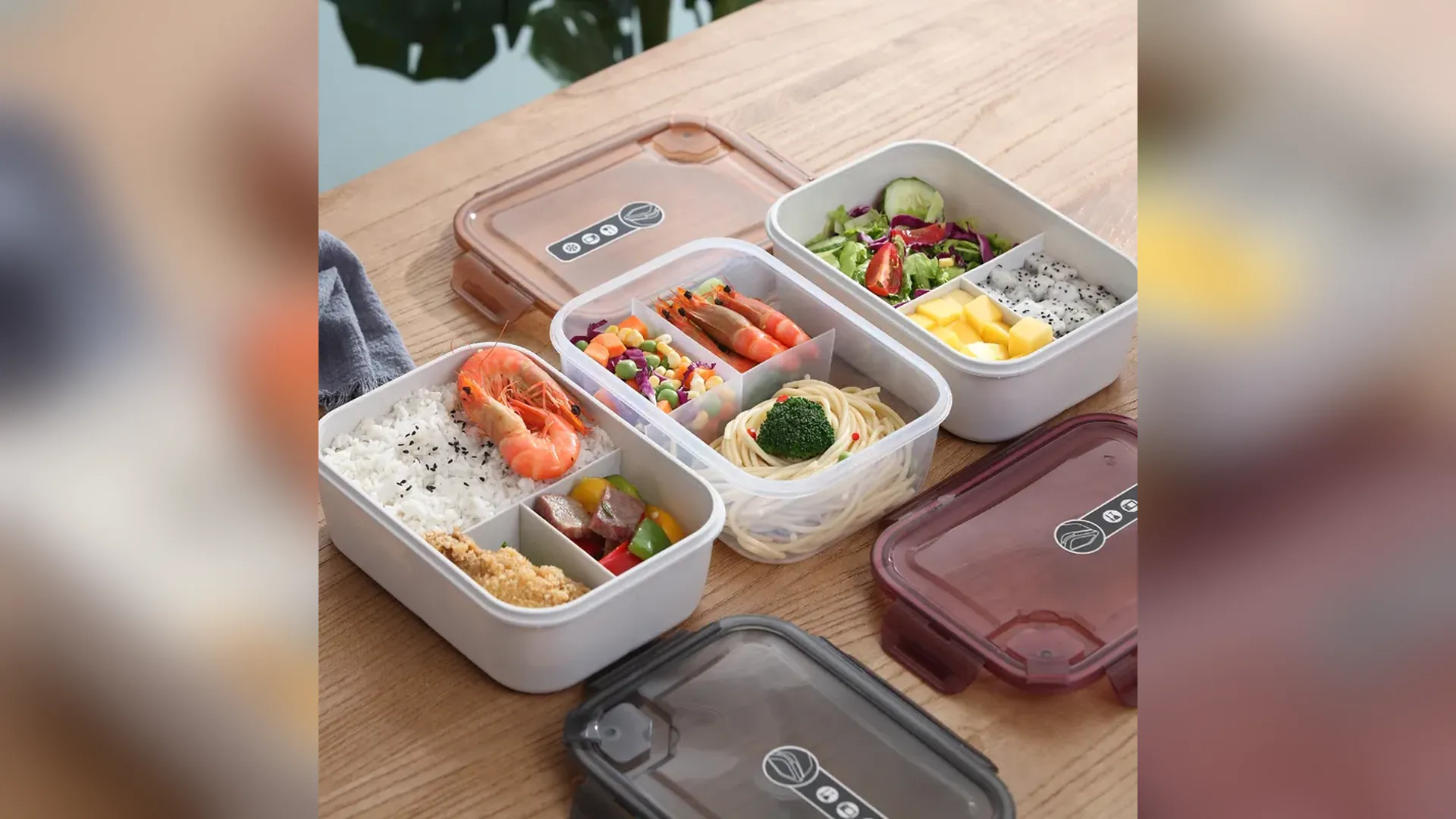
A plastic lunch box manufacturer is the party that owns the mould, the resin and the machine — not the party that lists other people's boxes. We run that side of the business in Jieyang, Guangdong, where our published figures put the plant's start in 2000, its floor area at 15,000 m², 30+ injection molding machines in the molding hall, and buyers in 60+ countries. What follows is the PP (polypropylene) half of our lunch box range — bento boxes at 1.3 L and a 1,200 ml ramen bowl — and the decisions between a drawing and a loaded container.
What Buyers Mean by a Plastic Lunch Box Manufacturer
Three businesses answer to the search terms this page sits under — plastic lunch box manufacturer, PP lunch box manufacturer, plastic lunch box factory — and only one of them makes anything. A trading company forwards your drawing to a plant it buys from, adding a layer between you and the tool. A directory — and much of what ranks for these terms is directories — sells visibility rather than a product. A manufacturer answers for the specification, the tool and the carton.
What changes at the plant is narrow and concrete: colour, compartment layout, wall structure, lid geometry, carton count and packaging form are all resettable against the model you choose, and the same party that cut the tool confirms the figures. What does not change is the arithmetic — unit weight and carton cube decide your freight. So the useful comparison is not "supplier A is cheaper than supplier B" but "which carton am I paying to ship". If the plant itself is still being shortlisted, our notes on what importers check in a lunch box factory cover that stage; this page starts from the model and the tool.
One scope note: everything below is PP. We also publish 304 stainless steel bento boxes and a borosilicate glass line, and we must not answer for them — the material stack changes the lid, the weight per piece and the compliance file. If you are still choosing between PP, steel and glass, that cross-material lunch box comparison covers all twelve published models side by side.
The PP Line We Mould: BX1051, BX1069 and 6529
Three published PP records carry this page — the two shapes a plastic bento box manufacturer and a plastic ramen bowl manufacturer are asked for most often: a rectangular compartment box and a round bowl. Every figure below is copied from the product record as it stands, including the fields the record flags as scope-dependent and the ones that are blank.
Model | Capacity | Compartments | Material | Unit weight | Packing | Carton / box size (cm) | Gross weight | MOQ |
|---|---|---|---|---|---|---|---|---|
1.3 L (43.96 US fl oz) | 3 | PP + silicone | 182 g | 72 pcs / carton | 62 × 47.5 × 58.5 | 14.3 kg | Not recorded | |
1,200 ml (40.58 US fl oz) | Not recorded (round bowl) | PP + silicone | 135 g | 60 pcs, kraft paper box | Not recorded | Not recorded | Not recorded | |
1.3 L (1,300 ml) | Not recorded | PP + silicone | Not recorded | 48 pcs / carton, OPP bag | 51 × 46 × 62 | 15 kg | 2,000 pcs |
Three notes on reading it. Unit weight is the record's "Grammage" field, which flags its own basis as needing confirmation — it is the piece, not the packed unit. The dimension column copies the field each record carries, and the two are not labelled alike: BX1051's figure comes from its "Box Size (confirm packing scope)" field and 6529's from its "Carton Size". Gross weight carries the same scope caveat, because it only means something once you know whether inner bags and dividers are inside the carton. BX1069 is a round bowl, so a compartment count does not apply to it. And 6529 is the only one of the three with a recorded minimum order. Prefer to see the whole range before committing to one model? The lunch box category page carries the recorded data for every line we publish.
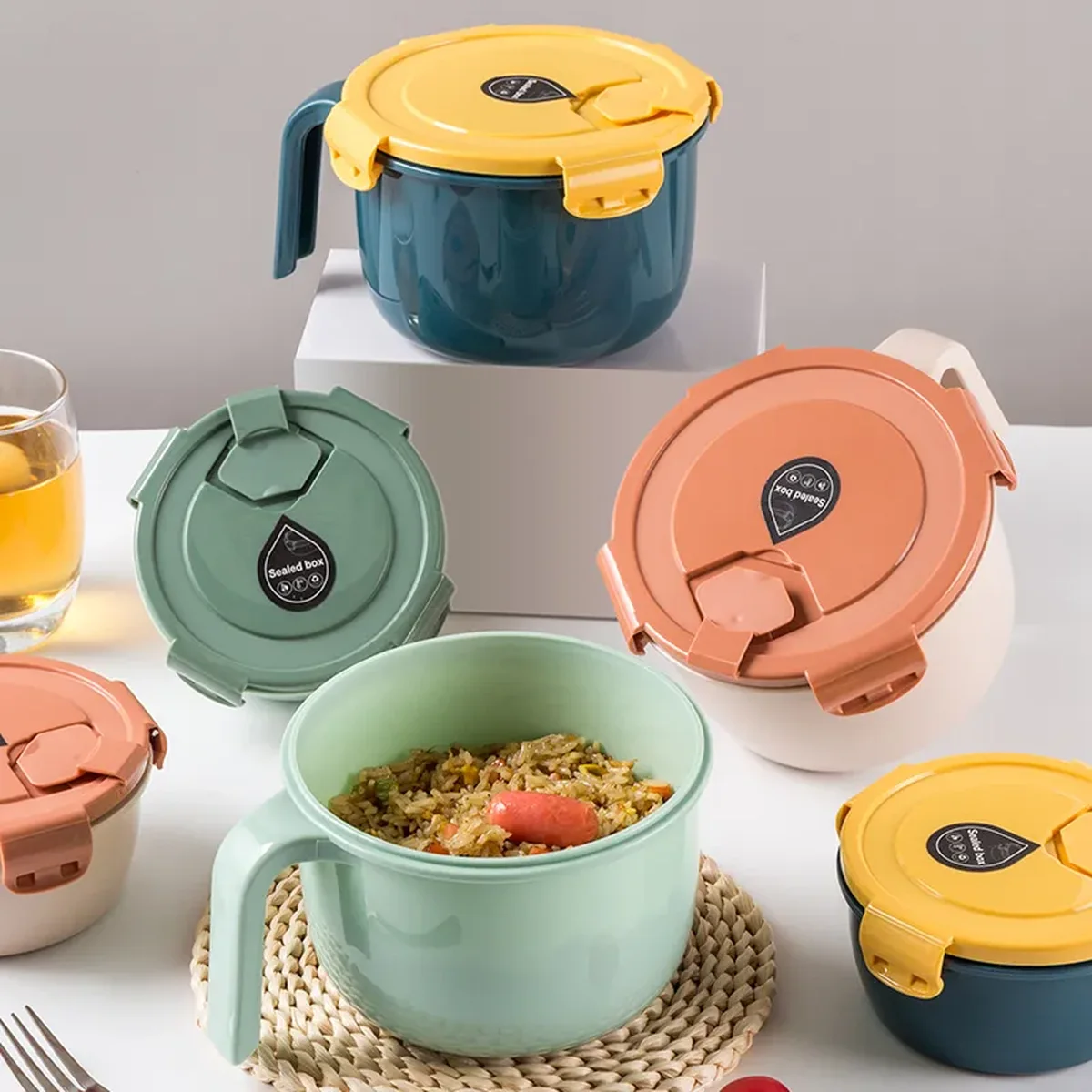
BX1069: the same round PP bowl with its clip lid and side handle, shown in a spread of body and lid colours.
All three are PP with a silicone sealing element, all three are recorded as OEM/ODM available with colour, size, logo and package customization, and all three sit in the 1.2–1.3 L band where one adult meal fits without a stack of parts. The weight spread — 182 g against 135 g for a similar capacity — is the number to watch, and the next section explains why.
Compartment Geometry: What Moulded Dividers Cost You
Compartment count is not a preference you express; it is a mould feature you buy. When a buyer asks a 3 compartment lunch box manufacturer for three compartments, the request is really for steel: each divider is a wall in the cavity, and each wall has to be thick enough to fill, drafted enough to release, and cooled fast enough not to warp the body around it.
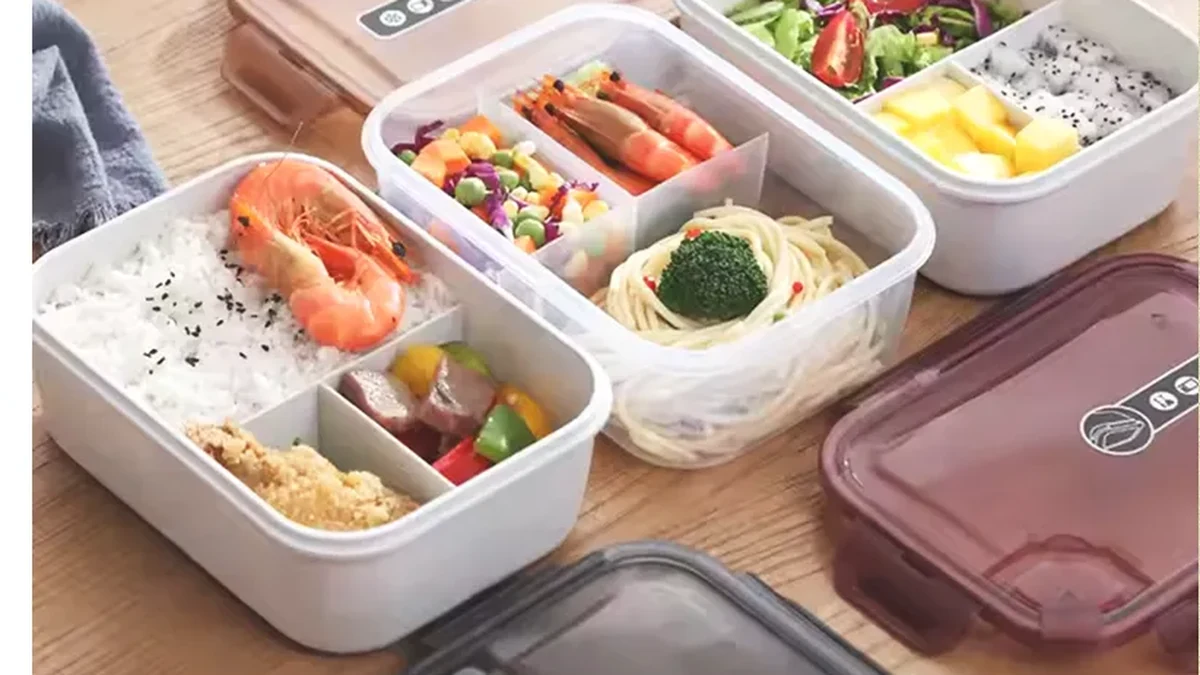
Two consequences follow. First, a divider is not free volume: three compartments rarely hold a third of the capacity each, because the dividers, their fillets and the base radii take space out of the middle. If your programme depends on portion control — meal-prep portions, school portions, a fixed protein portion — ask for the usable capacity per compartment, not the total.
Second, dividers buy rigidity. A full-height divider ties two walls of the box together and lets the body hold its shape with less material than a flat box of the same footprint. That is why a 1.3 L three-compartment body can be recorded at 182 g while a bowl of comparable capacity is 135 g: the bowl is a closed ring with no long unsupported wall, and the compartment box pays for its rigidity in grams. Neither structure is better — the gram figure is simply where the difference lands on a freight invoice.
One more decision sits outside the cavity, and it changes how the box leaves the factory rather than how it behaves in a kitchen: stacking or nesting. BX1051's record carries a stackable format for exactly the space reason you would expect, with the sensible caveat that the stacked dimensions should be confirmed for packing, warehousing and end use. The distinction is commercial. A stackable box carries load through its closed lid, so full boxes can be built into a display tower; a nesting box lets empty ones drop inside each other, which is what saves volume before the container is loaded. Most lines do one of the two properly and the other approximately, and the tooling list further down shows which of them you are changing when you ask for the other.
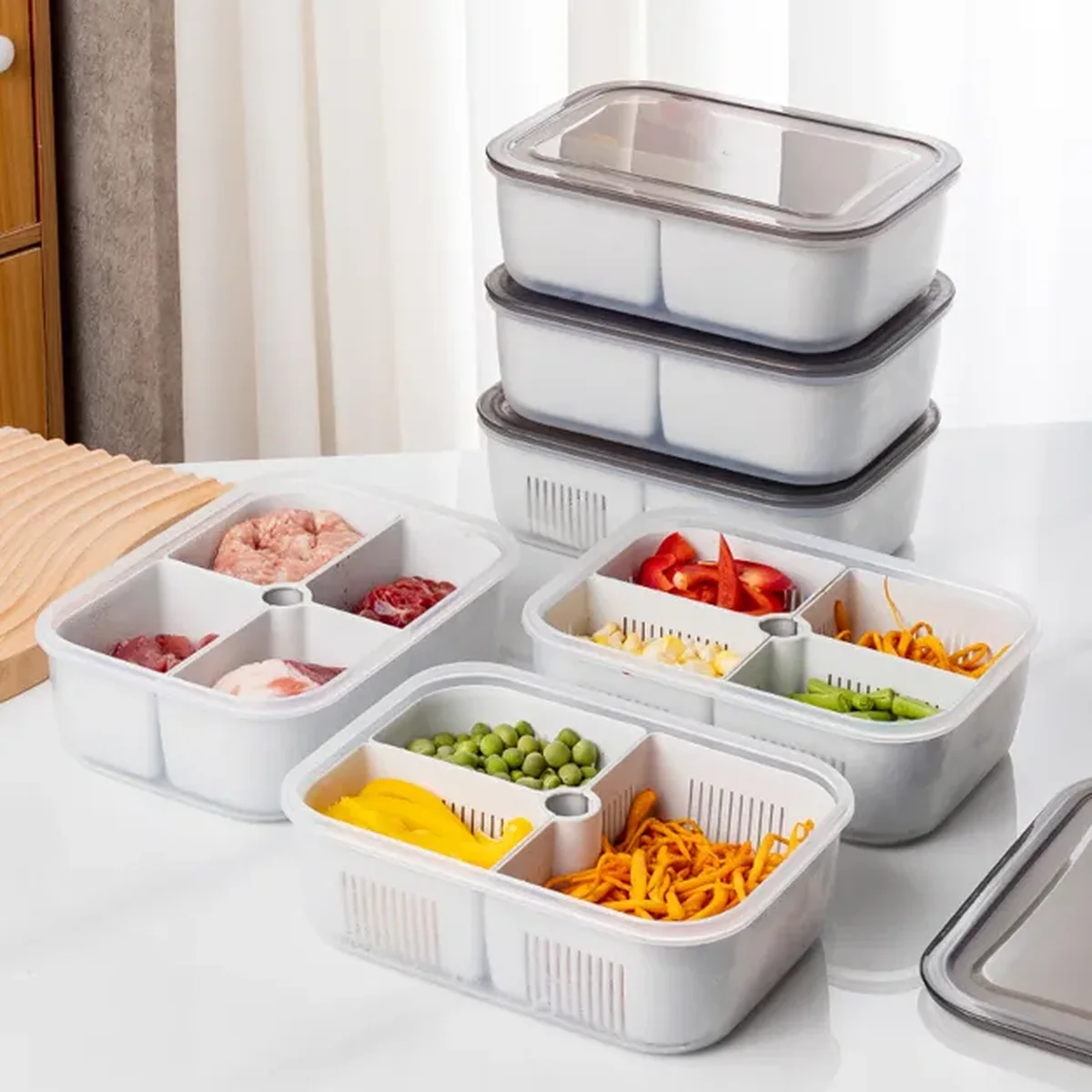
A PP compartment line from the same plant: moulded dividers, ribbed walls and a centre well, under translucent lids.
Lid Fit, Gasket and What Leak Performance Means on a Sample
Sealed, airtight and leak-proof get used as if they were one word, and any leak proof lunch box manufacturer should be able to explain why they are not. Sealed means there is a lid on the box. Airtight means the closure resists air exchange long enough to matter for freshness. Leak-proof means a filled, closed box survives a journey in a bag without wetting it. Only the last of the three is a performance claim, and it is the one a specification sheet cannot prove.
On PP bodies the closure is mechanical: a clip lid with a silicone gasket seated in a groove, pressing onto a land on the body rim. Four things decide whether it works. The gasket groove geometry — a gasket free to shift sideways in its groove will fail at the corner where pressure is lowest. The land width on the rim, which has to give the gasket something flat to seal against along the whole path. The clip tension, which has to hold with the box full and after a few dozen open-close cycles, not only when new. And corner continuity, because most leaks start where a straight seal meets a radius.
So test it the way it will be used: fill the box to its working level, close it, invert it, leave it, then carry it. Our note on testing a seal on your own samples sets out the loop we run. Treat the silicone gasket as a part in its own right, too — it is not PP, and a declaration written for the polypropylene body does not cover it.
Microwave, Freezer and Dishwasher: What a PP Lunch Box Tolerates
PP is the polymer most reusable lunch boxes are moulded from precisely because it keeps its shape across the temperature range a kitchen uses. That is a statement about the material family, and it is not the same thing as a claim printed on a retail carton. A printable claim belongs to a model, backed by that model's own test record, and it rarely covers every part of the box equally — body, lid and gasket can have different answers, and the gasket ages first.
For our own lines, the published records describe BX1069 as microwavable and BX1051's page mentions dishwasher cleaning; both records are explicit that the conditions must be confirmed for the model rather than assumed from the family. Four questions settle it with any factory: which parts of this model the claim covers, at what temperature and for how long it was tested, whether the lid stays on or comes off during reheating, and whether the same answer holds after fifty dishwasher cycles or only after one.
Reheating has a design side too: a sealed box that heats will build pressure, so a microwave claim normally assumes the closure is unlatched, opened or vented. Our notes on whether a plastic lunch box is microwave safe cover how to write that into a purchase contract instead of discovering the failure mode in a customer complaint.
One material fact belongs here because buyers ask for it: PP is one of the more easily recycled everyday plastics — it carries resin identification code 5 and rigid-plastic collection streams accept it where those streams exist. That is a materials statement, not an environmental one, and we publish no biodegradability claim for a PP box.
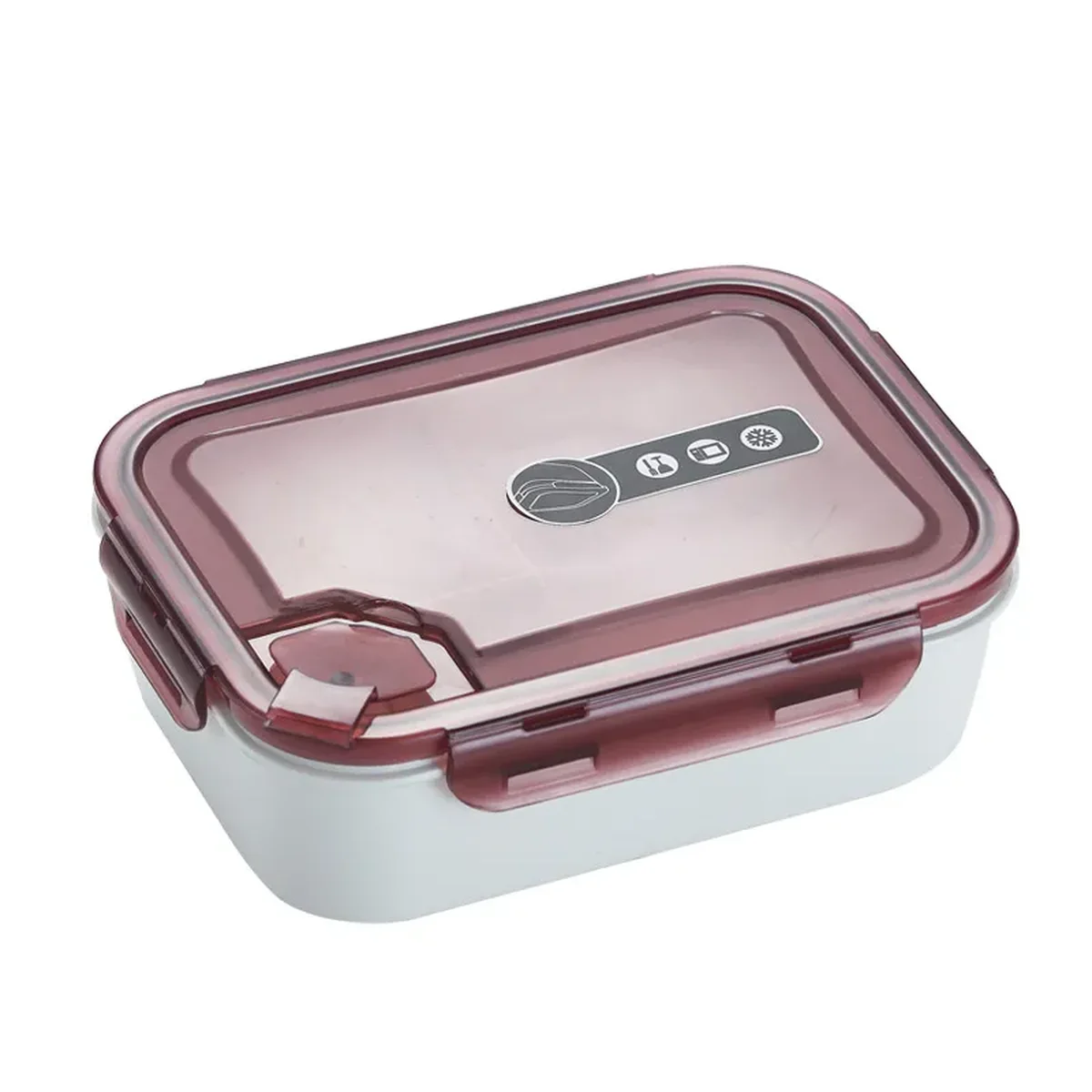
A lid can carry the icons; only the model's own test record makes them true.
Decoration on a PP Body: In-Mould Label, Silk Screen and Heat Transfer
Custom logo is the term most buyers use and the least precise. On a moulded PP box there are four routes, and they differ in cost, durability and where the mark sits relative to the food-contact surface.
A mark moulded into the part — raised or recessed letters cut into the cavity — costs nothing per unit once the tool exists, cannot wear off and cannot be washed away. It is also fixed: changing it means changing the steel. In-mould labelling takes a printed film into the cavity so it fuses with the surface during moulding; the print is durable and the whole face is available, but the tool must be built to accept the label. Silk screen is cheapest per unit at volume and suits one or two colours on a flat lid face, with the usual caveat that thin print abrades at the edges in a dishwasher. Heat transfer handles multi-colour artwork better than silk screen, at a higher unit cost.
Two boundaries apply whatever you choose. Decoration on the outside of a closed box does not change the food-contact surface; print on a surface that touches food does, and that is a different conversation with a different file behind it. And colour is not only decoration — the same box can be moulded in a translucent grade that shows the contents or an opaque grade in a matched colour, and the two behave differently in a microwave. Our review of how plastic colour is actually produced covers the colour side.
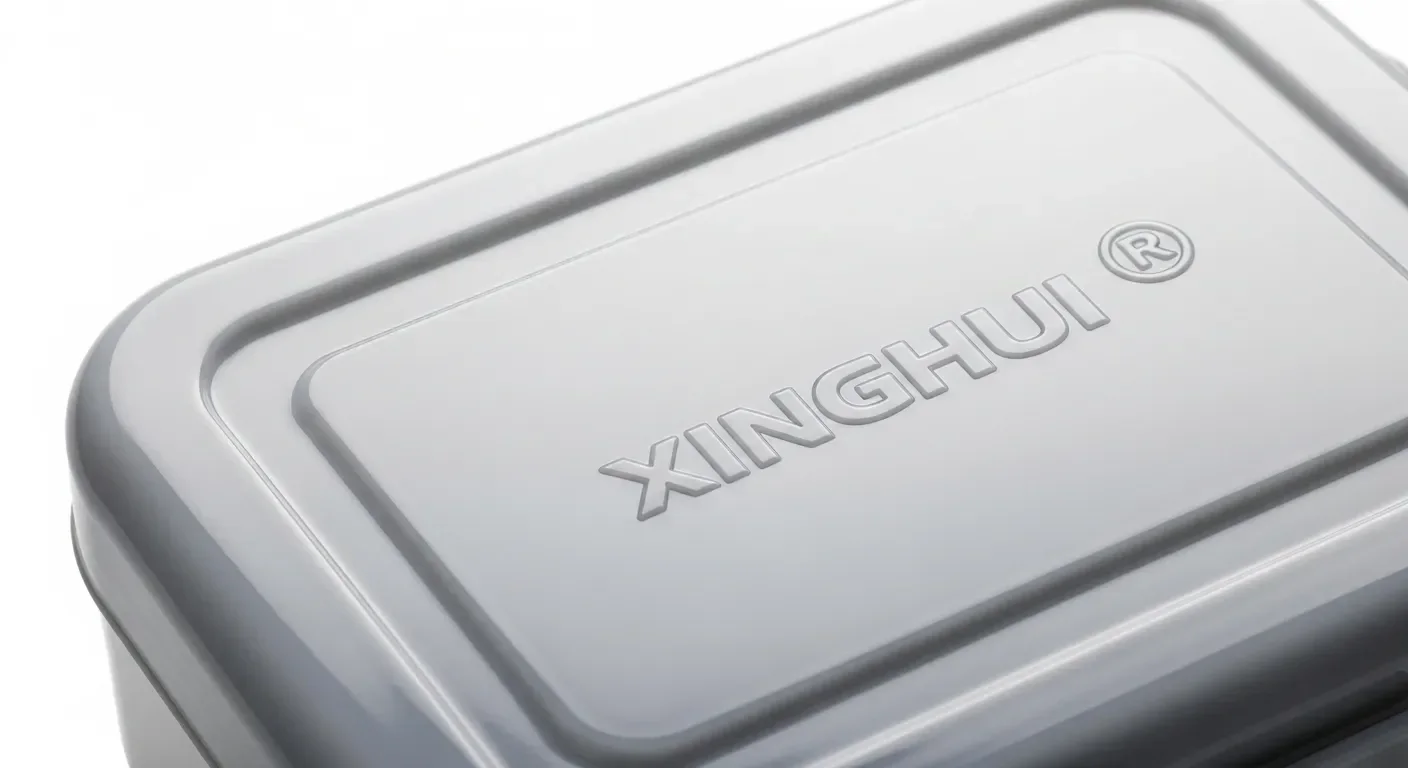
A raised mark moulded straight into the part — the route with no per-unit cost once the tool exists.
Tooling and Mould Cost: What Is Settable on an Existing Tool
This is where an order placed with a custom plastic lunch box manufacturer is either cheap or expensive, and an OEM lunch box manufacturer's tooling list is where the line gets drawn. On an existing tool you can change colour, the logo if the route needs no new steel, the packaging form — bag, kraft box, printed carton — the carton count and pallet plan, and the accessory set where the mould has a slot for cutlery. None of that touches the mould.
A new tool is required when you change what the steel defines: capacity, compartment count or divider position, wall structure, lid and gasket geometry, the stacking interface, or the outer form. That is not a sales policy, it is physics — those features are the cavity. The tool's cavity count is the separate decision that follows: more cavities raise the tool cost and cut the cycle cost per part, fewer lower the entry ticket and raise the unit price at volume. For a first order the honest question is not "how much is the mould" but "at my annual volume, what does it cost me per piece, and who owns it at the end". We cut our own tooling, so both halves are answerable in one quotation — our mould development process is on the record.
Before steel is cut there is a cheaper step, and skipping it is the most common way a programme loses weeks: a physical sample of the geometry, printed, held, opened and stacked, settles the fit questions no drawing review catches — which is what verifying a tool before it is cut in steel is for. After the tool exists the sequence is standard — first-shot samples, measurement against the drawing, seal and fit checks, then your written approval on a signed sample. What actually forces a new mould, and what does not, is set out in modifying an existing mould or cutting a new one.
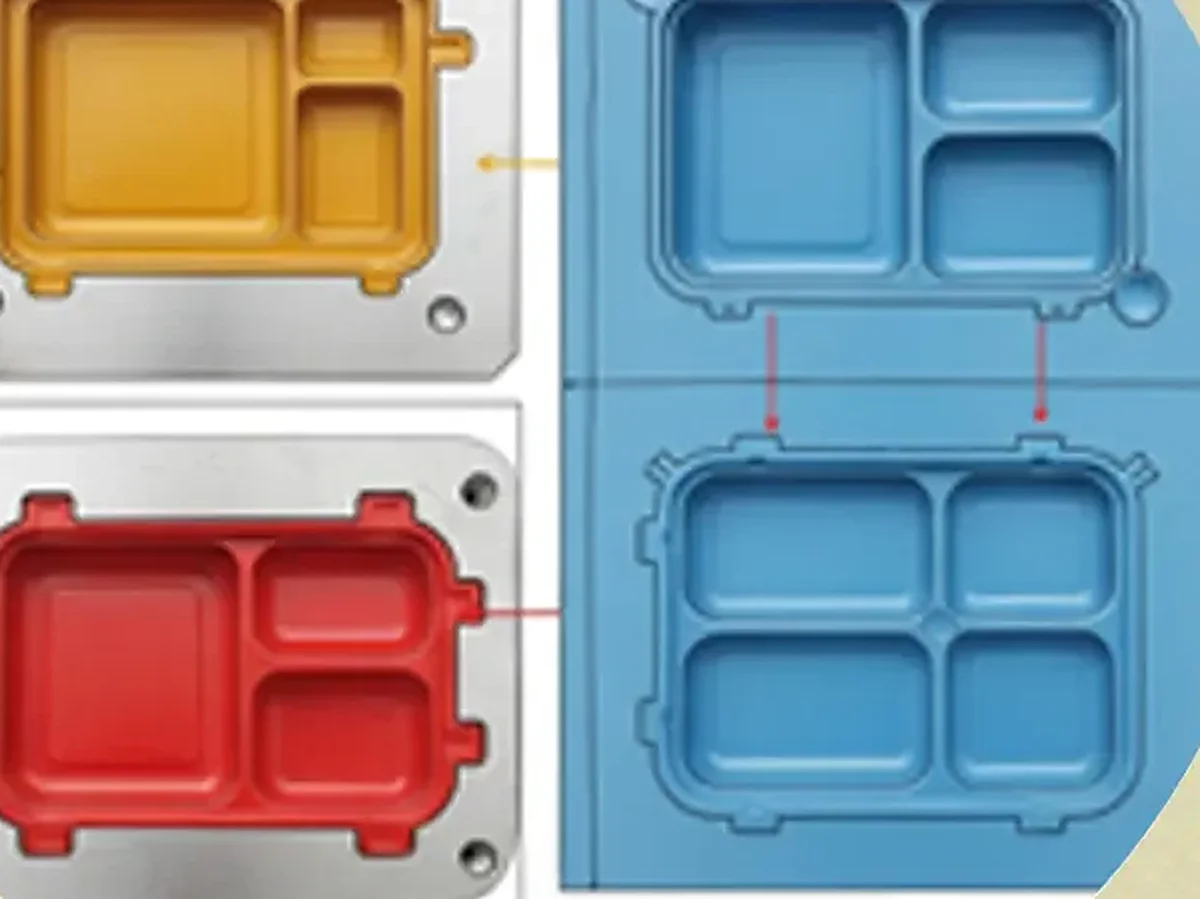
Tooling for compartment boxes: cores on the left, the cavity layout that defines the dividers on the right.
Sampling, MOQ and the Number That Decides Your Freight
Two numbers decide whether a lunch box programme is profitable, and neither is the unit price: units per carton and gross weight per carton, because freight is billed on the greater of weight and volume for the packed unit you actually ship. Read the two 1.3 L cartons above. BX1051 carries 72 pieces in a 14.3 kg carton; 6529 carries 48 pieces in a 15 kg carton, and their cartons differ in size. Per packed piece that is roughly 199 g and 0.0024 m³ for one, roughly 313 g and 0.0030 m³ for the other — about a fifth less volume and a third less weight at the same nominal capacity.
The difference is real, and the record explains it rather than us guessing: 6529 is documented with cutlery included and a lid that converts into a phone stand, and its carton carries fewer pieces — 48 against 72 — so the packed unit is heavier and bulkier on both counts. The point is not that one box is better but that "cheapest" is a carton decision, not a box decision, and a plastic lunch box manufacturer who cannot give you units per carton and gross weight is not giving you a price you can use.
On quantity: 6529 is recorded at 2,000 pieces, while BX1051 and BX1069 have no recorded minimum, so the figure is settled per model at quotation rather than published as a blanket number. BX1051's record carries a three-day sample lead time, and pre-production samples are approved in writing before a run starts. One constraint nobody publishes: a mixed-colour assortment usually means a minimum per colour as well as per model, so settle the assortment plan before you ask for quantities.
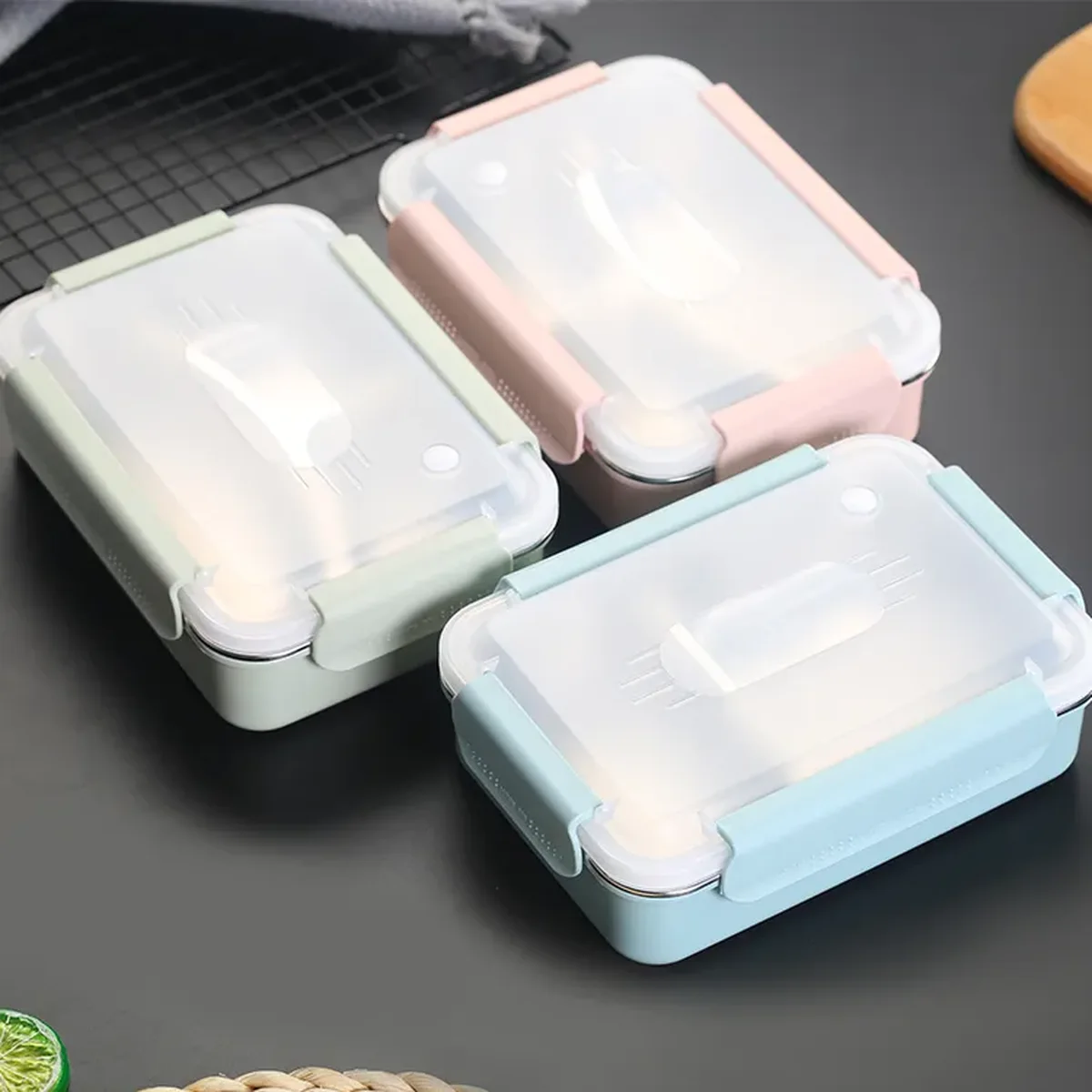
Three colourways of one PP bento body — the assortment split is quoted per colour, not per model.
Food-Contact Documents to Request Before You Print Any Claim
Nothing on this page is a certificate we hold: for a food-contact claim, the paper that names your model is the only thing that counts. Three things about a PP lunch box are specific rather than general. The first is the gasket: silicone is not PP, it is a separate material with its own statement, and a declaration written for the polypropylene body does not cover it. The second is the framework the file was written against: reports are commissioned for one market's rules, not for every market's, so ask which regulation the document names. The third is the BPA position: it is a model-level document rather than a company-level one, and the published pages for BX1051 and BX1069 describe those items as BPA-free, which is exactly the kind of claim that should arrive with a paper attached. The generic request list — a declaration of compliance that names the model, a third-party migration report, a material declaration for heavy metals, the plant's quality-management certificate — is not PP-specific at all, and our document request list for food containers walks through how to read each one.
Selling into the United States? The clause a laboratory report on the PP body should point at is 21 CFR 177.1520, the olefin polymers section, so ask for the report that names it by number rather than for a general statement of compliance.
In the European Union, the text a declaration for the PP body has to answer to is Regulation (EU) No 10/2011 on plastic food-contact materials; the European Commission's food-contact pages are where the surrounding framework is published.
For the German market the corresponding text is the Food and Feed Code (LFGB). Which of these your product needs is a decision for your importer or your laboratory, not for us.
Next Step
Send the brief and Xinghui Plastic Life will quote against a specification rather than an assumption: the layout and capacity you need, the units for your first order and the volume behind it, the colours and the assortment split, your logo files and decoration route, the packaging form, and your destination port and trade term. If you would rather start from a sample, say so in the first email — the sample step costs less than a tool and answers questions a drawing review cannot.
Xinghui moulds this line in Jieyang, so a question about the cavity, the gasket or the carton count comes back from the plant rather than from a forwarding desk. A brief that moves what the steel defines — capacity, compartment split, wall structure, lid geometry — goes through our mould development process; a brief that changes colour, decoration, packaging or carton count stays on the models recorded above. Either way, the wholesale lunch box comparison shows where this PP line sits among the twelve models we publish.
Continue reading
Related sourcing guidance
More practical context for your food storage container sourcing conversation.
Discuss your product range
Need help selecting or customising containers?
Share the product type, market and sourcing requirements with the Xinghui team.