
Lunch Boxes & Bento
School-District Lunch-Box Procurement: Compartment Layout, Dishwasher Cycles, Name-Label Areas and the Document Pack Your Compliance Officer Will Ask For
A school district buys a specification, not a kids lunch box. Compartment layout, dishwasher cycle counts, name-label areas, and the documents to demand.
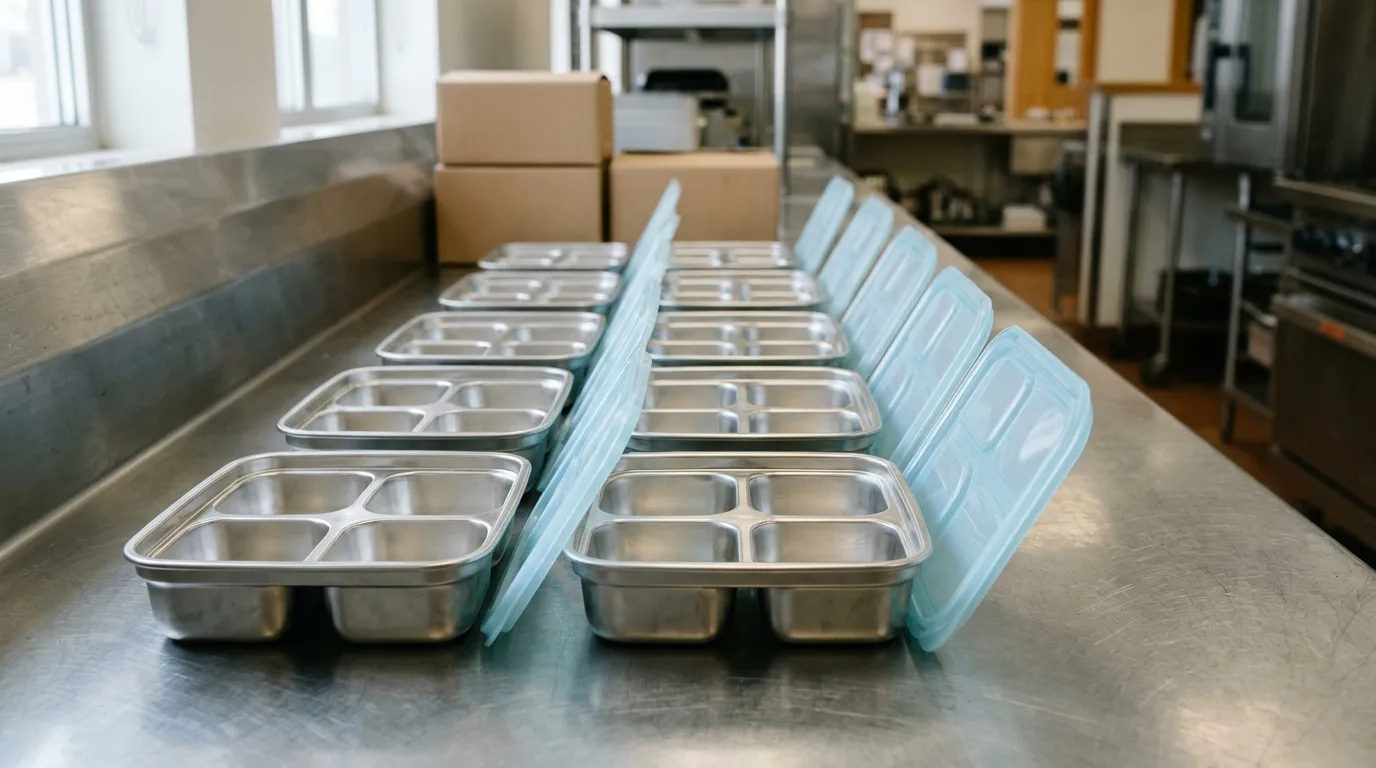
A district does not shop for a kids lunch box. School lunch box procurement is a writing exercise: a requirement, a three-year price, and an award that has to be defended to an auditor who was not in the room. The box is the easy part. The specification is the work.
That changes what a supplier conversation should sound like. Questions about colorways and carton discounts come after four harder ones: how many compartments the menu actually needs, how many wash cycles the box will see, where the district writes its asset number, and which documents land in the compliance file. Get those four wrong and the cheapest quote becomes the most expensive award.
This article walks through all four, with the federal rules that put them on the table, the arithmetic that turns a unit count into cartons and kilos, and a specification block you can paste into a solicitation. It does not certify anything for you. Every document named here is something a buyer requests and a factory produces, and the difference between those two verbs is the whole point.
School Lunch Box Procurement Starts in the Bid File, Not the Box
Four people sign a district lunch-box award, and they are not signing the same thing.
The child-nutrition lead signs for the menu: whether the box holds what the kitchen serves without the components running together. The procurement officer signs the solicitation, the evaluation criteria and the award itself. The compliance officer signs the file behind the award — specifications, declarations, test reports, country-of-origin statements. The receiving warehouse signs for cartons: how many, how heavy, how they split across twelve schools.
That is not bureaucratic decoration. Procurement with nonprofit school food service account funds is governed: 7 CFR 210.21 puts school food authorities under the general procurement standards of 2 CFR part 200, subpart D, and requires an authority's own procedures to include a written code of standards of conduct meeting the minimum standards in 2 CFR 200.318. A district can run its own process under state and local law. It cannot run an undocumented one.
The clause that matters most to a supplier sits in 7 CFR 210.21(c)(1). A state agency may impose a pre-issuance review, and when it does, the school food authority has to make its procurement documents available on request — solicitation documents, specifications, evaluation criteria, procurement procedures, proposed contracts and contract terms.
Read that list again as a supplier. Specifications are named. Evaluation criteria are named. If your product's advantages live only in a catalog photo and a sales call, none of them survive the file. The award goes to the box whose requirements were written down, because those are the only requirements anyone can score.
A district cannot evaluate what it did not specify, and an auditor cannot approve what the file does not contain.
The document question therefore arrives early. A compliance officer assembling a bid file wants the same core set every cycle; the documents to request from a food container factory sets that out, and what follows applies it to a lunch box.
Compartment Layout: Write the Menu Into the Spec
A reimbursable school lunch, under the USDA meal pattern, is built from five components: fruit, vegetables, grains, meat or meat alternate, and milk. A student has to take at least three, and one of them has to be a fruit or vegetable. The meal pattern is a menu rule, but it lands on the tray as a physical constraint: components that must be counted separately cannot merge into one puddle on the way to the table.
Compartment count is therefore a menu decision, not a design preference. Two compartments hold an entrée and a side. Four split the tray into an entrée, a grain and two cold items. Five add a dedicated well for a dip, a sauce, or the vegetable that leaks. A district running a hot entrée with two cold sides and a sauce cup needs five wells whether or not five wells is the cheaper box.
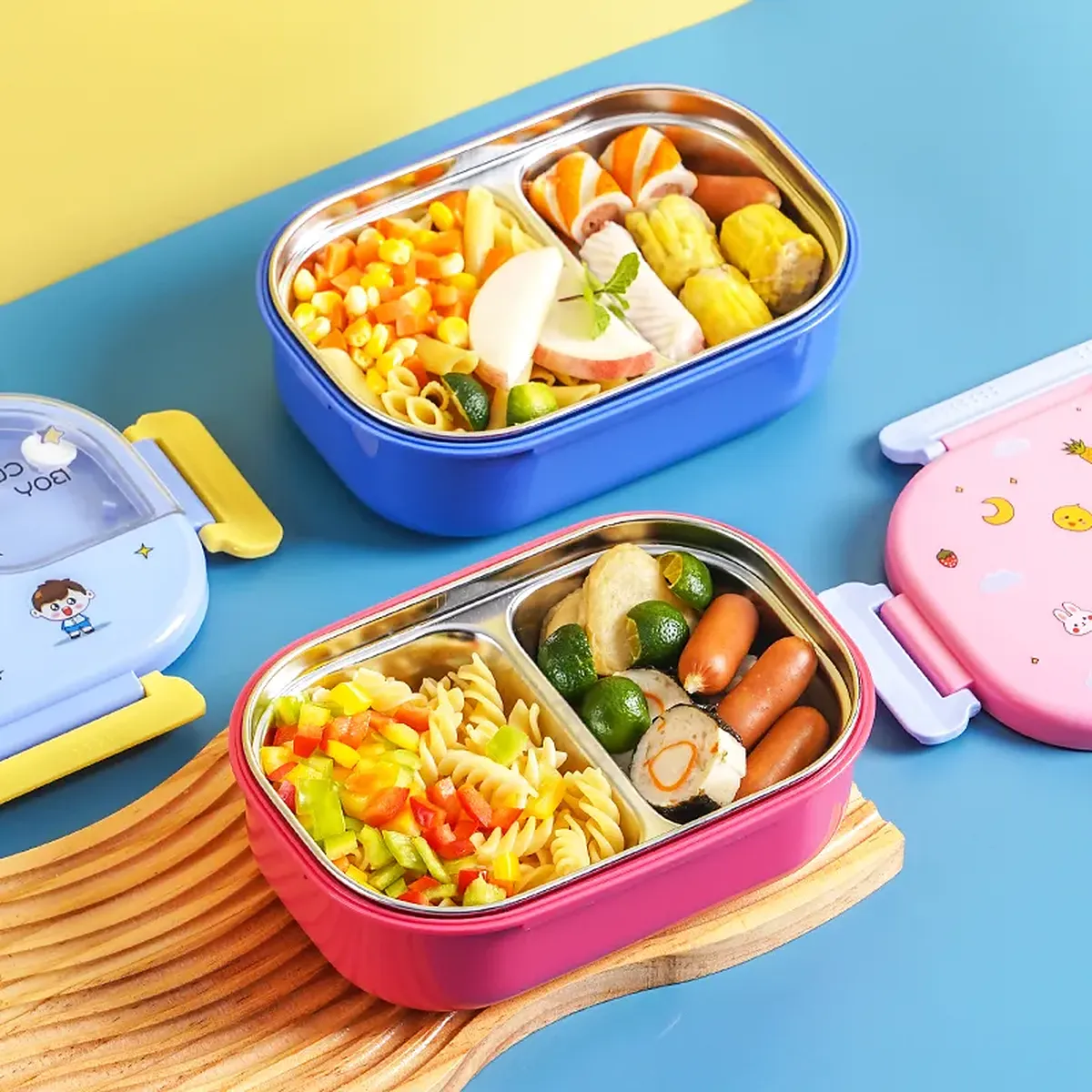
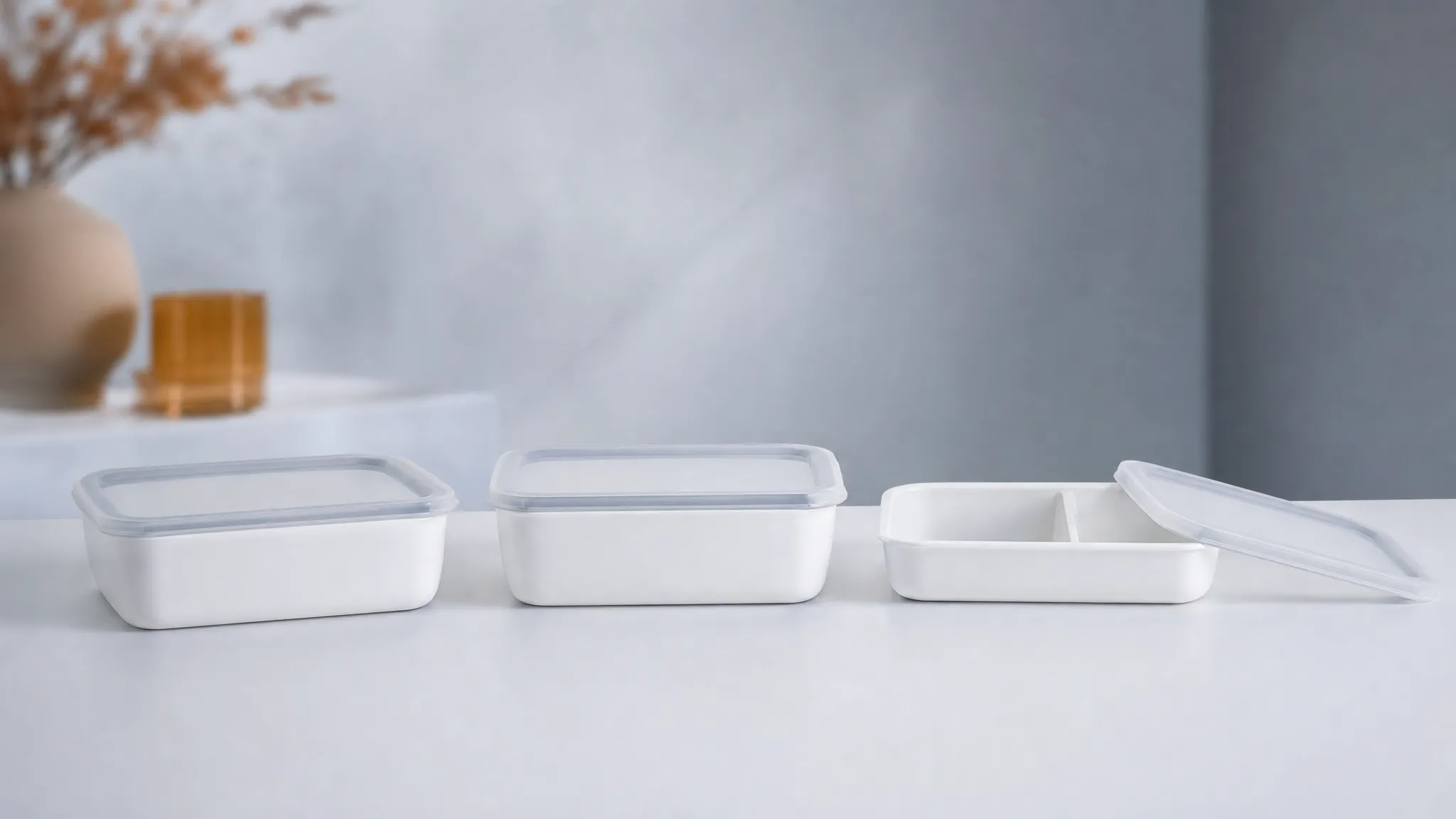
Lids off and wells filled: the photograph shows what the box carries, not how many wells its record specifies.
Then there is the question the catalog never answers: do the dividers reach the lid? A divider that stops two millimeters short of the gasket lets a sauce migrate into the fruit well at the first tilt, and a driver's route is a continuous tilt. This belongs in the specification as a written line rather than a hope. Ask whether the divider seals against the lid or merely divides the base, and ask for a filled tilt test at the angle your carriers actually see.
Fixed dividers fill faster on a serving line, because a server can slide a scoop along a straight wall. Removable dividers clean faster and let one mold cover two menu patterns, at the cost of a loose part that has to be inventoried, replaced, and declared as its own food-contact surface. For a district filling four hundred trays in twenty minutes, fixed dividers usually win on labor. For one that rewrites its menu cycle twice a year, removable dividers buy flexibility fixed ones cannot.
Depth is the line buyers skip. A 6.5 cm deep box holds a sauce cup upright; a 7.5 cm deep box of the same footprint holds more of everything and stacks less neatly in a rack. Compare the two on a filled sample, not on a drawing.
One more discipline point, and it is why this article keeps insisting on records. Our own product records state compartment counts for the 6527 (two), 6522 (four) and 6521 (five) models. The 6533 and 6536 records carry capacity, unit size, carton quantity and colorways, but no compartment count. A photograph suggests one. A photograph is not a specification, so the count has to be confirmed on the drawing before anyone prints it into a bid. If a supplier will not put a number on paper, the number does not exist yet.
Smaller orders hit the same four questions at a different scale, and the group-order version — capacity ladder, cleaning matrix, sample sign-off for a center buying in the tens — is written up in specifying kids' bento boxes for a preschool group order.
Capacity per Child: What 800, 1,100 and 1,400 ml Feed
Capacity is the specification line most often written as a single number for an entire district, which is how a K-8 award ends up with a box too big for a five-year-old and too small for a thirteen-year-old.
The useful range for a stainless steel bento box in school service runs from about 800 ml to 1,400 ml, and it splits along grade bands rather than along price. An 800 ml box holds a sandwich or a rice portion plus one side and fits a kindergarten tray without dominating it. A 1,100 ml box (37.2 fl oz) is the workhorse: an entrée, a grain, a vegetable, and room for a fruit cup. A 1,400 ml five-compartment box (47.3 fl oz) covers a middle-school appetite or a full entrée with two sides and a sauce.
Write two sizes into a K-8 school district solicitation. One size forces a compromise at both ends, and the compromise shows up as waste: a fifth-grader given 1,400 ml leaves food behind, and a kindergartner given 1,400 ml leaves more.
Model | Capacity | Unit size | Carton quantity | Gross weight per carton |
|---|---|---|---|---|
6523 | 800 ml (27.1 fl oz) | 22 × 15.5 × 6.5 cm | 24 pcs | 11.5 kg |
6536 | 1,100 ml (37.2 fl oz) | 21.5 × 15 × 7.5 cm | 24 pcs | 11 kg |
6533 | 1,100 ml (37.2 fl oz) | 24 × 17 × 7.5 cm | 24 pcs | 13 kg |
6522 | 1,100 ml (37.2 fl oz) | 25.5 × 18 × 6.5 cm | 24 pcs | 14.5 kg |
6521 | 1,400 ml (47.3 fl oz) | 29 × 22.5 × 6.5 cm | 18 pcs | 15.2 kg |
All figures above come from our own model records, not from a generic catalog table, and they carry the caveat every factory table carries: gross weight and carton quantity are stated per shipping carton and should be confirmed against the packing scope of your order.
Note what the table says about the 6523. The 800 ml box is the smallest in the family, and its carton is larger than the 1,100 ml 6536's — 54 × 32 × 50 cm against 47 × 34 × 47 cm. Carton dimensions follow a factory's nesting and dunnage decisions, not the capacity of the product. A buyer who assumes the smaller box ships in the smaller carton budgets freight on an assumption.
The 1,100 ml kids box used as the example throughout is model 6533, and its kids lunch box product page carries the full specification, colorways and customization options.
One line to add to any capacity clause: state whether the number is usable capacity or brim-full. A 1,100 ml brim-full box holds noticeably less once a lid displaces the top centimeter. Factories quote different bases, and two quotes that look identical on capacity may differ by a hundred milliliters of usable volume.
Dishwasher Cycles: The Number Behind the Claim
"Dishwasher safe" without a cycle count is a mood, not a specification. A dishwasher safe lunch box is one that survived a stated test, and the district owns the test because the district runs the machine.
Start with school days. A 180-day year over a five-year replacement cycle is 900 washes for a box that goes home once a day. If the same box carries a snack and a lunch and comes back through the wash twice, it is 1,800. Write the number you intend to hold the supplier to, because 900 and 1,800 are different tests, different materials, and sometimes different products.
Then decide which wash environment dominates, because a district usually has two. A central kitchen runs a rack or tunnel machine: higher water temperature, stronger detergent, and physical impact as racks are pushed and stacked. Classrooms and satellite sites hand-wash in a sink or run a domestic-style machine at whatever temperature the tap gives. A box that survives one environment can fail in the other, and a single "dishwasher safe" line hides which one was tested.
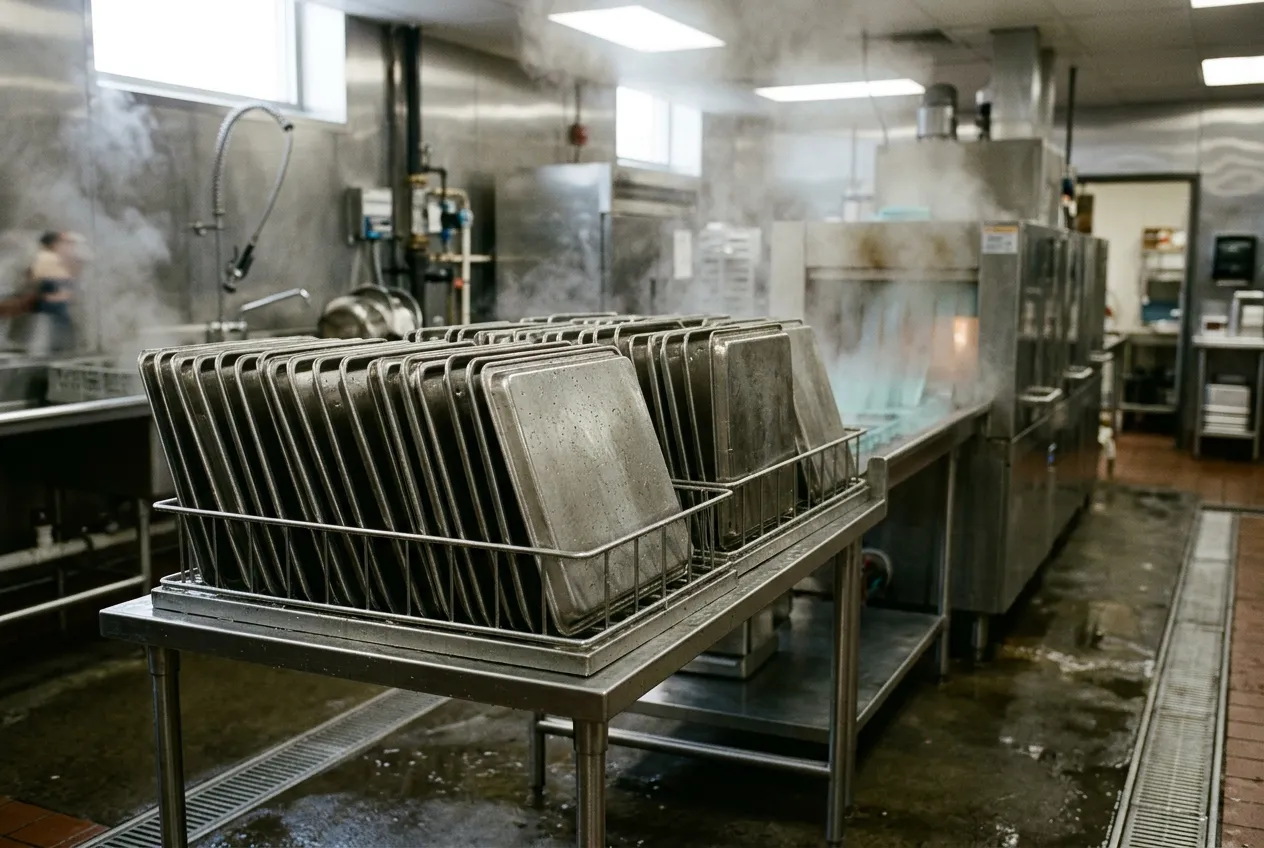
The rack is the real test fixture: heat, detergent and impact arrive together.
What degrades depends on the part. Polypropylene lids crack at the latch and hinge, where molded-in stress concentrates and detergent attacks it. Silicone gaskets swell or take a permanent set and stop sealing before the box itself shows wear. Stainless resists most of it, but 304 is not immune to chloride pitting when a chlorine-based sanitizer sits in a wet stack overnight. Printed or coated surfaces go first, which matters if the district intends the box to carry a logo for five years.
So the clause should carry four numbers instead of one adjective: cycle count, wash temperature, detergent type or pH range, and wash method (rack, tunnel, hand, or domestic machine). The test method behind a defensible claim — temperature, detergent chemistry, cycle life — is set out in what a dishwasher-safe claim actually requires. What a district needs on top is the number it will audit against.
"Dishwasher safe" is a claim about a test. "Dishwasher safe for 900 cycles at 71 °C (160 °F) in an alkaline rack machine" is a specification someone can fail.
There is a commercial consequence. A supplier quoting a five-year cycle life at 1,800 washes is quoting a different product from one quoting 900, and the second quote will look cheaper for exactly that reason. Compare quotes against the same cycle count or the comparison is meaningless.
Name-Label Areas: The Part of the Box the District Owns
The district adds the identity: an asset number, a classroom, a site code, sometimes an allergy flag. Where that information physically goes is a molding decision made eighteen months before anyone writes on a lid.
Four placements fail predictably:
- On the seal land. The label lifts the lid a fraction and the box weeps. Never put a pad on the gasket seat.
- Under the latch. The latch grinds the label off in the first month of rack washing.
- On the curved shoulder. Adhesive peels from a convex surface under heat cycling, and permanent marker beads on a gloss curve.
- In the wash shadow. A recess that traps water and food turns a label into a hygiene finding.
A working label area is a flat or lightly recessed pad, on the lid top or the box end, clear of the gasket by the full width of the seal land, finished matte rather than gloss. Size is a district decision, not a standard: a pad large enough for an eight-character asset number plus a handwritten site code is the practical minimum, and it belongs on the drawing in millimeters rather than in a sentence saying "large".
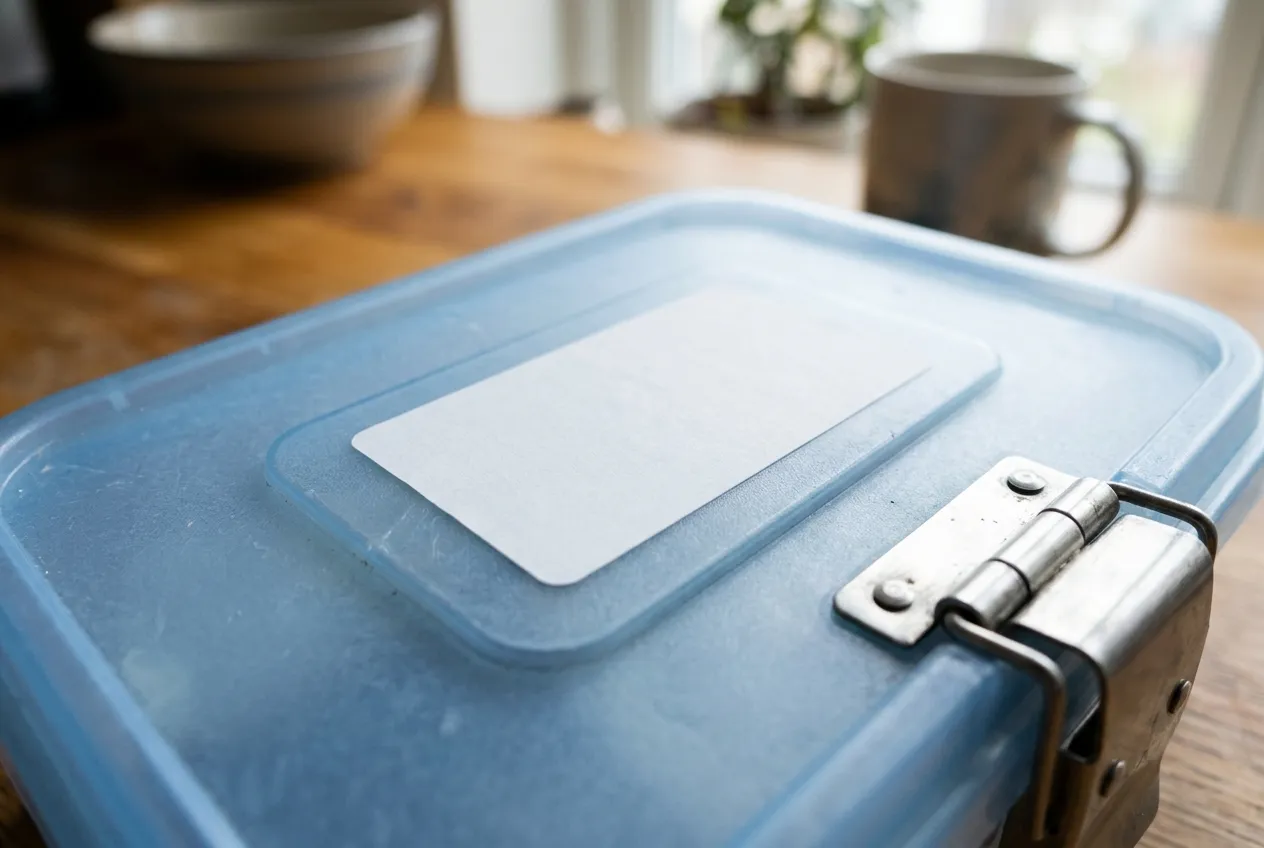
A pad, not a sticker: the flat recess is what keeps a label readable after 900 washes.
Lunch box name labels are the district's own consumable, so the pad has to match how staff mark them. Polypropylene has low surface energy, which is why some adhesives simply will not hold on it — a label that sticks to a steel body may slide off a PP lid. Permanent marker needs a matte, slightly textured pad; on gloss it beads and wipes away with the first detergent. A printed label under a clear window is a third option and a third molding change, and it moves the identity problem into the tool rather than the label.
Then the operational detail that catches districts every year: lids get separated in a rack. If the asset number lives only on the lid and lids are washed in a communal rack, the numbers travel to the wrong boxes. Either put one pad on the lid and a second on the base, or put the single pad on the base and accept that staff read it upside down. Both work. A pad on the lid only does not.
The base already carries information, incidentally. Any molded resin identification code sits on the underside, and where that code lands constrains where a label pad can go without crowding a surface that has to stay legible for recyclers — the molding and marking logic is covered in what the resin code on the base commits you to.
The Document Pack Your Compliance Officer Will Ask For
Four questions sit under every document request, and knowing them makes the requests predictable.
Is every food-contact surface covered by a declaration? Is anything in the product restricted — heavy metals, certain plasticizers? Does the claim printed on the box or the listing match a test someone can produce? And if a school reports a problem in March, can the lot be traced back to a production date?
Document | Who asks for it | What it answers | What it does not answer |
|---|---|---|---|
Food-contact declaration per part and per resin (PP body and lid, silicone gasket, 304 steel) | Compliance officer | Whether each material is declared for food contact, and under which regulation — for example 21 CFR 177.1520 for olefin polymers such as polypropylene, 21 CFR 177.2600 for rubber articles intended for repeated use | Whether the finished part performs at your temperature and fat content |
Migration test report with the conditions of use stated | Compliance officer, sometimes the state agency | Whether the material passes at the food type, temperature and duration tested | Anything about a use condition the report did not cover |
Heavy-metal statement for coatings and substrates, alongside 16 CFR part 1303 for lead in paint and surface coatings | Compliance officer | Whether a restricted metal is present above the applicable limit | Whether the coating survives 900 washes |
Plasticizer statement (which plasticizer, if any, and where) | Compliance officer | Whether a restricted plasticizer is present in a part a child handles | Whether every sub-component was declared |
Steel grade statement or mill certificate for the 304 body | Procurement officer, occasionally a board question | Which grade of steel was actually used | Whether the steel is domestic |
Lot or batch traceability from carton code to production date | Receiving, and the compliance officer after an incident | Whether a specific carton can be traced to a run | Whether the run was defect-free |
Care and use instructions, plus the substantiation behind any claim on the pack | Compliance officer, marketing | Whether the printed claim has a test behind it | Whether staff will follow the instructions |
EU declaration of compliance, if the district or a partner ships into the EU | Compliance officer for EU-bound stock | Whether the EU framework's requirements are declared | Anything about US federal school-meal rules |
Two limits on that table get misread in bid files.
First, there is no such thing as an FDA-approved plastic. FDA does not approve materials or products for food contact; it provides for substances and requires that they be used within the conditions of use. A supplier offering an "FDA approval certificate" for a lunch box is either misreading a declaration or inventing a document, and the wording that keeps a food-contact clause honest is set out in why there is no FDA-approved plastic. What a factory can legitimately provide is a declaration that the resins used are permitted substances used within their conditions of use, with supporting test data.
Second, a declaration only covers the parts someone remembered to declare. A lunch box is a body, a lid, a gasket, two latches, sometimes a divider set and a vent plug, plus whatever is printed outside. Parts that touch food directly and parts that touch it indirectly are not the same list, and the split decides what needs its own report — the reasoning is in direct versus indirect food contact. Ask for the schedule by part, not by product.
One framing question belongs to the district: whether a given lunch box is a children's product or food-service equipment changes which US requirements a compliance officer will cite. The Consumer Product Safety Commission publishes business guidance on what makes a product a children's product, and that determination is the buyer's to make with counsel. A factory's job is to answer the questions that follow, in writing.
Domestic Preference: Two Rules Buyers Conflate
Ask a supplier whether their lunch box is Buy American compliant and you will usually get a confident yes. The confident yes is a category error, and it survives in bid files because two different rules share one nickname.
The Buy American provision in 7 CFR 210.21(d) is written for food. It defines a domestic commodity or product as an agricultural commodity produced in the United States, or a food product processed in the United States substantially using agricultural commodities produced in the United States — and it defines "substantially using" as more than 51 percent of the food product consisting of domestically grown agricultural commodities. It requires school food authorities to purchase domestic commodities or products to the maximum extent practicable and to include that language in procurement procedures, solicitations and contracts. It applies to authorities in the contiguous United States, and to purchases for the school lunch program.
A lunch box is not an agricultural commodity and it is not a food product. It is a manufactured product, and the domestic-preference rule that reaches manufactured products sits in 2 CFR 200.322: recipients should, to the greatest extent practicable and consistent with law, prefer goods, products and materials produced in the United States, and the requirement must be included in subawards, contracts and purchase orders under federal awards. That section defines manufactured products to include plastics and polymer-based products. A polypropylene lid or a molded steel-and-plastic box is squarely inside that definition.
What this means for a supplier is narrower and more useful than a compliance badge. A factory can document origin per component: where the resin was polymerized, where the steel coil was rolled, where the gasket compound was made, where the part was molded and assembled. A factory cannot certify that a district met its domestic-preference obligation, and a certificate claiming so is worth nothing in an audit. Offer the component-origin statement and let the district make its own determination.
The same logic runs through the general procurement standards. Competition, a written code of conduct and a documented rationale for the award are the district's obligations, not the supplier's. A supplier's useful contribution is a quote structured so those obligations are easy to meet: a clear specification match, a stated origin per component, and terms that do not move after award. Terms are where bids quietly fall apart, and the deposit-and-balance structure that has to be settled before a purchase order issues is set out in what payment terms to expect from a Chinese houseware factory.
Carton Arithmetic for a District Award
Five thousand units is a modest district order for bulk lunch boxes for schools. It is also 209 cartons at 24 pieces per carton, because 5,000 divided by 24 is 208.3 and a carton cannot ship as a third.
Using the model records above, those 209 cartons work out as follows. Model 6533 at 50 × 36 × 47 cm per carton is 0.0846 m³ per carton, so 17.7 m³ and 2,717 kg gross. Model 6536 at 47 × 34 × 47 cm is 0.0751 m³ per carton, so 15.7 m³ and 2,299 kg gross. Model 6522 at 54 × 32 × 60 cm is 0.1037 m³ per carton, so 21.7 m³ and 3,030 kg gross.
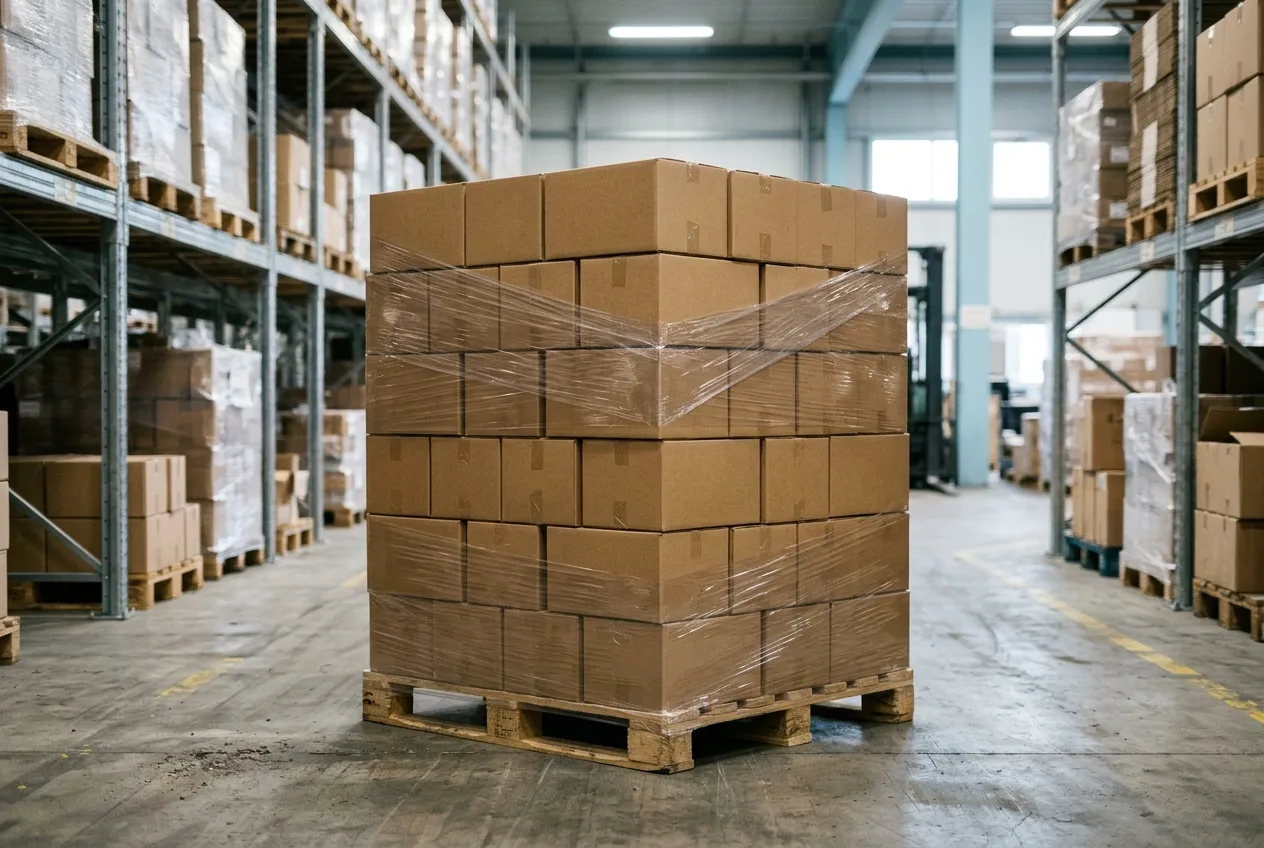
Carton cube, not unit capacity, is what the receiving dock actually handles.
The five-compartment 6521 changes the arithmetic twice: 18 pieces per carton instead of 24, so 278 cartons for the same 5,000 units, and 0.1064 m³ per carton, so 29.6 m³ and 4,226 kg gross. For the same unit count, the five-compartment box takes about 1.67 times the cubic meters of the 6533 and 56 percent more gross weight. That is a freight and handling decision hiding inside a menu decision.
Dividing gross carton weight by pieces gives a rough handling figure — around 542 g per piece for the 6533, around 844 g for the 6521 — including packaging. It is not the product weight, and should not be quoted as one.
Then the part no supplier controls: the receiving plan. A 209-carton delivery split across twelve schools is seventeen cartons per site, which means somebody breaks the pallet, re-labels sub-shipments and tracks twelve deliveries instead of one. Districts that skip this line discover it in the first week of term. Write who breaks the pallet and who owns the sub-shipment labels, or accept that the warehouse will improvise.
Where a district combines lunch boxes with other durable goods in one award, the loading logic changes again: a flat carton stacks well in height and badly in length, and mixing carton footprints wastes cube even when total weight is fine. That trade-off is covered in combining product lines into one LCL or FCL container.
What Goes in the Solicitation, and What You Sign at Sample Stage
Here is the specification block this article has been building toward. Ten lines, each auditable, each answerable by a factory in writing.
- Capacity in milliliters, with the basis stated (usable or brim-full), and the grade band each size serves.
- Compartment count, divider type (fixed or removable), and whether the divider contacts the lid.
- Material by part: body, lid, gasket, latches, divider set — with the food-contact regulation each part is declared under.
- Wash claim as four numbers: cycle count, temperature, detergent type or pH range, wash method.
- Label area: dimensions in millimeters, position by part, surface finish, and whether a second pad is required on the base.
- Carton quantity, gross weight and carton dimensions, stated per shipping carton.
- Carton marking: the district's own SKU and site code, with no third-party branding on the carton.
- Sample quantity and the criteria the sample is judged against.
- Warranty period, and what it excludes.
- Country of origin per component, as a statement rather than a certificate.
Two commercial lines belong beside those ten. The first is minimum order quantity (MOQ), stated per model and per colorway: a five-model award of 5,000 units clears a factory's total volume while no single model clears a 2,000-piece model minimum on its own. The second is the replacement rate, expressed per 1,000 units rather than as a vague willingness to replace, because that is the number a district can put in a budget.
A school lunch box supplier who can answer all ten in writing is a different proposition from one who answers with a catalog page. The sample stage is where those ten lines stop being words. Fill the sample with the wettest thing on your menu and tilt it the way a carrier tilts it. Run it through twenty cycles in the machine that will actually wash it, then look at the latch, the gasket seat and the printed surface. Stick a label on the pad and run twenty more. Weigh a full carton rather than trusting the figure. Ask for the second carton from the run, not the first, because the first carton is the one everyone inspects.
Two supporting pieces are worth reading before that meeting. The certification list a school buyer is usually handed — BPA-free statements, food-contact reports, the tests behind them — is covered in bulk kids lunch boxes for schools and brands, and the material-safety question parents and board members actually ask is answered in whether stainless steel lunch boxes are safe for kids.
The models used as examples here are the 1,100 ml kids box, model 6533, and the 1,400 ml five-compartment box, model 6521. Both are 304 stainless with polypropylene lids and silicone seals, both are molded in-house at Xinghui Plastic Life, and both carry the specification data a bid file asks for — carton quantities, gross weights, unit dimensions and customization options for color, size, logo and packaging.
A district that specifies these four axes before it invites quotes gets comparable bids, a defensible file, and a box that survives to the replacement cycle rather than to the first complaint. A district that buys on price alone gets a different outcome, and usually gets it in November.
Continue reading
Related sourcing guidance
More practical context for your food storage container sourcing conversation.
Discuss your product range
Need help selecting or customising containers?
Share the product type, market and sourcing requirements with the Xinghui team.