
Compliance & Food Safety
Direct vs Indirect Food Contact: Which Parts of a Lunch Box Need a Report and Which Do Not
FDA direct food contact is a test of surfaces, not a product status. Which lunch box parts need their own report, which need nothing, and what to ask for.

Somewhere on your supplier's specification sheet there is a line that reads, in substance, "FDA direct food contact." It sits in the same block as the capacity and the carton size, and because it sits there it reads like a settled property of the part, the way wall thickness is.
It is not. Nothing in Title 21 gives a lunch box, a lid or a gasket a direct-contact status, and the phrase itself comes from a distinction FDA draws somewhere else: between a substance added to food and a substance that is a component of an article that contacts food. Every plastic, silicone, colorant and ink in a lunch box sits on the second side of that line. In the agency's vocabulary none of them is a "direct" additive, because nothing in a lunch box is meant to end up in the food by design.
That is not wordplay. It changes what you can ask for, and what you can prove. A supplier who promises "direct food contact approval" has promised something no agency issues — the same trap that turns an FDA clause into an unenforceable sentence, which is why no FDA-approved plastic exists. What a supplier can actually hand over is narrower and far more useful: for each material in the product, the basis on which that material may lawfully sit against food, plus the evidence that the finished part does not transfer into the food more than the rules allow.
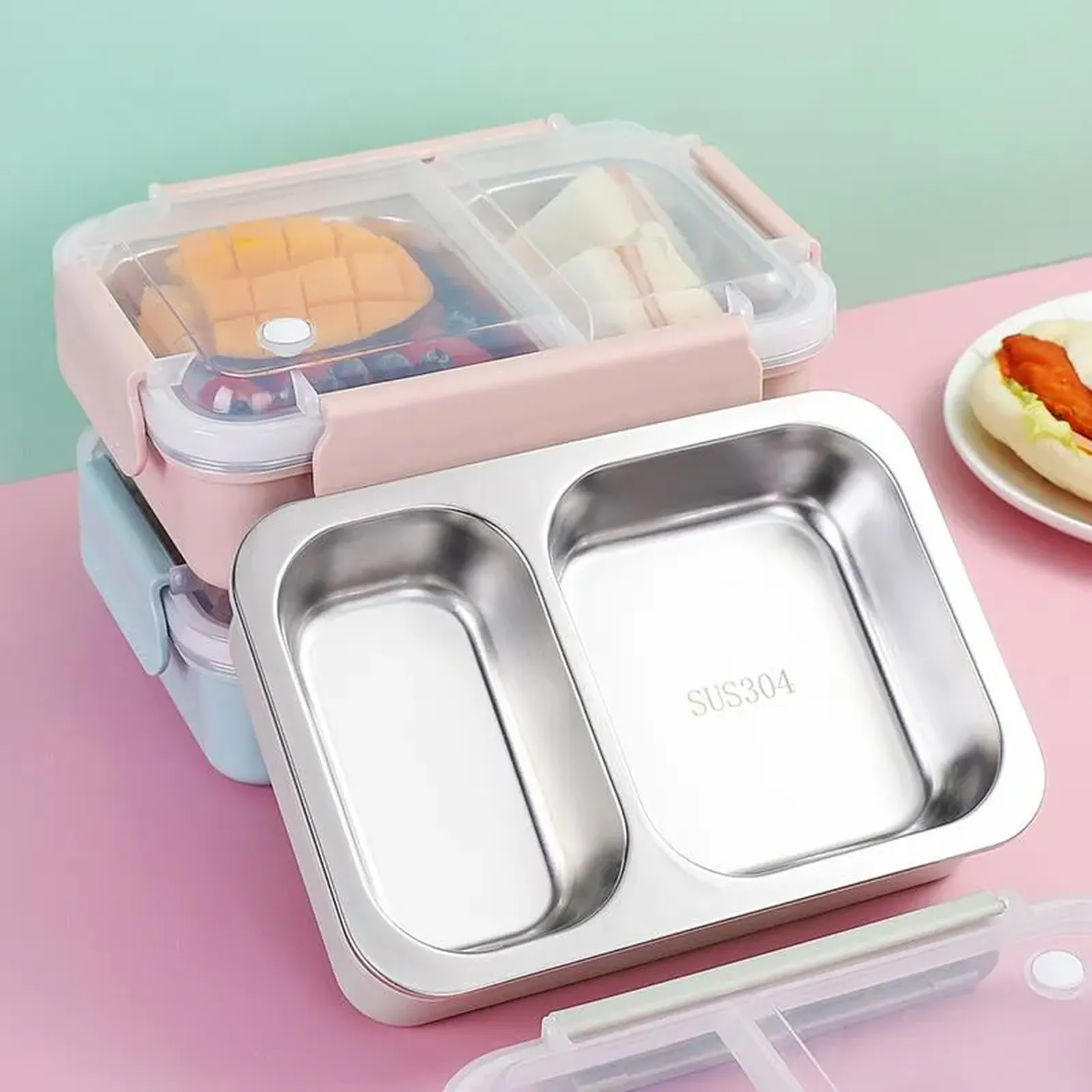
The rest of this page works that handover through one construction: a 304 stainless tray, a PP lid, a silicone seal, and a logo on the outside.
Direct Food Contact Is a Question About Surfaces, Not Products
Start with the sentence that creates most of the confusion. 21 CFR 174.5(c) says that the existence of a regulation permitting a substance as a component of articles that contact food "shall not be construed as implying that such substance may be safely used as a direct additive in food."
Read that the other way round and you have the whole article. Being cleared for food-contact articles is one thing; being cleared as a direct food additive is another; the first does not imply the second. Your lunch box lives entirely in the first category, and so does every material in it.
FDA's own definition of the unit it regulates is in 21 CFR 170.3(e)(3): a food contact substance is "any substance that is intended for use as a component of materials used in manufacturing, packing, packaging, transporting, or holding food if such use is not intended to have any technical effect in such food." Substance, not product. Component of materials, not the article on the shelf.
So when a buyer says "this part is direct food contact" and a factory agrees, both are using a shorthand that means this surface is the one food sits against. That shorthand is fine as long as it stays a description of geometry. It becomes expensive the moment it is treated as a compliance status, because the status does not exist and therefore cannot be evidenced.
Five Ways a Substance Gets Cleared, and What Each One Leaves You Holding
If "cleared" is not a certificate, what is it? 21 CFR 174.5(d) lists five ways a substance may be used as a component of an article that contacts food. Every claim a factory makes about a material traces back to one of these five, to a threshold exemption under 21 CFR 170.39, or to none — and "none" is the answer worth catching early.
Route in 21 CFR 174.5(d) | What it covers | What you end up holding |
|---|---|---|
(1) Generally recognized as safe "in or on food" | a substance accepted as safe for direct addition to food | a citation to the GRAS basis; unusual for a container wall, common for a food ingredient |
(2) Generally recognized as safe "for their intended use in food packaging" | a substance accepted as safe for packaging use | a supplier statement citing the GRAS basis — a statement, not a certificate |
(3) Prior sanction or approval | uses sanctioned before the 1958 food additive amendments | a letter naming the sanction; the thinnest paper trail of the five, so ask exactly what it cites |
(4) A regulation in part 174 itself, parts 175–178, and § 179.45 | the substance is listed, with limits on use | a section number and its conditions of use, printed on the declaration |
(5) An effective food contact notification (FCN) under section 409(h) | the substance has an effective notification for a described use | an FCN number, which you can look up yourself in FDA's inventory |
A sixth answer sits outside 174.5(d), and it is not a listing either: 21 CFR 170.39 exempts a migrating substance from regulation as a food additive where it is not a carcinogen, has no technical effect in the food, no significant environmental impact, and dietary concentration stays at or below 0.5 parts per billion — 1.5 micrograms per person per day — or, where the substance is already regulated for direct addition, exposure stays at or below 1 percent of the acceptable daily intake. What you hold is the exemption letter or its database entry, not a listing and not a certificate.
Two consequences follow. Route (5) is the only one you can verify without trusting the supplier, because FDA publishes the inventory of effective notifications by substance and use. And routes (1) to (3) are where sloppy paperwork hides: they are legitimate and common, so the document evidencing them has to name the basis rather than assert the conclusion.
The five routes are also why "it has a declaration of compliance" is not an answer on its own. A declaration is a statement by a business, and FDA's own explainer on how it regulates substances that contact food frames the whole question as one of authorizing substances; the page never reaches the question of approving a finished article. What a good declaration does is map each material in the product to one of these five routes. A declaration that does not is a letterhead, not a document. If you ship into several markets, the same mapping per market is what the five-market document map covers.
The Four Surfaces of a Lunch Box That Food Actually Reaches
A lunch box is not one surface. Take the most common steel-and-plastic construction and count what food can touch:
- The inner face of the tray — the whole floor and every compartment wall.
- The inner face of the lid — condensation, splash and, in most packs, direct contact once the box is closed and carried on its side.
- The seal band — the silicone ring or plug that meets the tray rim and presses into it.
- Inserts and accessories — dividers, sauce cups, and any cutlery that ships inside the box.
Everything else is outside that envelope: the outer face of the tray, the hinge, the latch, the handle, the print on the lid's top surface, the retail carton, the polybag. That outer group is exactly where the word "indirect" gets used, and exactly where buyers wave documents through that they should not — which is the subject of a later section.
There is a second reason to draw the boundary here rather than at the whole product. A seal is tested as a seal, and the moment you accept "the box passed" you have accepted a result for an assembly whose contact geometry may not include the gasket at all — the failure mode that shows up as a leak on a customer's counter rather than in the lab, and which seal-structure sample testing is designed to catch before the tool is cut.
The Part Map: Material, Regulation, Document, and What the Document Does Not Prove
Here is the table this page exists for. The left column is the part; the middle columns say what covers the material and what paper that produces; the right column is the discipline most buyers skip — what the document cannot tell you.
Part | Material as usually recorded | What covers the material | What to request | What it does not prove |
|---|---|---|---|---|
Tray or body, inner face (polypropylene) | "PP" | 21 CFR 177.1520 — olefin polymers, including the adjuvants allowed under 177.1520(b) | resin declaration naming the grade, plus a finished-article migration report | that the colorant, the seal or the lid is covered |
Tray or body, inner face (steel) | "304 stainless steel" | no section of part 177; composition plus the general suitability requirements in 174.5(a)(2) and (b) | mill or test certificate for the alloy, plus the supplier's declaration of intended use | that the polymer parts of the same box are covered |
Lid, inner face | "PP" or "PP+silicone" | 177.1520 for the polymer; 177.2600 if a rubber part sits in the food zone | a line in the migration report that names the lid as tested | anything about the print on the outside of that same lid |
Seal ring, gasket or plug | "silicone" | 21 CFR 177.2600 — rubber articles intended for repeated use | extraction data for the finished part against 177.2600(e) or (f) | the tray, the lid, or the adhesive that holds anything to either |
Compartment inserts, sauce cups | "PP" | 177.1520 | included in the article-level migration report, by part | parts the report does not enumerate |
Print, logo, varnish on the exterior | "custom logo", "printed" | 21 CFR 178.3297 for colorants used in polymers, with its own use limits; other ink components trace back to 174.5(d) | ink or colorant declaration plus migration data through the wall | that the ink is cleared for the inside face of the same part |
Retail carton, sleeve, polybag | "color carton", "OPP bag" | not a food-contact material unless it is the food package itself | nothing, in the ordinary case | — |
Two things about that table are worth saying out loud.
The first is that the middle column has a different answer for every row, and the answers do not collapse into "FDA compliant." A document that says the whole box is compliant has either silently generalized from one row, or is describing a test that happened to include several rows. You can usually tell which by looking for a parts list.
The second is that our own records show how easily the rows merge. Pull the published specification for a five-compartment stainless bento and the material line reads, in one cell, "PP+silicone+stainless steel304" (sic) — three materials, three regulatory bases, one string. That string is what a buyer's purchase order tends to copy, and it is the reason a factory can honestly say "the material is on the spec sheet" while holding paperwork for only one of the three. On this site, the five-compartment 6521 is listed exactly that way; other models in the range list the same combination with the same single cell.
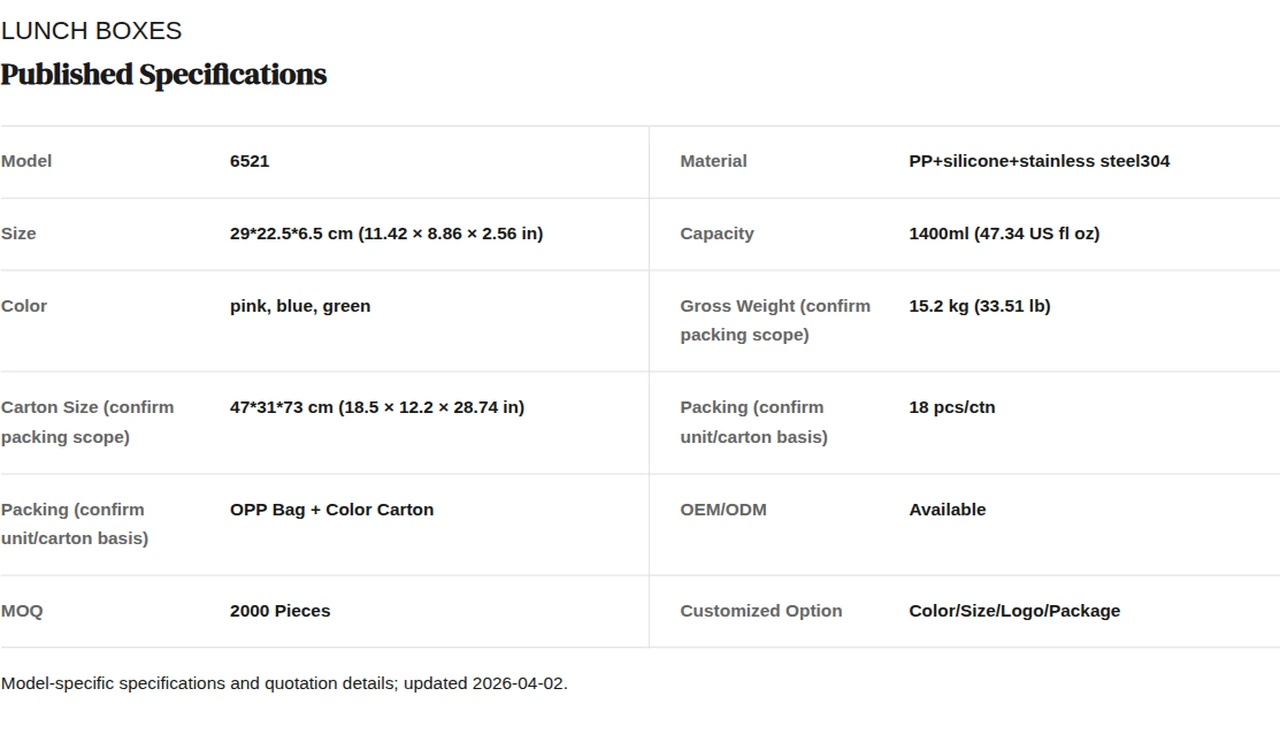
None of this means a combined material string is wrong on a product page. It means a combined string is not a compliance document, and the buyer who needs one has to split it. What each part needs on its own — including the glass and metal variants — is worked through the gasket, glass and base component map.
The All-PP Box Still Needs Three Clearances
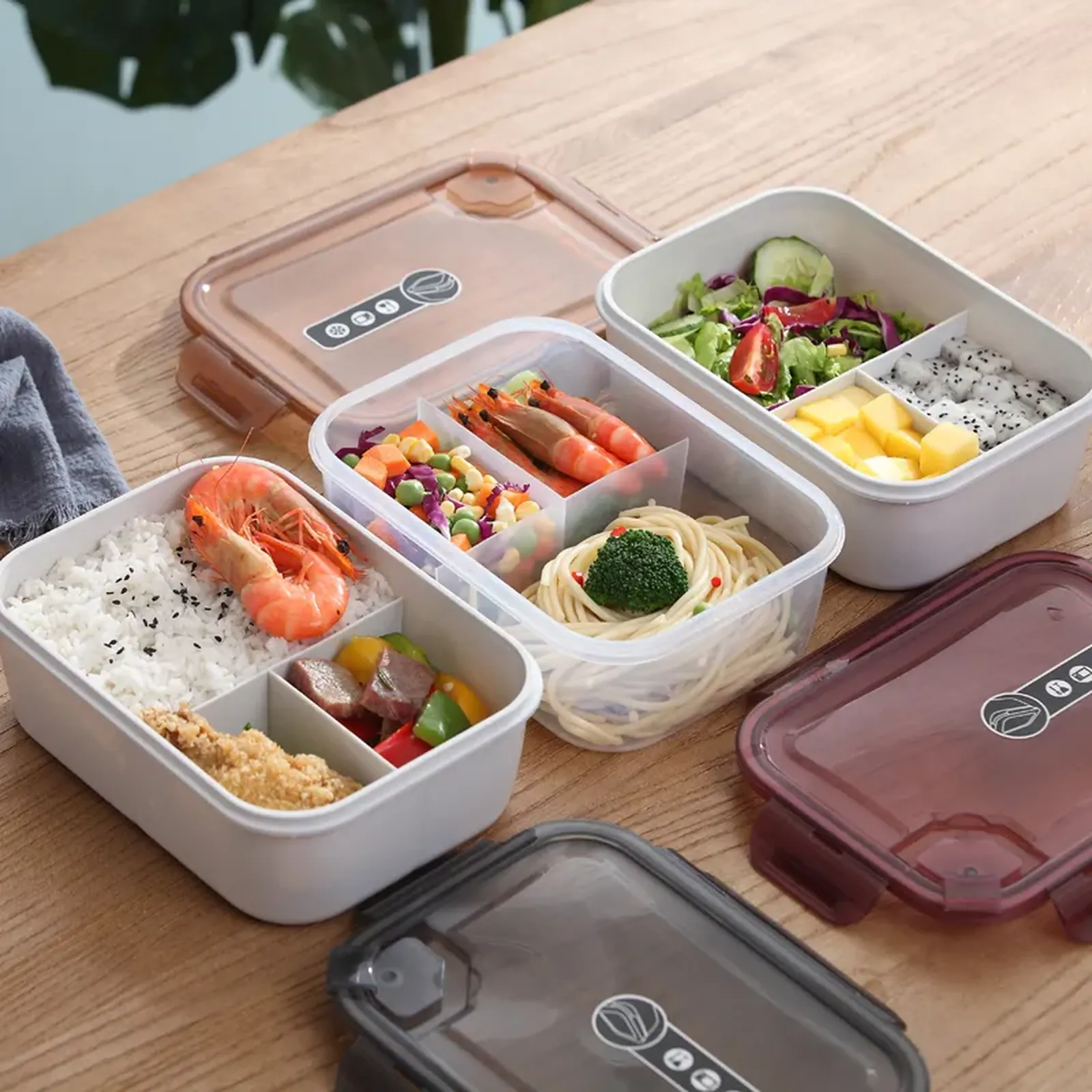
Take the plastic-only lunch box, the one with no steel in it — "plastic-only" meaning no metal, not one material, since the seal is silicone. One material looks like one regulation and one report. It means three documents, because a molded PP part is not "PP."
Start with the polymer. 21 CFR 177.1520 permits the listed olefin polymers as "articles or components of articles intended for use in contact with food," subject to the section. Polypropylene appears as item 1.1a in the specification table in 177.1520(c), and the table is not decorative — it sets four numbers that a resin has to meet: density 0.880–0.913 g/cm³, melting point 160–180 °C, a maximum extractable fraction of 6.4 percent in n-hexane at reflux temperature, and a maximum xylene-soluble fraction of 9.8 percent at 25 °C.
Those four numbers are what "food-grade polypropylene" actually means in the US. A resin certificate that says "food grade" without them has told you a conclusion; one that quotes them has told you the basis.
Then the additives. 177.1520(b) allows optional adjuvant substances in the polymer — antioxidants, processing aids, and the rest — but only where each is itself permitted by a regulation in parts 170 to 189, generally recognized as safe, or prior sanctioned. An adjuvant is a separate substance with a separate basis, and it is the part of the polymer package most often left out of a supplier's answer.
Then the color. If the part is molded in color, the colorant is covered by 21 CFR 178.3297, which lists colorants one by one, each with a ceiling on how much may be used — many entries read "not to exceed 1 percent by weight of polymers" — and each with conditions of use. A pigment that is fine at one loading under one set of use conditions is not automatically fine at double the loading. If the part is a natural or translucent resin, this row disappears from the file and the buyer should notice that it has.
The practical question for a plastic-only program is therefore not "is it food grade" but "which of the three did you document, and can I see the colorant entry in 178.3297 for the exact pigment you run." Two related threads are worth reading alongside this: the resin identification code on the base of the part, which tells you what the polymer family claims to be, and the difference between PP and PS in reusable containers, which is where a lot of "food grade" claims quietly change meaning.
The Stainless Body: Where the Plastic Paperwork Stops Being Relevant
Now the steel. This is the row where buyers most often arrive with the wrong paper, because part 177 is titled Indirect Food Additives: Polymers, and steel is not a polymer.
The regulation does not leave steel unaddressed; it addresses it as a material with a composition and a suitability duty rather than a listed additive. What 174.5 asks of any substance used as a component of a food-contact article is that it be "of a purity suitable for its intended use" (174.5(a)(2)), and 174.5(b) makes clear that holding a regulation never relieves an article of the general requirement that it not render food unfit — including by imparting odor or taste.
So the evidence trail for the tray is short and different in kind:
- Alloy identity. A mill or test certificate naming the grade, typically 304 for this product class — a materials document, not a food-contact document.
- Intended-use declaration. A statement that the finished article is intended for repeated food contact, that the surface is cleanable, and that nothing transfers to food.
- Surface condition. Cleanable geometry, no exposed braze or coating in the food zone, and the passivation that follows forming.
What that trail does not do is stretch. A mill certificate for the tray says nothing about the lid, and the lid is often the part that touches food most in a carried box. The category error itself — a "21 CFR 177.1520 compliant" certificate issued against a steel body — is taken apart in the stainless steel evidence guide; the point to carry into a document request is narrower. Steel evidence and plastic evidence are separate files, and a factory that can only produce one of them is telling you which half of the product it controls.
The Silicone Seal: The Part Food Touches Most and Buyers Document Least
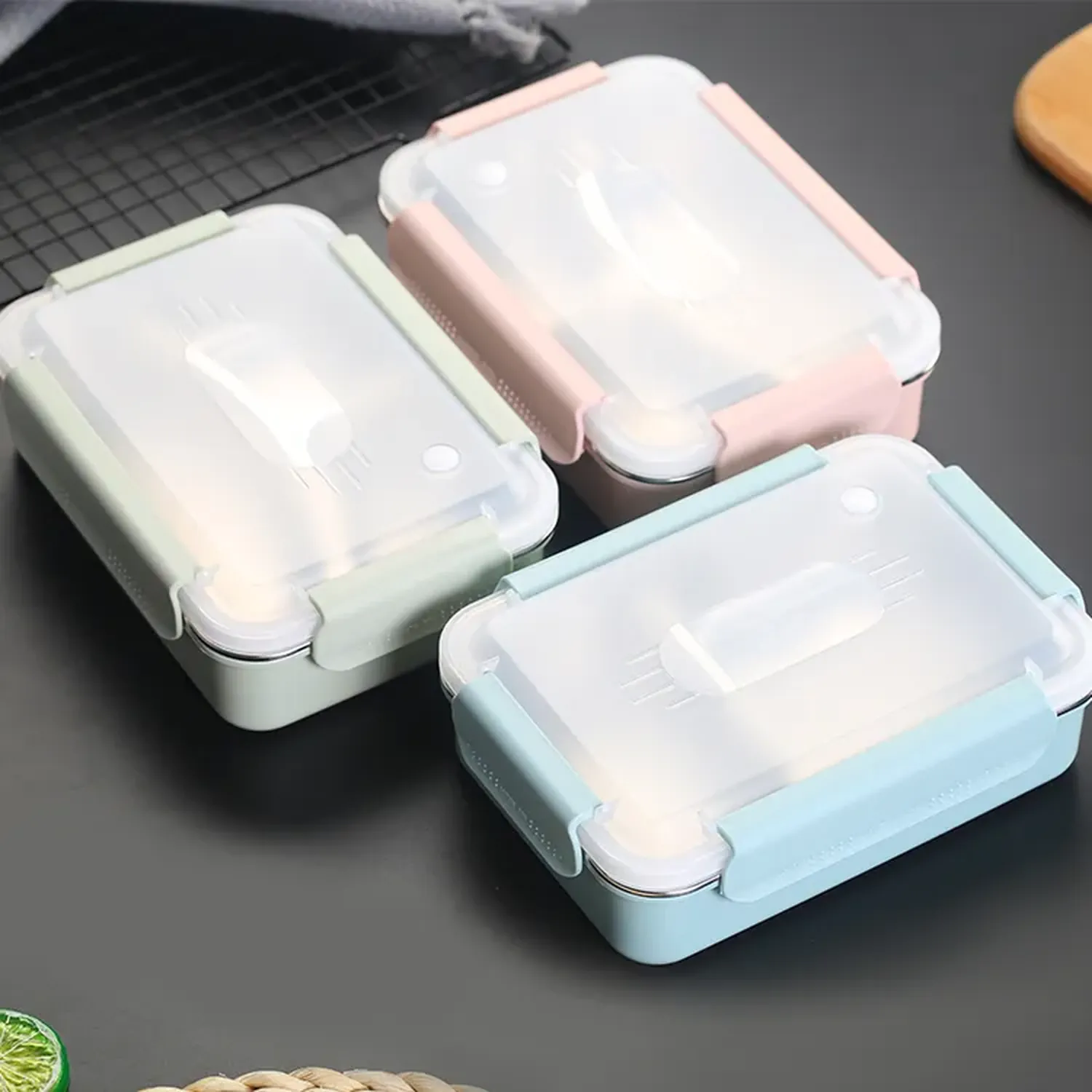
The seal is the smallest part in the box and the one with the most specific numeric test. Silicone is an elastomer, and the section buyers point to is 21 CFR 177.2600, rubber articles intended for repeated use.
Three details decide whether the report in front of you is the right one.
The limits are per square inch of the finished part, by food type. For aqueous food, the food-contact surface of the finished article, extracted with distilled water at reflux, may yield total extractives of no more than 20 milligrams per square inch in the first seven hours and no more than 1 milligram per square inch in the following two. For fatty food the medium is n-hexane and the limits are 175 and 4 milligrams per square inch over the same intervals.
Food contacted | Extraction medium | First 7 hours | Following 2 hours |
|---|---|---|---|
Aqueous | distilled water at reflux | ≤ 20 mg/in² | ≤ 1 mg/in² |
Fatty | n-hexane at reflux | ≤ 175 mg/in² | ≤ 4 mg/in² |
Dry | — | no numeric limit; the article is formulated and cured under good manufacturing practice | — |
Dry food has no number. If a supplier hands you a 177.2600 table for a dry-goods program and every row has a value, ask which food type the test simulated, because the dry-food provision sets a manufacturing standard rather than an extraction limit.
The test object is the finished part, not the compound. The wording is "the food-contact surface of the rubber article in the finished form in which it is to contact food." A compound data sheet from the silicone supplier is an input; it is not the test. And 177.2600(g) adds a requirement that is easy to overlook in a factory audit trail: finished rubber articles intended for repeated use must be thoroughly cleansed before first contact with food.
Whether the seal is molded as a separate ring, overmolded into the lid, or formed as a plug changes the tooling bill and the leak behavior — that comparison sits in the liquid silicone versus compression-molded seals piece — but it does not change what the buyer should be holding. The buyer should be holding extraction data for the part, against a named food type.
The Print, the Logo, and the Word "Indirect"
Everything above the tray rim is, physically, on the far side of a wall from the food. That is what indirect food contact means in a product conversation: the layer does not touch food, but the wall between it and the food is not necessarily a barrier.
Which is why the outside of the lid deserves its own paragraph in a document request. A colorant or ink on the exterior is still a substance that "may reasonably be expected to become a component of food" if it can migrate through the wall — and 21 CFR 170.3(e)(1) reaches materials used in producing containers whenever that expectation exists. The regulation does not care which side of the plastic the ink was printed on; it cares whether the substance arrives in the food.
Three routes for a logo change the answer:
- Molded into the tool. The wordmark is a feature of the same polymer as the part, so it inherits that part's clearance and adds nothing new to the file. The trade-off is a tool change per logo revision.
- Printed on the surface. Pad print, silk screen or UV print add an ink layer with its own components; those components trace back to 174.5(d), and any colorant used in a polymer system to the 178.3297 entries. This is the route that needs a declaration of its own.
- Heat transfer or film. A carrier film bonded to the surface puts an adhesive and a film into the stack, and both need a basis. It is the route most often described by suppliers as "just decoration."
For a part that is molded in color rather than printed, the colorant row from 178.3297 applies, and it applies with a percentage ceiling and a set of use conditions attached to the specific pigment. The ten coloring routes used in practice are catalogued in the colorant methods piece; which one you use does not change the substance test above.
There is a fourth surface treatment that behaves like print and is rarely described as one: the use symbols. A lid that carries microwave, refrigerator and freezer icons is making claims on the part itself, and each of those claims has its own test behind it, which is why a printed icon set and a printed brand mark should be asked about in the same breath.
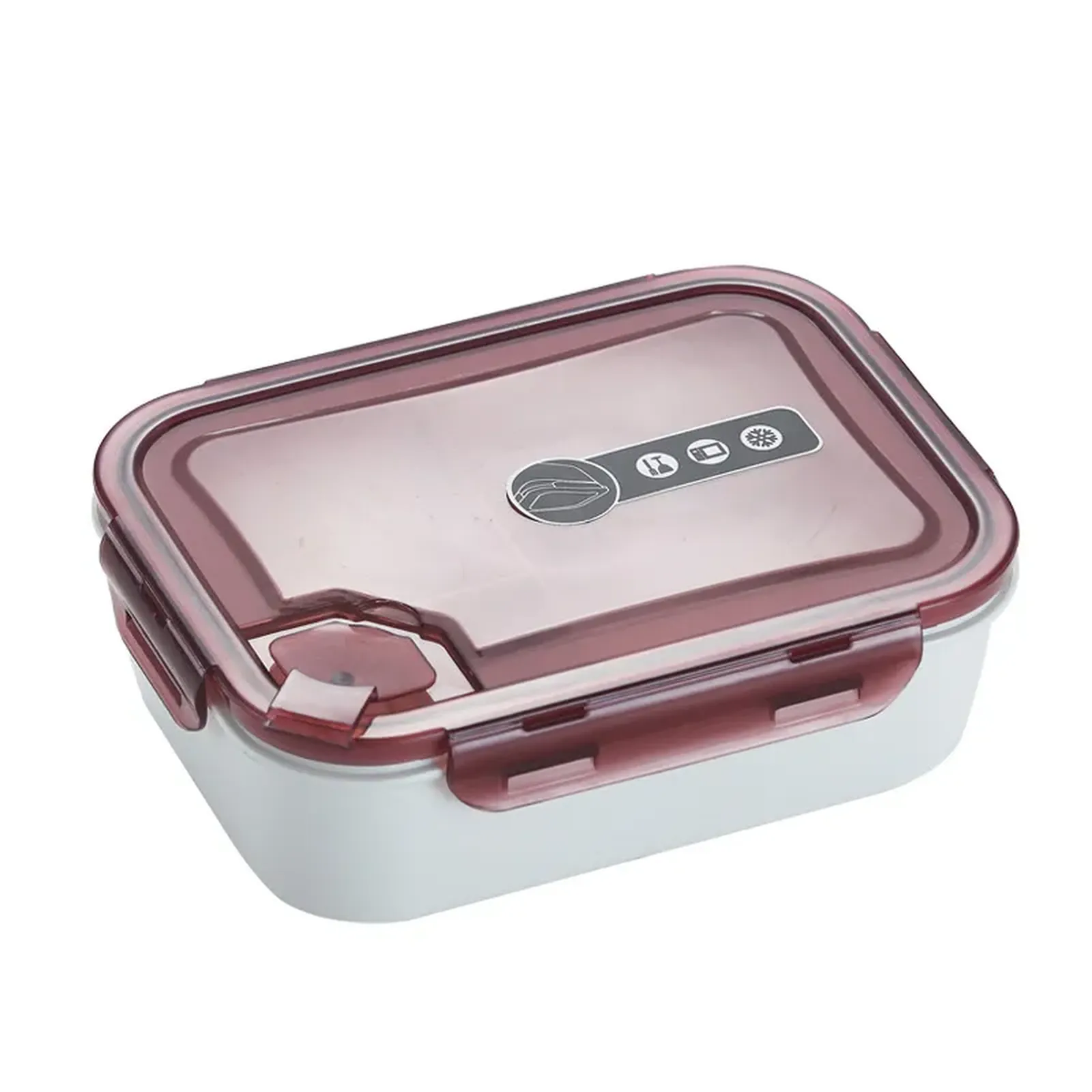
The question to put to a supplier is therefore not "is the logo food safe." It is: which of the three routes did you use, which substance list covers the ink or film, and does your migration test include the printed part or an unprinted control? If the test used unprinted parts, the print layer is undocumented no matter how the certificate reads. The same principle — the test has to match the part and the claim, not the family — is what makes microwave claims fail in contract clauses when the tested item and the sold item drift apart.
Which Parts Need Nothing, and What "Nothing" Actually Means
Here is the answer the search results rarely give, because it requires committing to a list. For an ordinary lunch box, these parts do not need their own food-contact report:
- The retail carton, sleeve and polybag, unless the carton is itself the food package.
- The hinge, latch, handle and outer shell, where they are outside the food-contact envelope and cannot be reached by food in normal or foreseeable use.
- The exterior print — the standard indirect food contact case — where the supplier can show either a cleared basis for every component or migration data through the finished wall.
- Any part fully enclosed by a functional barrier — a layer that, as demonstrated rather than assumed, keeps the substance out of the food.
The condition is doing the work in the last two lines, and it is not a formality. The sentence that makes "no report" legitimate is the fourth sentence of the 21 CFR 170.3(e)(1) definition of food additives:
"If there is no migration of a packaging component from the package to the food, it does not become a component of the food and thus is not a food additive."
Read it as a burden, not a relief. "No migration" is a finding, and findings come from tests, from a substance's own properties established in a regulation, or from a barrier whose performance has been measured. A supplier who says "it doesn't touch the food, so it doesn't need anything" has stated the premise and skipped the finding. The buyer's version of the same sentence adds four words: prove the no-migration. In practice that means the article-level migration report should name the article, cover the printed geometry, and state the food types it simulated. If a supplier's list of parts exempt from testing includes the gasket, ask for the extraction data again: a seal is compressed against food-bearing geometry and stays there through washing.
The Request List: Six Documents, and the Part Each One Is For
Turn the map into a request: one line per document, with the part named.
Document | Issued by | What it must name | What it does not prove |
|---|---|---|---|
Resin declaration for each polymer grade | resin supplier or converter | grade, the 177.1520(c) item, the four specification figures | anything about additives, color or the finished part |
Declaration of compliance for the finished article | the factory | every material in the bill of materials, each mapped to its route under 174.5(d) | that any test was run |
Migration test report on the finished article | an accredited laboratory | the article, the food types simulated, the parts included, the limits applied | parts the report does not enumerate; print that was not on the sample |
Extraction data for the elastomer part | laboratory or compounder, for the finished part | food type, medium, both extraction intervals | the tray, the lid, or any adhesive in the assembly |
Material certificate for the steel | mill or steel supplier | alloy grade and heat number | food-contact suitability of the finished article |
Ink, film or colorant declaration | ink maker or factory | the substances, the route (molded, printed, transferred), the use limits | that migration through the wall is negligible, unless tested |
A compliance pack assembled this way survives being read by somebody else — a retail customer's quality team, an importer's broker, a marketplace reviewer. The wider pack, including audits and packaging tests, is what the parent guide on compliance documents to request from a food container factory covers, and the certification landscape around it is the subject of the seven-certificate overview.

One note on the European side, since most document packs cross a border somewhere. EU law does not split the analysis the way US practice does. Regulation (EC) No 1935/2004 states in its recitals that any material or article "intended to come into contact directly or indirectly with food" must be sufficiently inert to preclude transfer of constituents in quantities that could endanger health, change the composition of the food unacceptably, or deteriorate its organoleptic properties — one requirement covering both sides of the wall. Article 16 of the same regulation then requires a written declaration of compliance for materials covered by specific measures. For plastics, Regulation (EU) No 10/2011 supplies the Union list of authorized substances and the migration limits the declaration refers to.
Five Questions for the RFQ, Not One
If the file has to be simplified to something a purchasing team will actually send, it is these five. They are ordered so that each answer narrows the next.
- Which materials in this product touch food, and which do not? Ask for the parts list, not the product name.
- For each food-contact material, which route under 21 CFR 174.5(d) are you relying on, and what document proves it?
- For the seal and any rubber part, what food type was simulated, and what were the extraction results against 177.2600(e) or (f)?
- Does the migration report include the printed or decorated part, or an unprinted control?
- Which parts of this product are covered by no document at all, and what is the basis for leaving them out?
The fifth question separates a factory that has thought about this from one that has a folder. There is no wrong answer a good factory cannot improve; there is a very telling silence.
If you are working through this on a specific construction, two starting points here are the four-compartment 6522, whose record lists the same three materials, and the plastic-only BX1051, recorded as PP+silicone, where the colorant row, the polymer row and the seal's own 177.2600 row all have to be separated. Either conversation with our team starts the same way: the parts list, and the five questions above.
None of the above is legal advice, or a statement that any particular product complies.
Continue reading
Related sourcing guidance
More practical context for your food storage container sourcing conversation.


Discuss your product range
Need help selecting or customising containers?
Share the product type, market and sourcing requirements with the Xinghui team.