
Compliance & Food Safety
Resin Codes 1-7 on the Base of the Part: What Each Number Commits You To in a Private-Label Spec
Plastic container recycling numbers name a polymer family, nothing more. What each code commits you to in a private-label spec, and the documents to demand.
Two people type plastic container recycling numbers into the same box and want opposite things. One is at a kitchen bin, asking whether a tub goes in the blue bag. The other holds a purchase order and a drawing, and needs a specification so that forty thousand tubs arrive with the right mark on the base and paperwork behind it.
The bin answer follows. The second reader is not served at all: nothing ranks for whoever signs the artwork approval, or learns in month nine that the "microwave safe" line has no test report under it.
This is for the second reader. Seven numbers, one question each: not is this plastic safe, but if this number goes on my part, what have I committed to writing down — and who produces the document that backs it.
The Recycling Number on the Base Is a Sorting Code, Not a Safety Label
The number in the triangle is a Resin Identification Code. ASTM D7611, which replaced the 1988 SPI system, says the codes "are used solely to identify the plastic resin used in a manufactured article" (ASTM D7611/D7611M). It goes further: they "are not 'recycle codes'", and the term "recyclable" "shall not be placed in proximity to the Code". Nothing in the standard is a safety assessment of the article itself — that duty sits with the food-contact clearance and the migration evidence further down this page.
The number says nothing about recyclability, and nothing about safety. Recyclability is local: the US plastics rate was 8.7 percent in 2018, against 29.1 percent for PET bottles and jars and 29.3 percent for HDPE natural bottles (US EPA). This site's note on what is recyclable in plasticware finishes that thought for the household half of the audience.
For a buyer, the code answers no specification question. It is the first line of one.
Five Lines a Resin Code Commits You To
A code on a drawing is not a material specification. It promises five other things: the polymer named properly, the food-contact basis, the migration evidence for the intended use, the claims you may print, and the mark itself — which code, at what size, with no environmental claim beside it under §4.2.
Code | Polymer | What the code commits you to writing down | The document that answers it |
|---|---|---|---|
1 | PET / PETE | Single-use by design, or repeated-use evidence; grade and clarity | 21 CFR 177.1630 plus a repeated-use migration report |
2 | HDPE | Density and grade (0.941 g/cm³ and above); any pigment or colorant still needs its own declaration | 21 CFR 177.1520 plus a migration report at the use condition |
3 | PVC | Why this resin, and the plasticizer system | The clearance for the compound, plus a plasticizer statement |
4 | LDPE | Film or molded, and the heat ceiling you will print | 21 CFR 177.1520 plus a migration report |
5 | PP | Homopolymer or copolymer, the specification item, the heat-claim basis | 21 CFR 177.1520(c) plus a migration report at the use temperature |
6 | PS / HIPS | Which polymer, and whether the article is foam or rigid | 21 CFR 177.1640 plus a migration report |
7 | Other | The actual polymer, named per layer if multilayer | That polymer's clearance, plus a declaration of compliance per layer |
Two documents sit behind it. Regulation (EC) No 1935/2004 sets the EU framework, and 10/2011 is the plastics measure with composition rules and migration limits (1935/2004, 10/2011). The declaration of compliance ties a specific part to those rules, and this site's five-market document map sets out what each market expects in it.
Codes 1 and 2: Clear and Opaque, Both Rarely the Body of a Reusable Box
Consumer guides rank PET and HDPE at the top, which is true for bottles and misleading here: neither is a body resin in this category.
PET is the clear one — bottles, jars, clamshells, and the thermoformed lids on many containers. It is cleared under 21 CFR 177.1630 and is among the most widely recycled plastics. The catch is design intent: a thin-wall PET tub is engineered for one trip, and once scratched, the scratch holds residue. PET is a strange choice for a reusable body (21 CFR 177.1630) and a normal one for a lid.
HDPE is the opaque workhorse — jugs, tubs, closures — cleared under 177.1520 beside polypropylene. Here it is uncommon: opaque bodies turn up in bulk food packaging far more often than in a retail storage box, where the customer wants to see the contents.
Across our 63 records PET never appears as a body; it appears as a component in four records (BX1131–BX1136, 3320–3329, 3320–3323, 8121) — a distinction the usual ranking of which plastic containers are safe for food never quite makes.
Code 5: Polypropylene, the Code Most Private-Label Food Containers Carry
Polypropylene is the resin this category runs on, and the number hides a fork. A 5 can be a homopolymer, a random or an impact copolymer; the three behave differently when a container is dropped, stacked or reheated, and all three print the same mark.
The US clearance is 21 CFR 177.1520, whose paragraph (c) sets the specifications the polymer must meet and (d) the test methods. "Meets 177.1520(c)" is a sentence a supplier can be held to in a way "food grade PP" is not (21 CFR 177.1520).
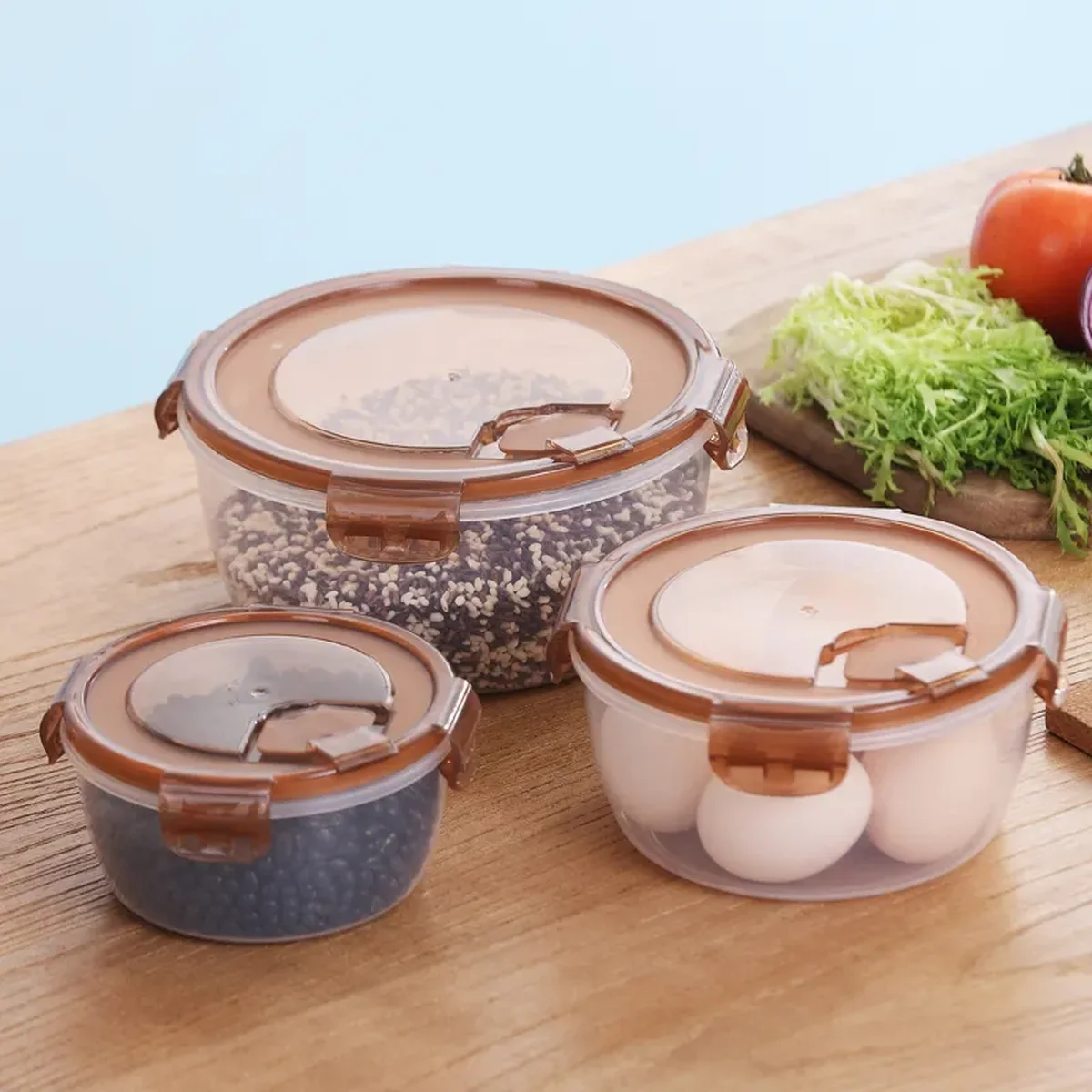
Put on the drawing: homopolymer or copolymer; the 177.1520(c) item; whether the grade is clarified or nucleated; and the migration conditions the heat claim rests on. Our note on whether PP is safe for food storage covers the consumer end; the meal-prep microwave question is where it gets asked in practice.
Code 6: Polystyrene, Including the HIPS That Has Its Own Paragraph
Code 6 is where precision pays. The US regulation is not a single material: 21 CFR 177.1640 is titled "Polystyrene and rubber-modified polystyrene", naming rubber-modified polystyrene — the polymer the trade calls HIPS — in its own title (21 CFR 177.1640). GPPS and HIPS carry the same number and are not the same purchase — one clear and brittle, one opaque and rubber-toughened, with the additive package part of what must be declared. Foam versus rigid is the second split: an expanded polystyrene clamshell and a rigid HIPS tub both print a 6 and face different local rules.
Our records hold two PS-bodied products, both soap dishes in HIPS (8842, 8843); five tissue-box records and one ice-cube tray carry a PS component. A supplier claiming "all seven codes" is describing a polymer list, not a product list, so ask which of your models is which. This site's material-by-material BPA answer covers the consumer worry; the spec question is narrower — which polymer, foam or rigid, and what the migration report says at the use temperature.
Codes 3, 4 and 7: The Numbers That Ask a Question Back
PVC (3) is a legitimate food-contact material in rigid form and the resin most associated with plasticizer migration in flexible applications. It appears in cling film, some clamshells and meat wrap, and is not a sensible body resin for a snap-lid box. A drawing marked 3 should prompt one question: what is the part, and why this resin.
LDPE (4) is a film resin — bread bags, squeeze bottles — fine at what it is designed for, which does not include being a rigid wall. Neither 3 nor 4 appears as a body material in any of our 63 records.
Code 7 carries no information. "Other" covers ABS, polycarbonate, acrylic, nylon, TPE, bioplastics and any multilayer structure that does not fit codes one to six; two parts marked 7 can share nothing but the digit. The rule is blunt: a 7 on the drawing obliges you to name the polymer yourself, and for a multilayer part, per layer.
Polycarbonate is the case everyone worries about, and the worry is bisphenol A, not the number. Expect retail compliance questions, a migration report and a statement of monomer content; "BPA-free" is a marketing phrase, while the document that matters names the polymer and its clearance. Our two ABS-bodied products are storage shelves (SN2415–SN2417), not food containers — an ABS frame or a TPE grid elsewhere in the range carries the same 7, which is the distinction a code cannot make.
Silicone, TPE and 304 Stainless Have No Number at All
A sealed lunch box may be a PP body, a silicone gasket, a TPE valve and a 304 stainless tray. Three of those four will never carry a resin code, and the buyer still specifies all four.
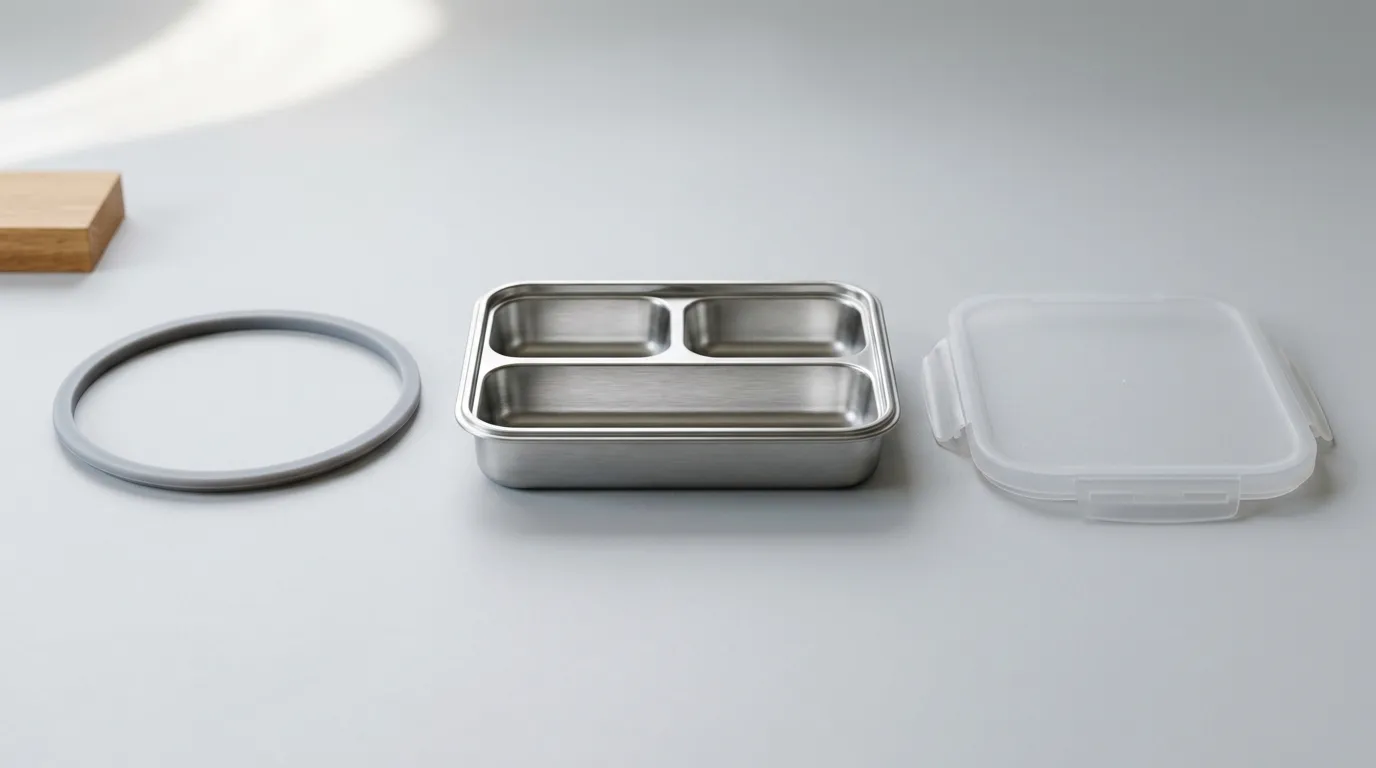
For silicone and other elastomers the US route usually runs through 21 CFR 177.2600, "Rubber articles intended for repeated use", which is where a supplier's citation should land if you ask (21 CFR 177.2600). Ask for the citation, not the phrase itself.
Stainless steel has no code and no 10/2011-style migration framework, so the alloy specification and the food-contact basis the destination market accepts replace it; this site's note on what 21 CFR 177 means for a stainless container goes further, and the gasket-and-insert piece covers the rest. Silicone appears in 23 of the 63 material fields and stainless steel in ten, five of them naming 304; in none of them does a code do any work for the seal or tray.
What the Codes Look Like Against Real Records
Drawn from our own product records — model, capacity, pieces per carton and carton dimensions as recorded, with gaps marked rather than guessed.
Model | Main-body resin | Code on the base | Capacity | Pieces per carton | Carton (cm) |
|---|---|---|---|---|---|
BX1051 | PP + silicone | 5 (body); gasket uncoded | 1.3 L (43.96 US fl oz) | 72 | 62 × 47.5 × 58.5 |
BX1094–BX1099 | PP | 5 | 1.4 L (47.34 US fl oz) | 72 | 59.5 × 43.5 × 53.5 |
BX1052 | PP + silicone | 5 (body); gasket uncoded | not recorded | 48 | 68 × 36 × 56.5 |
BX1053 | PP + silicone | 5 (body); gasket uncoded | not recorded | 24 | 61 × 30 × 57 |
BX1069 | PP + silicone | 5 (body); gasket uncoded | 1200 ml (40.58 US fl oz) | 60 | not recorded |
6521 | PP + silicone + 304 | 5 (body); lid and tray not recorded | 1400 ml (47.34 US fl oz) | 18 | 47 × 31 × 73 |
3332 | PP | 5 | not recorded | 56 | 64 × 49 × 56 |
Carton volume is where a resin decision becomes money. A BX1051 carton measures 0.172 m³; at 72 pieces, 10,000 pieces is 139 cartons, about 23.9 m³. The same 10,000 in BX1094's 0.1385 m³ carton is 19.2 m³ — nearly 4.7 cubic meters less per ten thousand — at LCL rates, a line item.
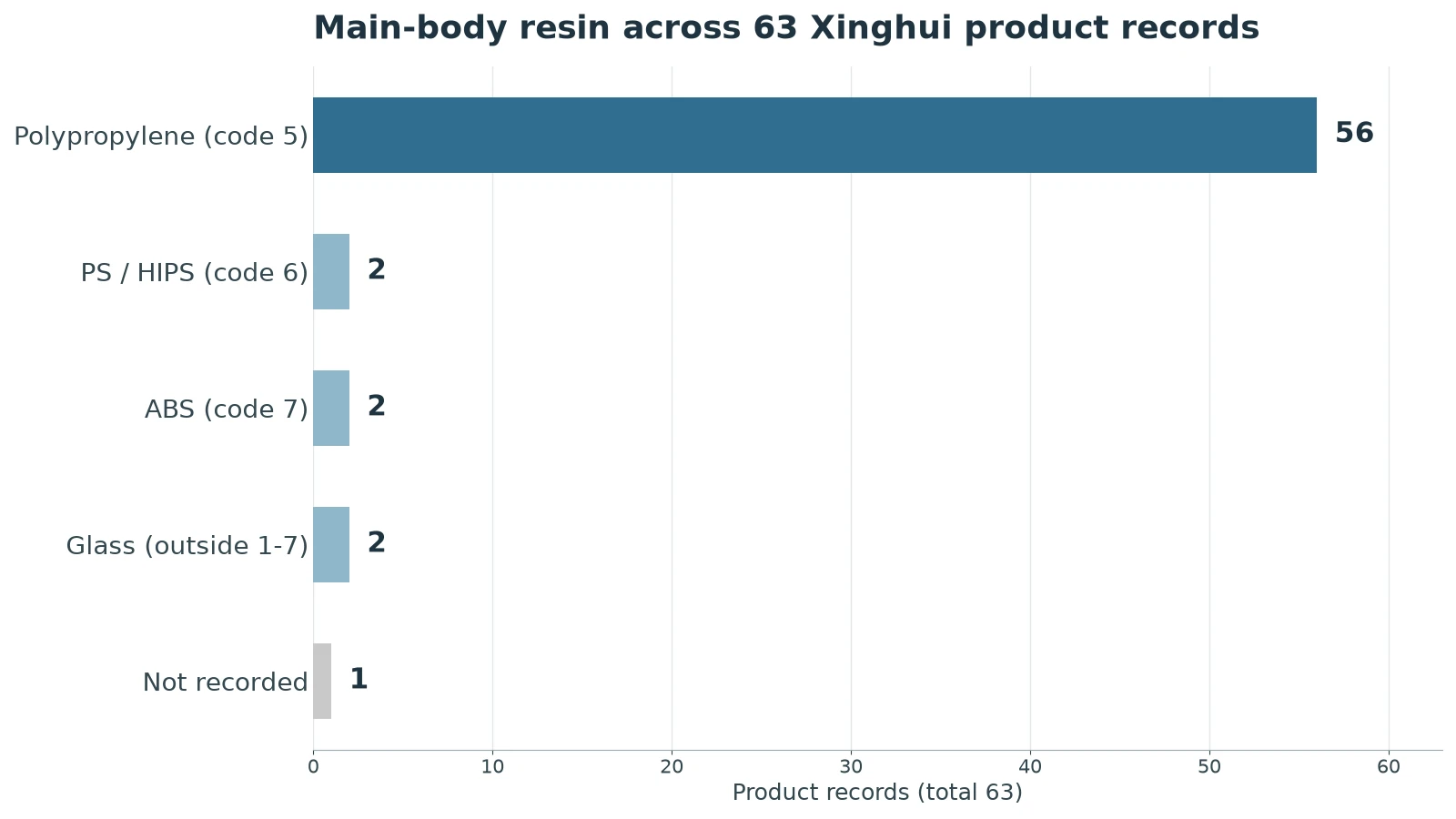
Across all 63 Xinghui records, 56 are polypropylene-bodied; two are PS or HIPS, two ABS, two glass, and one has no material field at all — a specification defect, not a database gap. The reusable-versus-disposable distinction decides which codes belong on a drawing at all.
The Seven Questions to Send With the Drawing
Send these with the drawing, and the answers tell you whether the supplier can hold the spec.
- Which polymer, by name and grade, and which item clears it? PP and HDPE: the 177.1520(c) item. PET: 177.1630. Polystyrene: 177.1640, and say GPPS or HIPS.
- For code 7 parts, what is the actual polymer, per layer? A one-word answer is a warning.
- Which migration report covers the intended use — temperature, simulant, repeated uses? Ask for the report, not the summary.
- What is the EU declaration of compliance status, and which version does it cite? If the answer is "we are FDA approved", two questions have been confused.
- What is the basis for each claim we intend to print — microwave, freezer, dishwasher, leak-proof, recyclable? One report per claim (microwave claims are the usual failure), or the claim comes off the carton.
- Where does the code sit on the base, and what does artwork approval say about claims near it?
- Is the tool new or existing? New tooling carries the current recycling mark (ASTM D7611 §4.4); an older mold may not.
The migration report and the artwork rule most often arrive late, and both are cheap to settle at the drawing stage. This site's contract clauses for microwave claims show what "settled" looks like in writing; the LFGB documentation route covers German retail, and the document pack for a food container factory collects the set.
The number on the base begins a paper trail; request the paper before the tool is cut and the cartons printed. If you are working through a specification now, send the drawing and the intended use through the private-label program, and the material and code that fit can be settled against our own records rather than a list on a recycling website.
Continue reading
Related sourcing guidance
More practical context for your food storage container sourcing conversation.
Discuss your product range
Need help selecting or customising containers?
Share the product type, market and sourcing requirements with the Xinghui team.