
Compliance & Food Safety
Reusable Bento Boxes for Private Label: The Spec Lines a Reusable Bento Has That a Single-Use Bento Does Not
A reusable bento box carries seven spec lines a single-use tray never does: grammage, lid life, repeated-use migration, wash cycles and carton arithmetic.
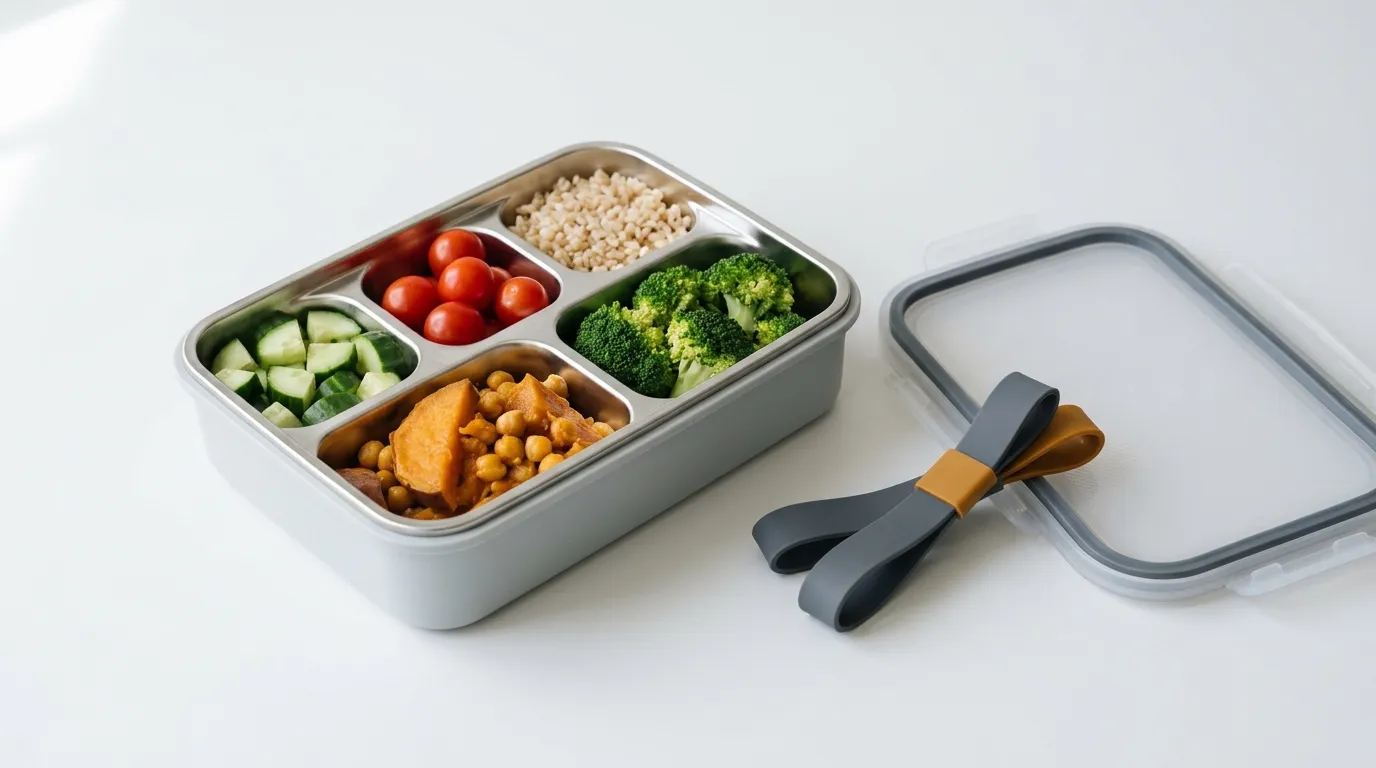
Search for a reusable bento box and you get a page of shop shelves: a French brand's 156-product collection, a bamboo-fiber series, two magazine rankings of the best boxes for a packed lunch. Every one of them is answering the same question — which one should I buy, for my own kitchen, this week. The phrase bento box reusable is typed by two different people: one is packing a lunch, the other is writing a purchase order.
That is a fine question. It is not the question this page answers. Somewhere in that same search is a buyer for a retail brand, an importer, or a private-label program manager who needs the answer to a harder question: if I put my name on a reusable bento and ship forty thousand of them, what has to be true about the product before the first carton leaves the factory — and how do I write those things down so that someone can be held to them?
The two product classes look alike on a shelf and behave nothing alike on a purchase order. A single-use bento tray is specified by capacity, price per thousand and one migration test. A reusable bento keeps going after that: it gets washed, dropped, microwaved, stacked in a work bag and judged in month six by somebody who paid retail for it. Each of those expectations is a line that has to exist somewhere in the paperwork.
What follows is seven of those lines. For each one, the question to put to a supplier and the document that should answer it. The model figures come from Xinghui Plastic Life's own product records and are here to show what a filled-in spec looks like — not to sell you a particular box.
Why a Reusable Bento Box Is a Different Purchase From a Single-Use One
A single-use tray is designed for one journey: filled, sealed, carried, eaten, discarded. Its spec sheet is short because its life is short. Capacity, material grade, lid film specification, weight per thousand, and a food-contact statement for first use. Nobody asks what happens on the fourth wash, because there is no fourth wash.
A reusable box has to survive a sequence instead of a moment. It is filled and closed hundreds of times. It goes through a dishwasher at a temperature nobody measured when the mold was cut. It sits in a fridge, then in a microwave. It gets printed with your brand, and that print has to look like your brand after a year of that treatment. And when the seal finally goes, the customer does not throw the box away — they contact whoever sold it to them.
That last sentence is the commercial reason this article exists. On a disposable product, a failure is invisible: the tray went in the bin anyway. On a reusable product, every failure has an owner, and the owner is the brand on the lid.
A disposable tray is judged once, on the day it ships. A reusable box is judged every day it is used — by somebody who has your name on the lid.
There is a regulatory push underneath the commercial one. The EU's single-use plastics directive (Directive (EU) 2019/904) targets a listed set of single-use items and requires a reduction in the consumption of single-use food containers; several markets have layered their own rules on top. Whether a specific SKU of yours falls inside that scope is a question for your market's competent authority and your own regulatory adviser — not for your factory, and not for a supplier's marketing page. What a factory can do is tell you exactly what its reusable alternative is made of and which documents back that up. That is the part you can put in writing.
The same split shows up in the ways a brand moves from one to the other. If you are currently importing disposable or single-use food containers, the article on reusable vs disposable food containers covers the switch at the level of the whole program; this page stays on the spec sheet.
None of the seven lines below changes because the range is aimed at adults or at children. A children's line simply adds a layer on top — age grading, smaller compartments, and whatever child-safety documentation your market demands — while the spec lines underneath stay the same.
Spec line | Single-use bento | Reusable bento |
|---|---|---|
Capacity | Nominal volume, sometimes usable volume | Nominal and usable volume — compartments and lid intrusion change both |
Mass and price basis | Price per 1,000 pieces | Grams per piece, plus a tolerance, plus grams per liter |
Lid | Fit for one closure; film or snap lid | Latch or hinge cycle life; gasket hardness and compression set |
Migration testing | Once, on the as-supplied article | The Annex V repeated-use conditions, checked item by item |
Wash behavior | Not specified | Cycle temperature, detergent, cycle count, dimensional stability |
Decoration | Printed on the carton and the sleeve | Printed on the product; adhesion after repeated washing |
Packing | Pieces per sleeve, pieces per carton | Pieces per carton, carton dimensions, gross weight, carton volume per piece |
Spare parts | None exist | Gasket and lid available as separate items |
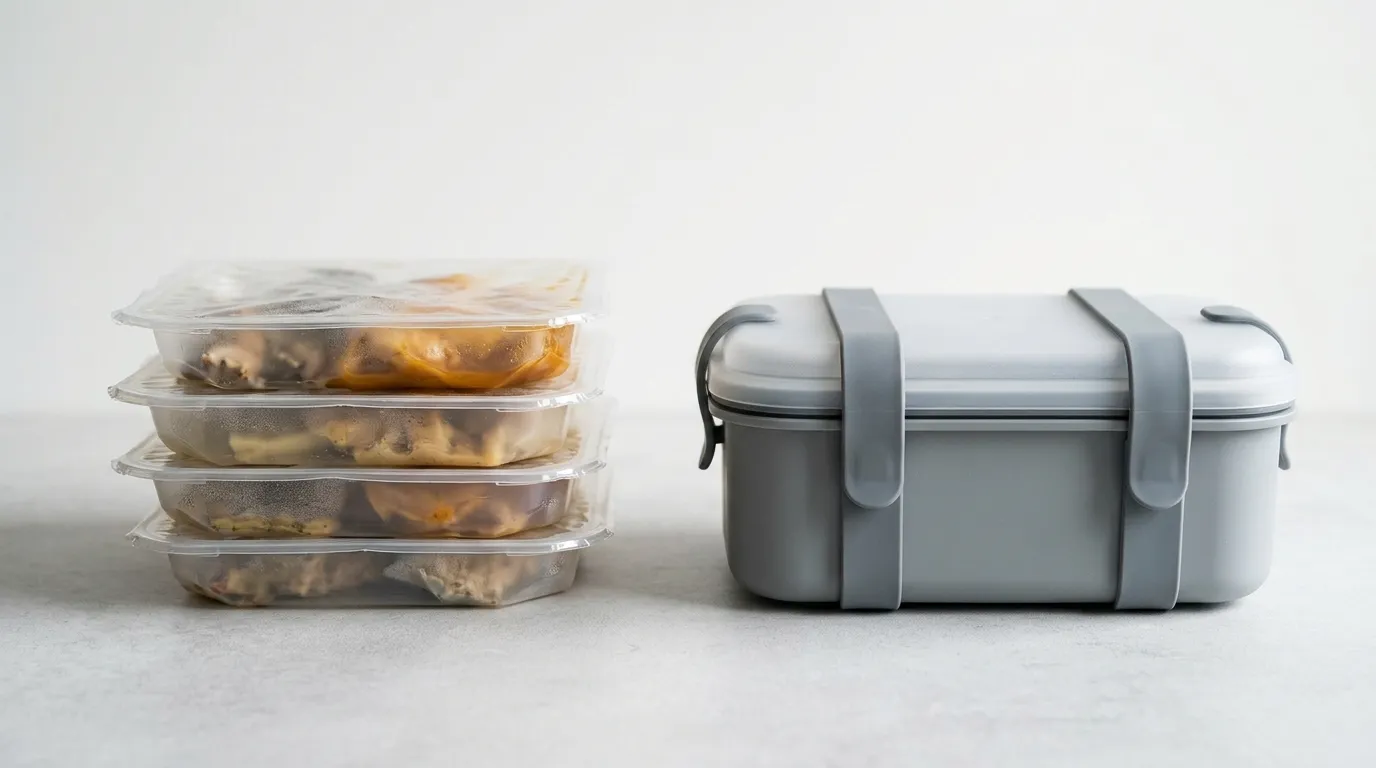
Two product classes, one shelf. The stack on the left is built to hold food once; the box on the right has a lid that is expected to close a few hundred more times.
Spec Line 1 — Grammage per Liter, Not Just Capacity
Ask a supplier for wall thickness and you will get either a range, a shrug, or a number that cannot be checked without cutting the box in half. Ask for the weight of one piece and you get something you can verify with a kitchen scale.
The factory records behind this article happen to carry both numbers for two of the models, which makes the arithmetic visible. Model BX1051 is listed at 1.3 L and 182 g per piece, which works out at 140 g of product for every liter it holds. Model BX1069 is listed at 1,200 ml and 135 g, or 112.5 g per liter. Both are polypropylene bodies with silicone seals, both sit in the lunch-box line, and the first carries a quarter more material per liter of capacity than the second. The two weights come from records that flag the unit basis as unconfirmed — the 182 g may cover tray, lid and gasket, or the tray alone — so get that basis written down before the ratio goes into a PO.
That ratio is the closest thing to a wall-thickness number you will get without destructive testing, and it correlates with the things buyers actually notice: how much the box flexes when a full one is picked up by one corner, how it behaves when a stack of six is loaded into a warehouse tote, whether the base stays flat after a hot wash.
Three cautions before you use it as a score. First, it only compares within a material class — a stainless steel tray with a PP lid will always be far heavier per liter than an all-plastic box, and that is not a quality signal, it is physics. Second, units drift. A 1,300 ml box is 43.96 US fl oz, the two numbers are rounded independently at different points in the chain, and the one on the packaging is the one a customer will check with a jug. Pick one and hold it. Third, nominal capacity is not usable capacity. Compartments waste volume at the corners, a lid that intrudes takes volume off the top, and a box rated at 1,400 ml will not hold 1,400 ml of soup. Ask for both figures, and ask which one the retail packaging will print — because that is the number a customer will measure.
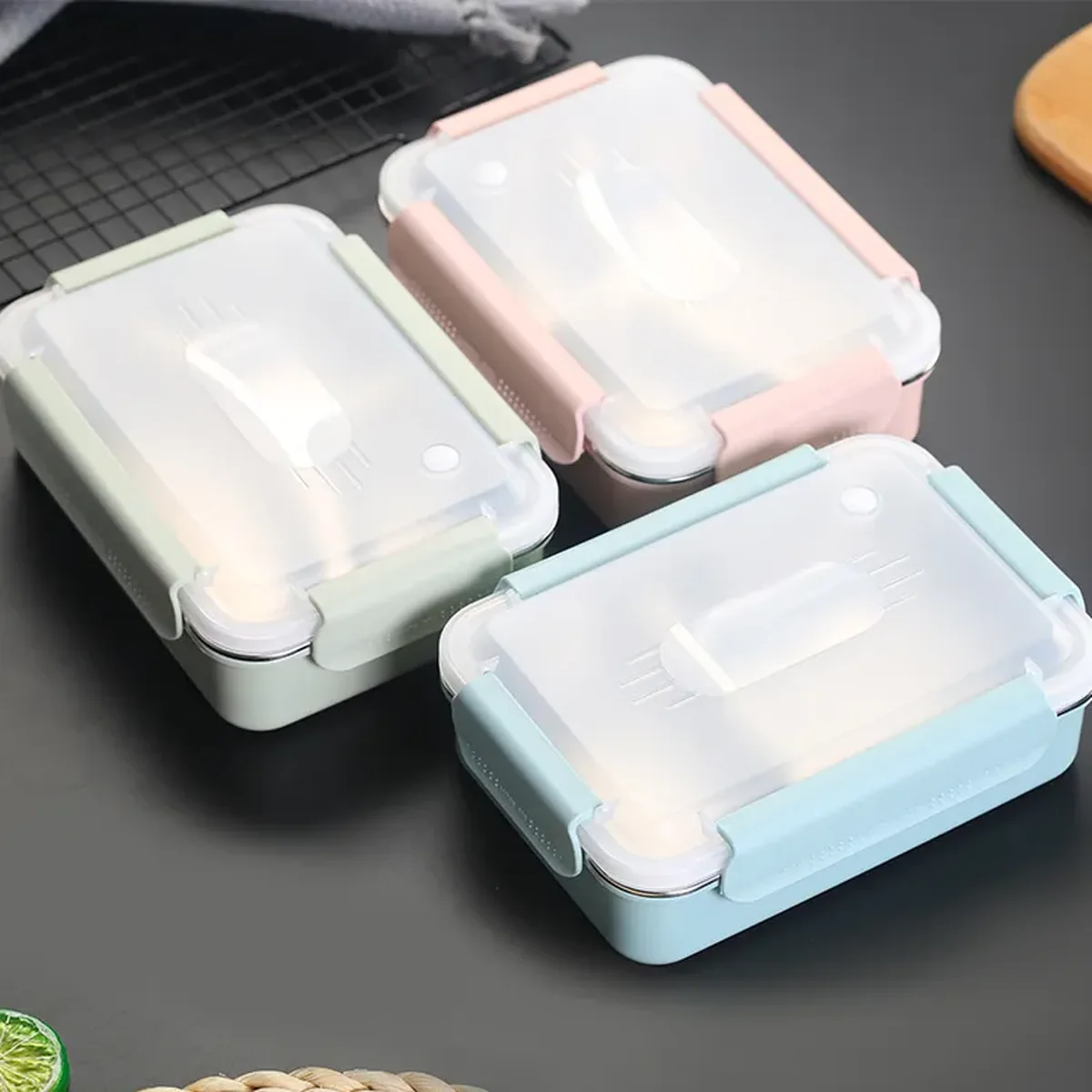
Stainless trays with frosted PP lids: the same 800 ml to 1.4 L range as the plastic boxes, at a completely different mass per liter. Grammage only compares within one material class.
A single-use supplier will usually answer this question in a different currency: price per thousand pieces. That is the right metric for a product that is bought by the thousand and thrown away by the thousand. It is the wrong metric for a product that has to still be in service at Christmas.
Spec Line 2 — The Lid Has a Service Life, so Put a Number on It
Every reusable bento fails in the same order. The base rarely fails first. The lid does: the latch loses tension, the gasket takes a compression set and stops springing back, a living hinge cracks at the fold line, or the lid-to-base interference that felt tight in the sample room stops feeling tight after two hundred closures.
So the lid needs a number, and there are three worth writing into the spec.
Latch or closure cycles. How many open-close cycles before the closure no longer holds the lid down? A supplier who has tested this will have a figure and a test method. A supplier who has not will offer you a sample and invite you to try it yourself, which is not a specification.
Gasket hardness and compression set. The silicone ring is the part that actually seals, and it is the part that ages. Shore A hardness tells you how hard the ring is; compression set tells you how much of its original thickness it keeps after being squeezed hot for a long time. If the answer to "what is the compression set" is silence, the seal is a hope.
Retention after washing, not just after molding. A lid that seals on day one and leaks on day ninety has passed the wrong test.
That is why a first-article leak test and a life test are different documents, and why a buyer should ask for both. The first-article test tells you the tool is capable. The life test tells you what you are warranting. The mechanics of how a seal is built and how to test one on a sample are set out in the note on leak-proof seal structure and sample testing; what matters here is that the result belongs in the purchase order, not in a chat thread.

The test that decides a lid's fate is not a flat box on a bench. It is a full box, closed, turned over, and left alone for the length of a commute.
Two more details belong on this line. Ask whether the cycle test was run on parts from the production tool or from a machined or 3D-printed prototype — those are different products. And ask what the gasket is made of and whether its grade is the same one that will be in mass production; a sample sealed with a harder, better ring than the order will ever see is a common way a leak test becomes fiction.
Spec Line 3 — Repeated-Use Migration, and the Gasket Nobody Tests
Food-contact compliance for a single-use tray is a one-shot exercise: test the article as supplied, file the result, ship.
For a reusable article, the EU plastics regulation changes the shape of the exercise. Under Regulation (EU) No 10/2011, one migration test on the as-supplied article does not on its own show that a repeated-use article stays compliant across its service life — the Annex V conditions for repeated use have to be checked item by item, and the case the file has to cover is the box that has been washed and refilled, not the box straight out of the mold. That is the whole difference between a disposable compliance file and a reusable one, and it is the line that most often goes missing when a brand re-specs from one to the other.
The second gap is the one nobody sees coming: the declaration you are handed almost always covers the plastic body only.
A bento box is not one material. It is at least two, often three: a PP base or tray, a silicone gasket or latch strap, sometimes a 304 stainless steel insert. Regulation (EU) No 10/2011 governs plastic materials and articles; a silicone gasket is not a plastic for its purposes, and a steel tray is not either. The framework regulation, Regulation (EC) No 1935/2004, sets the general safety requirement across all food-contact materials and requires a written declaration of compliance to travel with them — but "a declaration exists" and "a declaration exists for each component of my product" are different claims.
In the US the split runs the same way. The polypropylene parts are typically assessed against 21 CFR 177.1520, olefin polymers, and the section that fits a silicone gasket is 21 CFR 177.2600, rubber articles intended for repeated use — a section whose very title describes the part. Note what that means for the two product classes: the gasket in a reusable box is a repeated-use rubber article under a regulation written for repeated-use rubber articles. A disposable bento box has no gasket, so the question never arises.

Three components, three compliance tracks. A folder with one declaration inside it is not a document pack.
None of this is a legal conclusion, and none of it should be taken from a supplier's page as one. It is a list of questions with an unglamorous property: each one has a document-shaped answer, and a supplier either has it or does not. The five-market document map for reusable plastic containers is set out separately in the five-market compliance document map, and the problem of the non-plastic parts gets its own treatment in the note on non-PP parts, gaskets and glass inserts.
If you take one line from this section, take this: ask for the compliance document per component, and ask each one to name the model and the material grade it covers. A declaration that names neither is a brochure.
Spec Line 4 — Wash Cycles and the Claims Printed on the Box
"Dishwasher safe" is three words that hide a specification. A domestic machine runs a gentler program than the pass-through machine in a staff canteen or a school kitchen, and a box that survives one may not survive the other. The specification is not the word; it is the cycle, the temperature, the detergent and the number of repetitions.
The same logic applies to the other two claims that will appear on your packaging.
Microwave reheat needs a defined test: how long, at what power, with what kind of food, lid on or off, and what was measured afterwards. "Microwave safe" without those four parameters is a mood. The difference between a container that is microwave-safe and one that merely survives a microwave is set out in how to tell if a container is really microwave safe.
Freezer use needs a temperature and a drop test, because the failure mode is not the cold — it is what happens to a brittle box when it is dropped on the way out of the freezer.
On a single-use product, these words are decoration. On a reusable lunch box, they are terms of the sale. If your packaging says dishwasher safe and the box crazes after forty cycles, that sentence is the thing you will be arguing about — and the argument will be settled by whichever document you can produce, not by whose memory of the sample room is better.
So write the claim and the evidence in the same row of the spec — the cycle parameters spelled out, the test named, the report number recorded. The one claim that needs handling differently is "BPA-free", which is not a performance claim at all but a statement about a substance — and therefore belongs in the document pack, not in the feature list.
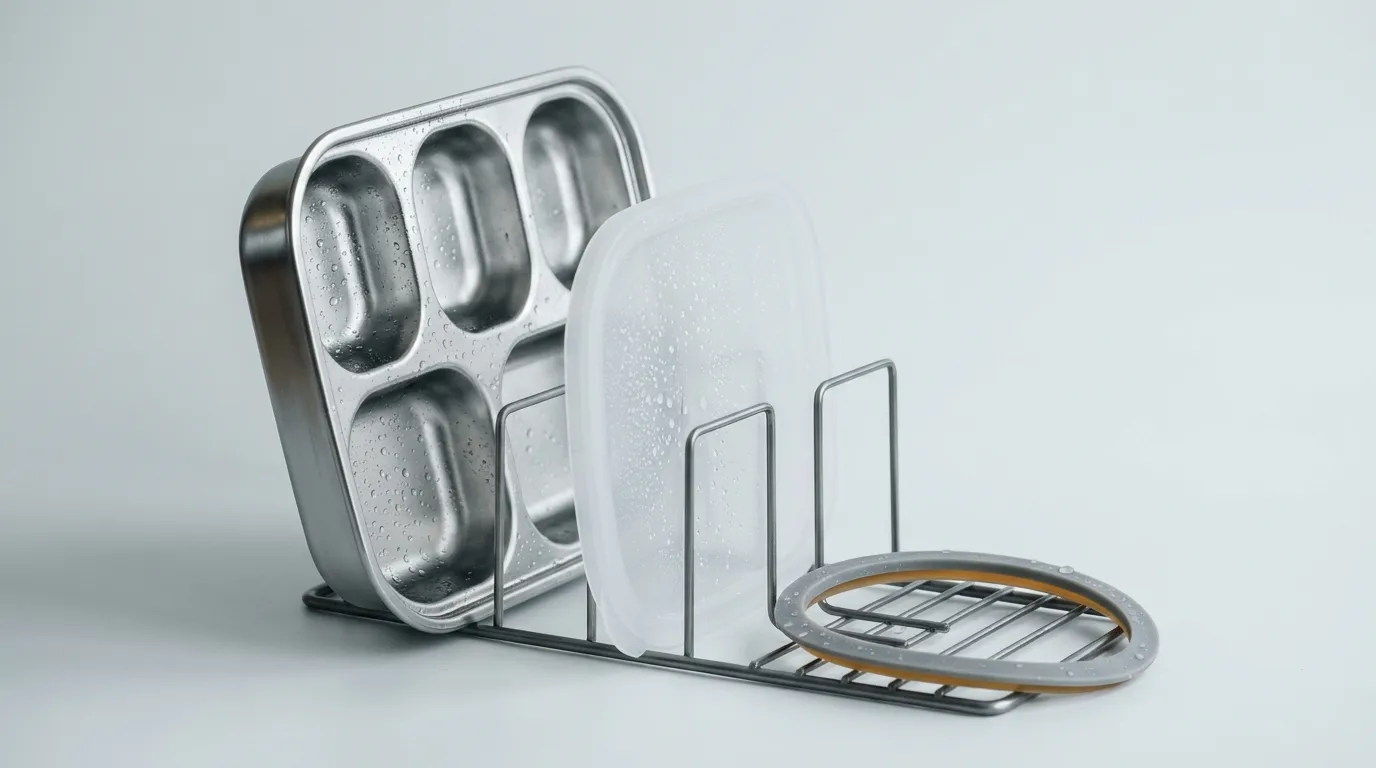
The claim is not "dishwasher safe". The claim is a cycle, a temperature and a count — and a box that still fits its lid afterwards.
Spec Line 5 — The Logo Is a Wear Part Too
Here is a line that a disposable supplier never has to think about. On a single-use tray, your brand lives on the carton and the sleeve. On a reusable bento, your brand lives on the product, in the middle of the wash cycle, for the life of the box.
That changes the question from "can you print my artwork" to "what does my artwork look like after two hundred washes, and who is responsible if it does not".
Four decoration routes are common on custom bento boxes — heat transfer, UV print, silk screen and laser engraving — and they behave differently on a frosted PP surface, which is what most bento lids are. The ranking of those methods by unit cost, turnaround and appearance on frosted PP is covered in the comparison of logo methods for a container set; the spec lines you need from this one are narrower:
- Adhesion after washing. Ask for an adhesion test result after a stated number of wash cycles, not just a print that looks good on the sample.
- Placement. A print that sits on the gasket land or across the latch flex zone is a leak waiting to happen. Decide where the mark may and may not go, and put that in the artwork brief.
- Color on the actual substrate. A brand color approved on white paper will not match on a translucent frosted lid; approve the color on the real material, under real light.
- Registration tolerance. If your artwork has more than one color, ask what misregistration the process allows before the mark looks wrong.
There is a commercial edge to this line that is easy to miss. The printed mark is the only part of the product that is unambiguously yours. A customer who cannot read your brand after a year of washing has, functionally, bought an unbranded box.

Same artwork, same substrate, different number of wash cycles. This is the test a print spec should be written against.
Spec Line 6 — Carton Arithmetic Is Where the Spec Meets the P&L
Everything above is about whether the product is right. This line is about whether the shipment is affordable, and it is the line buyers most often leave to the freight forwarder — which is a mistake, because the numbers that decide it are fixed at the mold, not at the port.
Three figures do the work: pieces per carton, carton dimensions, and gross weight. Divide the carton volume by the pieces inside it and you get a number that is far more useful than capacity: liters of shipping volume per piece. That is what you are actually paying to move.
Here is the lunch-box family in the factory's own records, one row per model whose record carries a capacity figure.
Model | Material | Capacity | Pcs / carton | Gross weight | Carton (cm) | Carton volume per piece |
|---|---|---|---|---|---|---|
6521 | PP + silicone + 304 stainless | 1,400 ml | 18 | 15.2 kg | 47 × 31 × 73 | ≈ 5.9 L |
6522 | PP + silicone + 304 stainless | 1,100 ml | 24 | 14.5 kg | 54 × 32 × 60 | ≈ 4.3 L |
6523 | PP + silicone + 304 stainless | 800 ml | 24 | 11.5 kg | 54 × 32 × 50 | ≈ 3.6 L |
6527 | PP + silicone + 304 stainless | 1,300 ml | 24 | 11 kg | 51 × 46 × 62 | ≈ 6.1 L |
6529 | PP + silicone | 1,300 ml | 48 | 15 kg | 51 × 46 × 62 | ≈ 3.0 L |
6533 | PP + silicone + 304 stainless | 1,100 ml | 24 | 13 kg | 50 × 36 × 47 | ≈ 3.5 L |
6536 | PP + silicone + 304 stainless | 1,100 ml | 24 | 11 kg | 47 × 34 × 47 | ≈ 3.1 L |
BX1051 | PP + silicone | 1,300 ml | 72 | 14.3 kg | 62 × 47.5 × 58.5 | ≈ 2.4 L |
BX1069 | PP + silicone | 1,200 ml | 60 | not recorded | not recorded | not recorded |
Carton volume per piece is calculated from the carton dimensions and piece count in the record; it is not a field the factory publishes. Gross weight and carton dimensions are recorded values — the two blank cells in the BX1069 row are the exception, because that record carries no carton dimensions or gross weight at all — and several of the figures carry a note in the source record that the packing scope should be confirmed — meaning whether the figure includes the inner color carton and any divider. Confirm the scope explicitly before you build a landed-cost model on it.
Two notes on what the table does and does not cover. BX1069 is a round bowl module with a handle rather than a compartmented bento box — it sits in the same lunch-box category in the records, and it stays in the table because it is one of only two models whose record carries a grammage figure. And the category holds more models than these nine: the ones left out either carry no capacity figure in the record yet or are a different product type, so there is no row here that a buyer could quote from.
Read the table for what it says about capacity. The largest capacity in the family is not the one that ships worst, and the smallest is not the one that ships best. The 800 ml model moves 3.6 liters of carton per piece while the 1,300 ml model in PP moves 3.0 — because geometry, the color carton and the piece count decide the packing, not the volume on the lid. Two boxes that look alike on a shelf can also differ in whether they are stackable at all, and a domed lid that will not take a second box rewrites the carton plan. Two records in the table (6527 and 6529) share identical carton dimensions at different piece counts, and 6527's per-unit size field in the record looks like a carton dimension rather than a box dimension. Both are worth re-confirming with the factory before a PO, and both are the kind of thing that only becomes visible when you do this arithmetic.
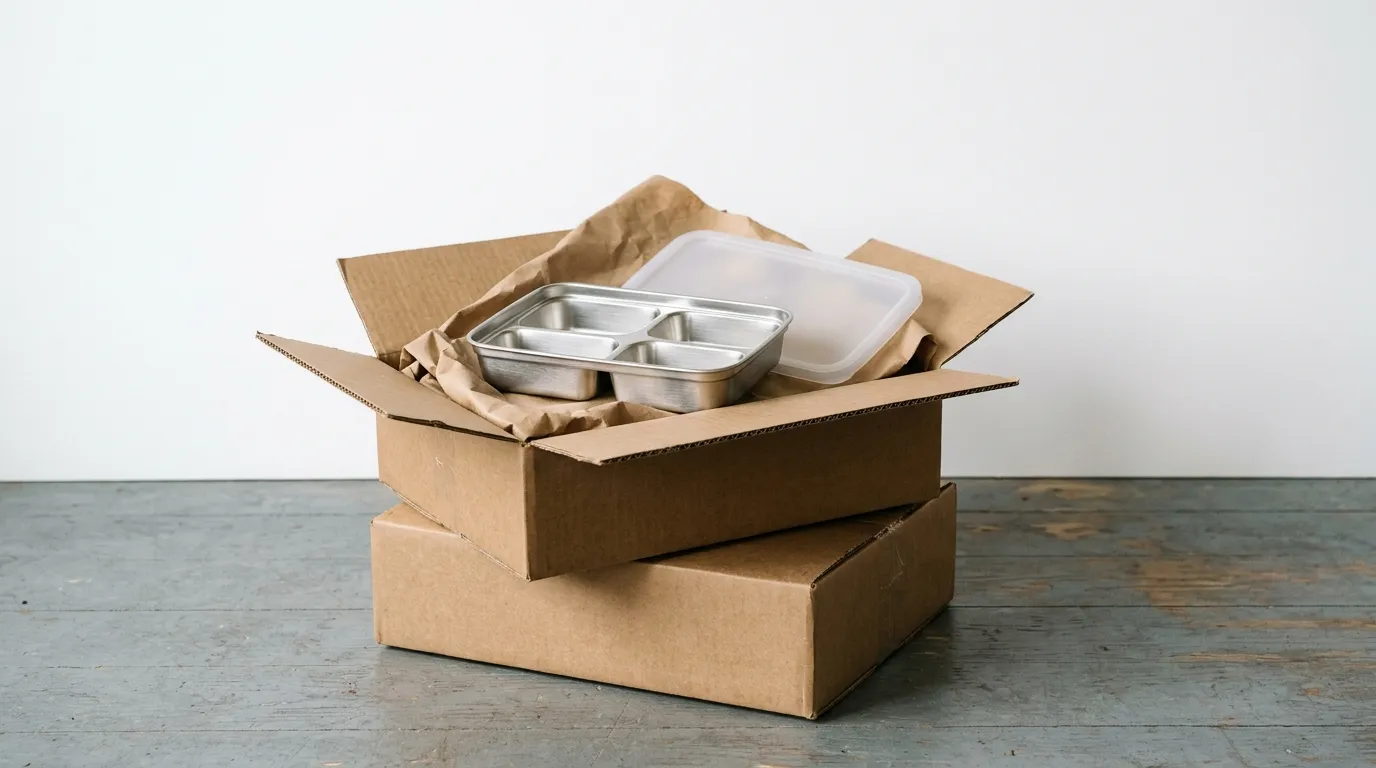
Pieces per carton, carton dimensions and gross weight: three numbers that decide your freight before a forwarder ever sees the file.
The packing side of the same problem — how nesting, stacking and carton geometry interact across a whole container — is worked through in stacking, nesting and carton math for freezer and fridge containers. For a bento box wholesale order, one extra question is worth adding to the list: does the inner color carton count inside the piece count, or sit outside it? The answer moves the volume per piece by a double-digit percentage.
Spec Line 7 — Spare Parts and the After-Sales Line
The gasket is a wear part. It is usually the first thing to fail, it fails on a fairly predictable schedule, and when it fails the customer's box stops sealing.
On a disposable product there is no equivalent question: the tray and its lid are one object with one life. On a reusable program, the absence of a spare-part line turns every gasket failure into a whole-box return, and every whole-box return into a conversation with your retail customer about defect rates.
So the seventh line is unglamorous and mostly ignored: is the gasket a separate part number, and can it be bought on its own?
Four things to pin down. Whether the gasket is sold as a spare at all. Whether it can be fitted by hand without tools, because a part that needs a jig is not a consumer spare. What the minimum order for spares is, and whether it can ride on the same container as the main order. And whether the same question can be answered for the lid, since a cracked lid is the other half of the same failure.
There is a packaging cousin to this line: the retail unit itself. If the box ships in a printed color carton that carries the instructions, the spare-part note and the claim language, then that carton is a controlled document too — reprints, revisions and version control all belong in the same conversation. The private-label retail packaging approval process covers how to keep that under control.
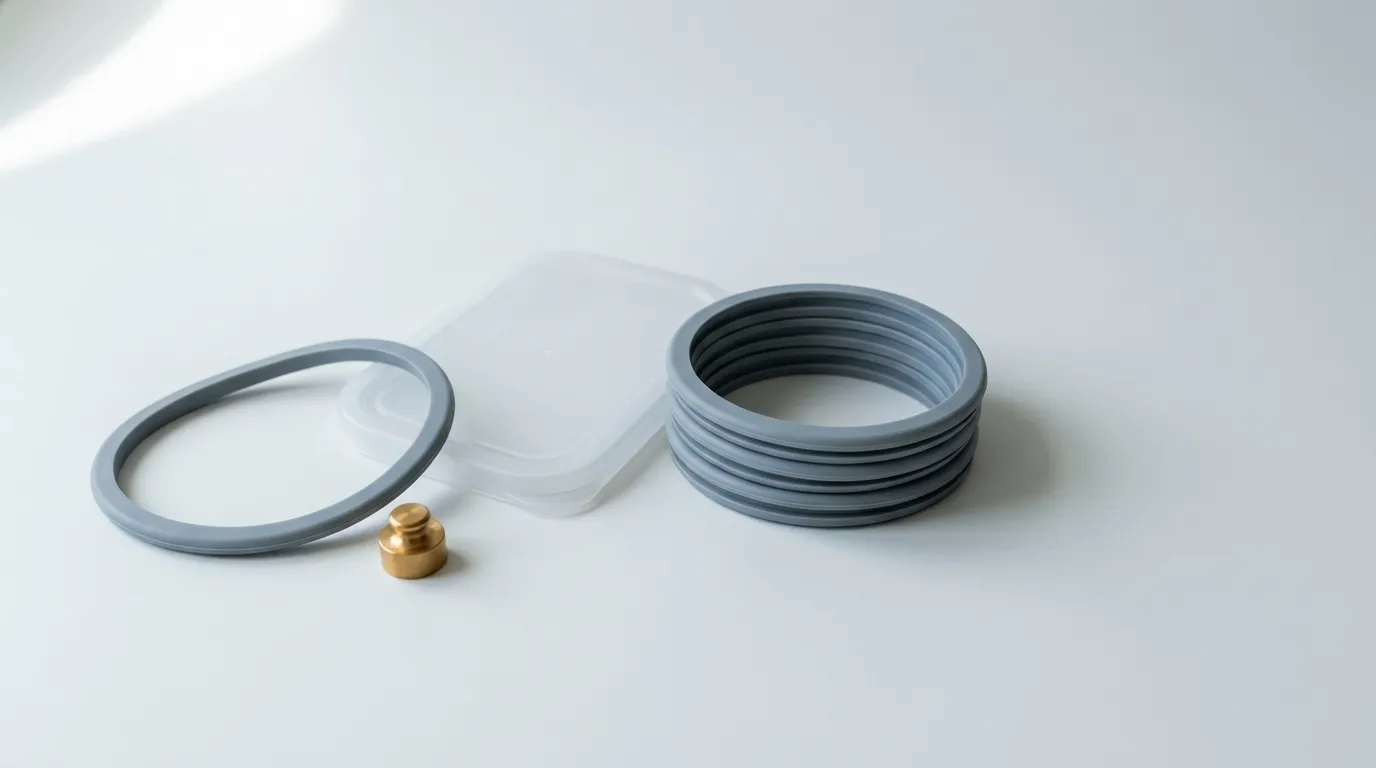
The cheapest line in the spec, and the one that decides whether a seal failure becomes a return or a two-dollar part.
The Document Pack, Component by Component
Put the lines above together and you get a folder, not a paragraph. The way to keep it honest is to build it component by component, with one question per component and one document per question.
Component | The question it answers | The document that should answer it | What "missing" looks like |
|---|---|---|---|
PP base, tray and lid | Is the plastic food-contact compliant for this use, including repeated use? | Declaration of compliance naming the regulation, the material grade and the model | A one-page "food grade" certificate with no grade and no model |
Silicone gasket, latch strap | Is the non-plastic part covered, and by what? | A separate declaration or test report for the silicone grade | The PP declaration re-sent, with the gasket not mentioned |
304 stainless insert | What is the food-contact basis for the steel, and is the grade stated? | A material certificate naming the grade plus the applicable food-contact basis | "Stainless steel" with no grade and no document |
Print and ink | Is the decoration food-contact appropriate and does it stay on? | Ink declaration plus an adhesion result after a stated wash count | A printed sample and a promise |
The assembled article | Do the claims on the packaging match the tests? | One claim-to-test table, one line per claim | Claims on the box, tests in a different folder, nothing linking them |
The general approach to requesting documents from a factory — what to ask for, in what order, and what a good answer looks like — is in which compliance documents to request from a food container factory. For the stainless steel components specifically, the note on 21 CFR 177 and stainless steel food containers explains why the question is harder than it looks.
One working rule: a document that does not name the model is not about your product. A document that does not name the material grade is not about any particular product. Both are common, and both are worth sending back.
What Goes in the Purchase Order
Specifications that live in a presentation get forgotten. Specifications that live in the PO get enforced, because the PO is the document somebody has to sign against at final inspection.
A workable one-page version, in the order the lines appear above:
- Capacity — nominal and usable, both in ml, with the compartment layout drawn.
- Mass — grams per piece with a tolerance, and the grams-per-liter figure that follows from it.
- Lid — closure type, cycle count tested, gasket grade and hardness, retention after a stated wash count.
- Compliance — one line per component, each naming the regulation or section, the grade and the model.
- Use claims — each claim with its test parameters and its evidence reference.
- Decoration — method, placement limits, color reference approved on the real substrate, adhesion result after washing.
- Packing — pieces per carton, carton dimensions, gross weight, and an explicit statement of whether the inner carton is inside the piece count.
- Spares — gasket and lid as separate part numbers, with a spare quantity per order.
- Sampling — which of the above were verified on the production tool, and which on a prototype.
Nine lines, one page. It is more than a single-use order needs, and it is the minimum a reusable program can be defended with.
If you are at the stage of deciding which material the box should even be made from — plastic, glass or steel — that decision comes before this page, and the material comparison in the private-label bento material guide is where that argument belongs. With that decision made, the seven lines above are what turn a sample you liked into a product you can warrant.
The factory's own bento range — the models, capacities and packing in the table on this page — sits in the private-label food container program, and one 800 ml three-color model line is described in more detail on the bulk bento lunch box product page.
If you want these seven lines turned into a one-page spec against your own model, send the capacity, the intended wash cycle and the destination market to Xinghui's custom-solutions inquiry. That is enough for a bento box manufacturer to fill the rest of the page in from the records behind this article.
None of the seven lines is bureaucracy. Each one is a specific failure that will otherwise arrive as a return, a chargeback or a one-star review in a language you do not read. Writing them down before the tool is cut is the only moment when they are free.
Continue reading
Related sourcing guidance
More practical context for your food storage container sourcing conversation.

Discuss your product range
Need help selecting or customising containers?
Share the product type, market and sourcing requirements with the Xinghui team.