
Compliance & Food Safety
LFGB Is a German Law, Not a Certificate: How to Read an LFGB Test Report and What Its Scope Really Excludes
An LFGB test report is evidence, not a certificate. See what the German law actually requires, how to read that report, and what its scope leaves out.
Ask ten suppliers for "LFGB certification" and you will receive ten PDFs with ten different titles — a test report, a certificate of compliance, a declaration, occasionally a one-page letter with a supplier's own logo where a laboratory's should be. All ten are answers to a question that was phrased wrongly. The phrase lfgb certification assumes Germany runs a certification scheme for food-contact containers. It does not. LFGB is a law, and what you are actually holding is evidence about a product — evidence whose value depends entirely on two things the phrase hides: what the law requires, and what the document's scope covers.
This is written for the buyer who already has the PDF open and needs to decide whether it is enough. It is the document-reading companion to our five-market compliance map for reusable containers, which covers where each market's rules sit; this page covers how to read the paper the German market expects.
LFGB Is a Law Before It Is Anything Else
LFGB stands for Lebensmittel- und Futtermittelgesetzbuch — the Food and Feed Code. It is a German federal statute, in force since 7 September 2005, and its consolidated text is published in full, in German, on the official German federal law portal gesetze-im-internet.de. There is no certifying body at the end of that sentence, because a statute does not certify anyone. It states obligations and leaves enforcement to the authorities.
Two structural facts about the law matter to a container buyer.
First, food-contact articles have their own chapter. Section 5 of the Code, running from §30 to §33, is the part that governs Bedarfsgegenstände — the legal term for materials and articles intended to come into contact with food, defined at §2(6). §30 sets out health-protection prohibitions; §31 is headed Transfer of substances to food, and is the provision that reaches into the product itself; §32 is the empowerment under which detailed regulations are issued; §33 prohibits misleading presentation. If you read only one clause, read §31: its first paragraph ties the national prohibition directly to Article 3(1) of the EU framework regulation, and its second paragraph empowers rules requiring that an article, under normal or foreseeable use, not release substances into food in amounts that could endanger health or impair the food's composition, odour, taste or appearance.
Second, the obligation attaches to the article placed on the market, not to a certificate. Nothing in that chapter creates an "LFGB certificate", because there is no state scheme to issue one. What the German market asks for is proof that a specific article was assessed against the law's requirements — and that proof is assembled from documents, the great majority of them issued by private laboratories and by the supplier, not by an authority.
That is why we publish our own position carefully here. We run an injection-moulding plant in Jieyang making thick-wall reusable PP containers, and the honest statement of our food-contact documentation is not "LFGB certified". LFGB applicability is a per-product, per-material question that has to be evidenced, item by item; presenting a law as a badge we hold would be exactly the failure this page is about.
Three Documents Buyers Call "the LFGB Certificate"
The single most useful thing you can do before reading any report is decide which of three document types you are looking at. They are not interchangeable, and a supplier who sends one when you asked for another is usually not being evasive — the vocabulary is genuinely muddled in this trade.
Document | Who issues it | What it actually says | What it cannot do |
|---|---|---|---|
Test report | A testing laboratory (ideally an accredited one) | "This sample, of this material, was tested by this method under these conditions, and the measured values were these." | It does not certify the factory, the production line, or future batches |
Declaration of compliance (DoC) | The supplier / manufacturer, on their own letterhead | "We declare the article complies with the applicable requirements, and here is the reasoning and the supporting test data." | It is a self-declaration, not a third-party verdict — its weight depends on what backs it |
Certificate / letter of assurance | Usually the supplier, sometimes a lab's sales department | A generic statement that a product "meets LFGB" | It carries no test data, no method, no sample identity — the weakest of the three |
For plastics in the EU, the declaration of compliance is not optional decoration: it is the document the framework regulation's scheme expects the supplier to hold, and it should reference the supporting migration testing. The compliance documents worth requesting from a food-container factory breaks that set down by buyer type; here the point is narrower — when a buyer says "send your LFGB certificate", the document that actually answers the question is nearly always the test report, and the DoC is what makes it usable in a contract.
Which Layer Governs What: EU, Germany, and the BfR Recommendations
Germany's rules for a reusable plastic container do not come from one place. They stack, and a report is only readable if you know which layer each test belongs to.
Layer | Instrument | Governs | Typical document |
|---|---|---|---|
EU framework | The general safety duty (Article 3) and labelling (Article 15) for every food-contact material on the EU market | The legal basis a DoC cites | |
EU specific measure — plastics | The Union list of permitted substances, plus overall and specific migration limits, for plastic articles | Migration test report + DoC | |
EU manufacturing rules | Good manufacturing practice for food-contact materials | Factory GMP documentation, audit records | |
German national law | LFGB §30–§33, and the Bedarfsgegenständeverordnung (BedGgstV) | The national prohibitions and the national rules for materials the EU has not harmonised | The national side of the file |
German technical recommendations | Substance lists and use conditions for materials with no harmonised EU measure | The reference a lab tests against for those materials |
The BfR layer is the one almost nobody explains, and it is the piece that makes "LFGB testing" concrete. The German Federal Institute for Risk Assessment and its predecessors have published these Recommendations — material by material — since 1958. The Institute states plainly on its own page that they are not binding legal standards; what they are is the current state of science and technology for how materials such as silicone, paper and rubber can satisfy the framework regulation's general safety requirement. For plastics, where Regulation (EU) No 10/2011 now harmonises the field, the Recommendations have retreated to the substances the EU list does not cover — polymerisation aids and similar production inputs.
That single sentence — not binding legal standards — is the clearest proof of this page's whole argument. A German test report is written against a law that binds and a recommendation that guides; neither is a certificate, and the recommendation says so itself. Where a container uses a silicone gasket, for example, the relevant guidance is material-specific: see the BfR Recommendation XV for silicones. Where it uses PP for the body, Regulation (EU) No 10/2011 is the operative measure and the BfR plastics recommendations apply only at the margins.
Our category hub for this topic, Compliance & Food Safety, collects the rest of the cluster if you want the surrounding context after this page.
What an LFGB Test Report Actually Contains
A supplier's PDF is only useful once you can see its skeleton. Every report worth relying on carries the same blocks, whether it arrives from a Chinese lab or a European one. Read them in this order.
- Laboratory identity and accreditation. The issuing lab's name, address and any accreditation mark. In Germany the national accreditation body is DAkkS; internationally the operative standard is ISO/IEC 17025. Accreditation is the lab's competence statement — but note that a report can carry a lab's name without the specific test being accredited, and a well-formed report will say so on its face.
- Report number and date. Your only handle for tracing the document later. A report with no stable identifier cannot be referenced in a contract.
- Sample description. What was received: the product, the material, the colour, sometimes a mould or article number, and the quantity. This is where scope begins — the report describes a sample, not a catalogue.
- Test method and reference. The standard or regulation the test follows, named explicitly. "With reference to…" followed by a numbered regulation or method is the norm.
- Test conditions. The food simulant, the temperature and the contact time. These decide whether the test resembles your product's real use at all.
- Results against limits. A table of measured values beside the limit each must satisfy.
- Conclusion and caveats. Whether the sample passed, plus any qualifications the lab attaches.
The last block is the one buyers skip and should not. A conclusion line without its caveats reads like a licence; the same line with its caveats reads like what it is — an opinion about one sample under stated conditions.
The bullets above describe the shape of the document. The menu of tests inside it is a separate question, because it is not the same for every article. For a reusable polypropylene container the core is normally overall migration, specific migration for the substances the formulation actually contains, and a sensory — organoleptic — assessment, which is the test sitting behind the odour, taste, composition and appearance wording in §31(2). Where an article includes coloured parts, mineral fillers or metal components, heavy-metal results commonly sit alongside the polymer tests rather than replacing them. Because the menu moves with the material and the colour, a generic checklist is the wrong instrument here: the report's own method list is what you compare against your intended use.
What the Report's Scope Excludes
This is the section no supplier's page will write for you, because the exclusions are precisely what a careful buyer pays for and a careless one never notices. A test report is bounded, and the boundaries are where disputes live.
The report references… | …and stops there. It does not extend to |
|---|---|
One submitted sample or batch | The production line, future batches, or the factory's quality system |
A named material (e.g. PP homopolymer) | Every masterbatch, colour or additive variant unless each was tested |
Stated contact conditions (simulant, temperature, time) | Uses outside those conditions — higher heat, longer storage, different foods |
The article as submitted | The lid, gasket, base insert or glass insert, unless they were named and tested separately |
The plastic body | Printing, ink, adhesive or coating layers, which sit under different provisions |
A conclusion about the sample | The place of manufacture — the report says nothing about where or how it was made |
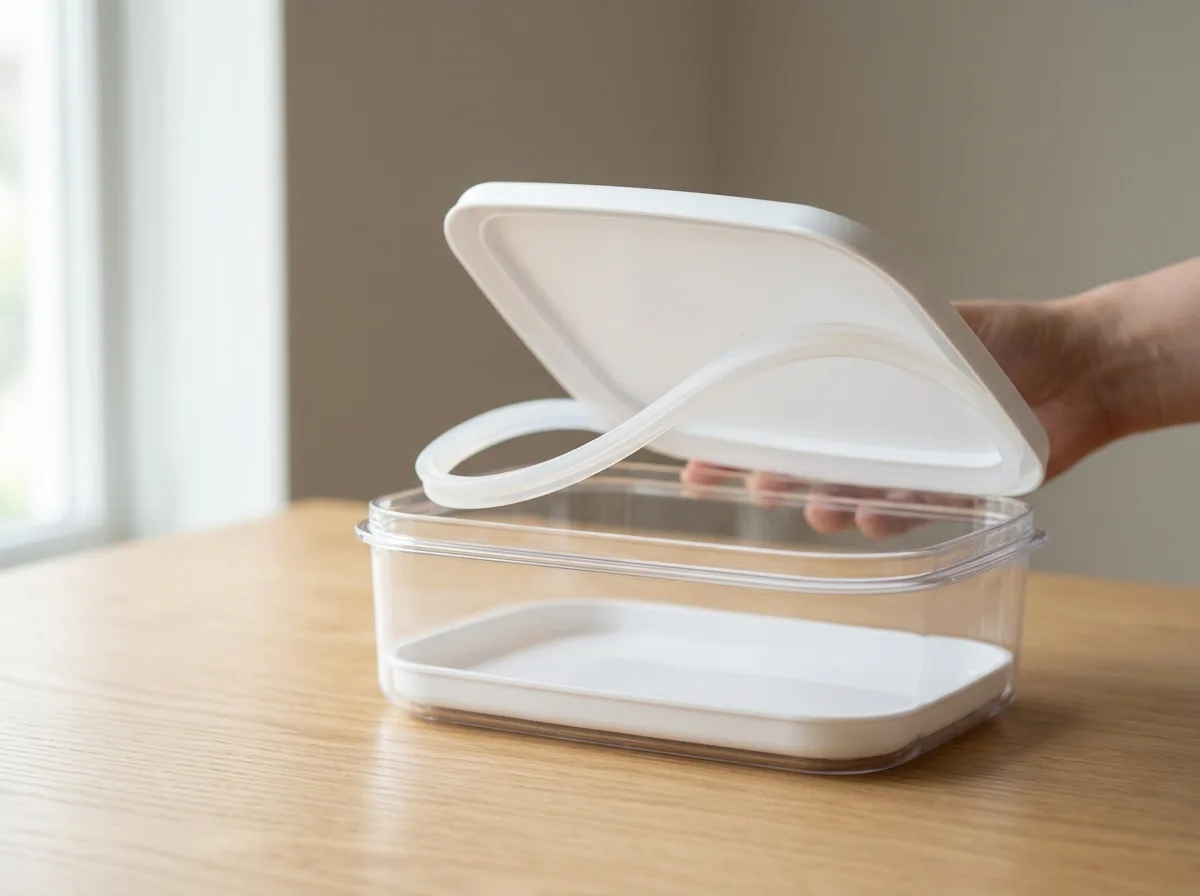
Two of those rows cause the most damage. The first is components. A reusable container is rarely one material; our own note on non-PP parts — gaskets, bases and glass inserts exists because a report for a PP body can be entirely correct and still leave the lid sealing ring, the base insert or the glass insert unaddressed. The second is variants. A report for one colour does not carry to the rest of a colour range, and a report for one size does not carry to a different wall thickness or volume unless the design was genuinely the same.
None of this means a report is weak. It means a report is specific, and its specificity is the reason it can be trusted. The mistake is treating it as a licence that covers a supplier, a range, or a brand.
How to Read a Report Line by Line: Seven Checks
Run these in order. Any one that fails does not make the document fraudulent — it makes it narrower than you assumed, which is enough to matter.
- Does the sample description match the product you are buying? Same material, same colour, same article. If the report names "PP container, 1,000 ml, clear" and you are buying a 1,500 ml amber-lidded box, you have a related document, not a matching one.
- Is the material named, or only "plastic"? A material-specific report (PP, or silicone for a gasket) can be reasoned about. "Plastic" cannot.
- Do the test conditions resemble your use? Check the simulant and the temperature. High-temperature and fatty-food contact are harsher cases than ambient water.
- Does the conclusion have a limit beside every result? Results without limits are data, not a finding.
- Are components accounted for? If the lid or gasket is a different material, ask for its line — or its own report.
- Is the issuing lab accredited, and is this test inside that accreditation? A report can note that a specific test is outside the lab's accredited scope; a good report says so explicitly rather than letting the letterhead do the work.
- Does the DoC match the report? The declaration should cite the test that supports it. A declaration with no traceable test behind it is a promise, not evidence.
The same discipline applies to performance claims built on top of the compliance file. A report that supports a food-contact statement does not thereby support a "microwave-safe" or "dishwasher-safe" claim — those are their own tested statements, as our failure modes and contract clauses behind microwave-safe claims sets out. Sample-level evidence and claim-level evidence are separate purchases; the seal-structure sample-testing note shows the same pattern on the physical-performance side.
Marks, Symbols and Marketplace Claims
Two artefacts get mistaken for certificates, and both are something else.
The first is the food-contact symbol. The EU framework regulation, at Article 15, allows a material or article to carry the words "for food contact", a specific indication of use, or the symbol reproduced in its Annex II. That symbol — a glass and fork device, historically derived from a 1980 Commission Directive — is a labelling mark. It tells a user the article is intended for food contact. It is not issued to a supplier, it carries no test data, and its presence proves nothing about whether any migration testing was done on your product.
The second is the family of voluntary quality marks. Germany has recognised voluntary labelling schemes, and suppliers sometimes present one as an "LFGB logo". A voluntary mark is, by definition, not a statutory certificate, and it is not the same thing as evidence about your article. When you see any mark presented as an LFGB certificate, the right response is not to accept or reject the mark but to ask a smaller question: which report, testing which sample, backs it?
Marketplaces sit in between. When a platform asks for compliance documentation to unblock a listing, what it wants is the underlying report and declaration for the product — a logo file is not a submission. The safe-plastic purchase specification we use for dishwasher-tested containers shows how that evidence is written into a purchase specification rather than left as a badge.
What to Ask Your Supplier Before You Print "LFGB"
If your packaging, listing or tender document is going to say anything about German food-contact compliance, get these on file first, and keep them with their scope attached:
- The test report for the specific material and article you are buying — not a similar model.
- The conditions that report was run under, and a comparison with your real use.
- A line for every component material: body, lid, gasket, insert.
- The declaration of compliance that cites the report, on the manufacturer's letterhead.
- The laboratory's name and accreditation status, and whether this test is inside it.
- A note on variants: which colours, sizes and thicknesses the evidence covers.
Notice the shape of that list. Nothing on it is a certificate, and that is the point — an LFGB document set is a chain of specific statements, each bounded, each traceable. Buyers who understand the chain stop asking suppliers for "your LFGB certificate" and start asking for the report, its scope and its backing. If you are building a container programme for the German market, that is also the container comparison and document question worth settling at RFQ stage, before artwork or listing text is written.
We are an injection-moulding plant, and our contribution to that chain is the container and the material documentation around it. We make reusable PP food storage containers and lunch boxes, and we hand over our food-contact paperwork with its scope stated rather than a badge claiming more than it can. If you want to see how that looks for a specific SKU, send us the model and the intended use.
Frequently Asked Questions
What does "LFGB certified" mean? Strictly, it is a shorthand that has no single legal meaning. LFGB is a German federal statute; a product is not "certified" by it. In practice the phrase is used loosely to mean "accompanied by a test report written against the German requirements". When a supplier uses it, translate it back into the report it refers to and read that.
Is there such a thing as an LFGB certificate? Not in the sense of a document issued by a German authority for a product. What exists is a test report from a laboratory, and a declaration of compliance from the supplier. If you are shown a document headed "LFGB Certificate", the useful question is who signed it and what sample it describes.
Does the testing have to happen in a German laboratory? The value of a report lies in the method, the accreditation and the traceability, not in the lab's postcode. A report from an accredited laboratory applying the recognised method is what the analysis needs; a report from a non-accredited lab is weak wherever it sits.
Does one report cover my whole container range? Only as far as the evidence reaches. Material, colour, size, wall thickness and every separate component can each move the answer. The safe assumption is that one report covers the article it names, and everything else needs to be checked against it.
Continue reading
Related sourcing guidance
More practical context for your food storage container sourcing conversation.
Discuss your product range
Need help selecting or customising containers?
Share the product type, market and sourcing requirements with the Xinghui team.