
Food Storage Guides
Dishwasher-Safe Plastic Containers: Cycle Count, Temp & pH
Turn "dishwasher safe" into a purchase spec: cycle count, water temperature, detergent pH, and the test data to require from any OEM factory before you order.
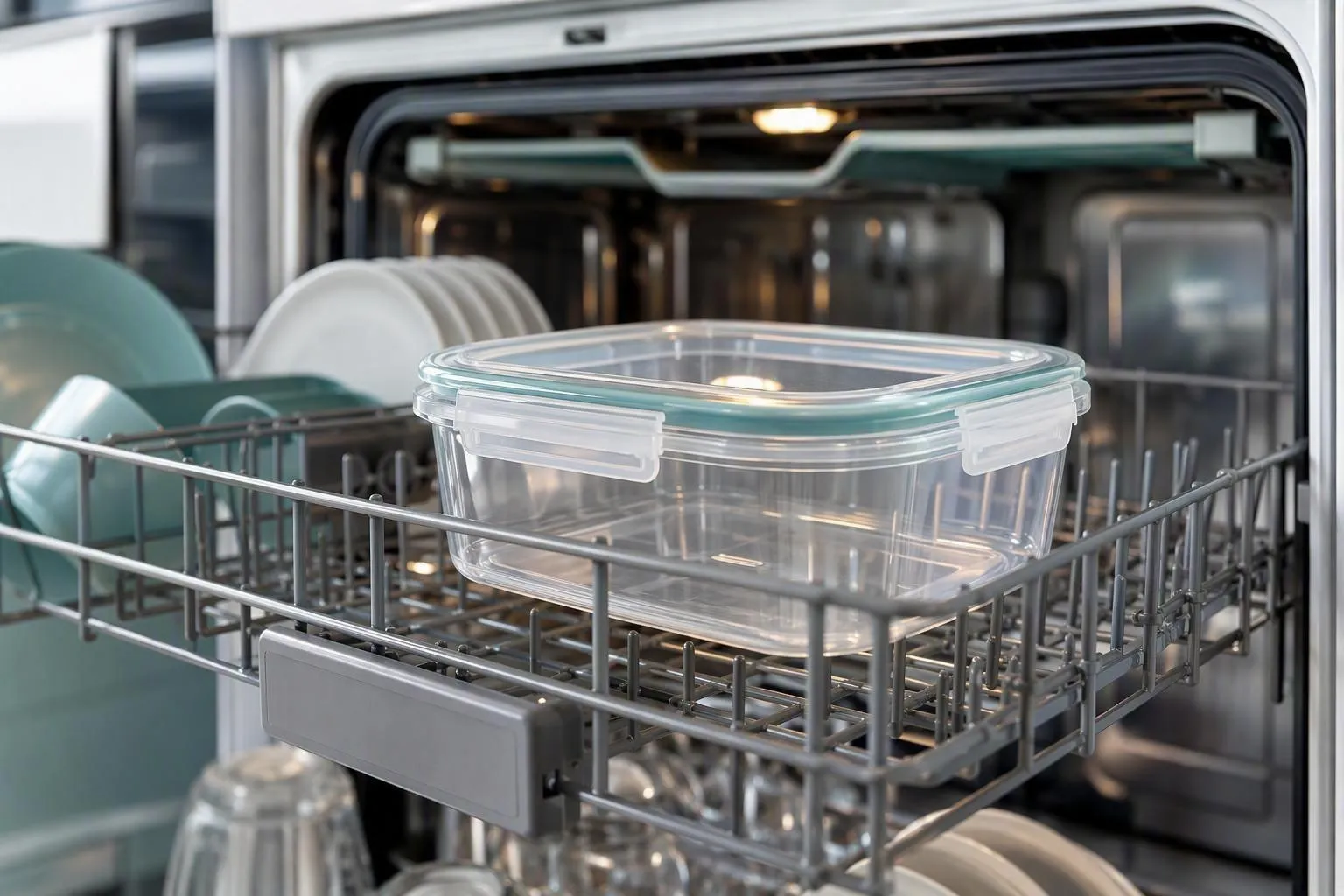
Key Takeaway: “Dishwasher safe” is not a universal standard with a single meaning. It only describes what a container survived under one manufacturer’s test conditions. If you shorten it to cycle count, water temperature, detergent pH, and the test method behind it, you turn a marketing adjective into a purchase specification you can hold any factory to.
Every online listing for meal-prep containers, bento boxes, and pantry storage claims it. Yet as a sourcing manager, the phrase tells you almost nothing you can act on. Two factories can both print “dishwasher safe” on otherwise identical-looking containers, and one will survive years of hot washes while the other clouds, warps, and loses its lid seal in weeks.
The gap between those two products is not luck. It is the difference between a vague claim and a measured one. This guide shows you how to close that gap: exactly which variables to specify, what test data to demand, and how to phrase the claim on your listing so it survives both a dishwasher and a marketplace audit.
Table of Contents
• What “Dishwasher Safe” Means for Plastic Food Storage Containers
• Water Temperature: The First Number in Your Spec
• Detergent pH: The Variable Most Sourcing Teams Ignore
• Material Durability and Realistic Cycle Life
• The Testing Standard Behind a Defensible Claim
• Writing a Listing Claim That Survives a Marketplace Audit
• Build Your Own Dishwasher-Safe Spec Card
• Quick Self-Test Checklist for Your Sample Lot
• FAQ
• Next Steps: Get the Spec in Writing
What “Dishwasher Safe” Means for Plastic Food Storage Containers
Stripped of marketing, the term describes one thing: an item that stays functionally and structurally intact under a specific set of dishwasher conditions. The Finish dishwasher-safety guide is blunt about this, noting that “dishwasher safe” is not a standardized claim — each manufacturer runs its own process and sets its own threshold.
That single fact explains most of the confusion in wholesale sourcing. When a supplier says a container is dishwasher safe, the real question is safe under what conditions, and safe for how long?
Functionally, a defensible dishwasher-safe claim requires four conditions to hold together:
• The polymer’s heat-deflection temperature sits well above the peak dishwasher temperature, with margin.
• The material tolerates hot water plus alkaline detergent without rapid hydrolysis, stress cracking, or surface whitening.
• The container geometry survives repeated thermal expansion and contraction without warping.
• The whole assembly — including the lid, hinge, and seal — still functions after many cycles, not just the base tub.
The last point trips up more private-label launches than any other. Bulk containers often outlast their own lids, because thin snap features, hinges, and gasket lands fatigue long before the heavier walls of the body degrade. If you are still deciding on the material, the food-safety groundwork in which plastic containers are safe for food storage carries directly into this dishwasher spec.
Water Temperature: The First Number in Your Spec
A dishwasher is not one temperature. It is a ladder of them, and where you place a container on that ladder changes how aggressively it is stressed.
Typical residential dishwashers run their main wash around 130–140°F (55–60°C) , with the final rinse a few degrees higher. That is the gentle end. Heavy and Pots-and-Pans cycles push the main wash toward 135–140°F and extend the time — longer exposure matters as much as peak temperature. Sanitize cycles are the stress test: to earn that certification, NSF’s dishwasher certification guidance requires the final rinse to reach at least 150°F (65.5°C) for 10 seconds or more.
Rack position is the second multiplier. The top rack stays measurably cooler, typically 120–140°F , because it sits farther from the heating element; the bottom rack runs hotter, closer to that element. This is why most standard dishwasher-safe test conditions assume top-rack placement, and why “top rack dishwasher safe” is the safest claim to make and substantiate.
For your purchase spec, the number that matters is the delivery temperature the container actually experiences , not the marketing label on the box. Ask for the wash temperature, the rinse temperature, the cycle time, and the rack position your claim depends on.
Detergent pH: The Variable Most Sourcing Teams Ignore
Temperature gets the attention, but the detergent is often the more aggressive partner in the degradation. Dishwasher detergents are deliberately strongly alkaline — that alkalinity is what dissolves baked-on grease.
Commercial testing of tablet-form detergents commonly measures an in-use solution around pH 10–11 , and powder formulas can spike higher, into the pH 11–13 band. At that alkalinity, hot water does the real damage: alkaline builders and silicates attack polymer surfaces, heat accelerates the reaction, and repeated thermal cycling turns microscopic surface stress into the clouding and crazing consumers actually see.
The engineering framing is worth keeping straight. A plastic like polypropylene resists hydrolysis well at alkaline conditions in the dishwasher range, which is one reason PP is the workhorse of reusable food containers. A copolyester like Tritan performs strongly too, but it relies on engineered hydrolysis resistance rather than a chemically inert backbone, so its long-term behavior under aggressive alkaline cycling is more sensitive to the exact detergent and temperature it faces.
For your spec, detergent pH is one of the few variables you can nail down precisely without expensive equipment — ask your factory which detergent, pH range, and concentration they used. If they cannot tell you, they have not actually tested the claim.
Material Durability and Realistic Cycle Life
Cycle count is where the adjective becomes a number you can compare across suppliers. Realistic expectations break down roughly along material lines:
Material
Heat-deflection range
Alkaline-detergent tolerance
Realistic life (top rack, standard detergent)
First thing to fail
PP (#5)
~100–130°C (210–266°F)
Best — nonpolar, hydrolytically stable
Often survives 100+ cycles when walls are thick and parts are unstressed
Lid hinge, seal creep, thin-wall warping
Tritan (copolyester)
~109–129°C (228–264°F)
Good, but relies on hydrolysis engineering
Eastman’s own durability testing shows 125+ residential cycles with no visual effect
Clarity haze, microcracking under stress, seal fatigue
Silicone (seals/lids)
Very high heat tolerance
Excellent, but can swell / retain residue
Heat rarely the limit; design is
Compression set, gasket flattening
ABS (avoid for dishwasher)
~90–105°C (194–221°F)
Poor for hot alkaline + stress
Hand-wash recommended in most cases
Crazing, whitening, warping
Two practical rules come out of this table. First, PP is the most forgiving bulk material for a repeated dishwasher claim, which is why most high-volume food-container lines are PP. Second, the sealing system, not the tub, sets your real cycle life — so your spec must cover the lid and any gasket independently, not just the container body.
The 100+ and 125+ figures above are industry-reported points, not universal guarantees. Wall thickness, fillet radius, pigment choice, and gate design all shift real-world survival. That is exactly why you should not accept a direction like “it will be fine” and instead ask for the number and the test that produced it.
The Testing Standard Behind a Defensible Claim
When you ask a supplier “is it dishwasher safe?” and they say yes, your next question should be: which method? A defensible claim is anchored to a named standard, not a shrug.
The most cited framework for domestic articles is EN 12875-1 and EN 12875-2 , which define a fixed number of wash cycles followed by an inspection for damage. In that context, a common “dishwasher-safe” threshold is 125 cycles , with 250 or 500 used to signal higher durability. Around it, IEC 60335-2-50 defines the household dishwasher safety test conditions, and its assumptions typically lean toward top-rack placement — reinforcing why a bare claim without a rack qualifier overpromises.
There is no single dedicated ASTM standard for consumer dishwasher-safe plastic containers, so a supplier pointing to an in-house protocol that mirrors EN 12875 is legitimate — provided they can show you the method and the result. The key is that the method is written down, named, and replicable, not that it carries a prestigious acronym.
A complete test report should state, in writing:
• The standard or in-house method used (e.g., EN 12875-1)
• The exact number of completed cycles
• The rack position tested
• Wash and dry temperatures
• Detergent brand/chemistry and concentration
• Water hardness in the test
• Loading configuration (lids on/off, nested or separated)
• Pass/fail criteria (warping, cracking, whitening, seal failure, fit loss)
• Inspection method (visual, dimensional, or functional re-seal)
• Material grade, wall thickness, and whether pigments/additives were included
Writing a Listing Claim That Survives a Marketplace Audit
The same rigor that keeps a container intact keeps your listing alive. Amazon Seller Central’s guidance on misleading and prohibited claims is clear that unsupported claims can trigger listing suppression, and “dishwasher safe” becomes a compliance risk the moment your adjectives outrun your evidence.
Marketplace-defensible wording mirrors the actual test conditions. Prefer phrasing such as:
• “Dishwasher safe, top rack only”
• “Top-rack dishwasher safe up to 140°F”
• “Do not use heated dry”
• “Safe for 150 normal dishwasher cycles, tested to EN 12875-1”
• Separate statements for the lid and base when their tolerance differs
Avoid absolute language that no reasonable test can back: “100% dishwasher safe,” “safe on any cycle,” “no warping ever,” or “lifetime dishwasher safe.” Each invites an expectation gap — one customer runs a sanitize cycle with an aggressive tablet and a top-rack-only product on the bottom rack, and the container warps. You did not oversell by intent; you underspecified, and the review reflects the actual failure, not your intent.
A measured claim does not weaken the listing. It protects it. A container that survives 150 documented top-rack cycles, stated precisely, reads as more credible to a serious buyer than a vague promise that survives nothing in particular.
Build Your Own Dishwasher-Safe Spec Card
You can consolidate all of the above into a one-page spec card to send any factory. This is the working tool that turns this article into your sourcing process:
Spec field
What to demand
Claim scope
Whole assembly (tub + lid) vs. tub only
Standard/method
Named standard or full in-house protocol (e.g., EN 12875-1)
Cycle count
Exact number completed (e.g., 150)
Rack position
Top rack / bottom rack / either
Wash temp
°F or °C of the wash + rinse
Cycle time
Minutes per cycle
Detergent
Brand, chemistry class, pH, dosage
Water hardness
Test hardness value
Loading config
Lids on/off, nested or separated
Pass/fail criteria
Warping, cracking, whitening, seal/fit loss, odor
Inspection method
Visual / dimensional / functional re-seal
Material + thickness
Resin grade, wall thickness, pigments
Send this card early in RFQ. A factory that can complete it line by line is giving you evidence you can use on your listing and in your QA; a factory that cannot is telling you the claim was never tested. That distinction saves you from the costliest failure mode in private-label sourcing: discovering a broken claim only after it reaches your customers. For meal-prep lines specifically, apply the same spec when you review custom meal-prep food storage containers from any shortlisted OEM.
Quick Self-Test Checklist for Your Sample Lot
Before you commit to a production run, run a small, cheap verification on your own sample lot:
• Run 25+ containers through 10 top-rack cycles with a standard alkaline tablet.
• Photograph each container at cycle 0, 5, and 10 against a neutral background.
• Inspect for haze, whitening, crazing, and surface etching at the same angle and light.
• Check lid fit and seal force after each wash — measure how easily it snaps closed.
• Record any dimensional change in the lid and rim with a caliper.
• Confirm the claim wording on your listing matches exactly what you tested.
Ten cycles will not prove a 150-cycle claim, but it will surface design-level failures — seal collapse, thermal warping, stress cracking — that testing at the factory, under their ideal conditions, can hide.
FAQ
Is “dishwasher safe” the same as “top rack dishwasher safe”? No. “Dishwasher safe” with no qualifier is ambiguous; “top rack dishwasher safe” specifies the cooler rack position that most standard test conditions assume. Always know which one you are claiming.
How many dishwasher cycles does a PP food container last? Polypropylene food containers commonly withstand 100 or more top-rack cycles when the walls are thick enough and the parts are not heavily stressed. The exact number depends on wall thickness, geometry, pigment, and detergent, so verify with real test data rather than assume.
What temperature do sanitize cycles reach? Sanitize cycles push the final rinse to at least 150°F (65.5°C) for 10 seconds or more, per NSF dishwasher certification requirements. That is hotter than a normal-wash main cycle and is the stress test for a dishwasher-safe claim.
Why do my containers cloud over in the dishwasher? Clouding or haze is usually surface damage: hot water plus strongly alkaline detergent (commonly pH 10–13) etches and micro-cracks the polymer surface, which then scatters light. It is a sign of cumulative ageing, not just residue.
Can I claim “dishwasher safe” on Amazon without test data? You can, but unsupported claims risk listing suppression under current marketplace guidance. A defensible claim states its tested conditions — rack, temperature, cycle count, and the method used.
Next Steps: Get the Spec in Writing
You now have everything you need to stop buying adjectives and start buying specifications. The next step is practical: send your shortlisted factories the spec card above and ask for their completed test report, not their marketing page.
As a PP food storage container manufacturer that supports OEM and ODM sourcing, Xinghui can provide verified material and dishwasher-spec information for the containers it produces. If you are comparing options, start with the wholesale food storage containers range and ask for the dishwasher test data for any product you shortlist. Then benchmark what you learn against the framework here — the container that survives the most documented, clearly specified top-rack cycles is the one that will hold up in your customers’ kitchens, and on your listing.
Continue reading
Related sourcing guidance
More practical context for your food storage container sourcing conversation.

Discuss your product range
Need help selecting or customising containers?
Share the product type, market and sourcing requirements with the Xinghui team.