
Lunch Boxes & Bento
Canteen and Staff-Kitchen Fit-Out: 304 Stainless Steel Food Containers for Restaurants
Where 304 stainless steel pays in a staff canteen fit-out, where polypropylene wins, and the carton arithmetic that turns 600 seats into cubic meters and kilos.
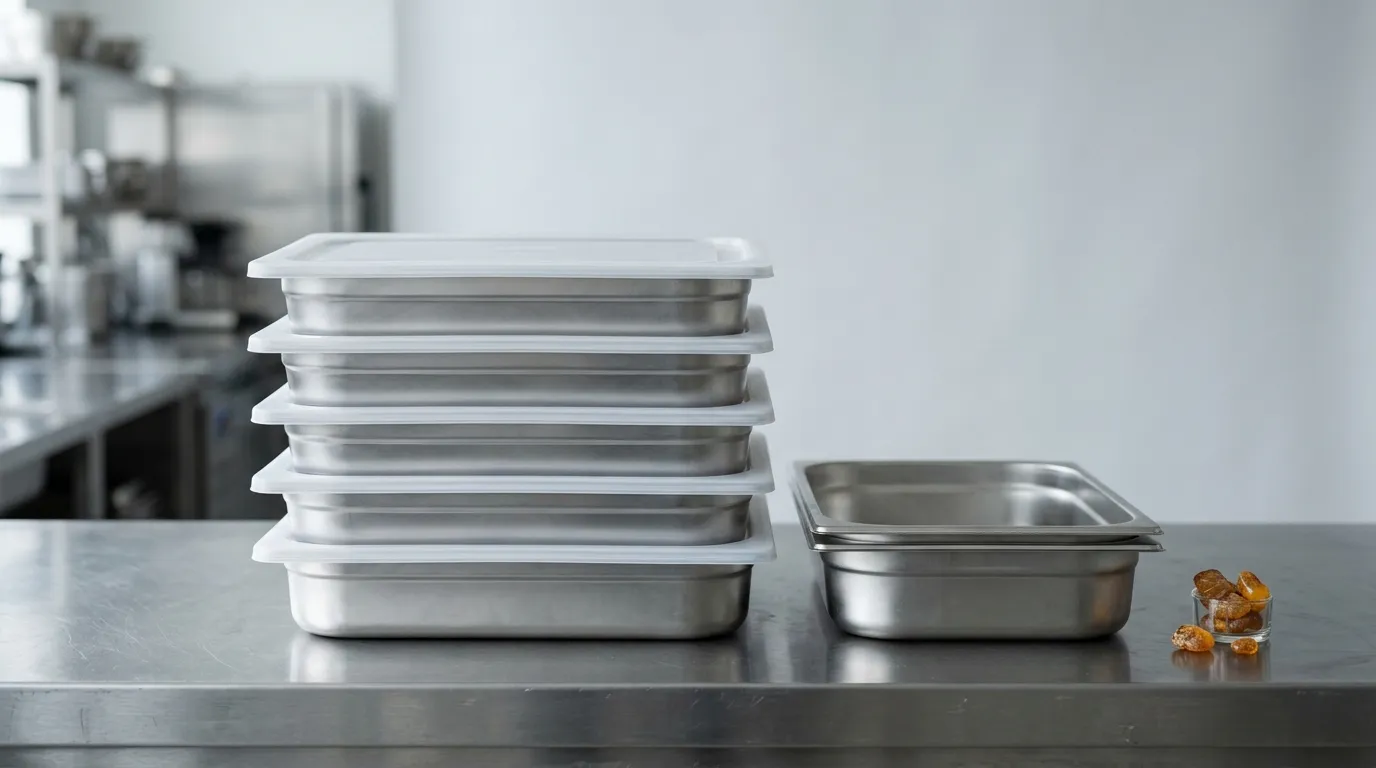
A staff canteen for six hundred people needs about six hundred containers, twice over if it runs two sittings, plus the ten percent that will be dropped, lost or walked off with. That order is placed once, by somebody whose job is the building — a facilities manager, a catering contractor, a distributor quoting the tender — and it is defended line by line in a budget meeting where "stainless because it is better" is not an answer.
This page is for that person, and it is about stainless steel food containers for restaurants, staff canteens and hospital tray lines. It answers three questions in the order they get asked: which specification lines actually move the price, where 304 stainless steel is the cheaper material over the life of the fit-out, and what a fit-out volume turns into in cartons and cubic meters.
Anyone shopping for one lunch box for one kitchen is served better elsewhere on this site — the Lunch Boxes & Bento index is the shelf for that reader. The number this page is built around is different: shipped volume per seat, because in an institutional order freight is not a rounding error, it is the second-largest line after the containers themselves.
The Unit of Purchase Is the Seat, Not the Box
A canteen does not buy containers. It buys a service point: one seat, served one meal, washed and returned, for however many years the operator expects the fit-out to last. Three consequences follow, and each one breaks a habit carried over from retail buying.
The first is that duty cycle, not material prestige, sets the specification. A tray in a hospital staff canteen goes through a wash line twice a day, three hundred days a year, and is scraped with a knife at the return window. A tray holding dry goods in a storeroom goes through none of that. These are different products with the same shape, and the price difference between them is real money multiplied by six hundred.
The second is that the carton is part of the product. A container that costs less per piece but ships at twice the volume per piece can lose the saving before it reaches the loading dock. The records behind this article carry both numbers, which is why the carton arithmetic further down can be done rather than asserted.
The third is that nothing gets replaced individually. When a canteen buys, it buys enough to cover the whole room plus spares, because a model that goes out of production mid-life leaves the operator with two incompatible stacks. That is why mixed-model orders and per-model minimums behave differently in this channel than in retail — the MOQ counting rules apply, and the wholesale sizing logic in the China supply picture is the same arithmetic at a larger scale.
What "Kitchen Storage Container Steel" Actually Names
People arrive at this subject through the phrase kitchen storage container steel, and the phrase hides a distinction that matters on a purchase order: it does not say whether the steel is the body or the closure.
In the record set behind this article, every single-wall stainless model is a steel body with a polypropylene lid and a silicone gasket. The steel is the part that touches hot food, takes the knife and goes through the wash; the plastic is the part that has to flex, seal and be replaced cheaply. A second family exists and is sometimes quoted by mistake: the double-wall insulated box, where a steel inner liner sits inside a plastic shell with an air gap between them, and the whole assembly is a carrying vessel rather than a service tray.
What the buyer thinks they are ordering | What the record actually describes | Where it belongs |
|---|---|---|
"Steel container" | Steel body + PP lid + silicone gasket, single wall | Canteen service, hot hold, tray return |
"Steel lunch box" (insulated) | Steel liner inside a plastic shell, air gap, 850 ml, 2 compartments | Transported meals, school and site deliveries |
"Steel canister" | Not in this record set at all | Not this supplier's line |
The distinction is not pedantry. An insulated box cannot go through a tray-wash line as a unit, its plastic shell is the part a tray-wash line attacks first, and it is bought for a different duty — carrying a meal out to a site, not washing and reissuing one in the building. Quoting one against the other is how a fit-out ends up over budget with the wrong product on site.
The Specification Table That Decides the Price
Nine lines decide what a stainless container costs and what it will survive. A quotation will normally show one of them and imply the rest. This is the table to take into a supplier conversation, with the last column copied into the purchase order so that the price has something to attach to.
Specification line | What the quote usually shows | What it actually changes | What to write into the PO |
|---|---|---|---|
Steel grade and mill certificate | The word "304" | Whether the body can be re-washed hot for years, and whether you can prove it after a complaint. 304 is the chromium-nickel grade the sheet standards cover as UNS S30400 — chemistry, not a marketing label (BSSA grade table) | "UNS S30400; mill certificate with heat number, one per lot" |
Steel thickness (gauge) | Usually absent | The biggest single lever on both unit price and dent resistance: a thicker body weighs more, ships heavier, and resists the tray-return trolley | "Nominal thickness, measured at three points on the base and one on the wall; the measured values recorded on the sample report" |
Finish | "Brushed" or "mirror" | Polished costs more labour and shows tray-return scratches sooner; a directional brush hides them | "Finish type and direction, stated once, applied to all lots" |
Weld and edge | Silent | A spot-welded corner traps food and fails first at the wash line; the rolled rim is what keeps a burr away from a hand | "Weld type; rim rolled; no burr above 0.1 mm at the rim" |
Lid and seal construction | "Leak-proof" | The gasket hardness and the latch count are the entire leak claim — two latches and four latches are different products at different prices | "Gasket material and hardness; four latches; 30-minute leak test at 45° with the lid latched" |
Compartment layout | A photograph | Compartment count and depth per capacity; a five-compartment 1,400 ml tray is drawn differently from a two-compartment 1,300 ml one, and the drawing is the cost | "Compartment count and each compartment's usable volume at the fill line" |
Stackability | Absent | Nested, stacked-with-lid, and stacked-empty are three different cartons at three different volumes | "Stacked height for ten units, in the shipping configuration" |
Wash and heat tolerance | A claim | Whether the unit survives the machine you actually own, which is a test result, not an adjective | "Wash-cycle report at the client's machine conditions; claim wording approved against it" |
Carton quantity and dimensions | A single number | The freight line. Pieces per carton and carton CBM turn a unit price into a landed cost | "Pieces per carton, carton L×W×H, gross weight, and whether the weight is per carton or per piece" |
Two of those lines carry a decision the buyer cannot delegate: thickness and latch count. Everything else can be settled by a specification; those two change what the product is.
Here is what the same nine lines produce in the current record set. Capacity, unit size, carton dimensions and pieces per carton are as published; shipped volume per piece is computed from the carton, which is the number that drives the carton arithmetic further down.
Model | Body | Compartments | Capacity | Unit size | Carton | pcs/ctn | Gross weight | Shipped volume per piece |
|---|---|---|---|---|---|---|---|---|
6521 | 304 steel + PP lid + silicone | 5 | 1,400 ml | 29 × 22.5 × 6.5 cm | 47 × 31 × 73 cm | 18 | 15.2 kg | 5.9 L |
6522 | 304 steel + PP lid + silicone | 4 | 1,100 ml | 25.5 × 18 × 6.5 cm | 54 × 32 × 60 cm | 24 | 14.5 kg | 4.3 L |
6523 | 304 steel + PP lid + silicone | Not stated in the record | 800 ml | 22 × 15.5 × 6.5 cm | 54 × 32 × 50 cm | 24 | 11.5 kg | 3.6 L |
6527 | 304 steel + PP lid + silicone | 2 | 1,300 ml | — | 51 × 46 × 62 cm | 24 | 11.0 kg | 6.1 L |
6533 | 304 steel + PP lid + silicone | Not stated in the record | 1,100 ml | 24 × 17 × 7.5 cm | 50 × 36 × 47 cm | 24 | 13.0 kg | 3.5 L |
6536 | 304 steel + PP lid + silicone | Not stated in the record | 1,100 ml | 21.5 × 15 × 7.5 cm | 47 × 34 × 47 cm | 24 | 11.0 kg | 3.1 L |
6639 | 304 steel liner, insulated shell | 2 | 850 ml | — | Color carton | Not recorded | Not recorded | Not recorded |
BX1051 | PP + silicone (no steel) | 3 | 1,300 ml | — | 62 × 47.5 × 58.5 cm | 72 | 14.3 kg | 2.4 L |
3334 | PP (no steel), dry storage | Not stated in the record | — | — | 59 × 56 × 65 cm | 80 | 14.7 kg | 2.7 L |
Read the last column against the fourth and the argument for this whole article appears: the 4-compartment 1,100 ml steel tray (6522) ships at 4.3 L of carton volume per piece, while the 1,300 ml polypropylene box (BX1051) ships at 2.4 L. The steel penalty is not even uniform within one capacity — the 1,100 ml 6536 ships at 3.1 L, because its carton is built differently — so carton geometry moves this number more than material does. Steel is not heavier because it is thicker metal. It is heavier because a steel body does not nest into itself the way a moulded tub does, so the carton carries air.
Where 304 Earns Its Price, and Where It Does Not
304 is an austenitic chromium-nickel stainless steel — roughly 18 percent chromium and a minimum of 8 percent nickel in the 1.4301 / AISI 304 designation — and the property that matters in a kitchen is not hardness but inertness: it stays passive in most food environments and tolerates the strong detergents used to clean a food plant (World Stainless, Stainless Food and Beverage). That is the whole case for it, and it is a case about cleaning chemistry, not about looking expensive.
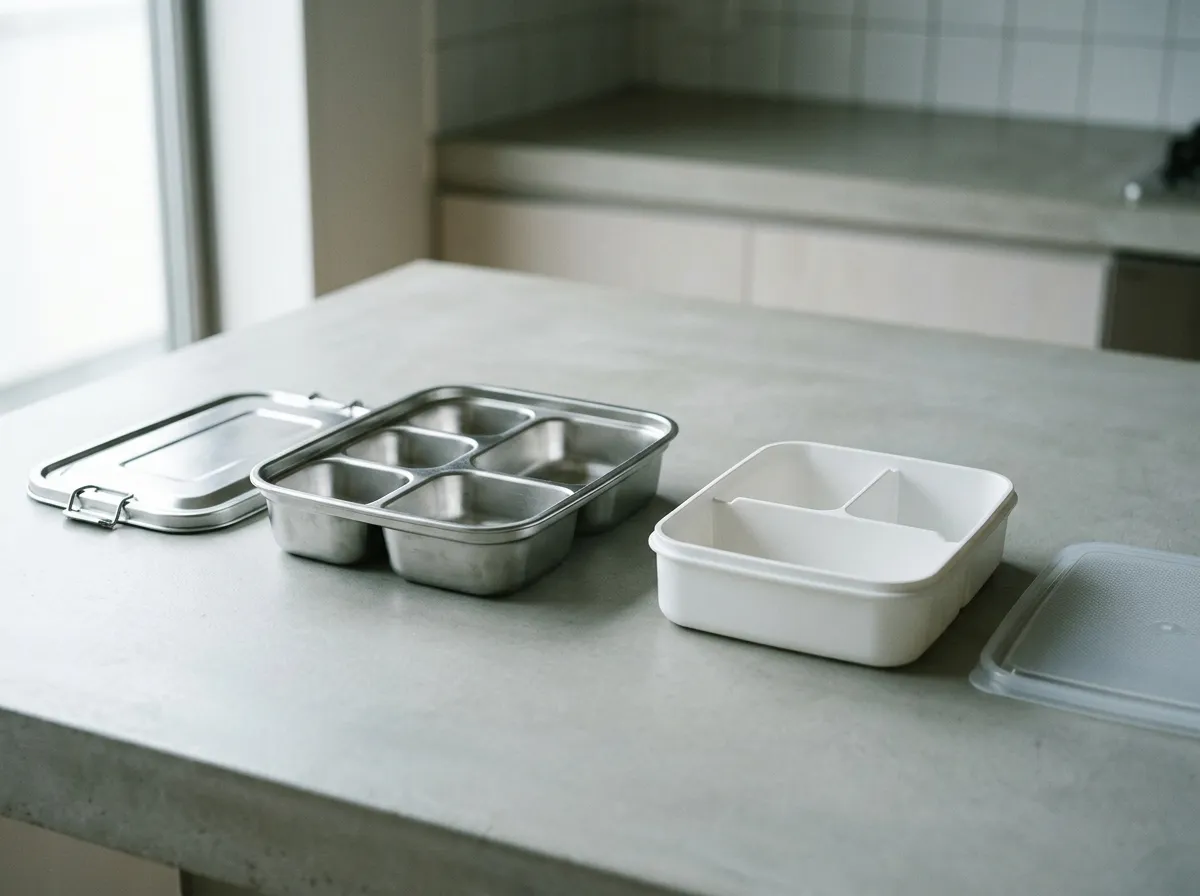
Material | What it tolerates | How it fails in canteen service | Food-contact basis | Freight and cost | Verdict for a staff canteen |
|---|---|---|---|---|---|
304 steel body, PP lid, silicone gasket | Hot food, knife and fork contact, repeated detergent wash, drop onto tile | Dents at the corners; the gasket, not the steel, is usually what ends the unit's life | Mill certificate for the steel; resin clearance for the lid and gasket | ~4.3 L shipped per piece on 6522; heaviest per seat | Buys itself on a hot-service line with a tray return |
316 steel body | Adds molybdenum; more chloride resistance | Same as 304, at a higher unit price | As 304 | As 304, plus the molybdenum premium | Rarely justified — a canteen is not a marine or high-chloride plant |
PP with silicone seal | Hot fill to a lower ceiling, dishwasher top rack, no knife contact | Scratches, stains with turmeric and tomato, deforms if it meets a hot plate | 21 CFR 177.1520 for the resin; gasket under 177.2600 | ~2.4 L shipped per piece on BX1051 | Wins on cold service, dry storage, and any order where freight is the binding constraint |
Melamine | Rigid, moulded, cheap per piece, holds shape | Chips at the rim; not a material for a microwave direction; heat and repeated washing are where claims go wrong | 21 CFR 177.1460 clears the resin for moulded articles, with conditions of use | Light, stacks well | Acceptable for low-duty dining; read the conditions of use before printing any heat claim |
Tempered glass | Oven and microwave, no odour carry-over | Breaks — and a break in a canteen is a stoppage, a sweep-up and an injury report | Its own clearance as a ceramic/glass article | Heaviest of all per seat; breakage adds a replacement line | Only where the menu or the client demands it |
The four duties where 304 pays. Knife-and-fork abrasion at the return window. Hot hold, where a plastic body softens and a steel one does not. Repeated detergent wash, where the steel's passivity is the asset. And drop onto a tile floor at six hundred covers a day, where a dented steel tray keeps working and a cracked plastic one does not.
The four duties where it does not. Cold and ambient storage, where nothing in the duty cycle justifies the freight. Single-use or takeaway service, where the container never comes back. Any site without a wash line, where a steel tray is hand-washed in a sink and the labour saving never materialises. And any tender where the freight budget is fixed and small — which, on the carton arithmetic further down, is a real and frequent constraint rather than a hypothetical one.
The boundary is worth stating plainly because it is where most fit-out budgets go wrong in the other direction too: buying plastic for a hot line to save freight, then replacing the whole order in year two. The material comparison behind that decision, including breakage and compliance, is worked through at more length in the plastic-versus-glass-versus-steel comparison and in the regulatory basis for a steel food container.
Heat, Detergent and the Claims You May Print
Three materials, three different kinds of paper behind a claim, and the failure mode is nearly always the same: a supplier prints a use direction the clearance does not support.
Polypropylene. 21 CFR 177.1520 is titled "Olefin polymers" and clears the resin by specification and extractive limits (eCFR 177.1520). Read it closely and notice what it does not contain: a service temperature for your part. A regulation that clears a resin is not a test report on a moulding, and "microwave safe" or "dishwasher safe" printed on a lid needs a report at the conditions you will print. If the lid is the part in question, the site's own purchase specification for dishwasher-safe containers sets out what that report has to contain.
Melamine. Melamine tableware sits under its own section, 21 CFR 177.1460, "Melamine-formaldehyde resins in molded articles" (eCFR 177.1460). It clears a resin and sets conditions of use for moulded articles; it is not a licence to print an oven or microwave direction. The pattern of failures in this material — a chipped rim, a hot plate, a printed claim with nothing behind it — is what the claim-versus-test-report article exists to prevent.
Silicone gaskets. The part that actually seals the tray is usually declared under 21 CFR 177.2600, "Rubber articles intended for repeated use" (eCFR 177.2600) — a section written for repeat use, which is why a fresh declaration is needed when the gasket supplier changes even though nothing about the steel changed.
In the EU, the frame is different and the duty is the same shape. Regulation (EC) No 1935/2004 requires that a food-contact material not transfer constituents in quantities that endanger health, change the composition of the food, or deteriorate its organoleptic properties (1935/2004). For the plastic components, Regulation (EU) No 10/2011 supplies the composition rules and the migration limits, including the overall migration limit (10/2011). What a German buyer will ask for on top of that is the LFGB route — the certificate question is a separate document from the EU declaration of compliance, and a supplier who conflates them has not done the work.
None of this is a certification this supplier issues. It is a list of documents a buyer requests, and The Documents to Request Before You Release the Order turns it into the list to send before the order is released.
What a Buyer Signs Off at Sample Stage
The sample is where a fit-out is decided, because everything after it is repetition at volume. An afternoon with a sample, a micrometer, a stopwatch and a sink will settle more than a page of specification.
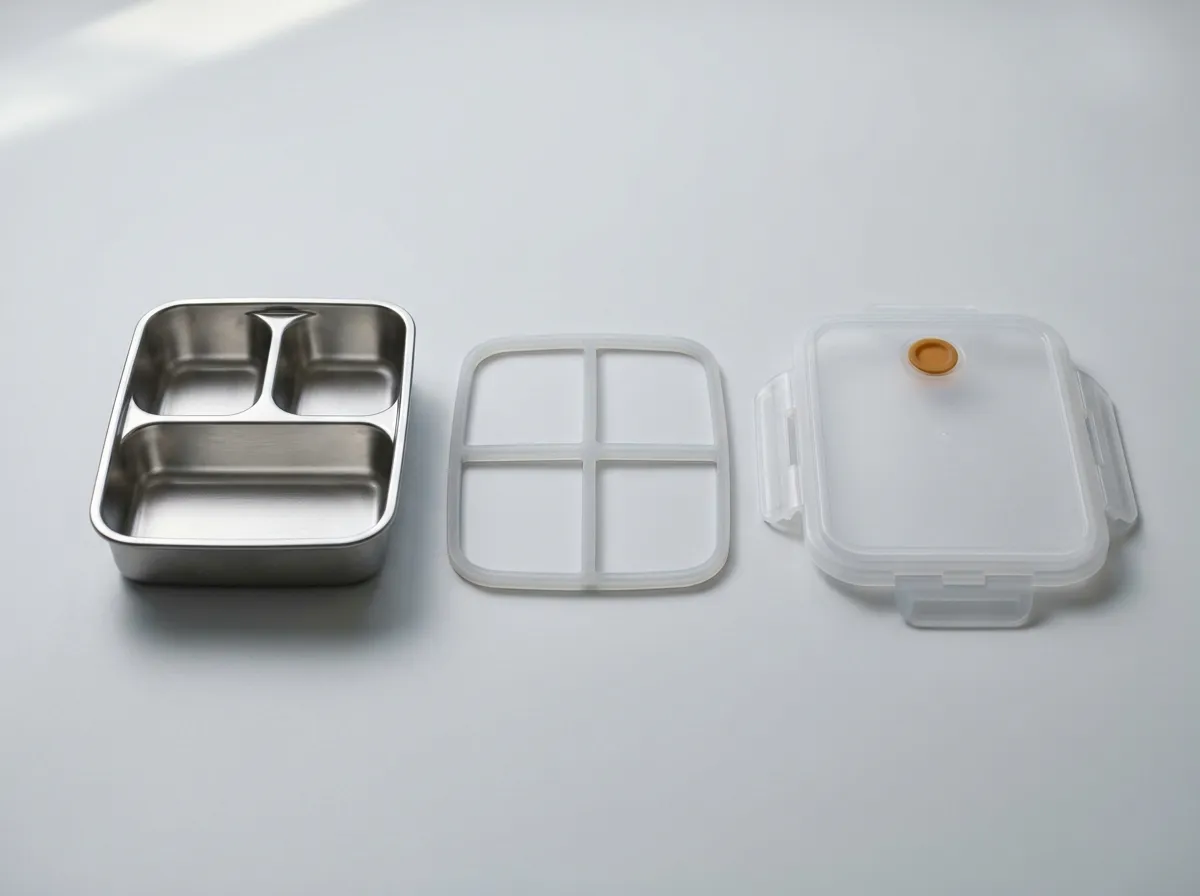
- Measure the steel, do not read the label. Three readings on the base, one on the wall, written into the sample report with the instrument's resolution. A supplier who cannot produce a reading has not measured anything.
- Run a finger round the rim. A rolled rim with no burr is the difference between a product that passes a workplace-safety review and one that does not.
- Look into the corner weld. A continuous weld is visible as one line; a spot weld shows as two marks with a gap that will hold food.
- Take the gasket out and put it back. It should seat without tools and stay seated when the lid is latched. A gasket that needs to be stretched into place will leak in month four.
- Leak test at the worst angle, not the flat one. Thirty minutes at 45° with the lid latched, filled to the line with water and a drop of detergent. Repeat with the compartment holding the sauce.
- Cycle the latches. Fifty open-and-close cycles by hand, then check the latch and the gasket seat again. Four latches across a 1,100 ml tray should feel the same at cycle fifty as at cycle one.
- Wash it, twice. One machine cycle at the operator's own conditions, then inspect for staining at the weld, gasket shrinkage and lid distortion. This is the test the canteen will run three hundred times a year.
- Fill each compartment to the line and weigh the water. Published capacity is a total; what a server needs to know is which compartment holds a portion. This is the number that ends up on the service specification.
- Drop the carton, then the unit. Carton corner drop, then the unit from waist height onto tile. A dented tray is acceptable; a cracked lid is not.
- Keep one unit sealed and dated. That is the golden sample, and it is the only thing that settles a dispute eighteen months later about what "the same product" meant.
Items 4 to 6 are the ones buyers skip and the ones that produce returns. The seal is a system of three parts and it is documented properly in the leak-proof seal structure article; what happens to the approved sample after this afternoon is covered in golden sample and mass production.
How a Fit-Out Breaks Into Models and Cartons
Now the arithmetic that decides the landed cost, done with real carton data from the records above.
Take a site with 600 seats, one container per seat per service, and a 10 percent reserve for breakage, losses and the drawer nobody audits. That is 660 units. Two models, same site, same unit count:
Line | 6522 — 4-compartment 304, 1,100 ml | BX1051 — 3-compartment PP, 1,300 ml |
|---|---|---|
Units required | 660 | 660 |
Pieces per carton | 24 | 72 |
Cartons to order | 28 (27.5 rounded up) | 10 (9.2 rounded up) |
Carton volume | 0.104 m³ | 0.172 m³ |
Shipped volume | 2.90 m³ | 1.72 m³ |
Shipped weight | 406 kg | 143 kg |
Same number of seats. The steel order occupies 68 percent more space and weighs nearly three times as much — 406 kg against 143 kg on the same 660 units. On an LCL shipment that difference is paid twice — once on the freight rate and once on the fact that a mixed container has to be planned around it, which is the arithmetic in combining lines into one container.
Three practical consequences follow.
Round up per model, not per order. At 24 pieces per carton, 660 units becomes 28 cartons and 672 units; at 18 per carton, the same requirement becomes 37 cartons and 666 units. The spare units are not waste — they become the reserve that keeps the room uniform.
Choose the compartment count before the capacity. The 5-compartment 1,400 ml tray (6521) ships at 5.9 L per piece and the 2-compartment 1,300 ml tray (6527) at 6.1 L, while the 4-compartment 1,100 ml (6522) ships at 4.3 L. If the menu is a main plus two sides, the fourth and fifth compartments are being paid for in freight on every seat in the building.
Buy the models that share a lid. Two models with the same lid and gasket geometry cut the spare-parts line to one item, and a canteen that loses lids — every canteen does — stops being a stock problem. The carton-planning side of the same question is worked through in stacking, nesting and carton math.
The Documents to Request Before You Release the Order
Compliance on an institutional order is a document set, and the buyer's job is to ask for it before the deposit, not after the first complaint. Six items, in the order they matter:
- Mill certificate or grade declaration for the steel, tied to a heat number, per lot. This is what turns "304" from a word into a specification.
- Declaration of compliance for the food-contact components, naming the regulation the market applies — the EU framework and its plastics measure for Europe, the relevant 21 CFR section for the United States. The five-market document map lists what each market expects in it.
- Migration test report at the use condition you will actually apply — temperature, duration, food simulant. A report at room temperature does not cover a hot-service line.
- Gasket material statement, with the supplier named. It is the component most likely to change without notice.
- Wash-cycle report from a machine comparable to the one on site, with the claim wording the supplier proposes to print.
- Golden sample agreement, signed, with the retained unit identified by lot and date.
If a new tool has been cut for the order, the same discipline applies to the tool itself before steel is cut — verification of a 3D-printed or first-article sample is the step that catches what a photograph cannot.
A Shortlist That Covers Most Staff Canteens
Four models cover the service conditions described above, from a hospital tray line to a restaurant kitchen plating a fixed menu, and the choice between them is a menu question, not a budget question.
- 6521 — 5 compartments, 1,400 ml. For a full tray service where the main, two sides, a fruit and a dessert are plated separately. 5.9 L of carton volume per piece, second only to the two-compartment 6527 at 6.1 L; justified only when the compartment count is genuinely used.
- 6522 — 4 compartments, 1,100 ml. For a main, two sides and a fourth item served in the same pass — a soup, a sauce or a dessert. On a menu that stops at three items the fourth compartment is freight paid for nothing, which is why it is not the default for a main plus two sides. 24 pieces per carton, 4.3 L shipped per piece, the best volume-to-capacity ratio of the four models on this shortlist.
- 6527 — 2 compartments, 1,300 ml. For a main-and-one format, or a site where the tray doubles as a takeaway container. Two compartments averaging 650 ml each at the fill line; 6.1 L shipped per piece.
- 6523 — 800 ml. For side dishes, children's portions and satellite service points where a full tray is too much food. 24 per carton, 3.6 L shipped.
For transported meals rather than tray service, the 6639 insulated two-compartment box (850 ml, 304 liner) is the different product described earlier: it keeps food warm on the way to a site and is not built to go through a tray-wash line.
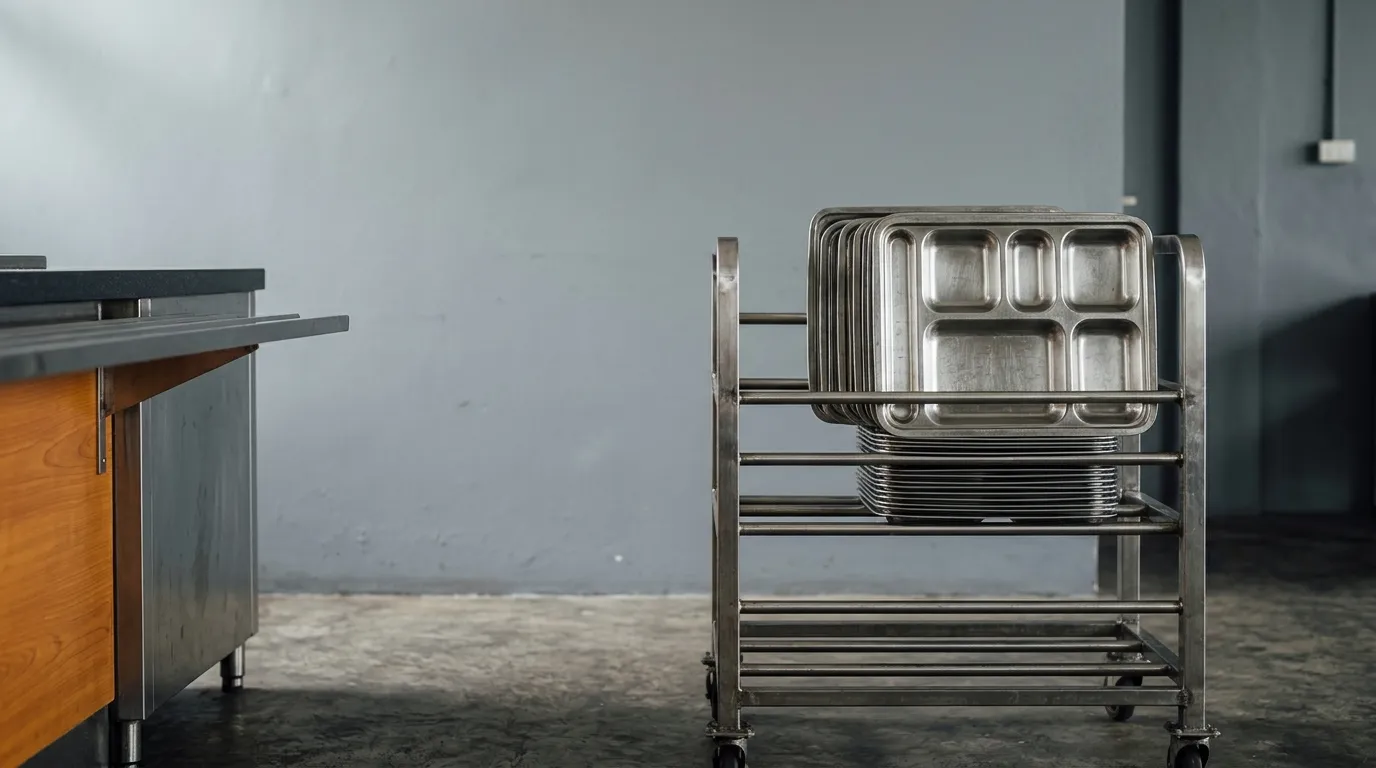
If you are pricing a fit-out, the useful starting point is the seat count, the number of services per day, and the compartment count the menu needs — from those three numbers the carton and cubic-metre figures above follow directly. Send them and we will return the model mix, the carton count and the sample plan that goes with it. What we will not do is quote a stainless tray for a cold-storage line where polypropylene does the job at half the freight; that order comes back in year two, and it comes back to a different supplier.
Continue reading
Related sourcing guidance
More practical context for your food storage container sourcing conversation.

Discuss your product range
Need help selecting or customising containers?
Share the product type, market and sourcing requirements with the Xinghui team.