
Compliance & Food Safety
Glass Food Storage Containers vs PP: The Four Numbers That Move, and the Document Set That Changes With Them
Glass food storage containers change four numbers and the whole document set. What a private-label buyer should demand: carton data, drop tests, lid claims.
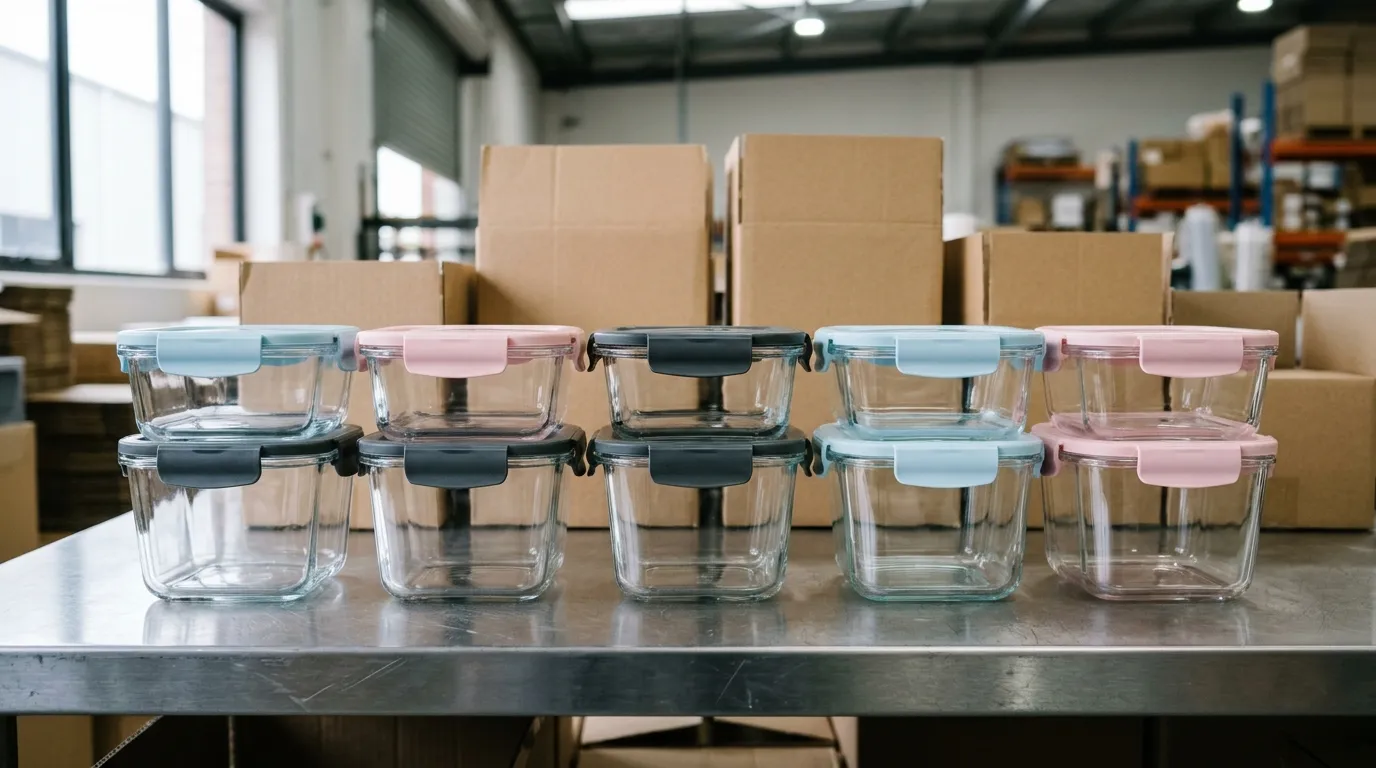
A retail buyer asks for glass, and the sourcing manager inherits a project that looks like a material swap. It is not. Moving a glass food storage container program off polypropylene moves four numbers before anyone discusses price: what a set weighs, what a carton holds, how the brand gets onto the product, and which part of the assembly the "oven safe" claim actually belongs to. Each one is measurable, and each one is missing from most supplier pages.
This article works through those four numbers using our own product records — a real borosilicate program, BX1021 through BX1029, against four PP storage records that carry full carton data. Then it does the part competitors skip: the arithmetic for 1,000 and 5,000 units, the breakage question as a packing and route problem rather than a material verdict, and the document set that changes when the body stops being plastic.
The point is not that glass is worse. Glass earns its price in specific programs. The point is that a glass program specified with a plastic program's paperwork will fail an audit, a freight budget, or a returns report — usually in that order.
Why Buyers Ask for Glass, and What They Are Actually Buying
The request arrives from the retail side, and the reasons are consistent: glass is inert, it does not hold odor, it shows the product, and it can go from fridge to oven without a second vessel. Those are real advantages and they are why glass storage keeps its shelf space.
The health argument is already settled elsewhere on this site — glass versus a plastic lunch box on health grounds covers chemical inertness, heat exposure and hygiene, and concludes that glass wins on those axes while plastic wins on weight and drop resistance. Read it if the question is "which is safer". This article answers a different question: what does it cost to specify, ship and document.
What a buyer is actually purchasing when they move to glass is a vessel with a wider temperature envelope and a decorative surface that behaves differently. Everything else — the lid, the gasket, the carton, the declaration — is still a plastic-and-paper problem, and that is where the surprises sit. A wholesale glass food storage containers program is not a plastic program with a heavier body. It is a program with a different bill of materials, a different freight profile and a different document list.
That distinction matters commercially. Brands that treat glass as a swap budget the body and forget the lid, then discover at sample stage that the "oven safe" line on the box is now a claim about a polypropylene component that was never tested at oven temperature.
Four Numbers That Move When Glass Replaces PP
Four things separate the two material classes, and none of them is a matter of opinion.
One: density. Borosilicate glass sits at roughly 2.2 g/cm³; polypropylene at roughly 0.9. That is a factor of about 2.4 on the material itself, and it does not translate one-for-one into product weight, because a glass body can be molded thinner than a PP body that has to survive latch loads. In practice a glass set lands somewhere near twice the shipping weight of the PP equivalent, which the freight arithmetic calculates.
Two: breakage exposure. PP fails by scratching, staining and eventually cracking at a latch. Glass fails by chipping at the rim, cracking from a corner impact, or shattering. The difference is not the frequency of failure — it is what failure costs. A cracked PP box is a complaint. A shattered glass container in a parcel is a complaint, a replacement shipment and, in some markets, a safety report.
Three: decoration. A logo on PP goes on in the mold, under a print, or as a label. A logo on glass is fired, etched or printed, and fired decoration near the rim is the first thing a compliance reviewer asks about, because it introduces metals into a food-contact zone. The decoration section covers the routes.
Four: the claim. Glass bodies are sold for oven use because borosilicate's low coefficient of thermal expansion lets it survive the temperature differential that cracks soda-lime glass. But a container is only as capable as its weakest part, and the weakest part of a glass container is almost always the lid. That is the lid section.
On the thermal side, the specification line that actually protects a buyer is the grade plus the test method, not the word "borosilicate". The coefficient of thermal expansion is measured by a defined method — ASTM E228 is the push-rod dilatometer method used for solid materials — and a supplier who cannot name the grade and produce a value for it is selling a word, not a material. Soda-lime glass is cheaper and perfectly serviceable for cold and ambient storage; it is the wrong grade for oven-to-fridge transitions.
A container is not oven-safe because the glass is. It is oven-safe because every part of it — including the lid someone left on — was tested that way.
The reference set for this article is the borosilicate program in our own records: models BX1021 through BX1029, 320 ml to 1,040 ml, glass body with a plastic latch lid, packed in a color box. Its glass food storage container product page carries the commercial detail. The records are also where the next section starts, because they show a gap that every glass buyer will hit.
What the Record Actually Contains
Here is the first thing a buyer discovers: PP programs have carton tables, and glass programs usually do not.
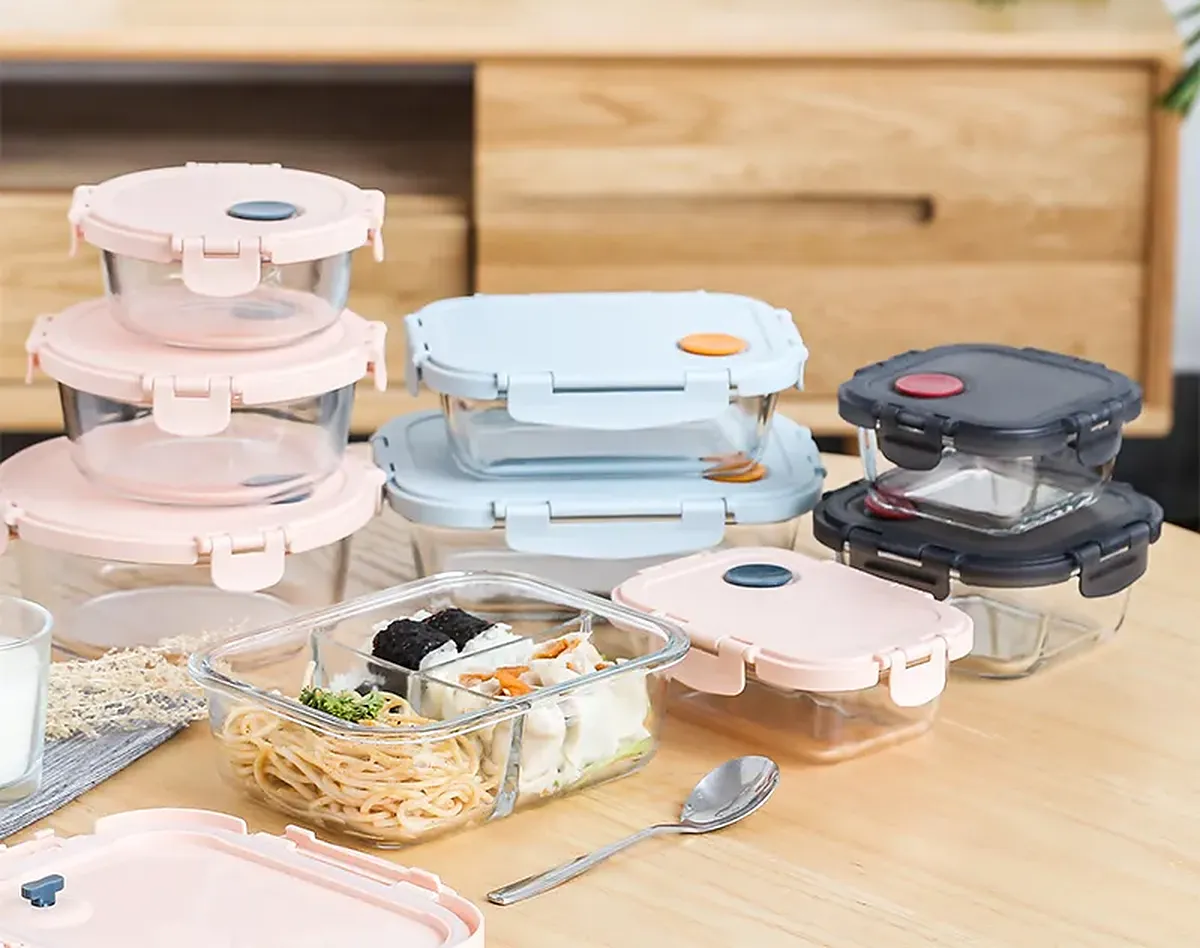
The BX1021–BX1029 set: glass bodies, colored PP latch lids, sold as a set in a printed color box.
Our own glass record states the model range, the material, the capacity band, the lid colors and the packing type. It does not state pieces per carton, gross weight, carton dimensions or unit weight. The PP records next to it carry pieces per carton, gross weight and carton dimensions, and the two canister models add unit weight. That asymmetry is normal in the category — glass is often sourced as a set from a glassware line and boxed by a third party — and it is exactly why a glass quotation so often arrives without a freight number.
Table 1 puts the material classes side by side on the properties that drive a purchase order. Table 2 shows what the records actually hold.
Table 1 — The same storage product in three material sets.
Property | Borosilicate glass body | PP body | PP lid and silicone gasket |
|---|---|---|---|
Density (material constant) | ~2.2 g/cm³ | ~0.9 g/cm³ | PP ~0.9 / silicone ~1.1 g/cm³ |
Thermal behavior | Sold for oven use; low expansion, so hot-to-cold transitions are the design case | Hot fill and reheating around 100 °C; above that, warpage and latch creep | Lid defines the product's ceiling: a 200 °C body with a 100 °C lid is a 100 °C product |
Failure mode | Chips at the rim, cracks from corner impact, shatters | Scratches, stains, cracks at the latch | Latch breaks first; gasket takes a permanent set and stops sealing |
Clarity over time | Stays clear | Yellows and hazes with hot fat and detergents | — |
Decoration route | Fired decal, etch, or print; rim decoration needs scrutiny | In-mold label, print, or a label pad | — |
Food-contact route (US) | No polymer regulation applies; ask for lead and cadmium release data | 21 CFR 177.1520 declaration | Gasket: 21 CFR 177.2600 |
Food-contact route (EU) | Framework statement naming the instrument used | 10/2011 declaration of compliance | National silicone rule plus the framework statement |
Freight per unit | Roughly twice the PP equivalent (freight arithmetic below) | Baseline | — |
End of use | Recyclable glass stream, heavy to move | Recyclable, light | Small parts, usually landfilled |
Table 2 — What the records actually hold, model by model.
Model | Material | Capacity | Units per carton | Gross weight per carton | Carton size | Unit weight |
|---|---|---|---|---|---|---|
BX1021–BX1029 | High borosilicate glass + plastic lid | 320–1,040 ml | not recorded | not recorded | not recorded | not recorded |
BX1053 | PP + silicone | not recorded in the record | 24 pcs | 12.4 kg | 61 × 30 × 57 cm | 425 g |
BX1052 | PP + silicone | not recorded in the record | 48 pcs | 16.2 kg | 68 × 36 × 56.5 cm | 298 g |
3332 | PP | not recorded in the record | 56 pcs | 16.1 kg | 64 × 49 × 56 cm | not recorded |
3334 | PP | not recorded in the record | 80 pcs | 14.7 kg | 59 × 56 × 65 cm | not recorded |
Every figure in Table 2 comes from our own model records, and every "not recorded" is a literal statement about the record, not a placeholder for a number someone forgot to type. Gross weight and unit weight are stated per carton and per piece; both should be confirmed against the packing scope of your order.
A cell that says "not recorded" is a specification gap. Filling it with a plausible number is how a freight budget gets built on a guess.
The PP comparator used throughout the arithmetic is model BX1053, a 3-piece airtight canister set packed 24 to a carton, whose bulk airtight food storage container record carries the full carton data. It is a fair comparator because it is the same product class — a stackable clear storage container sold in a set — in the other material.
So the first line of any glass RFQ is not a price question: ask for pieces per carton, gross weight, carton dimensions, unit weight, and the packing method inside the carton. Without those five, no one can compare a glass quote to a PP quote, and the cheaper-looking quote is usually the one with the missing data.
Freight Arithmetic for 1,000 and 5,000 Units
Now the arithmetic, with the assumptions stated where they occur.
The PP side is recorded: BX1053 packs 24 pieces per carton — eight 3-piece retail sets — at 12.4 kg gross, 517 g per piece, in a carton of 61 × 30 × 57 cm. That is 0.104 m³ per carton.
The glass side is estimated, because the record has no carton data. The estimate uses two stated assumptions: the carton footprint stays the same, and a carton carries half the pieces (12 rather than 24) because the weight per piece roughly doubles. At about 2.4 times the density and a thinner wall, a piece that ships at 517 g in PP ships at roughly 1 kg in glass including its color box. Both assumptions are checkable in one email to a supplier, and both should be replaced by measured figures before anyone books freight.
Table 3 — Per-1,000-unit freight arithmetic: recorded PP against estimated glass.
Line | PP program (BX1053, recorded) | Glass program (estimated) |
|---|---|---|
Units (containers) | 1,000 | 1,000 |
Units per carton | 24 (recorded) | 12 (assumption) |
Cartons | 42 (1,000 ÷ 24 ≈ 41.7, rounded up) | 84 (1,000 ÷ 12 ≈ 83.3, rounded up) |
Carton cube | 0.104 m³ (recorded size) | 0.104 m³ (same carton, half the pieces) |
Total cube | 4.4 m³ (42 × 0.104) | 8.7 m³ (84 × 0.104) |
Gross weight shipped | 521 kg (42 × 12.4) | ~1,050 kg (84 × ~12.5) |
Per 1,000 units, glass roughly doubles both the kilos and the cubic meters. At 5,000 units the same ratios give 209 cartons, 2,592 kg and 21.8 m³ for polypropylene against about 417 cartons, 5,212 kg and 43.5 m³ for glass.
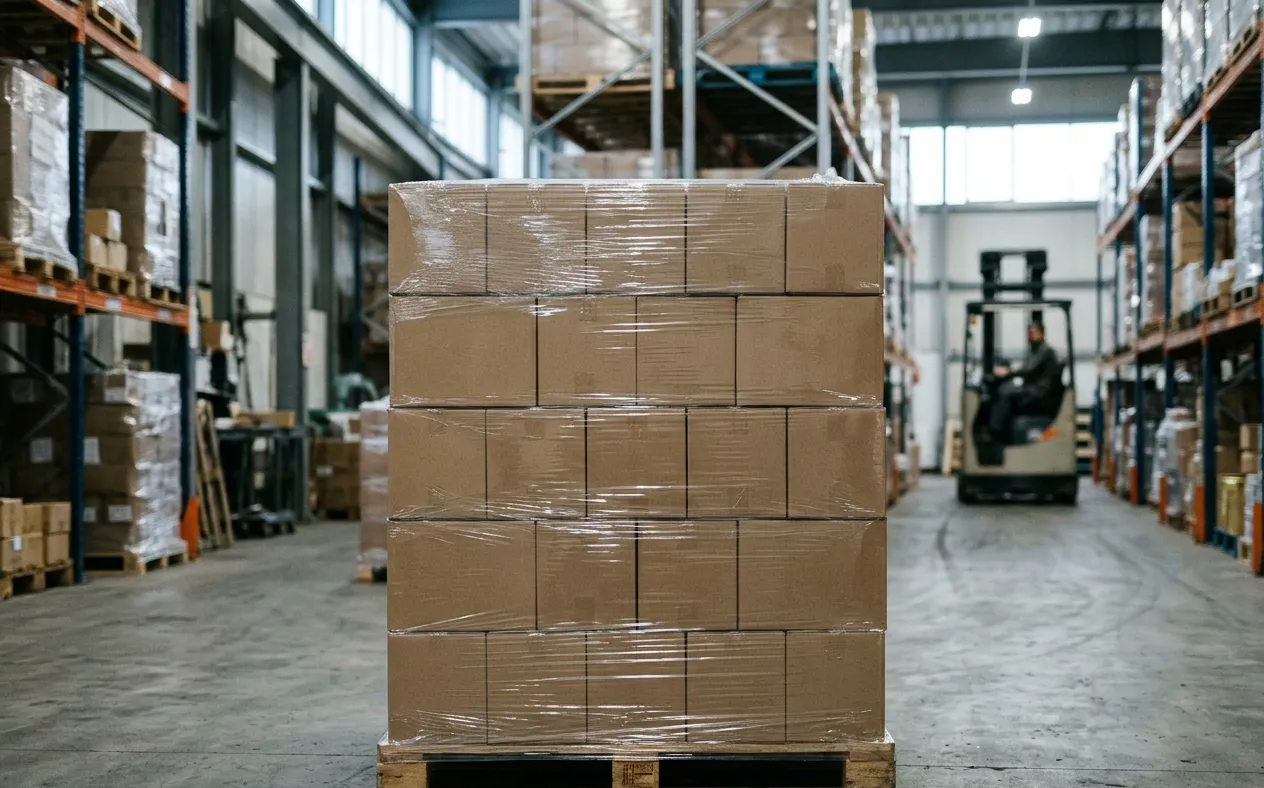
Gross carton weight and cube, not unit capacity, decide what a container load costs.
Two consequences follow, and neither is intuitive.
First, doubling the cube matters more than doubling the weight for a mixed container. Freight is charged on whichever of the two binds, and a glass program inside an LCL shipment full of light plastic goods will consume volume that other lines were counting on. The mechanics of carton footprints in a mixed load are set out in stacking, nesting and carton math for the plastic side, and they apply unchanged to glass.
Second, the cube follows the carton, not the product. A glass set in a printed color box with molded pulp dividers can consume more volume than its weight suggests, because the packaging is doing the protection work the breakage section describes. Buyers who assume the smaller product ships in the smaller carton get this wrong in both directions — a lesson the same arithmetic teaches on the PP side, where a smaller capacity model sometimes ships in a larger carton because of nesting decisions.
Breakage Is a Packing Spec, Not a Material Property
"Glass breaks, plastic doesn't" is true and useless. Breakage in a shipping carton is a function of packing design, carton strength, route and handling — which means it is a specification line a buyer can set and a supplier can be held to.
Start with what a failure actually costs. A 5,000-unit program is 417 cartons of twelve — about 5,000 pieces in all. If half a percent arrive damaged, that is 25 pieces; one percent is 50; two percent is 100. Each replacement piece is a second shipment, a second customs entry in some lanes, and a customer-service event. What matters more than the rate is that nobody has asked for it yet, because nobody specified a drop protocol.
Then set the packing. Glass sets ship in one of three ways: molded pulp dividers between pieces, corrugated inserts and individual wraps, or a molded tray inside a printed color box. Each step up in protection adds cost per set and removes a class of damage. The dividing line is usually the parcel network rather than the ocean container: a pallet that travels intact through a distribution center can still be destroyed by six parcel handoffs to a retail customer.
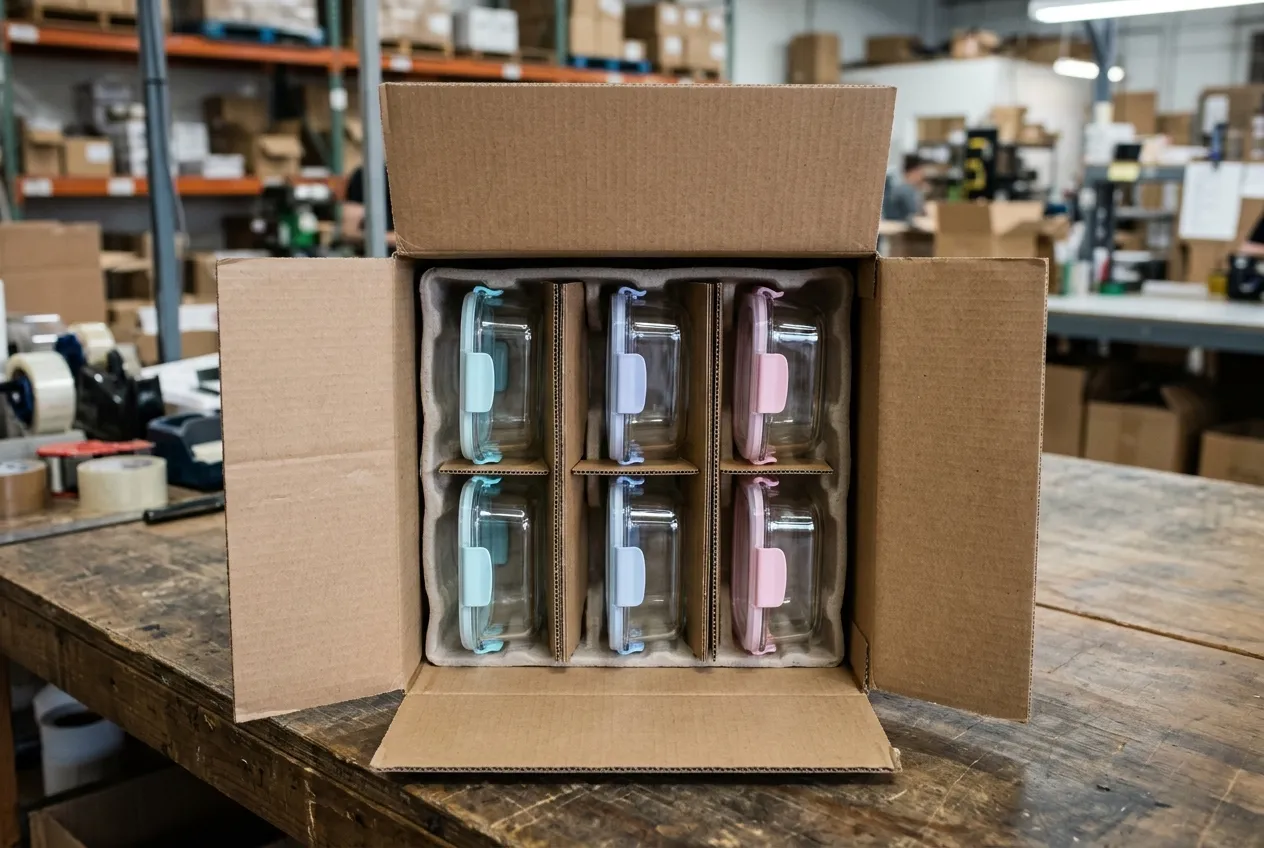
Corrugated inserts are the packing decision that turns a breakage rate into a number someone can be held to.
So the specification asks for three things, in writing:
- A named drop protocol. Carton-level drop testing to an agreed procedure, with the drop heights and orientations stated. A supplier who says "we pack safely" has not answered.
- A carton-level sample test. Not one container in a padded envelope — a full carton, dropped and opened, with the damaged count recorded.
- A replacement rate, expressed per 1,000 units, and what it excludes.
Retail packaging choices interact with all three, and the trade-offs between printed boxes, inserts and shrink are covered in retail packaging decisions for kitchen storage containers. What matters here is the order of decisions: packing design first, packaging artwork second. A brand that designs the box before the dividers usually redesigns the box.
The Lid Is the Weak Link in Every Glass Claim
A glass body can be sold for oven use at 200 °C and above. A polypropylene lid is specified around 100 °C, where warpage and latch creep begin. A silicone gasket sits between the two and behaves differently again: it tolerates heat, but it takes a permanent set under compression and heat cycling, and a gasket that has taken a set is a container that no longer seals.
Put those three facts together and, for glass food containers with lids, the claim is decided by the lowest-rated part. If the lid ships on the container, the container is a 100 °C product no matter what the glass can take. If the lid is sold separately, the claim has to say so on the pack, because the customer will not read the distinction anywhere else.
The same logic runs through the other claims:
- Freezer. Glass is fine at freezer temperature. The gasket stiffens, and a stiff gasket plus a latch under load is where a seal fails. Freezer-to-oven transition is a thermal shock test, not a storage question, and it needs its own report.
- Microwave. A glass body with the lid on traps steam; the vent, if there is one, is a lid feature. A vented lid and an unvented one are different products with different claim lines.
- Dishwasher. Glass is unaffected. The gasket is the part that ages, and the latch is the part that cracks. A 900-cycle claim is a claim about the lid assembly.
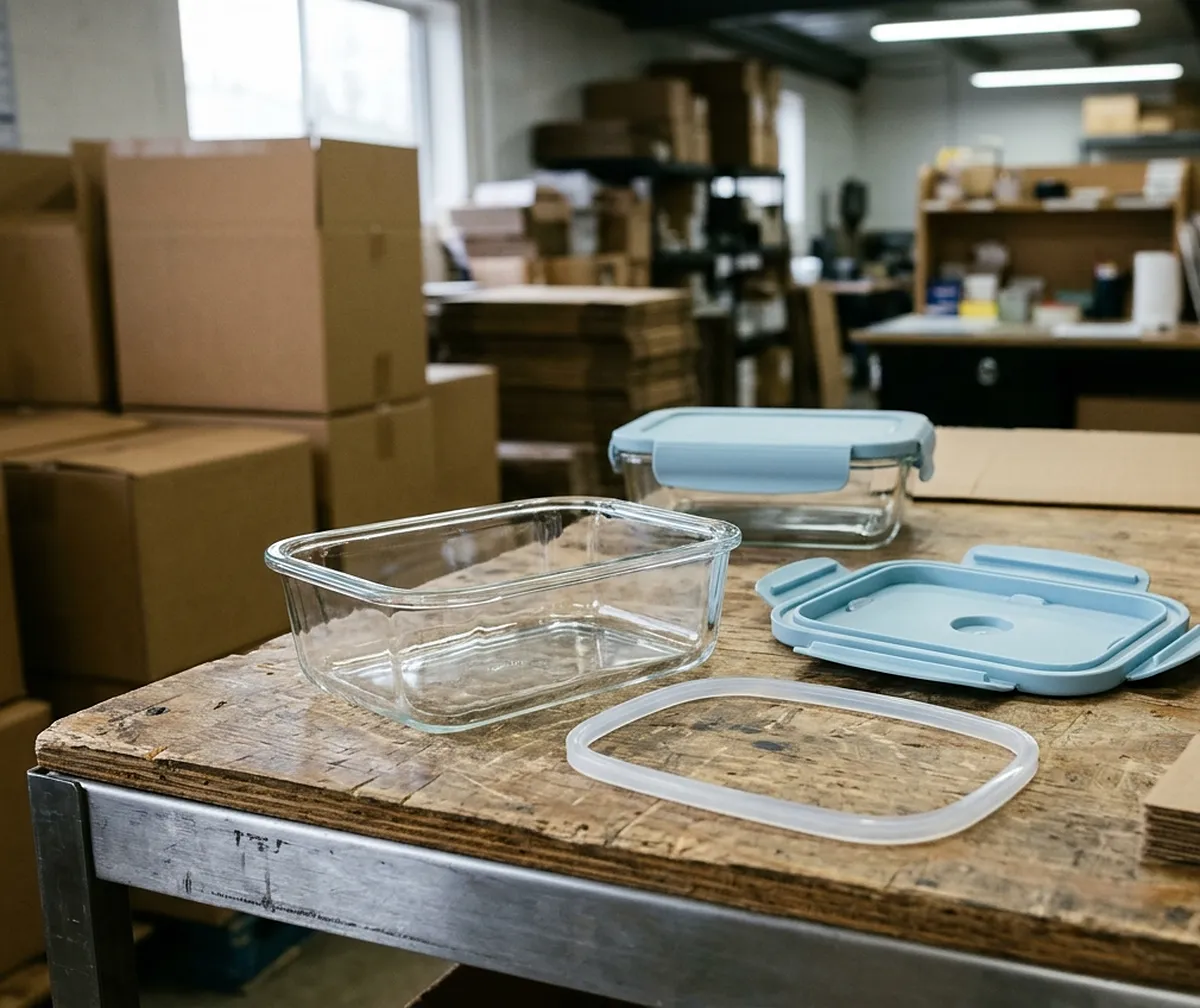
Three parts, three ratings: the claim on the box belongs to the lowest one.
What a buyer should demand is a claim per part rather than per product: body maximum temperature, lid maximum temperature, gasket service range, and the test that produced each. The failure modes a microwave claim has to survive — and the contract language that makes the claim enforceable — are set out in microwave-safe failure modes and contract clauses. Glass changes the body's row in that table and nothing else.
One useful discipline: write the claim as a sentence with a number in it. "Oven safe to 200 °C with the lid removed" is a specification. "Oven safe" is a marketing line that will be read as "everything in the box".
The Documents Change With the Material
This is the section that most glass programs get wrong, and it is not a legal subtlety — it changes what you ask for.
A glass body does not sit under the polymer regulations that are routinely quoted for it. In the United States, 21 CFR 177.1520 covers olefin polymers, which is the right citation for a polypropylene lid and the wrong one for a glass vessel. The FDA's packaging and food contact substances framework is the frame, and the practical document for a glass body is a heavy-metal release statement — lead and cadmium are the two a glass batch and its decoration are most often tested for — with the test method and detection limits named. There is no certificate that says a material is "FDA approved" — that status does not exist — so a supplier offering one has misunderstood their own paperwork.
In the EU, Regulation (EC) No 1935/2004 is the framework that applies to all food-contact materials. Regulation (EU) No 10/2011 is the plastics measure, and it covers the lid, not the glass. Which instrument a supplier's glass declaration invokes — a national rule, a release test standard, or the ceramics route — is a question for the buyer's compliance counsel; what a buyer can insist on is that the declaration names the instrument and the test method instead of asserting "food grade".
Table 4 — Documents by part and by market, and what each one does not prove.
Part | United States | European Union | Germany | What it answers | What it does not answer |
|---|---|---|---|---|---|
Glass body | Lead and cadmium release report with method and limits; statement of glass type (borosilicate or soda-lime) | Framework statement under 1935/2004 naming the instrument; lead and cadmium release data | LFGB conformity plus release data | Whether restricted metals release above the stated limit | Overall migration, thermal shock, breakage |
PP lid | 21 CFR 177.1520 declaration plus migration data at the conditions of use | 10/2011 declaration of compliance | LFGB conformity plus 10/2011 declaration | Whether the plastic meets its migration limits at the tested conditions | Anything about a use condition the test did not cover |
Silicone gasket | 21 CFR 177.2600 extraction data | National silicone rule plus a framework statement | LFGB plus the national silicone recommendation | Whether the elastomer meets its extraction limits | Seal life after heat cycling |
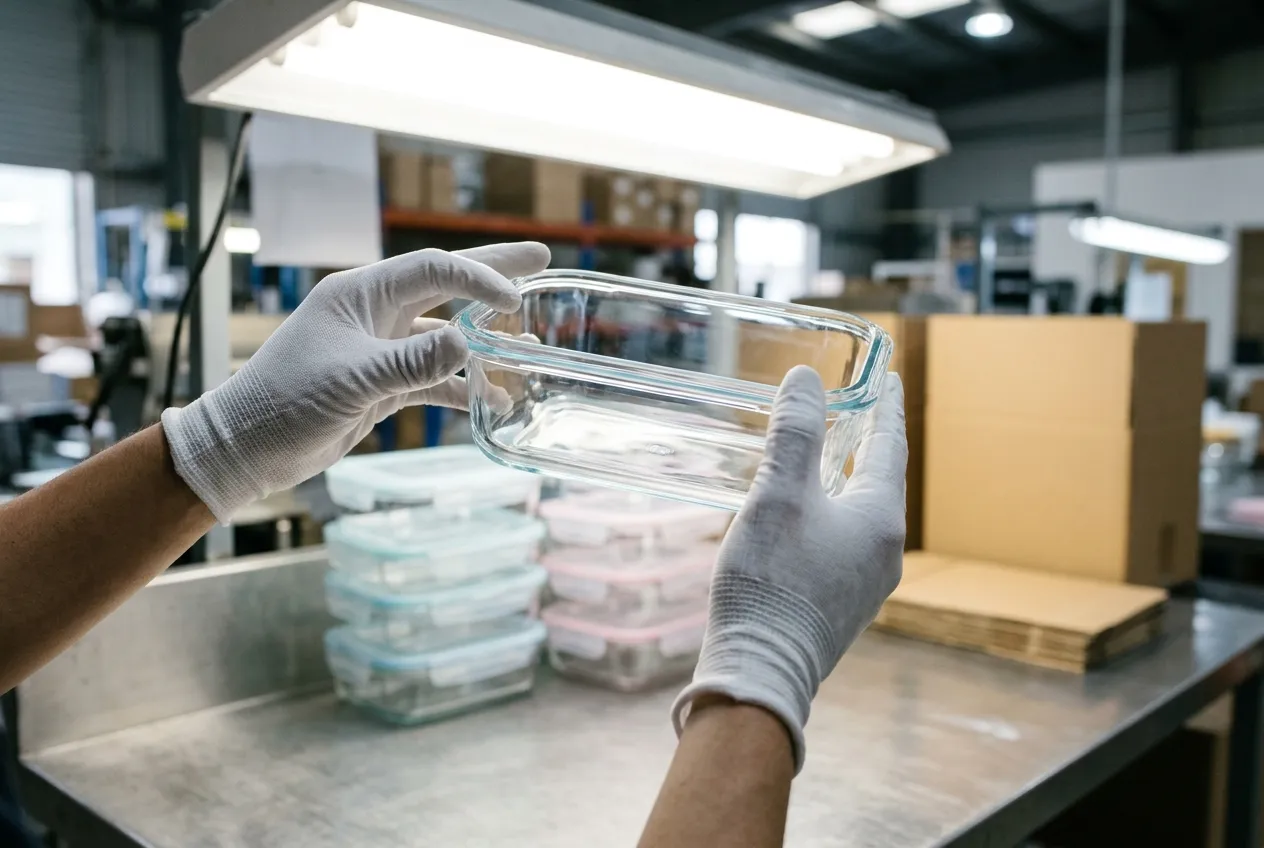
Rim inspection is where chips are found; the document that covers the rim is a release test, not a migration report.
Two limits on that table get misread in purchase orders.
First, a declaration covers the parts someone remembered to declare. A glass container with a lid, a gasket, two latches and a printed box is five surfaces, and the glass body's release test says nothing about the gasket. The split between direct and indirect food contact decides which parts need their own report; the component-by-component version for glass inserts, gaskets and bases is in non-PP parts: gasket, base and glass evidence.
Second, no document in that table proves the product works. A release test proves release. A migration report proves migration at the tested conditions. Neither proves the container survives a freezer-to-oven transition or a parcel drop, and neither is a substitute for the specifications in the breakage and lid sections.
Decoration and the Retail Box: Where Glass Programs Leak Margin
A logo is where glass and PP diverge commercially, because the decoration route determines both durability and compliance work.
Four routes exist. A fired decal is applied and kiln-fired; it survives dishwashing for years and costs the most per piece. An etch is permanent and reads as premium, but it is a single-color finish and it changes the surface where it lands. UV print looks sharp and fails in a dishwasher within a season. Pad print is cheap and wears at the rim, which is the worst place to lose ink on a food container.
The compliance consequence is geography, not cost: decoration near the rim sits inside the food-contact zone, which is why a fired decal close to the sealing surface attracts a lead and cadmium question that the same decal on the base does not. Moving a logo 15 mm down the wall is free. Discovering the problem after the artwork is approved is not.
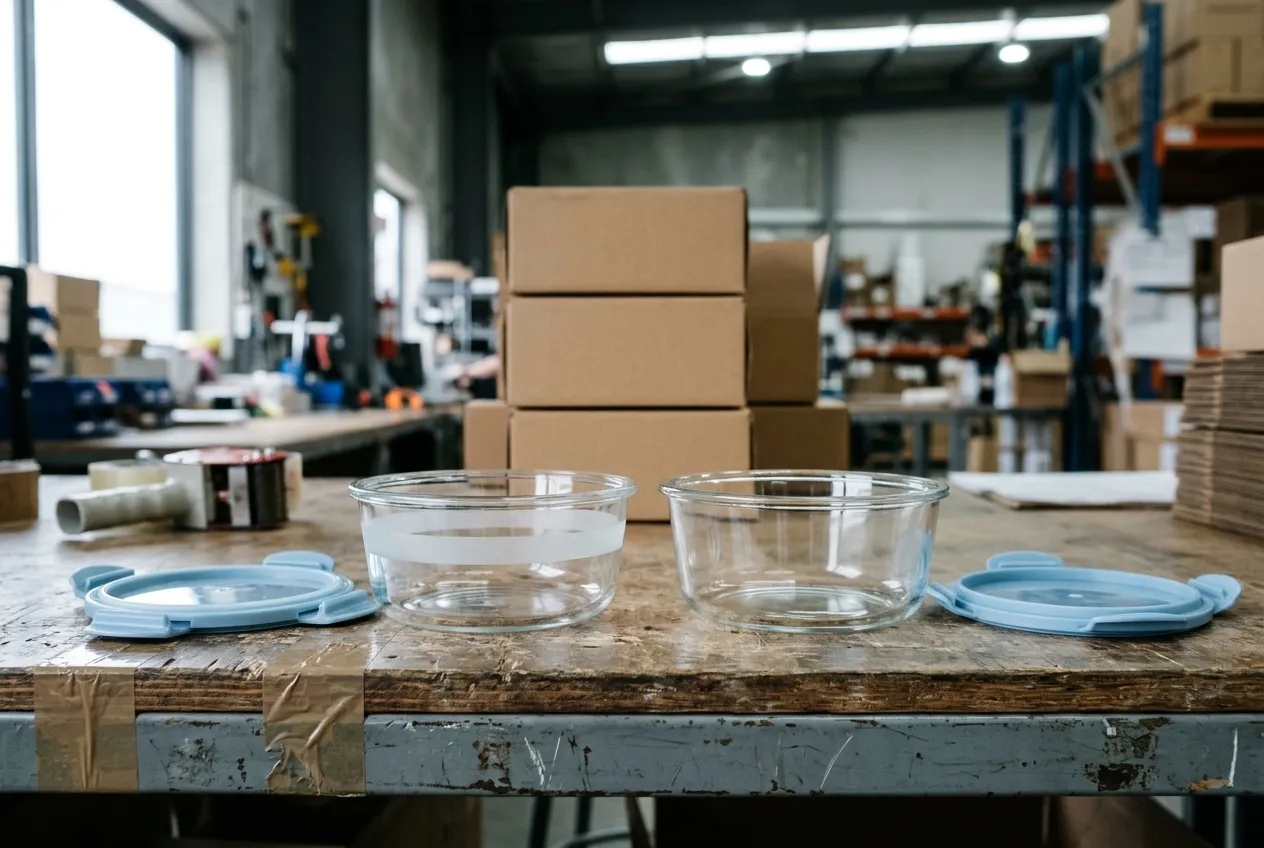
Etching is permanent and needs no ink; a band or a wordmark in the same process carries the same food-zone question if it lands near the rim.
The retail box is the second leak. A glass set ships in a printed color box because retail requires it, and that box carries the dividers the breakage section describes. The box adds cube, adds cost and does real protective work — which is why a "cheaper packaging option" usually means less protection, not less printing.
Then there is SKU count. The glass program in our records spans BX1021 to BX1029, a capacity ladder from 320 ml to 1,040 ml. A retail buyer rarely wants nine. They want three that cover small, medium and large, with one shape. Choosing those three before the carton table is built is the difference between a program that ships efficiently and one that ships three half-empty cartons. The SKU-mix and capacity-ladder logic is worked through in meal prep container SKU mix and capacity ladder — the arithmetic is material-agnostic, and a bulk glass meal prep container program runs exactly the same calculation with heavier units.
When PP Is the Better Answer
A comparison written by a factory that also sells PP should be honest about where PP wins, and it wins more often than the glass trend suggests.
PP wins when the product is for dry pantry goods. Airtight canisters, grain jars and flour containers do not need an oven envelope; they need a seal, a stackable footprint and a price that survives a supermarket shelf. Glass adds weight and breakage to a job that never needed heat resistance.
PP wins on drop-heavy routes. Anything that travels through a parcel network more than twice, or into a school, a site office or a subscription box, is a program where breakage exposure costs more than the perceived premium of glass.
PP wins when the cube binds. A container load filled with PP storage sets carries roughly twice as many sets as the same load filled with glass. For a distributor paying freight per container, that ratio is the business case.
PP wins on decoration flexibility, too: in-mold labeling and print allow full-color artwork without a kiln step or a rim-adjacency question.
The test is five questions, in this order: Does the product need an oven or a freezer-to-oven transition? Will it travel through parcel handoffs? Is the freight cube-limited? Is decoration central to the brand? Does the retail price support roughly double the shipping weight? Three or more "no" answers point to PP, and the tall PP storage format — model 3334 among them — covers the pantry case at a fraction of the shipped weight.
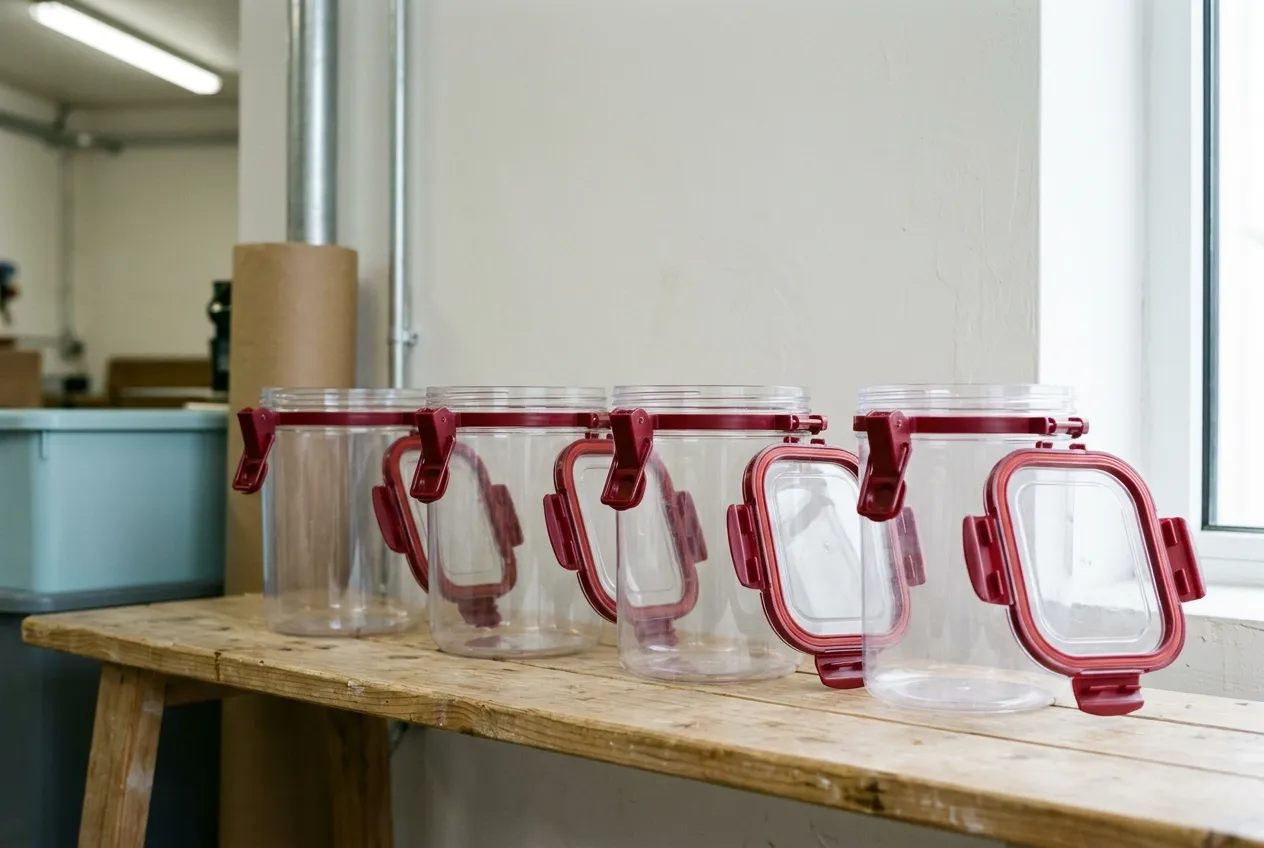
The PP case is not a consolation prize: same seal logic, half the shipped weight.
Where glass pays is where the oven and the shelf argue for it: meal prep that gets reheated, serving pieces that go to the table, gift and premium sets where the material is part of the proposition, and programs where a plastic taste or staining complaint has already cost more than the freight difference.
The Spec Block to Send Before You Ask for a Glass Quote
Here is the block this article has been building toward. Ten lines, each answerable in writing, each auditable later.
- Glass grade (borosilicate or soda-lime) and the coefficient of thermal expansion with its test method.
- Capacity in milliliters, with the basis stated (usable or brim-full), and the set configuration.
- Material by part: body, lid, gasket, latches — with the food-contact route each part is declared under.
- Claim per part, with numbers: body maximum temperature, lid maximum temperature, gasket service range, and the test behind each.
- Drop protocol: procedure name, drop heights, orientations, and the damaged count from a carton-level test.
- Packing method inside the carton: dividers, wraps, molded tray — and the color box specification.
- Carton quantity, gross weight, carton dimensions and unit weight, stated per shipping carton.
- Decoration route, position on the part, and a lead and cadmium statement for any decoration in the food-contact zone.
- MOQ per model and per color, and the sample quantity with the criteria the sample is judged against.
- Country of origin per component, as a statement rather than a certificate.
Two lines belong beside those ten. The first is the replacement rate, expressed per 1,000 units. The second is the document pack itself, per part — and the place to start assembling it is which compliance documents to request from a food container factory, which lists the core set every program needs before the material-specific additions in the document section.
At sample stage, test the four numbers rather than looking at them. Weigh a full carton instead of trusting the sheet. Drop the second carton from the run, not the first. Put the lid on, fill the container with the wettest thing in the range, and freeze it overnight before reheating it. Read the decoration where the customer's mouth will be, not where the artwork looks best.
Xinghui Plastic Life runs glass and polypropylene storage programs from our plant in Jieyang, including the borosilicate set behind this article — BX1021 through BX1029, 320 ml to 1,040 ml, with color, size, logo and packaging options — and the PP canister records used as the comparator. If you are converting a storage line from one material to the other, send the ten-line block above and we will answer it line by line, with the record gaps marked as gaps rather than filled with a number.
Continue reading
Related sourcing guidance
More practical context for your food storage container sourcing conversation.


Discuss your product range
Need help selecting or customising containers?
Share the product type, market and sourcing requirements with the Xinghui team.