
Compliance & Food Safety
Airtight vs Leakproof: Two Specs Wholesale Buyers Keep Merging, and the Separate Test Each One Needs
Airtight and leakproof are two different tests, not two grades: one measures a pressure differential, the other measures liquid escape. What to demand.
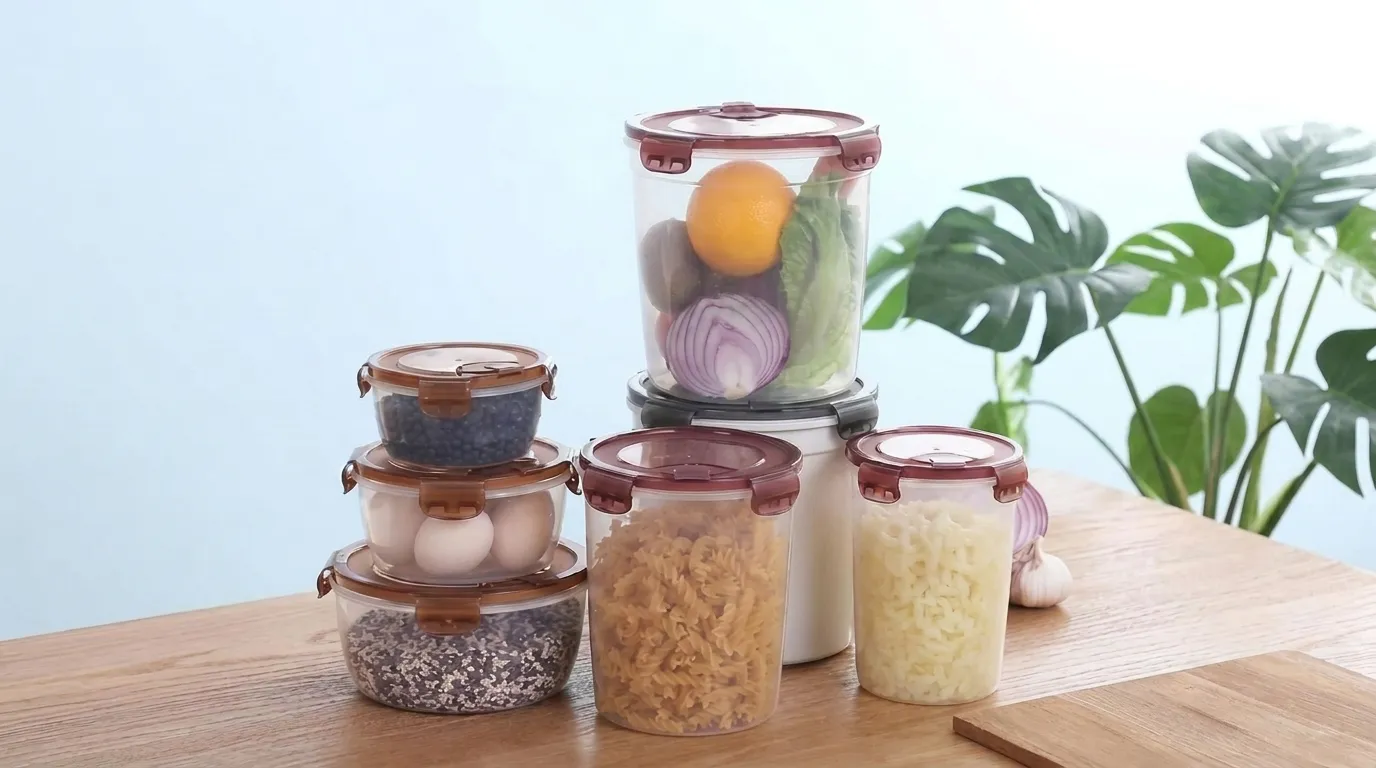
A purchase order line reads: container must be airtight and leakproof. The supplier ticks both. Nobody writes down what will be measured, at what pressure, with what inside, at what temperature, for how long, or who signs the number. Eight weeks later a pallet of soup sits in a distributor's warehouse with liquid in the carton, and both parties are honestly surprised, because both of them believed the line had been specified.
It had not been specified. It had been described.
Airtight vs leakproof is usually treated as a comparison of two grades of one property, one a little stronger than the other. It is actually a comparison of two measurement traditions: they answer different questions, and the loads they test differ by roughly two orders of magnitude. Once a buyer sees that, the phrase stops being a wish and becomes two clauses with numbers in them.
Airtight describes how well a closure resists gas movement across a pressure differential. Leakproof describes how well a container resists liquid escape at a stated fill level, orientation, temperature and duration. They are measured by different tests, they fail in different ways, and a pass on one says nothing about the other.
Airtight vs Leakproof: The Two Words Are Not Two Grades
Buyers usually treat these as points on one scale — as if a container were "sort of sealed" or "properly sealed" and the second word were the stronger version of the first. That model produces the wrong specification, because it implies a single test could rank every container and the buyer only has to pick the cut-off.
There is no single test. There are two, and they measure different physical events.
Claim | What it promises | What physically ends it | The test that proves it | Where the evidence lives |
|---|---|---|---|---|
Airtight | The closure limits gas exchange, so dry contents stay dry and odors stay put | A path opens at the lid line under a pressure differential; the gasket stops compressing into its working range | Differential-pressure testing of an empty rigid container (ASTM D4991), or vacuum decay (ASTM F2338) | A report stating the differential, the dwell time, the instrument and the pass threshold |
Leakproof | Liquid stays inside when the container is carried, tipped or packed on its side | Liquid reaches a channel at the lid line and gravity, orientation, time or temperature drives it through | A liquid-containment protocol the buyer defines: fill level, orientation, duration, temperature | A report stating those four conditions plus the acceptance criterion |
Watertight | The everyday word for "liquid does not get out", used loosely in listings and in conversation | Same as leakproof, but with no agreed measurement behind the word | None on its own — it inherits whatever test the seller happens to have run | Nothing, until you attach one of the two protocols above |
The third row is why watertight vs airtight shows up so often in search data: it is the vocabulary question. The engineering question is the first two rows, and they are not interchangeable. The category as a whole lives under one compliance topic — food-contact compliance and safety — but closure performance is a separate discipline from material safety, and the two get confused constantly.
What Airtight Actually Measures
There are two traditions hiding behind one word, and they do not measure the same thing.
In flexible packaging, airtightness is a permeation number. A film or a vacuum bag is rated by its oxygen transmission rate and its water-vapor transmission rate, measured per unit area over time. That is a property of the material and its thickness, and it is meaningful for a bag because the whole surface is the barrier.
In rigid containers, almost none of that applies. A polypropylene box with a gasket is not a bag. The wall is a millimeter or two of a semi-crystalline polymer; gas moves through it slowly and predictably. The variable that decides whether the box is airtight or not is the closure — the gasket compression line, the latch force that maintains it, and the flatness of the rim it presses against. That line is where a path opens, and it is where a test has to look — it is also the part a compliance file has to name separately, which is why which parts of a container need a report is a different question from which parts touch food.
The standard that actually addresses this is ASTM D4991, Standard Test Method for Leakage Testing of Empty Rigid Containers by Vacuum Method. Three details in its scope matter more than the method itself:
- It tests empty containers. The container is the subject; the product inside is not.
- It works by differential pressure, and establishes the point at which leakage begins, with a limit of approximately 95 kPa (13.8 psi) differential.
- It points flexible packaging elsewhere — "see Test Method D3078 for flexible packages."
For a non-destructive production check, the related method is ASTM F2338-24, Standard Test Method for Nondestructive Detection of Leaks in Packages by Vacuum Decay Method. The 2003 edition still circulating in supplier files covered only non-lidded trays, lidded trays and cups, which is why the method used to be borrowed into rigid-container work as a practical shortcut. The current edition adds rigid, nonporous packages and flexible nonporous packages to its scope, so a lidded polypropylene box now sits inside the method rather than at the edge of it. Two of its own clauses are worth carrying into a purchase specification: results are qualitative, accept or reject, and the acceptance criteria are established from baseline measurements taken on control, non-leaking packages. In other words, the standard tells you to establish the threshold from a known-good sample — it does not hand you a universal number.
The method makes more sense once you see what it is imitating. In an aircraft hold the pressure outside a sealed container falls while the air inside stays at whatever the container was packed at, so the closure is pushed outward from within. Testing with a vacuum applied outside the container reproduces that push without pressurizing the product, which is why the standard is written around an empty container and a differential rather than around a filled one.
Which is the point a buyer should take away: "airtight" on a rigid container is a statement about a closure, tested on an empty container, against a threshold someone chose. If your specification does not say who chose it, you have not specified anything.
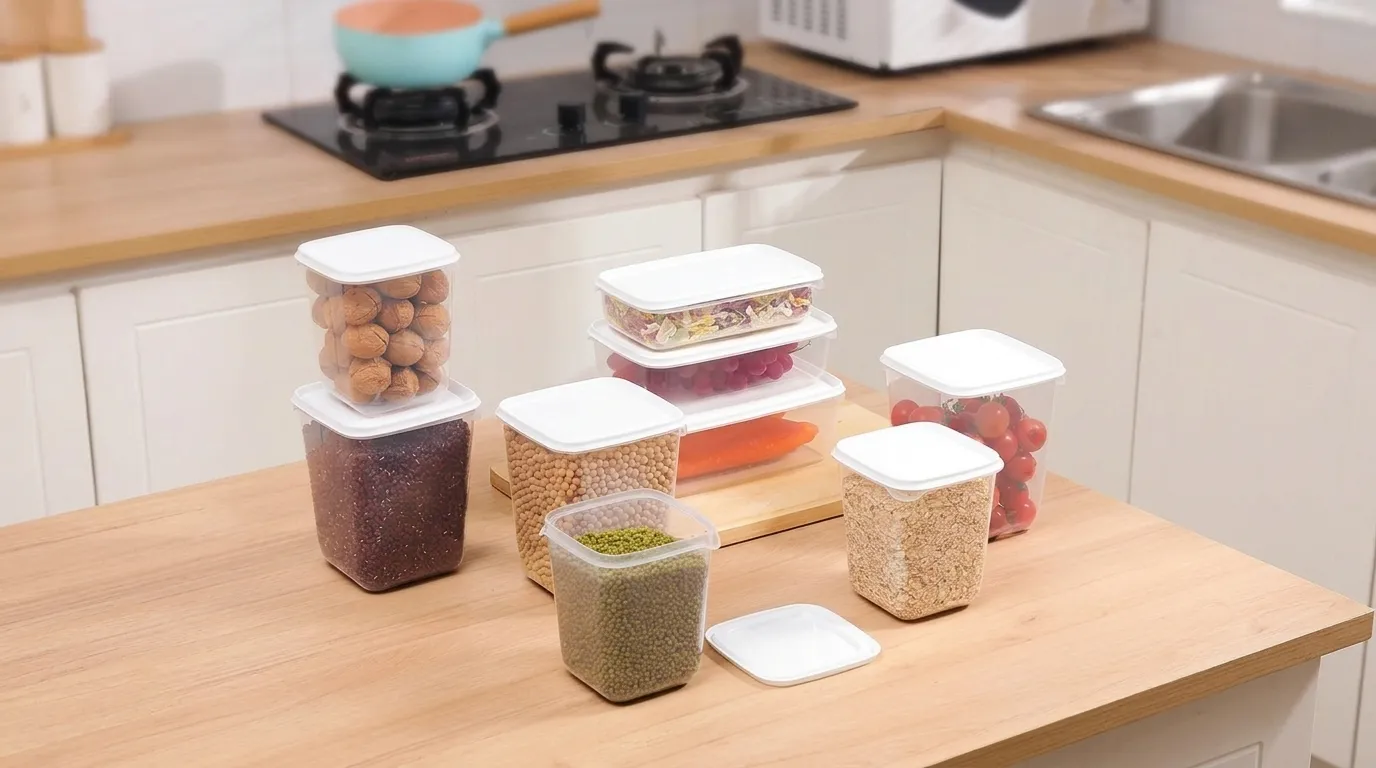
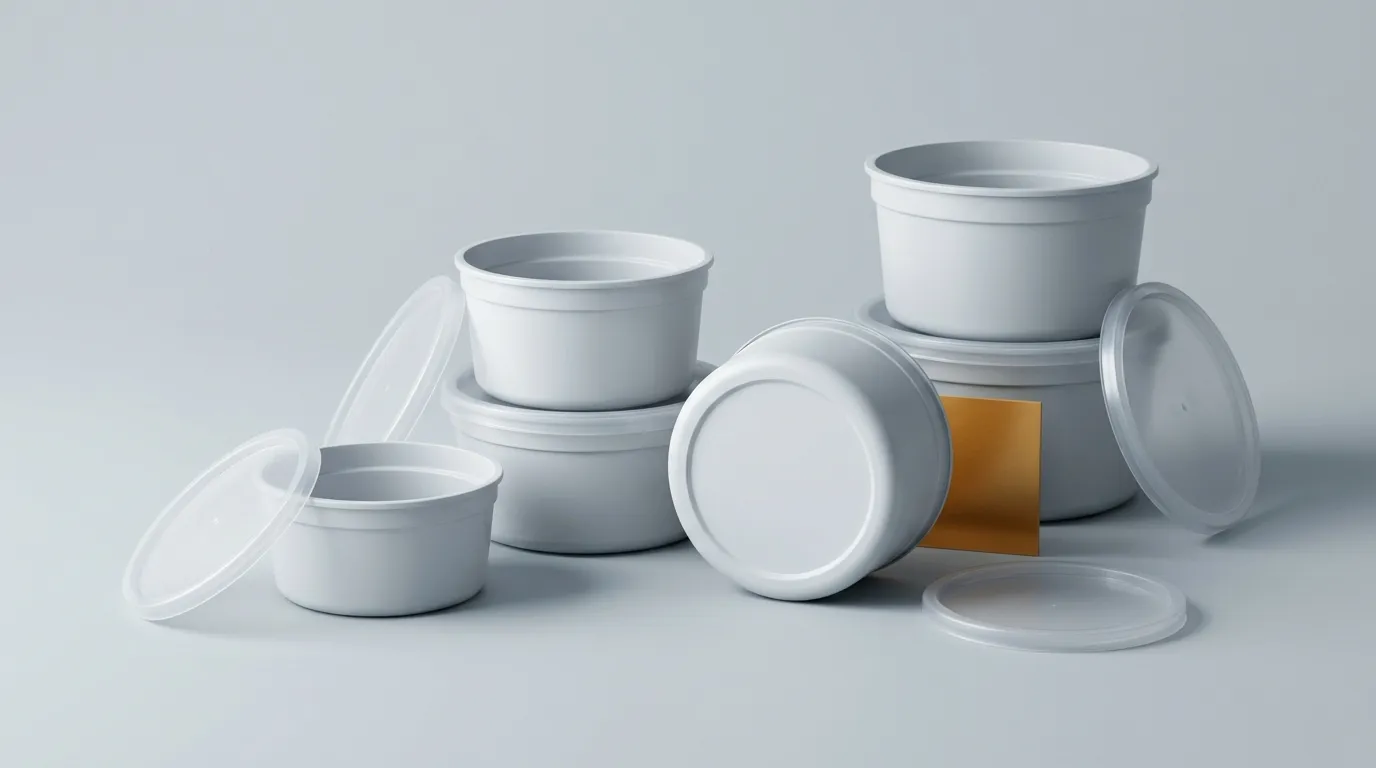
Notice what a canister of this type can and cannot do. With a flat lid that seals by interference rather than by a compressed gasket, two separate things are true, and only one of them is a pressure claim. Dry goods stay crisp for months because water vapor crosses that rim slowly — a transmission-rate result, not a differential one. Against a 95 kPa differential the same closure is unlikely to hold, because there is no clamp force keeping a gasket in compression, so it is the wrong product to promise liquid containment with. One container, one plausible claim, and the other claim simply does not apply.
What Leakproof Actually Measures
Nothing in food-contact regulation defines it. Chapter 21 of the Code of Federal Regulations tells you what the plastic may be made of — 21 CFR 177.1520 covers olefin polymers, which is where polypropylene sits — and says nothing about how a closure should perform. There is no federal leakproof test for a lunch box, and no certificate that makes a container leakproof.
That is not a gap to complain about; it is a gap the buyer fills. A leakproof claim is only as good as the protocol written next to it, and the protocol needs four things before it means anything:
- Fill level. Full to the rim and half full are different tests. A container filled to 80 % of nominal capacity behaves differently from one filled to the shoulder, because the headspace absorbs motion and the liquid surface has less room to travel.
- Orientation. Upright, on its side, inverted, tilted 45°, or shaken. Each one puts liquid against a different part of the seal.
- Duration. Ten seconds of inversion is a demonstration. Twenty-four hours in a bag is a test.
- Temperature. A hot fill that cools pulls a partial vacuum against the gasket and can draw liquid into a channel that was dry at room temperature. A cold container stiffens the gasket and reduces how completely it conforms to the rim.
Add the two mechanical facts that decide most real failures — whether the lid is loaded while it sits there, and whether the liquid is water or something that wets better — and you have a protocol that predicts field behavior instead of describing a bench.
Most factory "leak tests" are a version of the same act: fill, close, invert, watch, wipe, report. That act is a legitimate test. It becomes a specification only when the four conditions above are written down. If the report does not state them, the report describes one afternoon and not a production capability.
The geometry of where these paths open — gasket groove, latch travel, rim flatness — is a subject of its own and is covered in where reusable containers actually leak. The structural choice between gasket, snap-lock and screw closures is covered separately in how seal structures behave under test. Neither of those pages answers the question this one is about: which claim your paperwork has to carry.
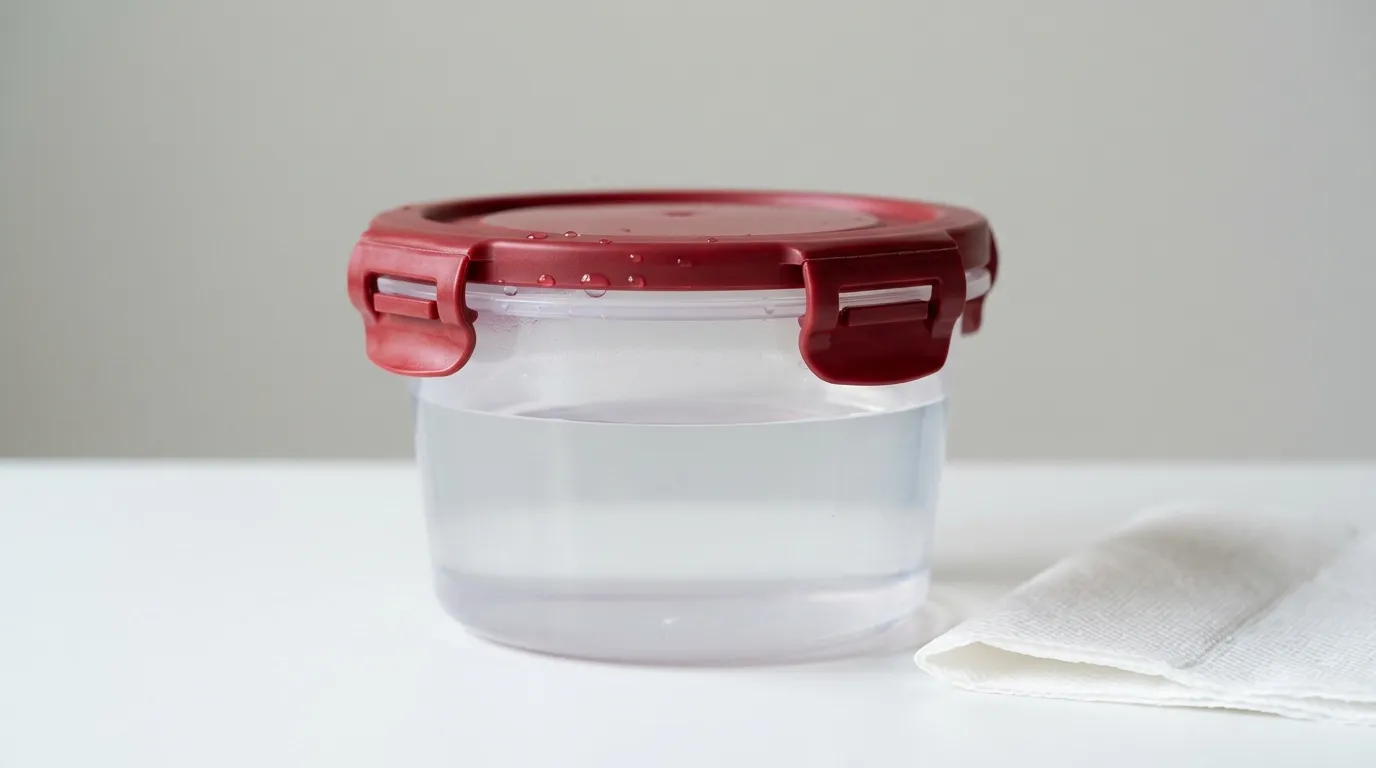
This frame shows the test set up rather than mid-test: a container filled and closed, still standing upright, with an absorbent pad within reach on the bench. The measurement begins when the box is turned over onto that pad and left there for the stated time — with the pad under the lid line, a slow weep shows up as a damp patch long before it becomes a puddle. The variables that change the result are all outside the frame — how full, how long, how warm, and whether the box was standing or lying down.
Five Tests and What Each One Can Prove
Buyers often ask for "a leak test report" and accept whatever arrives. It is worth knowing which of these you are actually being given, because each one answers a narrow question.
Method | Reference | Container it fits | A pass proves | A pass does not prove |
|---|---|---|---|---|
Vacuum method on an empty rigid container | ASTM D4991 | Rigid and semi-rigid containers, closure fitted | The closure holds a differential pressure up to the test limit without leakage commencing | Anything about a filled container, or about liquid under gravity |
Vacuum decay | ASTM F2338-24 | Trays, cups, rigid non-porous packs | No leak above the threshold set from control samples | That the threshold was right, or that the pack survives handling |
Bubble emission | Flexible packaging and pouches | A submerged pack releases no gas stream at the tested pressure | Anything about a rigid container's gasket line | |
Dye penetration | Factory or lab protocol | Any container with an accessible seam | Liquid carrying a tracer reaches a path the eye would miss | The rate, or the behavior under load and temperature |
Water fill and inversion | Buyer-written protocol | Any container | Liquid stays in under the stated fill, orientation, time and temperature | Gas-tightness, or performance outside those four conditions |
Two more methods belong in the same conversation even though they are not leak tests. Distribution testing — ASTM D4169, Standard Practice for Performance Testing of Shipping Containers and Systems — is what tells you whether a container that passed on a bench still passes after a parcel network. And a simple compression check on a filled carton tells you whether the stack in a container is pressing lids open, which is a failure mode no bench test will ever show you.
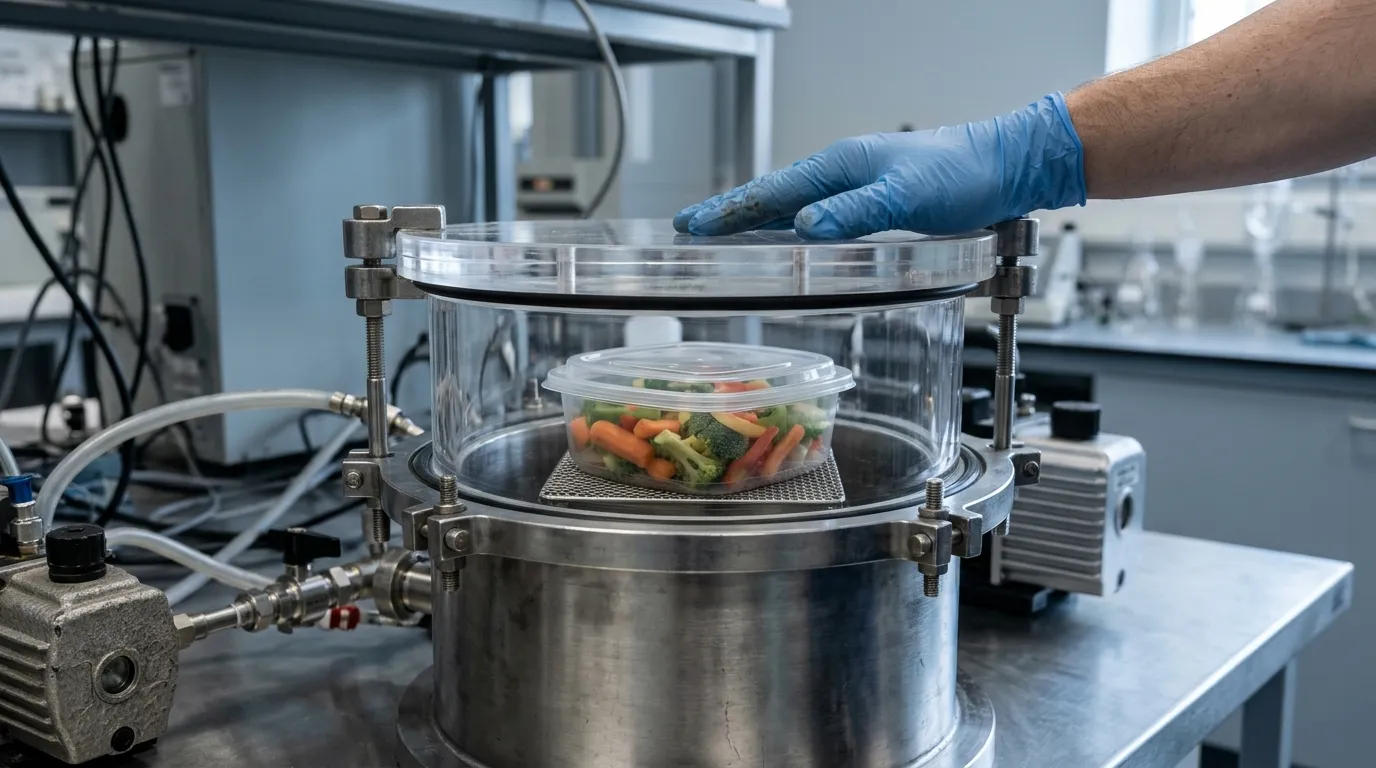
The vacuum chamber is the test most buyers picture when they say "airtight", and it is a good test. It is also the one that is easiest to over-read: it says the closure held a differential for a defined time on that day, with that gasket batch, on an empty container.
Why One Test Cannot Stand In for the Other
This is the part that gets skipped, and it is the part that decides whether your specification is worth the paper.
The loads differ by two orders of magnitude. D4991 works up to roughly 95 kPa of differential. A container lying on its side with 100 mm of soup above the lid line generates about 1 kPa of hydrostatic pressure. That is a ratio near 97:1. Passing the 95 kPa test is genuinely harder in one sense — but it is a different load path, applied to a dry, empty container, in one orientation, for a short dwell. A container that survives a vacuum chamber can still weep through a channel that only opens when the box is on its side and the latch is unloaded.
Orientation is a variable, not a detail. A vacuum test pulls from every surface at once. Real failures are localized: the box tips in a bag, one latch takes the load, the opposite rim lifts a fraction of a millimeter, and liquid finds the gap. Nothing in a chamber reproduces that.
Wetting changes the answer. Water at 20 °C has high surface tension and sits on a surface as a bead. A tomato sauce, a curry or a dressing carries surfactants that lower that tension substantially, so the same channel that resists water will wet and wick. A water-only test can therefore miss exactly the product that generates the returns. If your line packs sauces, test with the sauce — or with water plus a drop of detergent, and say so in the report.
Time and temperature are the amplifier. A ten-second inversion, a thirty-minute inversion and a night in a delivery bag are three different tests. Add a hot fill cooling to room temperature and you have added a pressure cycle the bench never saw. This is the same mechanism that makes microwave and dishwasher claims fail in the field: the container is fine at the moment of the test and marginal at the moment of use.
Headspace decides how big a leak looks. The same physical hole produces a different pressure reading on a 400 ml canister than on a 3-liter box, because the pressure change depends on how much air is inside. A threshold copied from one SKU to another is not a threshold, it is a guess.
Freezer use inverts the problem. In frozen storage, the load case is not liquid escape at all; it is expansion, impact and temperature cycling, which is why freezer claims need their own evidence rather than a stronger version of the leak test.
Put together, those asymmetries give a simple rule: the airtight test protects the dry goods, and the leakproof test protects the carton. Different customer complaints, different return costs, different tests. One number cannot cover both.
Writing Both Claims Into One PO Line
A specification is not a longer sentence; it is a set of fields that a supplier can meet or miss. For closure performance, eight fields do most of the work.
Field | What airtight needs | What leakproof needs | What goes wrong without it |
|---|---|---|---|
Claim | "Airtight" plus the function it serves (moisture, odor, oxidation) | "Leakproof" plus the use case (carried, packed on its side, shipped) | The word becomes marketing and the supplier picks the cheapest interpretation |
Method | A named method, or an explicit factory protocol described in the report | A written protocol, agreed before the sample run | Two reports that cannot be compared |
Load | Differential in kPa, plus dwell time | Fill level as a percentage of nominal capacity | A pass at a load nobody cares about |
Orientation | Not applicable in a chamber test | Upright, side, inverted, shaken — state one | A test that never puts liquid where it leaks |
Temperature | Test temperature and stabilization time | Fill temperature, cooling, storage temperature | Failures that only appear after a hot fill |
Sample | Number of units and how they were drawn | Same, plus which carton or cavity | A single-unit demo passed off as a capability |
Criterion | Maximum pressure decay or "no leakage commenced" | No visible liquid, no mass loss above X g, or a dry absorbent pad | A judgment call at the moment of inspection |
Escalation | What happens on failure: re-test, sort, or reject the lot | Same | A batch that ships "because it was probably fine" |
Two fields are routinely missing and are the easiest to add. The first is the sample draw — which cavity, which shift, which carton. A report that does not say where the units came from cannot be extrapolated to a production lot. The second is the escalation, because a failed leak test with no agreed consequence is a conversation, not a control.
On the material side, the same discipline applies to what the container is made of. Resin codes printed on the base identify the polymer family, and dishwasher claims need their own purchase specification for the same reason closure claims do: the performance is a tested property with conditions attached, not a category the product belongs to.
Which Claim Your Line Actually Needs
Most catalogs put both words on every product. That is a merchandising habit, not an engineering statement, and it costs the buyer money in two directions: over-specifying a dry-goods canister, and under-specifying the one SKU that carries soup.
Line (records on file) | Claim that carries weight | Claim that is decoration | Test to require |
|---|---|---|---|
Lunch box, BX1051, 1.3 L, PP + silicone, 72 pcs per carton as recorded | Leakproof — it travels in a bag | Airtight — useful for odor, not the return driver | Fill to 80 %, invert 30 min at 20 °C, absorbent pad under the lid |
Ramen bowl, BX1069, 1,200 ml, PP + silicone, 60 pcs per carton as recorded | Leakproof — hot liquid, handle carry | Airtight — secondary | Fill with hot liquid, cool to room temperature, then invert |
Stainless bento, 6521, 1,400 ml, PP + silicone + 304 stainless, carton 47 × 31 × 73 cm | Leakproof at the lid; the steel body is not the question | Airtight — secondary, and it is the lid that carries it | Same liquid protocol, plus a check that the gasket seats after 20 open/close cycles |
Round canister set, BX1052 / BX1053, PP + silicone, 48 and 24 pcs per carton as recorded | Airtight — dry goods, pantry storage | Leakproof — there is nothing liquid to leak | Differential-pressure test, or a documented factory vacuum protocol |
Rectangular tall set, 3335-3338, PP | Airtight — flour, grains, cereals | Leakproof — decoration | Same as above, with the flatness of the rim called out |
Grain jar, 3040-3043, PP, packed in OPP bags per record | Airtight | Leakproof — decoration | Same, plus a humidity check if the destination is tropical |
Two notes on reading that table. The packing figures above are the ones carried in the product records, and those records themselves ask for the unit-per-carton basis to be confirmed at quotation — which is exactly the discipline this article is about, applied to the carton instead of the closure. And "decoration" is not a criticism of the product; it is a statement about what the buyer should spend test budget on. A canister that holds grain does not need a 24-hour inversion test, and paying for one does not make the grain fresher.
For buyers assembling a first order, this is the same logic that governs how tall storage containers should be specified and which canister niches justify private labeling: the claim has to match the contents, and the contents decide the test.
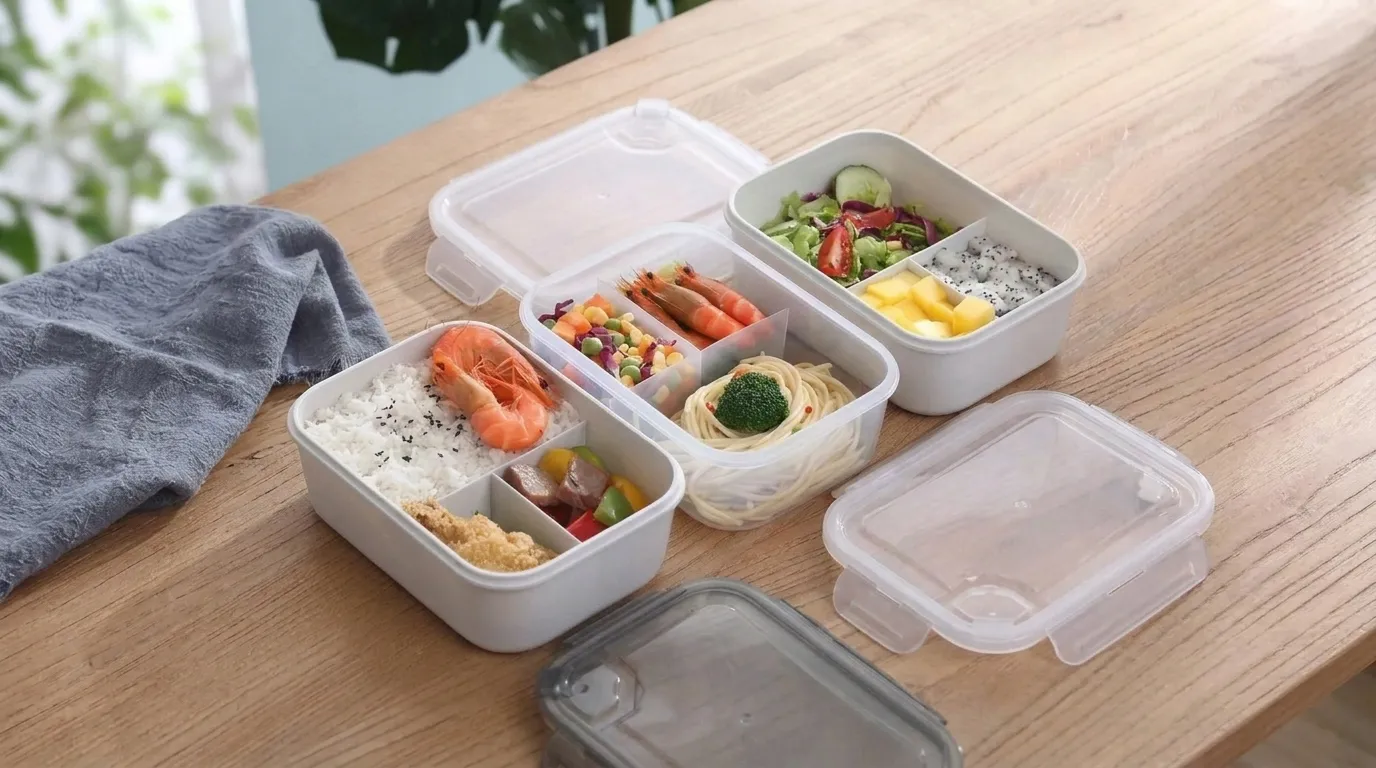
The lunch box row is the one that usually gets under-specified. A three-compartment box with a snap-lock perimeter is sold as a lunch box, packed as a lunch box, and used in a bag — which makes the liquid protocol the claim that matters, and makes any airtight language on the carton a remark rather than a specification.
What a Test Report Has to Say to Be Usable
A report is a document you will be asked to defend, possibly by a retail buyer, possibly in a claim. Six fields decide whether it can carry that weight.
Field | What a usable entry looks like | Reject it if |
|---|---|---|
Identification | Model, cavity, material grade, gasket batch, production date range | It names only "the sample" |
Method | A standard number, or a protocol described in enough detail to repeat | It says "leak tested" |
Conditions | Load, fill level, orientation, temperature, dwell time | Any of the four is missing |
Result | Numbers with units, per unit tested, not a single verdict | It reports "pass" with no measurement |
Threshold and basis | The criterion, and where it came from — standard, customer spec, or control samples | The threshold appeared without a source |
Signatory | Testing party, date, and whether it was in-house or third-party | It is unsigned or undated |
Two structural points are worth more than any single field. First, an in-house report and a third-party report answer different questions: in-house tells you the factory can run the test and knows its own process; third-party tells you an outside party verified a sample. Both are useful; conflating them is not. Second, a photo of a container is not a result. Photos document that a test happened. They do not document what it measured.
The wider document set a food-container buyer should be holding — declarations of compliance, migration test reports, material specifications — is laid out in which compliance documents to request from a factory. Closure performance sits alongside those documents, not inside them: a declaration of compliance will not tell you whether the lid holds soup.
Two Clauses, Before and After
The rewrite is mechanical. Take the sentence, name the test, name the conditions, name the consequence.
Version | Wording | What it pins down |
|---|---|---|
Before | "The container shall be airtight and leakproof." | Nothing. Both words are unmeasured, so both are unenforceable |
After — airtight | "The container shall show no leakage when tested to ASTM D4991 on empty units, at a differential of [value] kPa held for [value] minutes. The test report shall state the differential, dwell time, number of units and cavity. Failure of more than [value] of [value] units shall trigger 100 % sorting of the lot before shipment." | The method, the load, the evidence, and what happens when it fails |
After — leakproof | "The container shall show no liquid escape when filled to [value] % of nominal capacity with [water at 20 ± 2 °C / the product], closed, and held inverted for [value] minutes at [value] °C. An absorbent pad shall be placed under the lid line for the duration. Any visible liquid on the pad shall constitute failure." | The four conditions that make a liquid test repeatable, plus the criterion |
The numbers in brackets are placeholders by design. They are commercial decisions — how much risk the buyer is willing to carry against how much the factory will charge to hold a tighter threshold — and they belong in the negotiation, not in a blog post. What is not negotiable is that each bracket gets filled before the sample is approved, because a bracket left empty is the sentence you started with.
If You Are Looking for the Best Airtight Container, Ask This Instead
Buyers arrive at this subject from a search phrase like best airtight container, and the results they get are shopping lists: brand roundups, lab-tested rankings, forum threads about which pantry jar keeps crackers crisp. Those lists answer a real question — which jar to buy for a kitchen — and they are useless for someone placing a wholesale order, because "best" is not a property a factory can hold a tolerance on.
The buyer's version of the same question is a ranking of claims:
- What is inside the container? Dry goods need an airtight claim. Liquids need a leakproof claim. Frozen goods need neither as the primary claim; they need temperature and impact evidence.
- What does the container do between the factory and the customer? If it ships in a carton on a pallet, the claim has to survive distribution, not just a bench.
- What will the customer do with it that you did not plan for? A lunch box goes in a bag. A canister gets filled to the rim. A freezer box gets dropped.
- Which of those behaviors generates the return? That is the claim to test, and the other claim is a line on the box.
Ranking that way usually produces one tested claim per SKU and one sentence of copy that matches it — which is cheaper than testing everything, and more defensible than testing nothing. Distributors reading sell-through after the first container tend to arrive at the same conclusion from the other direction, which is why reorder decisions based on what actually sold so often turn into specification changes on the second order.
Check It Yourself Before the Carton Ships
A buyer does not need a laboratory to catch the majority of closure problems. A week and a bench will do.
- Draw the sample from the run, not from the sample room. Twelve units, from at least two cavities if the tool has more than one, and from the carton that will actually ship.
- Run the liquid protocol at both temperatures. Fill to 80 %, close as a customer would, invert on an absorbent pad for 30 minutes at room temperature. Repeat with a hot fill, let it cool, then invert. Record what the pad shows, and photograph it.
- Run the differential test on empty units if the airtight claim matters, or ask for the factory's protocol to be run in front of you on the same draw.
- Load the lid. Stack four filled cartons on one unit for 24 hours and re-run the liquid check. Stack load is the cheapest simulation of a container at sea that exists.
- Keep the approved unit. The unit that passed becomes the reference against which later production is compared — the same principle that makes a golden sample the anchor for mass production rather than a formality.
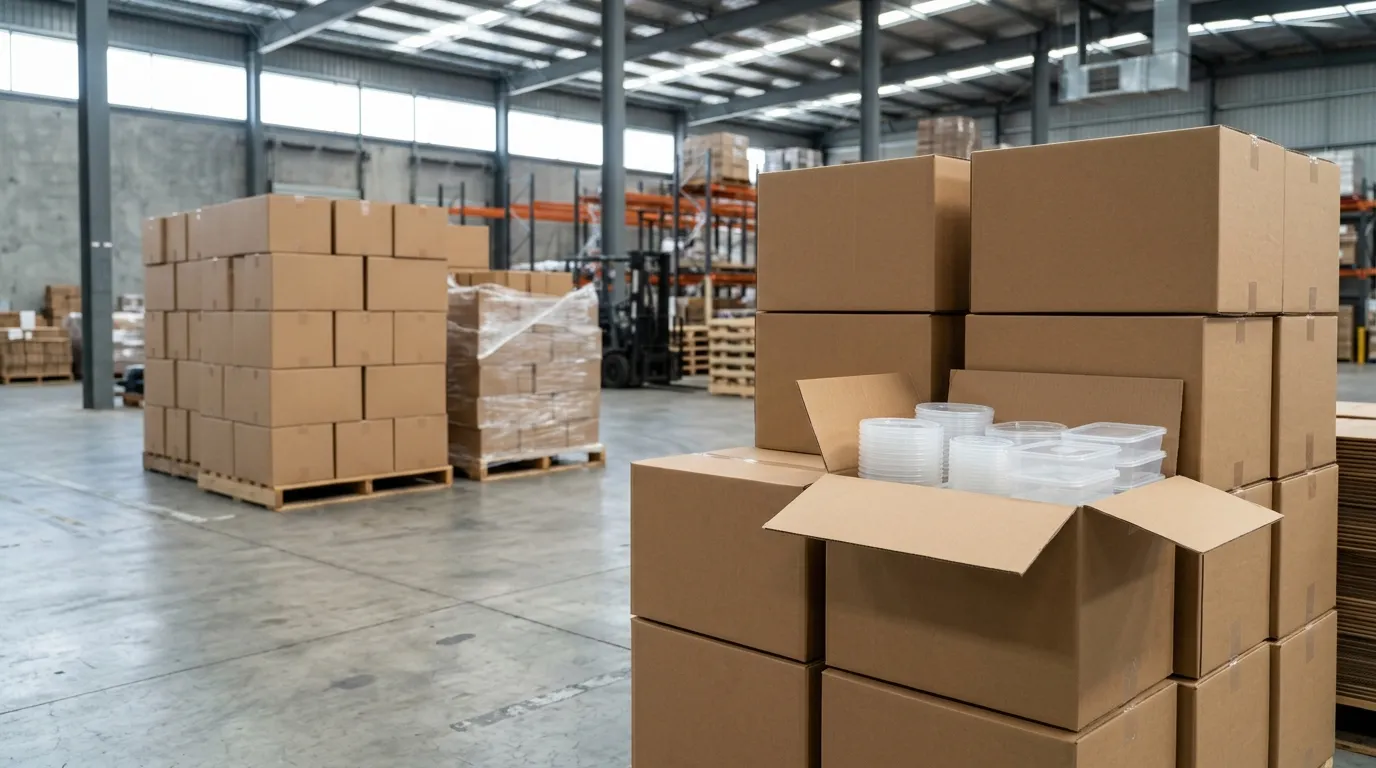
Everything in this photograph is a load case. Cartons compress, pallets shift, and a container that passed an upright bench test spends six weeks with something heavy resting on its lid. The claim has to survive the carton, not the bench.
What You Can Print on the Box
The last decision is the copy, and it is a compliance decision as much as a marketing one. Three rules keep it defensible:
- Print only the claim you tested. A vacuum test supports an airtight statement. It does not support "leakproof", however similar the two sound in a meeting.
- Keep the conditions available. If a retail buyer or a marketplace asks what "leakproof" means on your pack, the answer is the protocol, and it should exist in writing before the artwork is approved.
- Let the market decide the wording. Different destinations treat on-pack performance claims differently, and a claim that is unremarkable in one market can attract questions in another. Check which market you are printing for before the artwork is approved, not after.
None of that is legal advice, and none of it requires a certificate. It requires that the sentence on the box and the sentence in the report describe the same test.
The Line to Write Next
Airtight and leakproof are worth separating because they cost different amounts to prove and they fail in front of different people: airtight fails quietly, in a pantry, months later; leakproof fails loudly, in a bag, on the way to work. A specification that names one test for both claims has quietly chosen which failure it is willing to have.
If you are building that specification now, the useful next step is to write the two clauses for your own SKU list and send them with the inquiry, rather than after the sample. A factory that can answer them in writing — method, conditions, threshold, sample — is telling you something about its process before you have spent anything. A collection of round canisters, lunch boxes and rectangular sets with the carton data already recorded can be quoted against a closure specification; the ranges, the models and the packing details are on the wholesale food storage container range page.
Continue reading
Related sourcing guidance
More practical context for your food storage container sourcing conversation.

Discuss your product range
Need help selecting or customising containers?
Share the product type, market and sourcing requirements with the Xinghui team.