
Compliance & Food Safety
Square Plastic Containers vs Round: The Shelf-Facing and Carton-Fill Math That Decides Which Shape Your Freight Bill Prefers
The circle-in-square penalty looks like 27%. On a 48-inch shelf it is 14%, in a 610 mm carton 33% and in a 682 mm carton nothing. Here is the arithmetic.
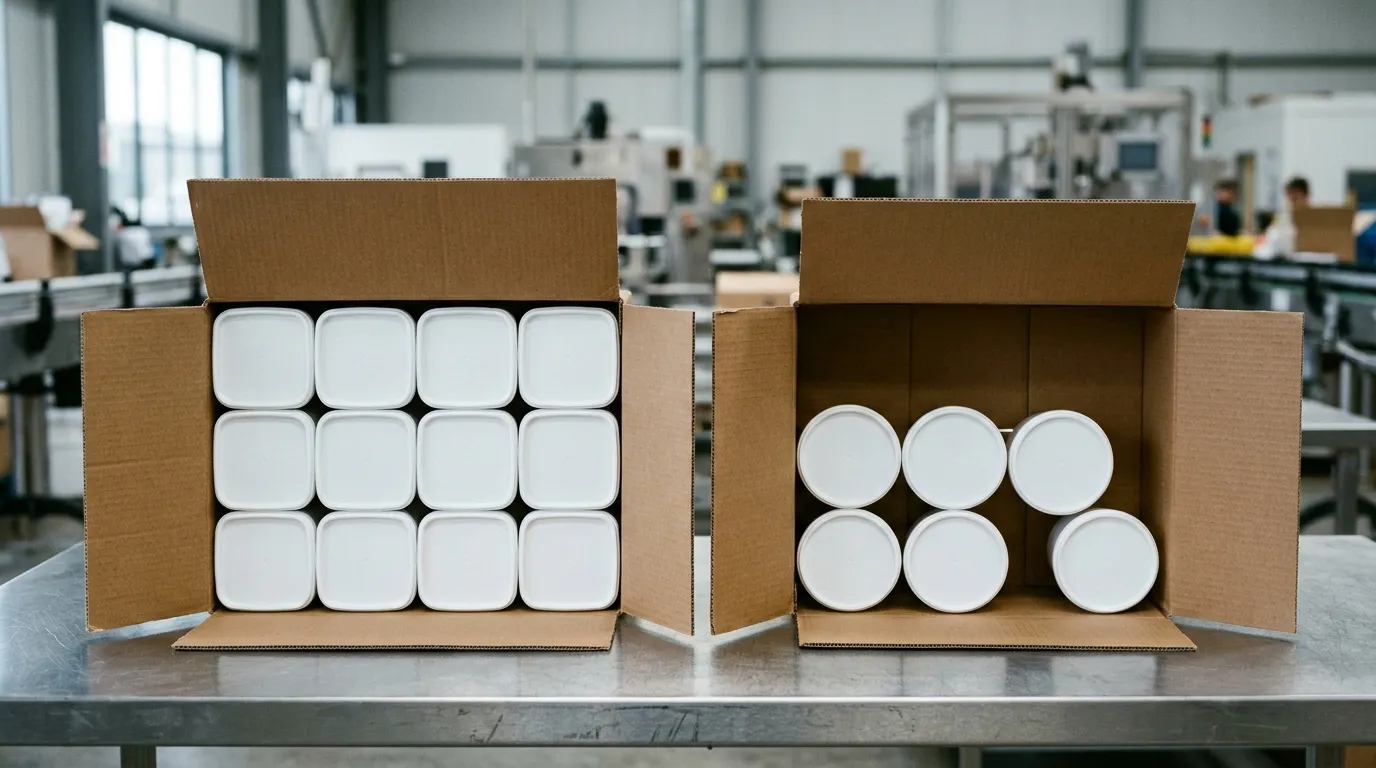
Take two 1,000 ml food tubs with the same capacity, the same polypropylene and the same lid. Give one a square footprint and the other a round one: the choice stops being aesthetic the moment they reach a shelf, a carton and a freight invoice. A square plastic container returns 14% more units across a 48-inch shelf section and 33% more inside a 610 by 400 mm export carton. Put both in a 682 mm carton and the advantage drops to zero. Same two containers, three answers — and the variable that moves is not the shape but where the integer steps of the layout land.
This page runs that arithmetic with dimensions you can substitute. We mold thin-wall PP food containers at the Xinghui plant in Jieyang, Guangdong, so the numbers come from the same place our quotes do: a carton table, a pallet pattern and a stowage factor.
The Number Everyone Quotes Is the One That Matters Least
A circle inscribed in a square covers 78.5% of it. That ratio, π ÷ 4, is what every article on this subject leads with, and Inline Plastics states it plainly: whatever the arrangement, circles leave gaps. Flip it and you get the marketing version — a square holds up to 25% more in the same footprint.
Both statements are true, and neither predicts a unit count, because units are integers and areas are not. A 21.5% area penalty only reaches a purchase order if the layout divides badly enough to drop a whole column. Sometimes it does; sometimes it vanishes. Three measurements survive contact with a carton: facings (units at the front of a fixed shelf run), units per carton, and cubic meters per unit (what the forwarder invoices). None is a percentage of anything. Each is a floor division, and floor divisions have cliffs.
A footprint ratio tells you how much air is in a bounding box. A floor division tells you how much air you pay to ship. They agree only by coincidence.
Equal Capacity Means a Bigger Diameter, and That Is the Real Penalty
The round vs square container comparison only works if both hold the same amount, which is where the second-order effect hides.
A round tub that holds what a 150 mm square plastic container holds needs a bigger diameter. Equal area means the diameter is 150 ÷ 0.886, or 169 mm — 12.8% wider. In envelope terms the two are identical: 150 × 150 × 62 mm gives 1.395 liters of outside volume for about a liter of capacity; Ø169 × 62 mm gives 1.391. Capacity parity costs the round container 19 mm of width.
Two framings follow, and buyers mix them up constantly:
- Same footprint (square 150 mm vs round Ø150 mm): the square carries 27% more product per layer. This is the π ÷ 4 ratio, and it is the honest number when your shelf cannot get wider.
- Same capacity (square 150 mm vs round Ø169 mm): the square carries 33% more units in the carton layouts below — more than the area ratio, because the wider diameter loses a column as well as the corner triangles.
The gap between 27% and 33% is not measurement error. It is the integer step, and it is worth more than the geometry it rides on. It is also why the shape decision belongs next to the real cost build-up of the molded part, not in a design review on its own.
A competent round layout is not stuck at 78.5%, either: offset rows lift a circle field to 90.7% of the plane, which is why nobody packs drums in a straight grid. But offset packing needs a free boundary, and a carton wall, a shelf divider and a pallet edge are not free boundaries. Inside a rigid rectangle you get the grid, or a row count that shifts with every change of depth.
Shelf-Facing Math: What 48 Inches Actually Returns
Shelf facing is what a planogram counts: one unit wide at the shelf edge. A US grocery gondola section runs about 48 inches — 1,219 mm — with shelf depths commonly between 18 and 24 inches. Take a 508 mm (20 in) shelf, front both containers, and count:
Container | Footprint | Across 1,219 mm | Rows on 508 mm | Units per section | Facings | Capacity per section |
|---|---|---|---|---|---|---|
Square | 150 × 150 mm | 8 | 3 | 24 | 8 | 24.0 L |
Round, equal capacity | Ø169 mm | 7 | 3 | 21 | 7 | 21.0 L |
Round, equal footprint | Ø150 mm | 8 | 3 | 24 | 8 | 18.8 L |
The square section returns 24 units against 21 — +14.3%, not 25%. The 27% figure matches the last row instead: 24 rounds of Ø150 hold 18.8 liters where 24 squares hold 24 — which is where the looser 25% shorthand comes from.
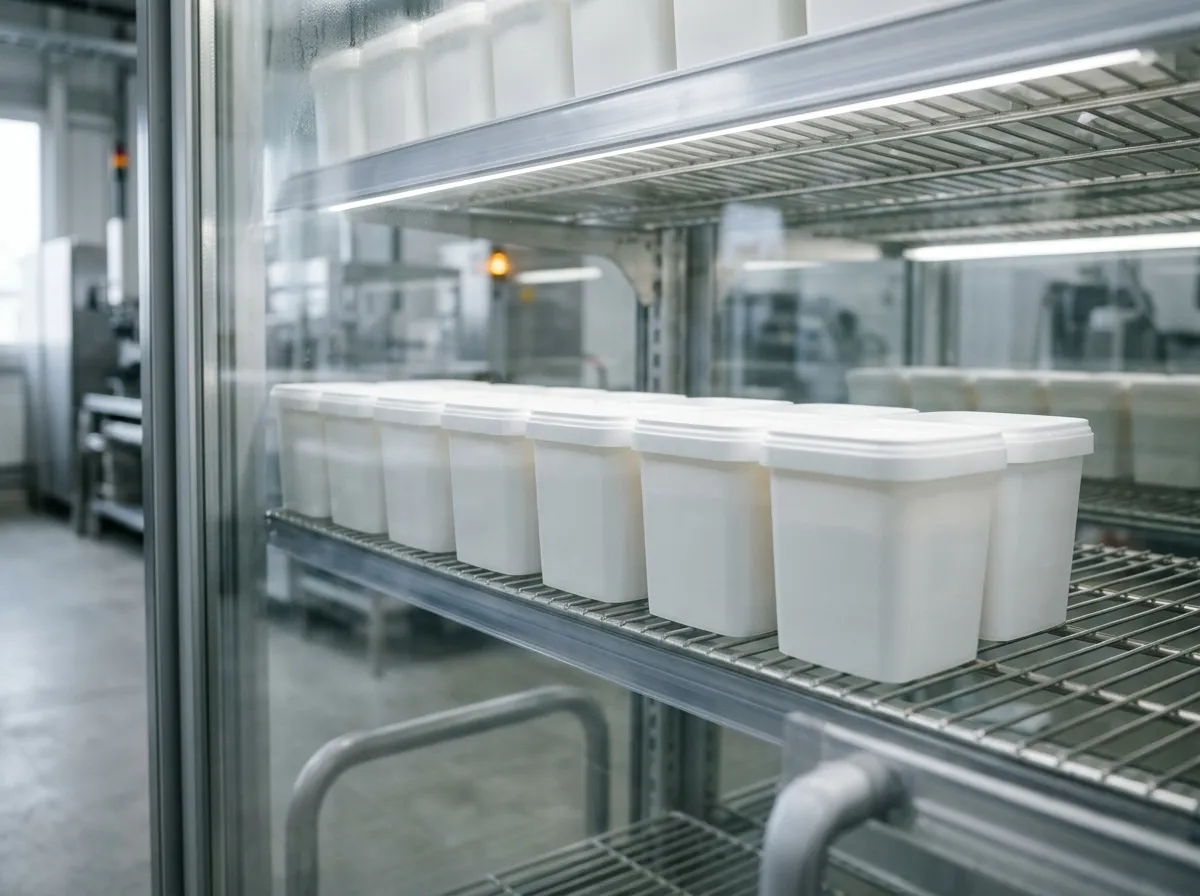
Two details matter more than the headline. First, the depth is nearly fully used by both: 3 × 150 = 450 mm of 508 for the square, 3 × 169 = 507 mm for the round — a one-millimetre fit that a 169.4 mm OD would break; 520–530 mm is the depth that makes three round rows reliable. A fourth row fits in neither. Second, retail does not planogram in 48-inch runs; it plans in modules, usually 600 mm or 1,200 mm. On a 600 mm module four 150 mm tubs front exactly 600 mm and three Ø169 front 507 — the same one-column cliff you are about to meet in the carton, worth +33%. A shelf has no walls, so this is nominal. If a retailer asks for a shelf-efficiency number, the module is what they will check, and the retail packaging spec is where module width gets agreed.
One caveat keeps this honest: facings are a merchandising argument, not a product argument. A buyer already selling a round soup tub will not switch because a square fronts one more unit. They switch when the freight line moves enough to pay for new tooling and new artwork.
Carton Fill Rate: Four Columns or Three in a 610 mm Carton
Carton fill rate is the share of a carton's internal volume occupied by the packed containers. It decides whether you ship product or air, and it is computed per carton.
Use a common export carton: 610 × 400 × 390 mm internal, 0.0952 m³ — 610, not 600: 4 × 150 leaves nothing for the poly bag and the loading tolerance. Both containers are 62 mm high overall, so six layers stack with 18 mm of headroom.
Container | Across 610 mm | Rows on 400 mm | Layers | Units per carton | Container volume | Carton fill rate | Cube per unit | Cartons per 10,000 |
|---|---|---|---|---|---|---|---|---|
Square 150 mm | 4 | 2 | 6 | 48 | 67.0 L | 70.4% | 1.98 L | 209 (19.9 m³) |
Round Ø169 mm | 3 | 2 | 6 | 36 | 50.1 L | 52.6% | 2.64 L | 278 (26.5 m³) |
Everything except the column count is identical: same rows, same layers, same carton. The whole 33% comes from 604 ÷ 150 = 4.03 against 604 ÷ 169 = 3.57, both floored. The square's fourth column uses 600 of the 604 mm available; the round's fourth needs 676 mm and is 72 mm short. Give the carton 6 mm a side and it reads 36 against 36 — the fourth column has 4 mm of slack.
Read the fill rates against two outside benchmarks. Best-in-class carton fill sits at 75–85% — above that, picking and unboxing get harder. The square lands at 70.4%, normal for rigid containers. The round lands at 52.6%, which is close to a limit: the EU packaging regulation caps the empty-space ratio at 50% for transport and e-commerce packaging from 1 January 2030 or three years after its implementing acts, whichever is later, and the round carton is already 47.4% empty. A carton 33 mm wider — 643 mm internal, 50.09% empty — crosses the line; on depth it takes 22 mm.
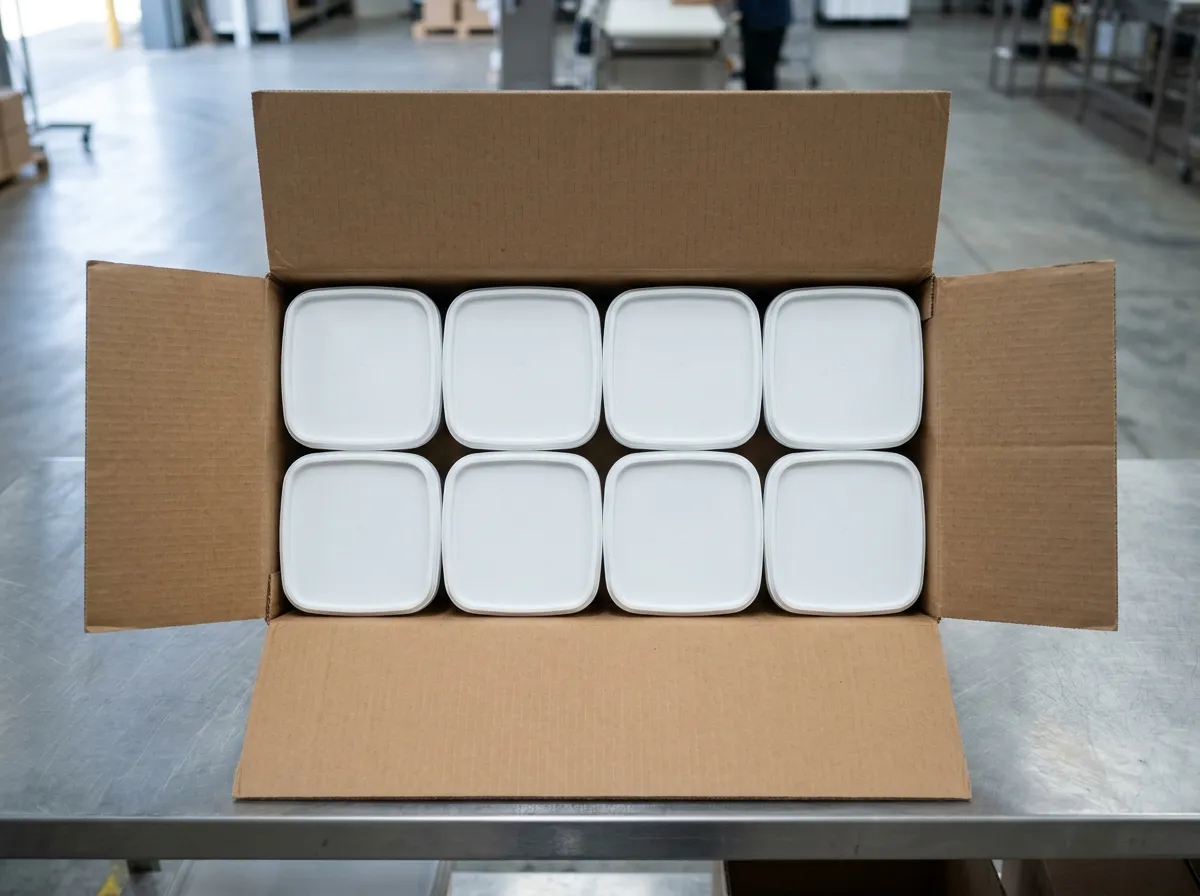
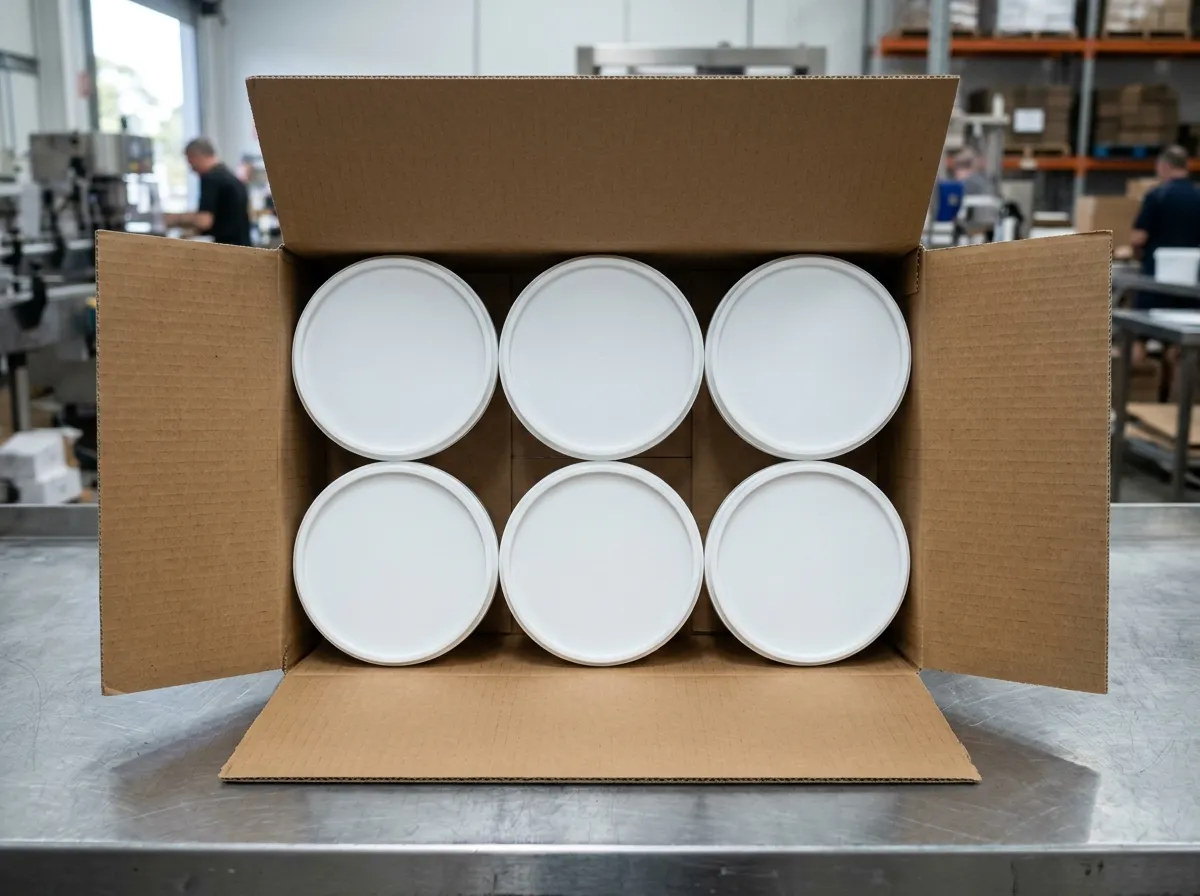
These figures exclude lids packed separately, dividers and poly bags — the frames above are bare cartons. Those change the constants, not the method. The mixing effect is separate: a truck carrying two shapes loads badly in both directions, which is the argument in mixed-container loading, and a new case pack is usually what forces new shipping marks.
The Carton Width Decides, Not the Shape
If the 610 mm carton is the villain, widening it should fix the problem. It does — abruptly. Same depth, same height, same containers, the same 3 mm a side, varying only internal width:
Carton width (internal) | Square units | Round units | Square advantage |
|---|---|---|---|
600 mm | 36 | 36 | 0% |
610 mm | 48 | 36 | +33% |
640 mm | 48 | 36 | +33% |
660 mm | 48 | 36 | +33% |
676 mm | 48 | 36 | +33% |
682 mm | 48 | 48 | 0% |
720 mm | 48 | 48 | 0% |
760 mm | 60 | 48 | +25% |
The step sits at 682 mm, not 676: four Ø169 need 676 plus 3 mm a side. Below it the round container pays a third of the carton; at or above it the shapes are equivalent in units and, since capacities match, in product. At 682 mm the square simply stops winning and carries 76 mm of dead width.
A rule short enough for a sourcing email: keep the carton width a few centimetres above an integer multiple of the round diameter, plus 3 mm a side. If your case pack is 610 mm because four 150 mm tubs define it, you buy the 33% column by default. Widening from 610 to the 682 mm that adds the fourth round column costs nothing on the pallet: the 1,200 × 800 four-up is the 600 mm carton's asset (two 610 mm cartons measure 1,220 mm), and both widths lay three per layer. Cartons cost less than containers, so the Incoterm you quote under only decides who pays for the carton.
What One Column Costs in Freight
Square container shipping is where the arithmetic turns into money.
- Per 10,000 units: 209 cartons and 19.9 m³ for square, 278 cartons and 26.5 m³ for round.
- Per 30,000 units: 59.5 m³ against 79.4 m³. A 40-foot high cube holds about 76 m³, roughly 70 m³ usable after stowage losses — so the same order fits one container in square and needs a second in round.
- Units per container: about 35,300 square against 26,500 round at 70 m³ usable.
- At a stated $2,900 per 40'HC from South China to the US West Coast: $0.082 against $0.109 per unit at full-container rates — $0.027 per unit. On the 30,000-unit order the square ships in one container and the round in two: $2,900 against $5,800 — a $2,900 difference, or about $0.097 a unit.
That number is worth an argument in a meeting, and survives a change of forwarder: at any rate per cubic metre the round pack pays 33% more.
Two mechanics amplify it. On LCL, freight bills on whichever is greater, weight or volume — and a 42 g tub in a 0.0952 m³ carton is nowhere near weight-limited, so cube bills. On parcel, dimensional weight does the same with a different divisor: the carton's billed weight is set by its dimensions, not the two kilograms of tubs inside it. Both routes read the carton's outside dimensions, which is why bulk tall-container programs that look expensive per unit often quote cheaper landed than a smaller pack that cubes out.
The Material Side: Six Percent, Not Thirty
Set the freight delta next to the material delta and the asymmetry shows.
A square cavity does not fill as evenly as a round one. Corners concentrate stress: they sit farthest from the gate, pack last and warp first, and they need a minimum section the flat walls do not. Packaging Digest puts the blow-molded figure at about 8% more material and 18% less space for a square bottle. For thin-wall injection molding our planning figure is lower, around 6% on shot weight: a 42 g tub-and-lid set becomes roughly 44.5 g. At $1.35/kg for food-grade PP, 2.5 g is $0.0034 per unit — against a $0.027 freight difference. Eight times larger, in the other direction.
If a supplier tells you square containers cost more to make, they are right, and the amount is an order of magnitude below the freight it saves.
Tooling is the one place the comparison can flip, and only at low volume. A square cavity needs corner radii designed for draw, more polishing on four flats, and often a slightly longer cycle because corners cool last — call it 10% on an $18,000 cavity, or $1,800. Over 100,000 units that is $0.018 each, two-thirds of the freight gain; over 500,000 it is $0.0036 and irrelevant. The same logic runs through the wall thickness and grammage decisions that set the unit's weight, and through the mold design review where corner radii, gate position and the weld line on a logo get fixed.
Where the Round Container Still Wins
The arithmetic above makes square look settled. It is not, and the cases where round wins are specific enough to name.
The seal. A circular sealing land has constant curvature, so a gasket compresses by the same amount along its whole path. A square land has four 90° turns where the gasket must change direction; without a generous corner radius the gasket bunches at the turn and seal thickness varies exactly where drop loads concentrate. Leaks in square containers start at a corner. This is the distinction that separates airtight from leakproof, and what a seal structure test is designed to catch.
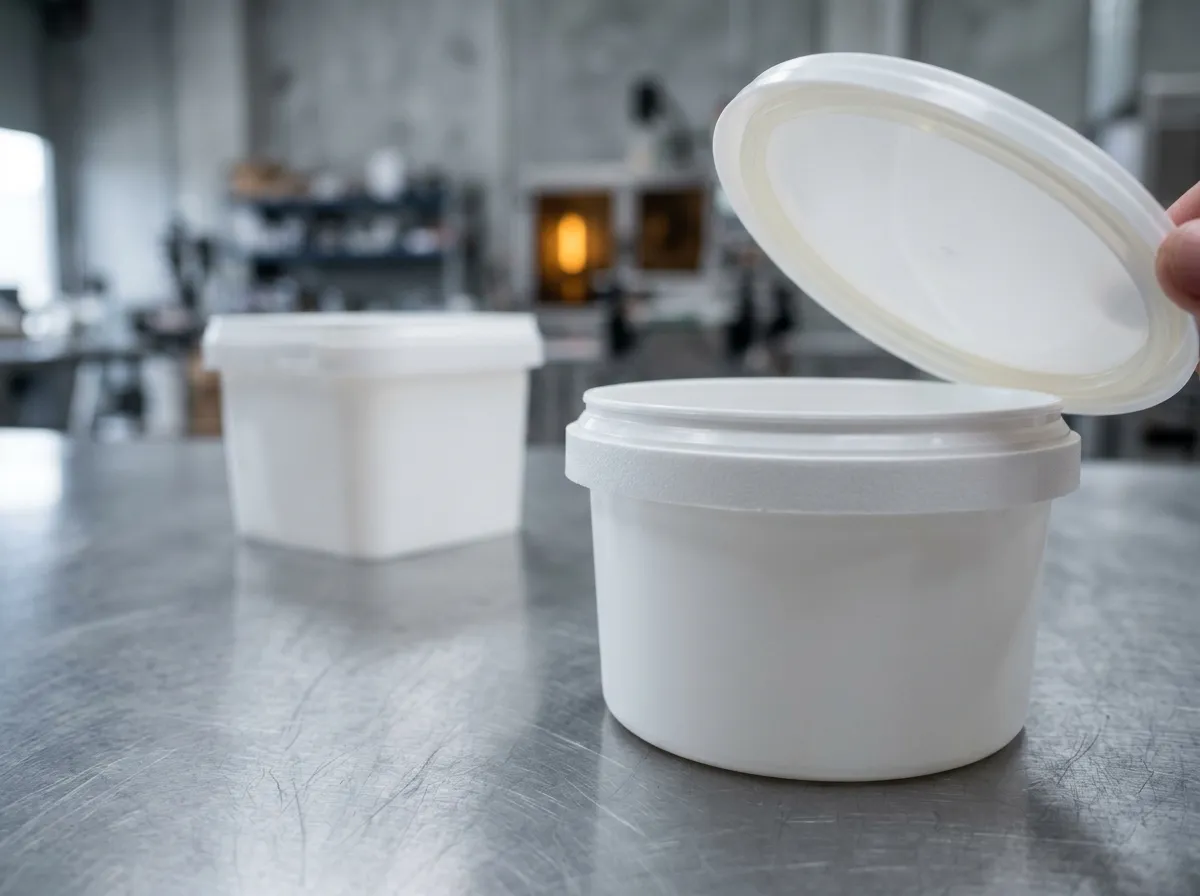
Wall uniformity. A round part has one draw ratio; a square part has one at the flats and another at the diagonals. The corner needs a thicker section to fill and survive ejection, which is where the 6% comes from — and on a clear part, where you see it.
Cleaning. Corners retain food and take brush work. For foodservice buyers answering a HACCP question, a round tub is easier to defend, and the difference shows in a wash-cycle audit rather than a spec sheet.
Service. Soup, stew, deli salad, yogurt, grain bowls: the container is the vessel you eat from. A spoon works in a circle and scrapes a corner badly. Round is also what the category looks like — consumer expectation, which no arithmetic overrides — and a square soup tub reads as catering.
Hot fill and vacuum. A round body resists internal vacuum by hoop compression. A square panel pulls in, which is why square containers in vacuum or hot-fill duty end up ribbed — and ribs take back capacity the footprint just won.
One line-efficiency point is separate: round lids need no orientation, so a capping head cannot seat one 90° off; square lids seat at four orientations and all of them look correct.
The Test and Compliance Layer the Shape Moves
Shape does not change which resin you need, but it changes what you test and, at the margin, what you document.
Distribution testing. A loaded carton is tested to a distribution cycle — ASTM D4169 for a general sequence, or an ISTA protocol for parcel. A square carton lands on a corner; a round one tends to rotate onto its edge. That is why square case packs more often need corner protectors or dividers, and why the pass margin between two cartons of the same board grade is not symmetric.
Food contact. Both shapes sit under the same clause. For polypropylene in the US that is 21 CFR 177.1520; the corner's thicker section is still a food-contact surface inside the same declaration. Geometry creates no new regulatory route, but a thicker corner is a different section if anyone asks for a per-part breakdown — the ground the five-market compliance map covers.
Packaging law. The EU packaging and packaging waste regulation writes a 50% maximum empty-space ratio into the obligations for grouped, transport and e-commerce packaging. At 47.4% empty, the round carton in the table above has 2.6 points of margin; the square has 20.4. That is the first point where a shape choice carries a compliance number rather than a cost one.
Run It on Your Own Spec in Twenty Minutes
Every figure here is reproducible with a calculator and four dimensions.
- Fix the capacity, not the size. One liter brimful, lid on.
- Get both footprints. Square side as designed; round diameter = side ÷ 0.886.
- Get the carton's internal dimensions in millimeters — not outside dimensions, not the "standard box" description.
- Floor-divide each axis separately. Across, then rows, then layers. Never divide volumes, never use bounding-box area: a carton of the right volume with the wrong proportions holds nothing.
- Multiply and convert. Units per carton → cartons per 1,000 → cubic meters per 1,000 → dollars per unit at your own rate.
- Repeat at your real carton widths, not the width you wish you had. The answer changes at each multiple.
Two errors account for most of the bad arithmetic in RFQs. The first is using outside carton dimensions, which overstates capacity by 8–10 mm per axis and can turn a 3-column layout into a 4-column one on paper. The second is assuming clearance: allow 3–5 mm per side for the poly bag and loading tolerance, because a cell that fits at zero clearance on a drawing does not fit at 6 a.m. on a packing line — which is why the carton above is 610 mm. Pre-shipment inspection is where a carton table gets checked against reality, and the same arithmetic is why PP and PS programs quote differently despite identical geometry, once wall thickness and drop performance join the loop.
The Decision Rule
Choose a square plastic container when the carton and shelf module you are locked into sit a few centimetres above an integer multiple of the round diameter: that is where the 33% is free and the material and tooling penalty is an eighth of the freight it saves. Choose round when the container is the vessel the product is served from, when the seal must hold under drop, or when the product is hot-filled or vacuum-packed — and accept a higher freight bill unless you buy the carton width to match.
If you are choosing between the two for a 1,000 ml private-label program, send the capacity, the carton you can buy and the module you have to fit to the Xinghui team, and we will send back both layouts with unit counts and cube — we mold both shapes in Jieyang, so it is cheaper to run before the cavity is cut. The private-label food container program is where the pack format gets fixed.
Continue reading
Related sourcing guidance
More practical context for your food storage container sourcing conversation.
Discuss your product range
Need help selecting or customising containers?
Share the product type, market and sourcing requirements with the Xinghui team.