
Sourcing & OEM
Mold in Plastic Containers: Why It Grows at the Seal, and the Gasket and Drainage Details to Specify Against It
Mold in plastic containers grows at the seal, not in the plastic. Why the gasket groove keeps water, which gasket to specify, and the drainage details to list.
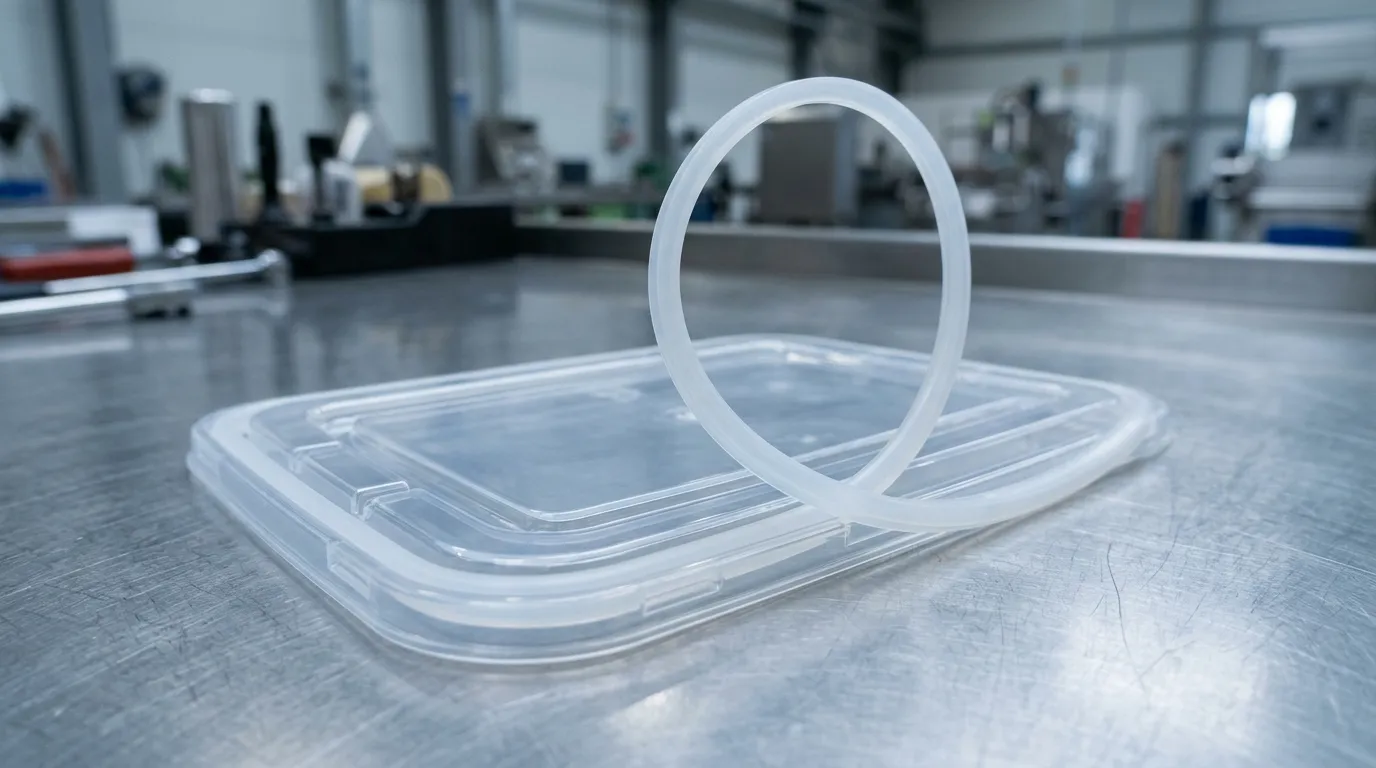
A container that has gone moldy at the seal is usually still a sound container. The body is intact, the latch still closes, the lid still holds water. What has failed is a channel a few millimetres deep that nobody wrote a specification for: the groove the lid gasket sits in.
That is why the complaint arrives late and reads the same way every time. Not "it leaks" — a leak is caught in the first week and costs a replacement. It is "there is a black line under the rubber and it comes back after washing", reported in month four by a customer who has already stopped trusting the product. By then the container is out of warranty, the review is public, and the fix is a tooling change rather than a spec change.
A lid gasket is a second part, in a second material, dropped into a groove cut to a third tolerance. This page is about the two decisions that decide whether that assembly stays clean — what the gasket is made of and what shape the channel around it is — and how to put both of them in writing so the factory cannot default them for you.
What Mold at the Seal Actually Is — and Where It Is Not
Mold does not eat polypropylene. It needs moisture, a nutrient film and time, and the plastic body supplies none of the three on its own. The nutrient film comes from food: starch, fat, protein, the thin residue that survives a rinse. The moisture comes from washing, from condensation, and from the food itself. The time is whatever sits between two washes. That list of three is our own rule of thumb rather than a quotation, but the part of it that matters is not controversial: the US EPA's guidance on mold states the controlling condition in one line — "The key to mold control is moisture control." Hold a surface damp and the nutrient film and the time take care of themselves.
Mold in plastic containers is a moisture question before it is a material question. Search for the problem and every result is about cleaning the plastic. That answers the wrong question. The plastic is the one part of the assembly that dries in minutes. The gasket and the groove are the parts that do not.
Two things happen in that groove that do not happen anywhere else on the container.
The first is that the gap between gasket and groove wall is small enough to hold water by capillary action. A container turned upside down on a rack will shed everything except what is inside that gap. The second is that the gap is closed on three sides. Air does not move through it, light does not reach it, and the residue that collects there is not exposed to the shear of a dish brush unless the gasket comes out.
This is the same meeting point that decides whether a container leaks — the place where the gasket, the groove and the rim's flatness have to agree, which is what makes the lid the part that fails first. Leaking and going moldy are two failure modes of one geometry. A groove that is too tight to release the gasket is usually also the groove that holds the water.
Why the Seal Is the Only Part of the Container That Stays Wet
Walk the life of one container through a week and count the moments the seal is wet but nothing is being cleaned.
After hand washing, the lid goes on a rack. Water sheets off the flat surfaces in seconds. The groove keeps a film, and if the gasket is seated, it keeps it under the gasket as well. The lid is then stacked on the container while still damp, because that is how a kitchen works, and the groove is now enclosed on the fourth side too. Dry time goes from minutes to hours, or to never.
In a microwave, the mechanism is worse. Steam generated by the food pressurises the headspace and pushes vapour past the gasket; when the container comes out and cools, the headspace contracts and pulls that vapour — now carrying dissolved food solids — back through the same path and into the groove. This is the reason a container can be spotless and still smell after a week of reheating: the residue is not on the surface, and venting and headspace are the variables that decide how much of it gets pushed under the lid.
In a dishwasher the water is hot, the detergent is alkaline, and the spray pattern does not reach into a seated groove. The gasket is also the part most likely to be displaced by the cycle — a gasket that walks out of its groove mid-wash sits folded for the rest of it, and a folded gasket is a permanent leak path and a permanent moisture trap. Whether a lid survives that is a written specification question, not a brand question; the same variables are laid out in what a dishwasher-safe claim has to specify.
Three wetting events, one conclusion: the seal is designed to keep water out of the container, and nothing in a standard container design is tasked with getting water out of the seal.
Lid Gasket Material: Silicone, TPE, or Bonded Into the Lid
Almost every quote for a sealed container says "food grade silicone gasket" and stops there. That phrase describes a compliance route, not a material specification, and it says nothing about the two properties that decide whether the part survives three years of washing.
The first property is elastic recovery. A gasket works by being compressed and springing back. If it takes a permanent set — stays flattened after the lid is opened — it stops sealing and starts collecting. Silicone is a thermoset: once cured into a ring it keeps its elastic memory across repeated compression and a wide temperature band. TPE is a thermoplastic elastomer: cheaper, bondable to polypropylene, and it softens with heat, which is exactly the condition a microwave and a dishwasher create. Under long compression at temperature, a TPE compound is generally the one that flattens first. That difference is measurable, and the test that measures it is standardised: ISO 815-1 determines compression set on vulcanised and thermoplastic rubbers held at constant strain — normally 25% — at ambient or elevated temperature.
The second property is removability. A gasket that cannot be lifted out cannot be cleaned behind, and no amount of consumer education fixes that. Bonding the seal into the lid removes two assembly problems (a ring that falls out, a ring refitted inside out) and creates one permanent hygiene problem. It is a legitimate engineering choice for a single-use or low-cycle product. It is the wrong choice for a reusable container sold to a household that will keep it for years.
Table 1 sets the four constructions against each other on the criteria a buyer actually has to defend.
Seal construction | How it seats | Under heat and long compression | Can it be removed for washing | What fails first |
|---|---|---|---|---|
Silicone ring, removable | Compression in an open groove, held by interference | Recovers; thermoset, no softening point in domestic use | Yes, by fingernail | The groove, not the ring — if the groove does not drain |
Silicone ring, retained or glued in place | Bonded, staked or trapped under a lip | Recovers, but cannot be inspected underneath | No | Residue film under the ring; cleaning is surface-only |
Over-molded TPE lip | Bonded directly to the lid during molding | Softens with heat; takes compression set sooner | No | Flattening lip, then leakage; moisture held at the bond line |
Flat gasket disc or sheet | Clamped between lid and rim | Recovers poorly at the cut edge; creeps | Usually replaceable | Creep at the rim, then a wet seam |
Whichever row you choose, the material still has to be named with a grade, a hardness and a food-contact route, because "silicone" covers everything from a soft sponge compound to a 70 Shore A structural ring. A gasket quoted without a durometer figure is a gasket you cannot compare against the next quote, and a gasket quoted without a compression-set limit is one nobody has promised anything about.
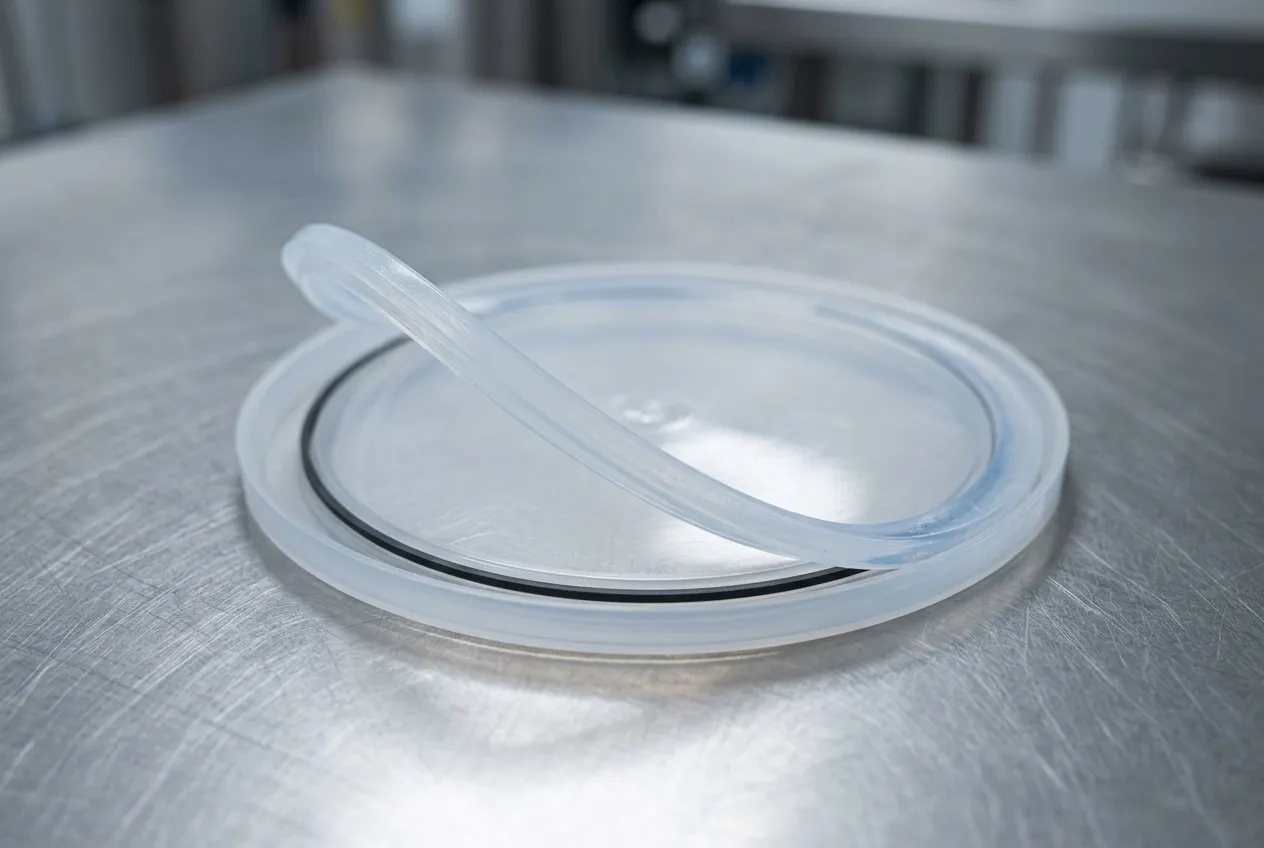
The part in the middle of the argument: a gasket that comes out can be washed; the channel it came out of is the part that decides whether it dries.
There is a separate reason not to treat the gasket as a detail of the lid: it is a non-PP part with its own document trail. Everything that is not polypropylene needs its own evidence, and the silicone ring is the part of a food container most often missing from the pack. How the ring itself is produced — liquid silicone injection versus compression molding — changes the tooling bill and the flash on the sealing face, which is a cost and fit question covered in the process comparison for molded seals. It does not change the hygiene problem. A perfectly molded ring in a groove that holds water still grows mold.
The Drainage Detail Nobody Writes Down
Every purchase order we see specifies the gasket. Almost none specifies what the groove does with water. That is the gap where the complaint comes from, and it is closed with drawing notes rather than money.
Make the channel open at one point. A groove that runs as a closed loop with the gasket seated at both ends is a sealed vessel with a wet interior. A relief slot — a short interruption in the groove wall, at the parting line or at a corner — gives water somewhere to go and air somewhere to enter. Two slots opposite each other dry faster than one, and they cost nothing at tooling stage because they are cut into the same insert.
Do not make the groove deeper than it is wide without a way out. Depth holds water; width lets it evaporate. Deep-and-narrow is the geometry that produces the black line, because the gasket compresses into the bottom of the channel and the water sits above it with no exposed surface area to speak of.
Keep the sealing line and the drainage path separate. This is standard practice in industrial case design and rarely written down in houseware: drainage recesses placed outside the sealing line prevent water pooling, and a drip edge reduces capillary ingress. Translated into a container lid: the gasket seals on a land, and anything outside that land is shaped to shed water rather than to hold it. Inside the land, the volume should be as small as the seal allows.
Decide how the lid dries, and design for that position. If the intended use is lid-off, groove-up on a rack, say so, and make sure the groove can be reached by air from above. If the intended use is nested lids, the groove will be face-down on a wet surface and will never dry. A recess that lets a lid stand on its edge, or a stack that holds lids at an angle, is a drainage feature even though it looks like a packing feature.
Watch the corner radius. Corners are where the groove is deepest, where flash and short shots collect, and where a gasket is least likely to seat evenly. The groove itself is a designed feature with a width, a depth, a lead-in and a corner treatment — a groove specified only as "for the gasket" is not specified at all. A defined radius and a clean parting line at the corner cost nothing in the drawing and remove the single most common place for residue to start. Gate position, draft angle and where the parting line lands all decide whether that corner is clean steel or a step the gasket has to jump.
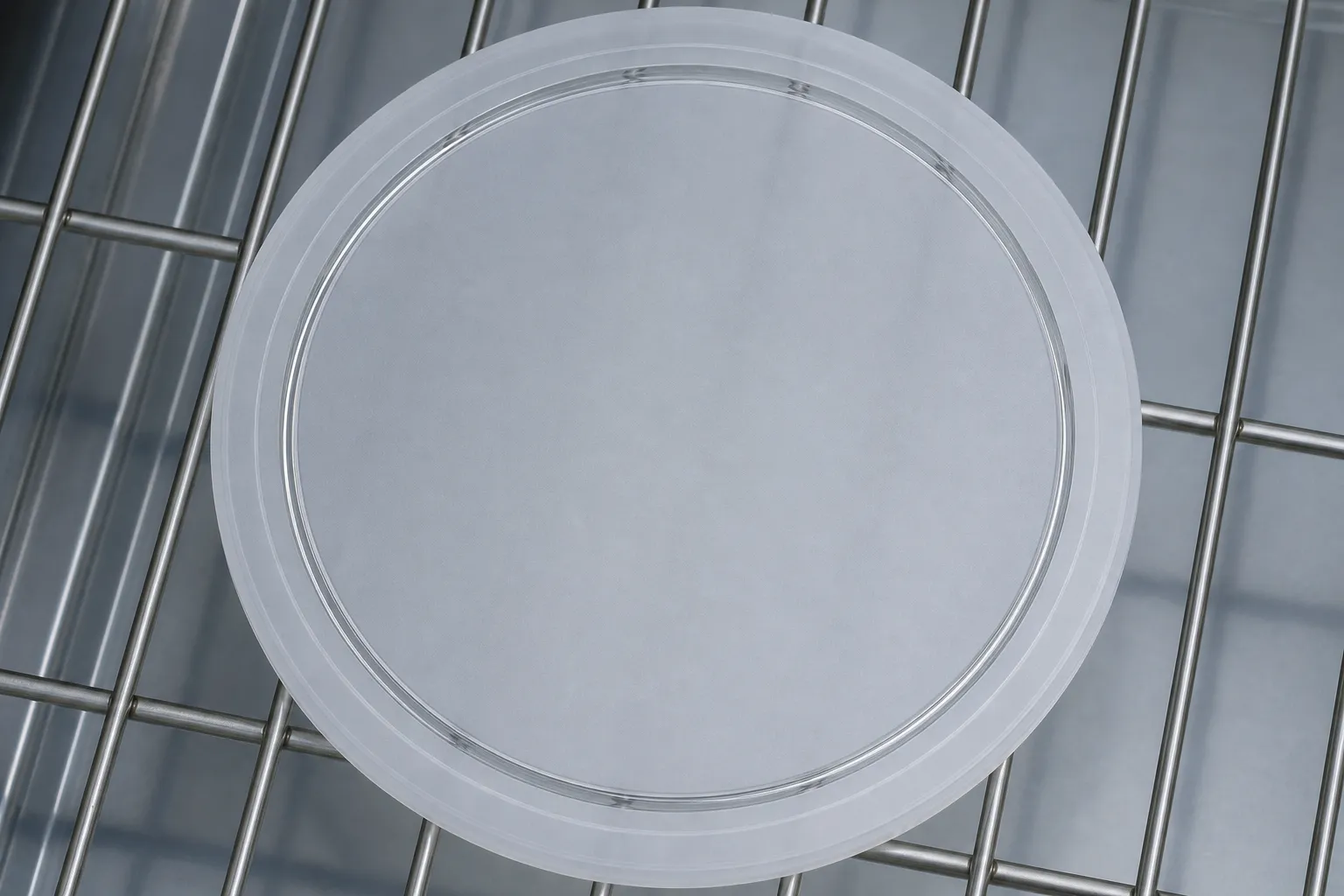
A lid that sheds water from every flat surface still has one channel it has to let go of on its own. This is the feature the drying check in the next section is looking at.
None of these five items is expensive. All five are invisible on a quote sheet, which is why they have to be written down.
What Goes Into the Specification
The specification is not a paragraph about quality. It is a short list of statements that a factory can be held to, each with a check that takes under a minute on a sample.
Field | What to state | Why it decides mold | How to check on a sample |
|---|---|---|---|
Construction and removability | Gasket removable by hand, no tool; retained against falling out in transit | A fixed gasket cannot be cleaned behind | Lift it with a fingernail; shake the closed lid |
Material and grade | Silicone or TPE, named compound family, not just "food grade" | Determines recovery and heat behaviour | Ask for the compound datasheet, then compare grades across quotes |
Hardness | Shore A value with a tolerance | Too soft creeps and traps; too hard will not seal a molded rim | Durometer reading on the ring, three points |
Cross-section | Cord diameter or profile, with tolerance | Decides the gap left for water after compression | Measure the ring in its free state, then in the groove |
Compression set | A limit, with the test named and the time/temperature stated | Predicts whether the ring still seals in year three | Ask for the test report — ISO 815-1 results are comparable across suppliers |
Groove geometry | Depth, width, corner radius on the drawing, not in email | Sets both the capillary gap and the dry-out path | Section the lid or measure with a pin gauge |
Drainage | Number and position of relief slots; no closed pocket | Water leaves or it does not | Fill the groove with water, invert, watch |
Service window | Declared microwave, freezer and dishwasher conditions | Sets the material class and the test cycle count | Match the claim to the test report, not to the label |
Replacement part | Gasket available as a separate item; minimum quantity; colours | Decides whether the product survives a worn seal | Ask for the part number before the PO, not after |
Read Table 2 again as a purchase order, and separate the two moments it can be applied. On a tool that has not been cut yet, all nine lines are drawing notes and cost nothing — they go on the drawing, before the steel exists. On a tool already in production, the material and hardness lines are paperwork that can still be specified on the next order, but the groove geometry and the relief slots are a mold change, which is exactly why they belong in the first drawing rather than the second order. The two lines that always cost money are the material grade and the replacement-part commitment, and the second one is usually recoverable, because a gasket SKU is small, light and cheap to hold.
The same spec has to survive the carton, because a gasket that is correct on the drawing and crushed in transit arrives as a leak. What the packing data looks like on the gasket-sealed families we run is in Table 3 — it is here to show the level of detail a spec should reach, not as a catalogue.
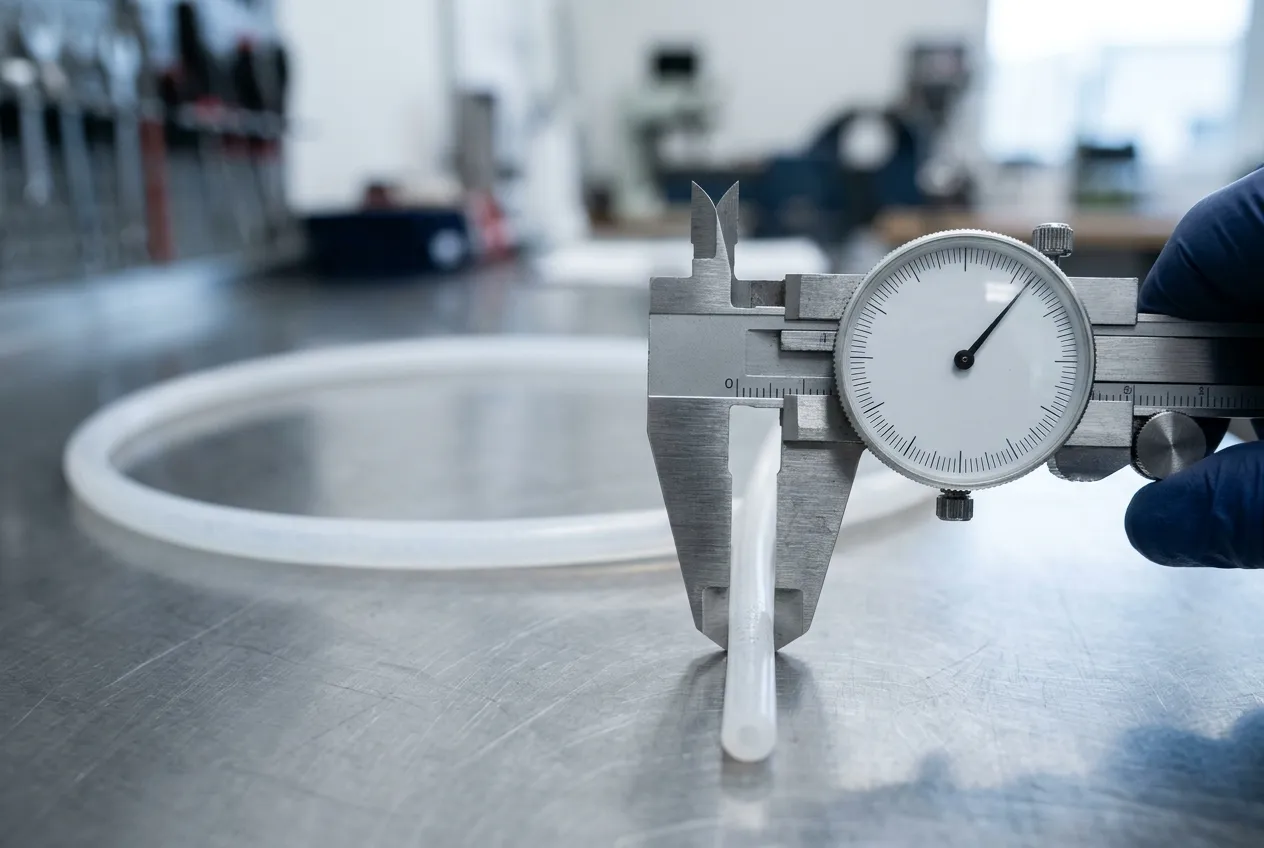
The cross-section is the number a spec can hold a supplier to. The groove that number has to fit is the one almost nobody writes down.
Model | Material | Capacity | Packing | Carton size / gross weight |
|---|---|---|---|---|
BX1051 | PP + silicone | 1.3 L (43.96 US fl oz) | 72 pcs/ctn | 62 × 47.5 × 58.5 cm / 14.3 kg |
6529 | PP + silicone | 1300 ml (43.96 US fl oz) | 48 pcs/ctn, OPP bag | 51 × 46 × 62 cm / 15 kg |
6527 | PP + silicone + stainless steel | 1300 ml (43.96 US fl oz) | 24 pcs/ctn, OPP bag | 51 × 46 × 62 cm / 11 kg |
6521 | PP + silicone + 304 stainless | 1400 ml (47.34 US fl oz) | 18 pcs/ctn, OPP bag + colour carton | 47 × 31 × 73 cm / 15.2 kg |
6522 | PP + silicone + 304 stainless | 1100 ml (37.2 US fl oz) | 24 pcs/ctn, OPP bag + colour carton | 54 × 32 × 60 cm / 14.5 kg |
6523 | PP + silicone + 304 stainless | 800 ml (27.05 US fl oz) | 24 pcs/ctn, OPP bag + colour carton | 54 × 32 × 50 cm / 11.5 kg |
6536 | PP + silicone + stainless steel | 1100 ml (37.2 US fl oz) | 24 pcs/ctn, OPP bag | 47 × 34 × 47 cm / 11 kg |
Figures as recorded in our own product data; confirm the packing basis and the gross-weight scope on the quote, since carton figures are quoted per packing configuration. The body material in that table is the least interesting variable — PP and PS behave much the same way in this failure mode, because neither of them is the part that stays wet.
How to Prove It on a Sample, Not on a Datasheet
A supplier can promise a removable gasket and a draining groove in an email. Five checks on one sample settle it, and none of them needs a laboratory.
- Open it the way a customer would. Take the lid, find the gasket, lift it with a fingernail. If it needs a knife, a spudger or a video tutorial, the cleaning instruction will not be followed, and the product's hygiene depends on a behaviour you cannot enforce.
- Wet it and leave it. Wash the lid, shake it once — the way a person does — and stand it groove-up on a draining rack. Look again in two hours. Standing water in the groove means the geometry holds water, and no gasket material compensates for that.
- Invert it full. Fill the groove with clean water and turn the lid over. Water should leave through the relief slot rather than sit in a pocket. If it beads and stays, the slot is either missing or in the wrong place.
- Cycle it, then re-measure. Run the number of wash cycles you intend to claim — hand wash at household temperature, or the dishwasher programme you will print on the box. Then take the ring out and measure it in its free state against the sample you started with. A ring that no longer stands proud of the groove has taken a set, and the seal is now working on the rim alone. Pair this with the seal test itself; the difference between airtight and leakproof is the difference between two tests, and passing one tells you nothing about the other.
- Leave residue in it for 72 hours. Wipe the groove with a thin film of cooked starch or oil, close the lid and leave it at room temperature for three days, then wash normally. Any retained film, clouding or odour in the groove is the failure mode arriving early, in your hands instead of a customer's.
Sample-stage seal evaluation is not a new discipline on this site — the structure-level version of the same protocol is set out in how a seal structure gets tested at sample stage. The hygiene variant above is what you add when the claim on the box is "reusable", not just "leakproof".
The Compliance Questions to Ask About the Gasket Itself
The gasket is a second material in contact with food, and it is the part buyers most often forget to document. Two things are worth getting right before you ask anything.
The first is scope. In the EU, plastic food-contact materials are covered by Regulation (EU) No 10/2011; silicone is not a plastic, so the silicone ring is not governed by that regulation — it falls to national measures, of which Germany's BfR recommendations on food-contact materials are the ones most often cited in a European buyer's pack. In the US, rubber articles intended for repeated use sit under 21 CFR 177.2600. A supplier who answers "10/2011" for a silicone gasket has answered about a different part.
The second is that a document has to name the part, not the polymer. "Food grade silicone" on a website is a marketing statement. What answers the question is a Declaration of Compliance that names the gasket material and grade, plus a migration test report run on the finished gasket — not on the raw compound, and not on the container body.
So the questions to put in the RFQ are narrow:
- Which regulation or national measure does the gasket material comply with, and can you send the Declaration of Compliance naming that grade?
- Is there a migration test report for the finished gasket as supplied, and which laboratory issued it?
- Are the colourants and any processing aids declared, and do they have their own food-contact statements?
- Is hardness checked per batch, and can we see the record for the batch that ships?
- If we print a food-contact claim on the retail box, which document supports that exact wording?
None of these asks the supplier to certify anything on your behalf; each asks for a document you can file. The wider pack — what a factory should be able to produce for the body, the lid and the insert, and in what order — is set out in the document pack to request from a food container factory, and the rule that decides which parts need their own report is direct versus indirect food contact. The gasket is almost always a direct-contact part. It is also almost always the one missing from the folder.
The Clause Worth Adding Before the Next Order
If the specification is already written and the tool is already cut, one clause is still worth adding to the next order — most of it is a note on the drawing, and only the relief slots touch the steel: the lid gasket must be removable by hand, seated in a groove with at least two relief slots and no closed pocket, in a named silicone grade with a stated hardness and a stated compression-set limit, and available as a replacement part under its own item number.
Every element of that sentence is checkable on a sample in an afternoon, and each one maps to a failure that would otherwise reach a customer in month four. The replacement-part half is the one buyers skip and the one that decides whether a container is still usable when the ring finally goes — a small spare part, or a whole set in the bin.
Both sides of our own range sit in this argument, but they do not answer it the same way: the seven lunch box families in Table 3 each carry a silicone sealing ring seated in a molded groove, while a good part of the food storage container range is a plain PP or PP+PET box with no ring to dry. Whether a given mold's ring lifts out by hand is one of the items we confirm per model at quotation, and which of the clauses above each mold already meets is a question we would rather answer at quotation than after a claim. If you are re-specifying an existing line, the faster route is usually to send the current drawing and ask what the groove does with water; the answer tells you in one reply whether the mold needs touching or only the paperwork.
Continue reading
Related sourcing guidance
More practical context for your food storage container sourcing conversation.


Discuss your product range
Need help selecting or customising containers?
Share the product type, market and sourcing requirements with the Xinghui team.