
Sourcing & OEM
Whose Name Is on the Carton? Neutral Packing, Shipping Marks and Keeping Your Supplier Out of Your Customer's Shipment
Neutral packing is a decision about whose name ships with the goods. A field-by-field look at shipping marks, origin rules and the paper trail behind them.

Neutral packing is the cheapest line item in an import order and the one that decides who your customer believes made the product. The words arrive in a first email as an adjective — "can you do neutral packing?" — and leave, if nobody stops them, as a blank brown carton while the factory's name stays on the invoice, the bill of lading and the emails you answer every week. What "neutral" actually names is a decision about whose identity travels with the goods, and that decision is written down in exactly one place: the shipping marks on the carton.
This page is written for the buyer who has to answer that email. It works from the published model records behind this site — the carton counts, gross weights and box dimensions of the houseware lines in the current catalog — and from the rules that decide what may and may not be left off a carton in international trade. It is not a guide to choosing a cardboard supplier, which is what most search results for the phrase turn out to be, and it does not repeat the retail-packaging approval workflow or the FBA labeling process, both of which already have pages here.
The argument runs in one direction. Neutrality is a scope, not a switch, and it has three levels. It cannot remove country of origin or the paper trail, only the supplier's name. The carton carries two separate blocks of marking read by two different audiences, and the fields in the second block have to come from a packing record that the factory either has or does not. Then come the places the name survives anyway, the cost of the neutral route against a printed box, and the single document that settles all of it before production starts.
What "Neutral" Actually Covers — Three Levels, Not One
The phrase covers three different orders of work, and the price of each is not related to the other two. A supplier who says "yes, neutral" without asking which level you mean has answered a question you did not ask.
At the outer level, the master carton loses the factory's name, logo and promotional print. What remains is functional: how many pieces are inside, what the item is, how much it weighs, where it is going. This is the level the term usually refers to, and it is the cheapest because a carton is a brown box either way — the saving is in not printing it.
At the inner level, the retail box that the end customer sees is replaced. A printed color box becomes a plain white or kraft folding box, or the unit is packed in a plain bag inside the master carton. This is the level a distributor who intends to apply their own label actually needs, and it is the level at which stock stops being customer-specific.
At the unit level, the label itself — barcode, item code, any sticker that names anyone — is applied by a party of your choosing rather than printed at the factory. This is the highest control and the most labor, and it is where white label packaging operations actually live: a generic product, a generic box, and an identity applied close to the point of sale.
Level | What it removes | What stays visible on the shipment | Who usually asks for it | What it costs to reverse |
|---|---|---|---|---|
Outer carton | Factory name, logo and promotional print on the shipping carton | Item reference, quantity per carton, weights, dimensions, origin, carton number | Anyone who does not want the factory's name at the receiving dock | Re-cartoning the order, not re-stickering it |
Inner / retail box | The printed color box the end customer would see | The product itself, in a plain box or bag, inside the master carton | Distributors and house brands that apply their own packaging | The retail presentation, which cannot be added back after the fact |
Unit label | Any printed identity on the item or its immediate pack | The product and its packaging, unlabeled until someone labels it | Sellers whose channel requires their own label or barcode | Labor at the destination, and the cost of doing it twice if it is wrong |
The practical consequence is that the three levels are sequenced, not interchangeable. Ask for the outer level and the inner box still carries whatever the factory printed on it. Ask for the inner level and you have committed to a packing line that no longer produces a sellable retail unit off the end of the machine — which is why the question "how is the minimum counted" changes the moment you move from the first level to the second, as it does on any mixed order where the count runs per model, per color or per carton (the MOQ counting article works through that arithmetic).
Write the level into the quotation request as a sentence, not a word: "master carton neutral, no factory name or logo on any face; inner box plain white, unprinted; unit label applied by buyer's agent at destination." Each clause is a different instruction to a different person in the factory, and a one-word answer covers none of them.
What Neutrality Cannot Remove: Origin, Traceability and the Paper Trail
Two things survive every version of neutral packing, and buyers discover both at the worst possible moment — when a container is held, or when a retailer's compliance team asks a question the carton cannot answer.
The first is country of origin. Neutrality is about the seller's identity; origin is about the goods. In the United States the marking requirement sits in 19 CFR Part 134, and the section headed "General rules for marking of containers or holders" — 19 CFR 134.22 — is the one to read with your customs broker before the carton artwork is approved, because that is where the container's own marking is dealt with separately from the article's.
What that section requires is conditional, and the conditions are what decide a neutral program. The article itself has to be marked. The outermost container has to be marked when the article inside is excepted from marking under subpart D of the part — the container is marked because the article cannot be (134.22(a)). And when the container carries the name and address of a US importer, distributor or other US party, 134.22(c) requires the origin of the contents to be stated in close proximity to that address, in wording such as "Contents made in France". That last condition is not hypothetical for a neutral shipment: it is what happens the moment a distributor's US address is printed on the carton in place of the factory's. Every importing market has its own version of the rule, not every market requires origin on the package at all, and the version that applies is the destination's, not the factory's. None of those branches can be settled at the factory, because each depends on the destination and on whose name is on the carton. A supplier who offers to leave origin off without asking where the goods are going is guessing about your customs file.
The second is the paper trail. A commercial invoice, a packing list and a bill of lading each carry a consignor — the party shipping the goods — and in a direct factory shipment that party is the factory, whatever the carton says. The marks on the carton are checked against those documents at the destination: the carton number on the box has to be the carton number on the packing list, character for character. UNECE Recommendation 15, the international reference on simpler shipping marks, builds its whole standard on that identity between package and document. Neutralizing the box while the invoice still names the manufacturer is theater — useful only against a specific audience, which is the subject of a later section.
There is one more line in that recommendation worth quoting to a supplier who wants to print his own address on every carton. It advises against showing the sender's name and address on packages where doing so raises the risk of pilferage. That is a trade argument, not a legal one, and it is the argument that usually wins the internal discussion: a carton that advertises a known brand of housewares is a carton worth opening in a container yard.
None of this is a compliance opinion about your shipment. It is the shape of the question to put to your broker and to your customer's compliance team: which marking is required on the article, which on the container, and which documents must carry the same mark. The document pack a factory should be able to hand over on request is set out in the compliance documents article; origin marking is a fair addition to that request list.
Two Blocks on Every Carton, and They Are Read by Different People
An export carton carries two blocks of marking, and confusing them is the most common way a well-specified order arrives unusable. The split is old and it is not decorative: each block answers a different question for a different person, and each sits on a different face for that reason.
The main mark is the identifying block, printed in the largest type on two opposite faces so that it is readable whichever way the carton is stacked. It answers: whose carton is this, which order does it belong to, where is it going, and which carton of how many is it. Its readers are the forwarder, the container freight station and the receiving dock — people who never open the box and decide where it goes from the outside.
The side mark sits on the other two faces, in smaller type, and answers what is inside: item reference, quantity, net and gross weight, external dimensions. Its readers are the warehouse receiving clerk and the picker, who need to know whether this carton can be lifted, where it can be stacked, and whether it can go straight to a pick face without being opened.
The German insurance industry's cargo handbook, the Transport Information Service, splits complete package marking into three parts under DIN 55 402 Part 2 — shipping mark, information mark, handling instructions — which is the clearest version of the same idea and the one worth adopting as a checklist. Its handling-instruction component is standardized separately in ISO 780, the symbol set for this way up, fragile, keep dry and stacking limits. Symbols are used where the instruction is universal; they cost nothing to print and remove a translation problem at the destination.
Block | Where it goes | Type size | Who reads it | The question it answers | What goes wrong without it |
|---|---|---|---|---|---|
Main mark | Two opposite faces | Largest type on the carton | Forwarder, container freight station, receiving dock | Whose carton, which order, which destination, carton n of total | The carton is held, mis-routed, or opened to find out |
Side mark | The other two faces | Smaller, readable at arm's length | Warehouse receiving, pickers, customs | What is inside, how many, how heavy, how big | Counts are reconciled by breaking cartons open |
Handling symbols | Upper part of the faces, only where they apply | Standardized pictograms | Handlers and forklift drivers | How to treat it | Damage the packaging did not cause |
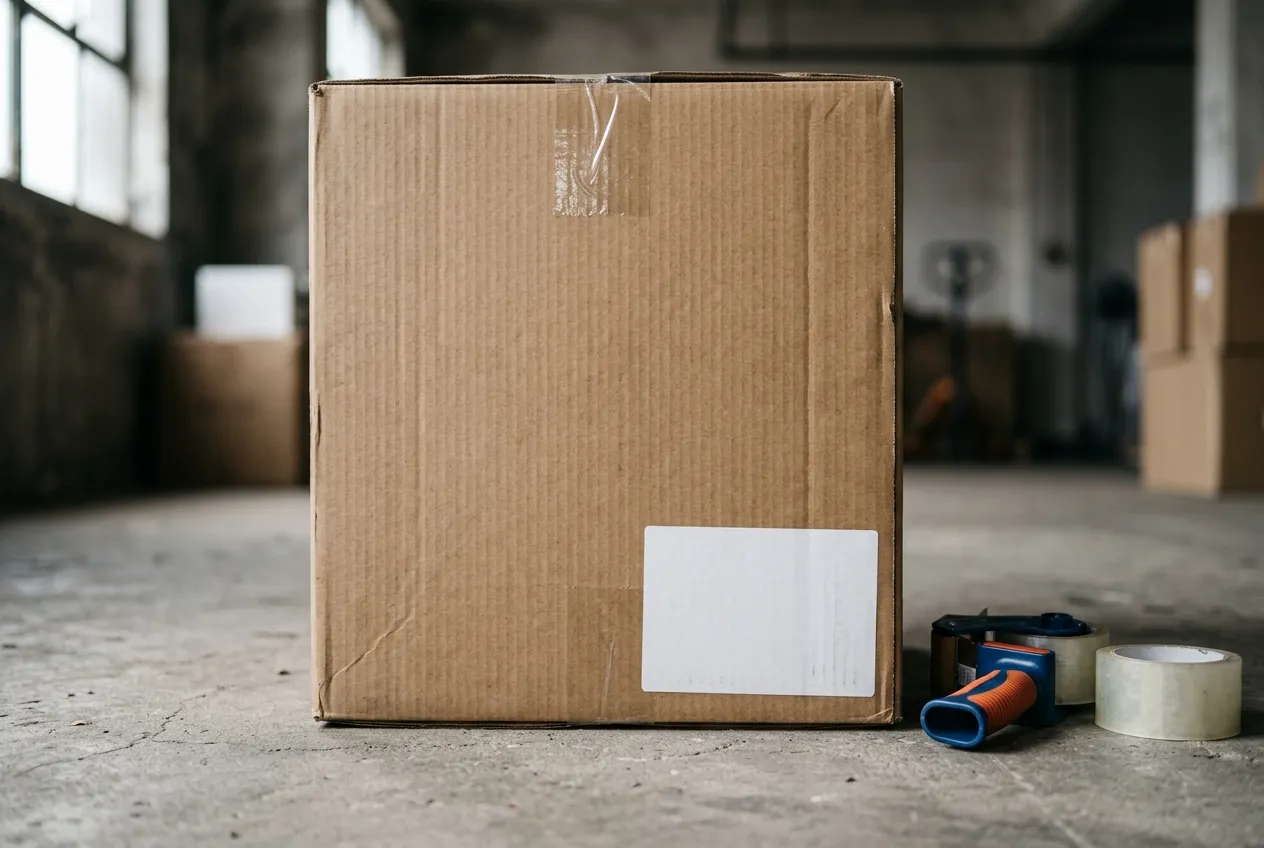
The reason to keep the blocks separate has nothing to do with tidiness. A main mark that swallows the side mark — because someone put the SKU, the weights and the dimensions into the big block — produces a face where the forwarder cannot find the destination at a glance and the picker cannot find the count at all. The reverse is just as common: a side mark promoted to the main faces so that a warehouse scanner can read it, at the cost of the routing information being legible from only one side.
Who bears the work of getting this right follows the commercial terms, not the factory's preference: under FOB the carton leaves marked as agreed, and what happens at the destination is the buyer's side of the line. The FOB, CIF and EXW article sets out where that line falls for each term, which matters here because the party paying for re-marking at the destination is decided by the term, not by the mark.
The Side Mark, Field by Field
Below is the field set a houseware carton usually carries, and for each one the reason it exists rather than the convention that it exists. The list is longer than the international recommendation, and that gap is itself the point: UNECE Recommendation 15 describes a minimal standard mark of four elements — an abbreviated name, a reference number, a destination and a package number — and explicitly asks that other data be kept to a minimum. The ten-field mark in commercial use is a buyer-driven habit layered on top. Where a contract, a letter of credit or a retailer's routing guide specifies a mark, that document wins over both the recommendation and the habit.
Field | Why it is on the carton | Who reads it | Who supplies the data | What breaks without it |
|---|---|---|---|---|
Consignee code | Identifies whose goods these are without printing a brand name in full | Forwarder, receiving dock | Buyer | Carton is routed by elimination, or opened |
PO / reference number | Ties the carton to one purchase order, which is how a mixed delivery is sorted | Warehouse receiving, accounts payable | Buyer | Cartons from two orders get mixed at receiving |
Carton number, n of total | Lets anyone count a shipment and find the one carton that is missing | Receiving dock, inspection | Factory, from the packing record | A short shipment cannot be proven, only suspected |
Item / SKU reference | Says which product is inside without opening it | Pickers, warehouse system | Buyer's item code, factory's model map | Two similar models are indistinguishable on the floor |
Quantity per carton | The count the buyer is paying for, checkable without scales | Receiving, inspection | Factory's packing record | Quantity is verified by opening every carton |
Net weight | The weight of the goods alone, used in customs and freight calculations | Customs, forwarder | Factory, or derived by subtraction | Declared weights cannot be reconciled |
Gross weight | The weight that decides lifting, stacking and freight | Handlers, forwarder | Factory's packing record | Manual handling of a carton that needed equipment |
Measurement (L×W×H) | The number that becomes CBM, and therefore freight | Forwarder, 3PL | Factory's carton record | Freight is booked on an estimate |
Country of origin | The one marking neutrality does not remove | Customs, ultimate purchaser | Factory, per destination rule | Clearance delay or redelivery |
Case barcode / SSCC | Machine-readable identity at carton and pallet level | Scanners, retailer systems | Buyer's GS1 allocation, printed by factory | Every carton is keyed in by hand at the DC |
Two of those rows cause more rework than the rest. Origin, because a buyer who has specified "totally neutral" sometimes means it literally until the broker explains what that costs. And the case barcode, because it is the field most likely to be treated as a sticker problem when it is an artwork problem. A GS1 SSCC is an eighteen-digit number that has to be allocated by the party owning the GS1 prefix and then printed into the carton artwork or applied as a label at a specified position — two very different production paths, with different failure modes. A case barcode on a houseware carton is more often the ITF-14 symbology carrying a fourteen-digit trade-item number, which has its own allocation rule and its own place in the artwork. Either way, the barcode and label work on a first order, including the FBA variant, is itemized in the labeling and carton prep article; what belongs here is only the decision of which path the mark takes.
The Numbers a Side Mark Quotes Have to Come From Somewhere
Every field in the lower half of that table is a number, and every number has to exist in a packing record before anyone can print it. This is where neutral packing stops being a conversation about cartons and becomes a conversation about data. The records behind this site's houseware range show both what a complete record looks like and what an incomplete one costs you.
Model | Packing stated in the record | Pieces per carton | Gross weight | Carton dimensions | Gross weight per piece | Carton volume |
|---|---|---|---|---|---|---|
BX1051 | 72 pcs | 72 | 14.3 kg | 62 × 47.5 × 58.5 cm | 0.20 kg | 0.172 m³ |
BX1052 | 48 pcs | 48 | 16.2 kg | 68 × 36 × 56.5 cm | 0.34 kg | 0.138 m³ |
BX1053 | 24 pcs | 24 | 12.4 kg | 61 × 30 × 57 cm | 0.52 kg | 0.104 m³ |
6521 | 18 pcs/ctn; OPP Bag + Color Carton | 18 | 15.2 kg | 47 × 31 × 73 cm | 0.84 kg | 0.106 m³ |
3332 | 56 pcs; a second label on the same record reads Paper-based bidding | 56 | 16.1 kg | 64 × 49 × 56 cm | 0.29 kg | 0.176 m³ |
SH3185 | 1 pc in a box, 24 pcs/ctn | 24 | 13 kg | 62.5 × 39 × 74 cm | 0.54 kg | 0.180 m³ |
3334 | 80 pcs; a second label on the same record reads Paper-based bidding | 80 | 14.7 kg | 59 × 56 × 65 cm | 0.18 kg | 0.215 m³ |
6639 | Color carton | Not stated | Not stated | Not stated | — | — |
The record labels these fields "confirm packing scope" and "confirm unit/carton basis", which is the record telling you what this table is telling you: a gross weight is only meaningful once you know whether it describes one carton or one piece, and a packing line that says "OPP bag" is describing the inner pack, not the carton count. Two readings of the same column produce carton marks that disagree with the packing list, which is the failure the marks exist to prevent.
The arithmetic that follows from a complete line is the whole reason to want one. Take 6521: eighteen pieces to a carton at 15.2 kg gross is 0.84 kg per piece as it ships, and a 47 × 31 × 73 cm carton is 0.106 m³, so a 28 m³ loading — a normal usable volume inside a 20 ft container — takes 263 cartons, or 4,734 pieces. The same arithmetic on BX1051, at 72 pieces and 14.3 kg per carton, gives 0.20 kg per piece and 0.172 m³ per carton, so the same container holds 162 cartons and 11,664 pieces. The per-piece volume differs by about two and a half times between those two lines, which is a fact about how the cartons are filled, and it is the sort of fact that only becomes visible when packing records are complete. The mixed container article takes that arithmetic the rest of the way into a loading plan.
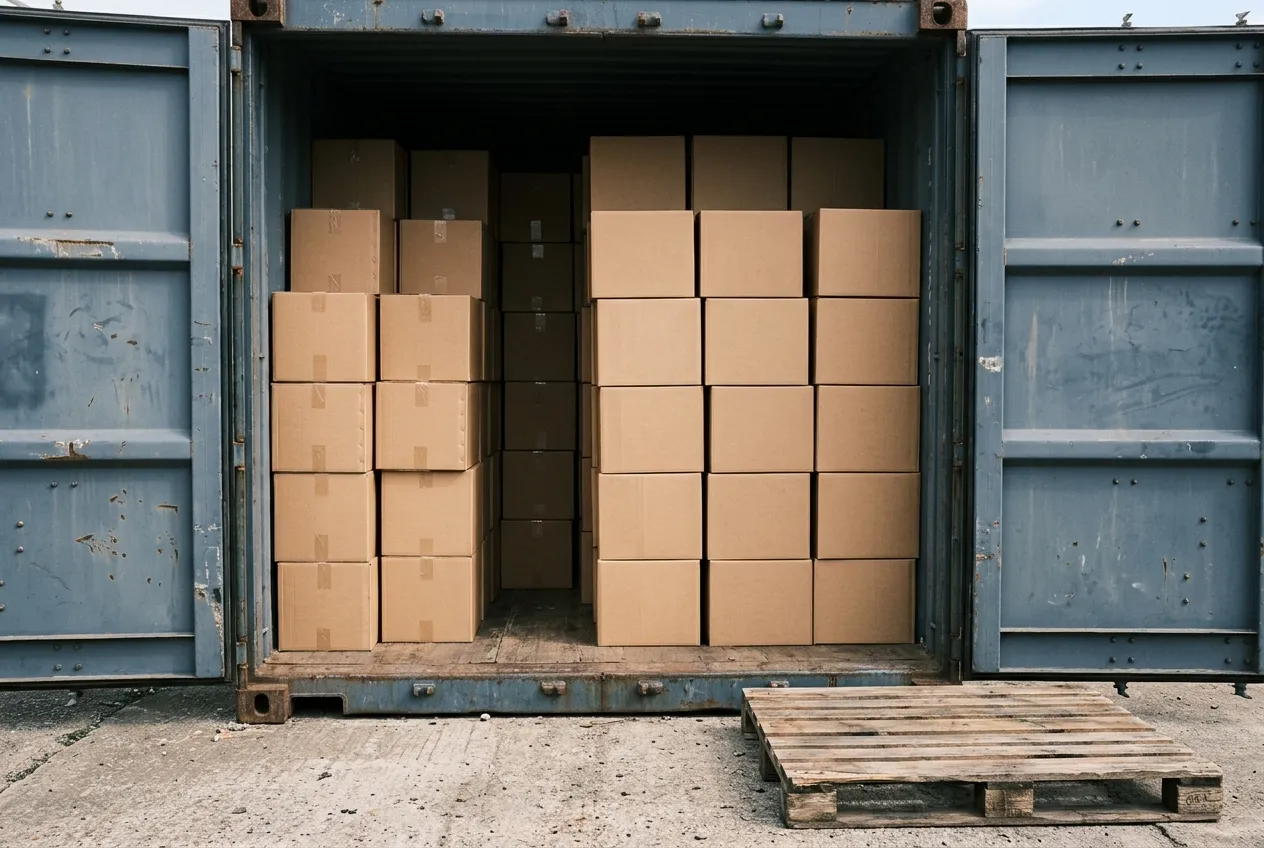
The last row is the one to look at if you are buying a mixed order. 6639 states a color carton and no carton data at all — no count, no weight, no dimensions — so a mark sheet cannot be written for it from the record; it has to be requested, measured and confirmed before the artwork stage. That is the failure worth naming, because it is invisible in a quotation: the model gets quoted, sampled and approved, and the first time anyone learns the carton was never measured is when someone tries to print a side mark on it.
The seven rows above it show what the alternative looks like, and also why completeness is not the same thing as legibility. Each of them carries a count, a gross weight and a carton size, which is the whole set a side mark needs, and each still had to be read with care — a packing column that says "OPP Bag + Color Carton" is describing an inner pack, and a gross weight is only a carton weight once the packing scope is confirmed. A record can hold every field a mark needs and still be ambiguous about two of them. That is why the request goes out per model rather than once for the order: the question to put to a supplier is not "do you have the data" but "send me the packing data sheet for each model in this order before I approve the marks", and the answer tells you whether the factory ships on records or on memory.
Where the Factory's Name Still Shows Up After You Neutralize the Carton
A blank carton is one surface out of about ten, and the other nine are where neutral programs quietly fail. The useful discipline is to decide what you are protecting against before deciding what to remove — the end customer, a competitor reading a container yard, or a retailer's buying team — because each audience sees a different surface.
Surface | Who sees it | Can it be neutralized | What it takes |
|---|---|---|---|
Outer carton print | Forwarder, dock, 3PL, anyone in the yard | Yes, completely | A carton artwork without a factory mark; tape and closure without a printed logo |
Inner / retail box | End customer | Yes, at the inner level | A plain box or bag specified in the quotation, not assumed |
Unit label | End customer, retail DC | Yes, if someone else applies it | Labeling moved to the buyer or a 3PL, with a cost and a failure mode |
Molded-in marks on the part | End customer, forever | Not usually | A tooling change; a resin code or a country-of-origin mark molded into a part does not come off |
Manual, warranty card, care leaflet | End customer | Yes | Buyer-supplied print, or no leaflet at all |
Commercial invoice and packing list | Customs, broker, buyer's finance | Partly | The consignor block names the shipper; a trading company in the middle changes what it says |
Bill of lading | Carrier, customs, bank under a letter of credit | No | This is the legal record of who shipped what |
Pallet label / SSCC | Retail DC, 3PL | Yes | Buyer-allocated numbers, printed to the retailer's spec |
Container seal and CFS paperwork | Carrier, customs | No | Part of the transport record |
Email signature, domain, quotation template | Anyone you correspond with | Yes, and usually forgotten | A separate buying identity if the concealment matters |
Read the column that says "no" and the strategy becomes clear. The paper trail names the shipper, and no carton artwork changes that. So a neutral program is never anonymity; it is a decision about which audience sees which name. If the audience is the end customer, the inner box and the leaflet are the surfaces that matter and the outer carton is almost irrelevant. If the audience is a competitor or a retailer's sourcing team reading a container yard or a DC, the outer carton and the pallet label are the ones that count. If the audience is your own customer's compliance department, none of it can be removed, and pretending otherwise is the risk.
That distinction is also what separates a factory from a trading company in a neutral program. A trading company can offer neutrality on the carton very easily, because the carton was never theirs; it cannot change the consignor on the documents without changing who is legally shipping. Verifying which of the two you are dealing with before you design a neutral program around them is the subject of the factory versus trading company article, and it is worth doing before rather than after the artwork is approved.
Neutral Carton vs Retail-Ready Box: What Actually Changes in the Order
Neutral packing is often described as a way to save money on packaging. It is more accurate to say it moves cost from printing to labor, and adds a category of risk that a printed box does not have. The comparison below is structural — no prices, because packaging quotations do not survive being copied between markets — and it is the shape of the conversation to have with a supplier before the packing line is set.
Line | Neutral kraft carton | Printed color box | Retail-ready shelf pack |
|---|---|---|---|
Artwork step | A mark sheet and a carton dimension; no design | Full artwork, proof cycle, color approval | Artwork plus a retailer's routing and shelf specification |
Proof cycle | One carton sample, checked for dimensions and strength | Several rounds, with color targets | Several rounds, plus a retailer compliance check |
Print minimum | None — a plain carton has no plate | A minimum run per design, per color | A minimum run plus a packaging spec approval |
Die-line | Standard carton, or a plain die | Custom die, cut and crease | Custom die, often with a display feature |
Carton strength | Chosen for the load, easily upgraded | Chosen for shelf presence as well as load | Chosen for the display, which is a different structure |
Who labels | Buyer, distributor or 3PL, at destination | Factory, in the print | Factory, to the retailer's spec |
Rework risk | High on labeling: a wrong label is applied to finished goods | High on artwork: a wrong color is printed on thousands of boxes | High on both |
Damage and claims | Judged on carton strength alone | Judged on both box and product | Judged against a retailer's damage allowance |
What the buyer pays for | Cartons and labor | Design, plates, print run and cartons | All of that plus compliance work |
The two failure modes that follow are worth naming, because both are common and neither is a carton problem.
The first is the leftover label. A neutral carton travels to a co-packer or a 3PL and comes back with a sticker on it, and the sticker is applied by a person working at speed against a purchase order that names a different customer. Nothing on the carton prevented it, because a blank carton has no label field — no printed box on the face telling the operator where the label goes. A printed retail box is self-correcting in that respect: the wrong label is visibly wrong. If you choose neutrality, specify the label position and the label content as part of the same instruction, even though nothing is printed there yet.
The second is the retailer rejection at the door. A neutral carton that was never checked against the receiving requirements of the chain it is going to — carton markings, label position, pallet configuration — is a carton that gets refused after it has crossed an ocean, and the fix happens at the destination at destination labor rates. The retail packaging article covers the approval workflow that a retail-ready pack has to pass; a neutral program aimed at a retailer needs the same routing specification even though the box is blank.

The honest summary of the cost comparison is that neutrality pays when the volume is uncertain, the channel is not yet fixed, or several customers can share one stock-keeping unit. It costs more than a printed box when the destination is a retailer with a routing guide, because you have taken on work that the print would have done for you.
The Mark Sheet to Send Before Production — and What to Get Back
Everything above collapses into one document, and the document is short. Call it a mark sheet: one page per order, one block per carton type, stating what is printed on which face, in what size, and what is deliberately not printed anywhere.
The sheet has five parts, and a supplier who receives all five can produce a carton without guessing. First, the carton identity: model, pieces per carton, carton dimensions and gross weight, taken from the packing record and confirmed rather than copied. Second, the main mark content: consignee code, reference number, destination, carton numbering format including the total. Third, the side mark content: item reference, quantity, weights, measurement, origin, and the barcode decision with its number range if the buyer allocates it. Fourth, the neutrality clause in explicit words — no factory name, logo or promotional print on any face; no factory-branded tape; no leftover labels from another customer's order inside or outside the carton. Fifth, the handling symbols that actually apply, chosen from ISO 780 rather than added for decoration.
What should come back is equally specific. A die-line or carton drawing with the mark positions dimensioned, not a verbal assurance. A proof or first-carton photograph of each face, taken flat and readable, before the production run rather than after. A packing list whose carton numbers match the carton numbering format you specified, character for character, because that match is the whole function of the mark. And one retained carton from the first production batch, kept as the reference for the inspection that follows.
That last item connects to the inspection stage: a pre-shipment inspection that counts cartons but does not read them is only half an inspection. The checklist for a houseware pre-shipment inspection, including what to compare against the approved sample, is in the pre-shipment inspection article; the carton mark check belongs on it, and it is a five-minute check when a mark sheet exists and an argument when one does not.
Sequencing matters more than completeness here. The mark sheet has to be agreed before the carton artwork is approved, and the artwork before the packing line runs; a mark change after the cartons are printed is a re-carton at best. The full sequence from RFQ to shipment, with the points at which each document should be signed off, is set out in the sourcing walkthrough.
Questions to Settle Before the PO
Eight questions, in the order they cause trouble. Each has an answer that can be written down, which is the test of whether it has been settled.
- Which level of neutral? Outer carton, inner box, unit label — name all three and state which are in scope.
- What is printed on the inner box? If the answer is "nothing", confirm that the inner box is plain rather than the factory's standard retail box turned inside out.
- Which carton fields are required, and by whom? A field list with a source for each: buyer, factory packing record, or destination rule.
- Where does origin go, and on what? Article, container, or both — confirmed with your broker, not with the factory.
- Is the carton data complete for every model in the order? Pieces per carton, gross weight and dimensions, per model, before the marks are approved.
- Who applies the label, and to what position? If anyone other than the factory, say so in the neutrality clause and specify the position anyway.
- Does the destination have a routing specification? If a retailer or a marketplace is the destination, its carton and label requirements outrank both this article and the factory's habit.
- What comes back before production? Die-line, first-carton photographs, a packing list that matches the numbering, and one retained carton.
A neutral program that answers those eight is a manufacturing instruction. One that answers "yes, we can do neutral" is a sentence in an email. The difference between a neutral packing program from a China supplier that runs cleanly and one that produces an argument at the destination is rarely the factory — it is whether those eight answers existed before the cartons were printed.
Xinghui Plastic Life ships houseware orders from Jieyang on the basis this article describes: a carton record per model — the same records the table above is built from, gaps included — a mark sheet agreed before artwork, and neutral packing specified at the level the buyer names rather than assumed. If you are building a neutral or house-brand program and want the packing data for the models you are considering, send the eight questions above with your target quantity and destination, and the reply will come back as packing data and a mark sheet rather than a promise.
Continue reading
Related sourcing guidance
More practical context for your food storage container sourcing conversation.

Discuss your product range
Need help selecting or customising containers?
Share the product type, market and sourcing requirements with the Xinghui team.