
Food Storage Containers
Kitchen Storage Container Manufacturer: Desktop Racks, Cup Drainers, Drip Trays and Ice Trays from One Injection Molder
One injection molder for four kitchen storage families — drain and drip trays, cup racks, ice trays and desktop racks — with model, carton and packing data.
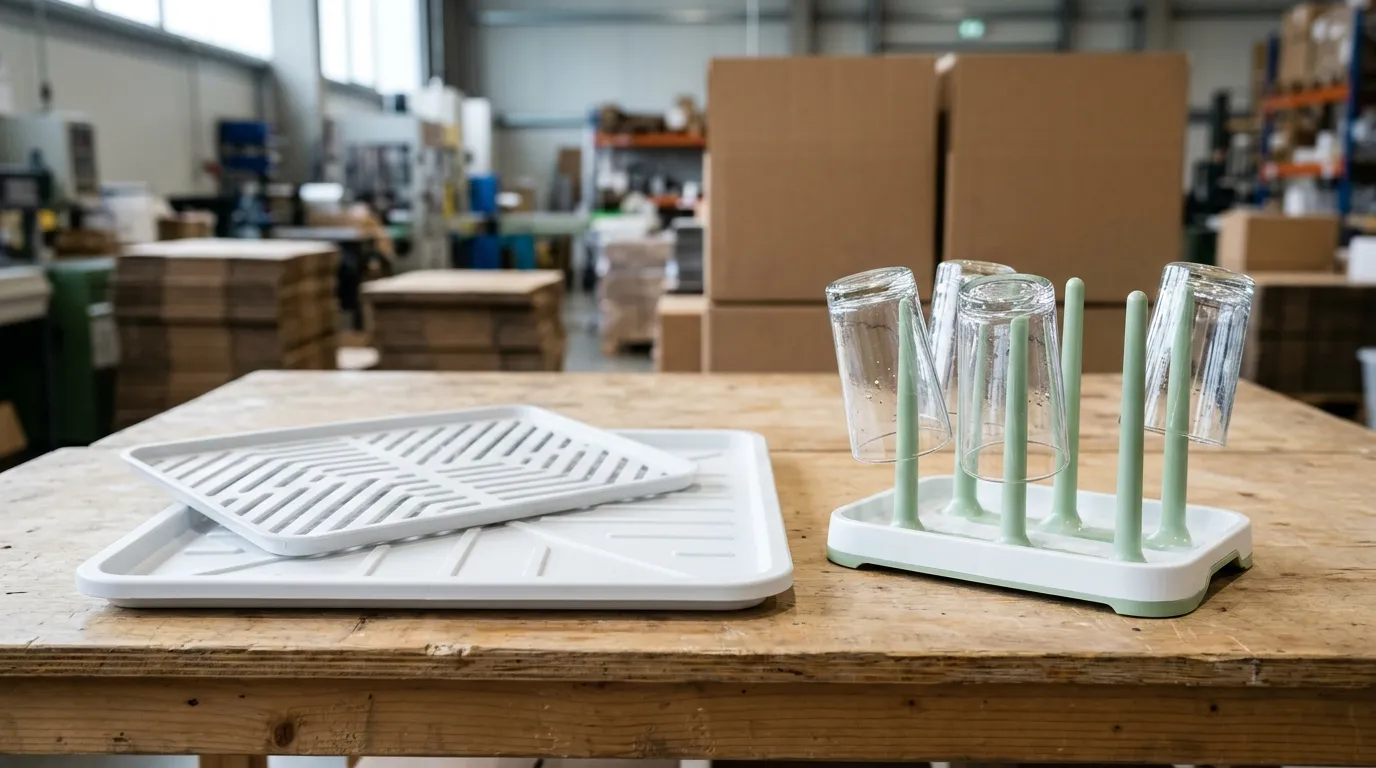
This article is for the buyer who is not shopping for one product. They are trying to decide whether the drain trays, cup racks, drip trays and ice trays they saw in one catalog belong on one purchase order — and whether the factory that quoted them can actually run all four.
The catalog makes them look like one category. Twelve published product pages sit under kitchen storage on this site alone, and they share a molding base: the same machines, the same resin supplier, the same packing hall. The procurement reality is three separate problems stacked on top of each other. Freight is set by the carton. Cost is set by how many materials sit inside each part. Compliance is set by which parts touch food. A buyer who negotiates all four families as one block usually gets a unit price that looks competitive and a landed cost that is not.
This article works from published product records — model, part dimensions, carton dimensions, gross weight, packing quantity — and it says so plainly when a record does not carry a number. Every figure below traces to a product page you can open. If you are reading brand reviews of storage containers for your own kitchen, this is not that article.
What a kitchen storage container manufacturer actually ships
"Kitchen storage" is a shelf label, not a product family. What a factory in this line actually quotes are four families that differ in geometry, in material count and in how they are tested:
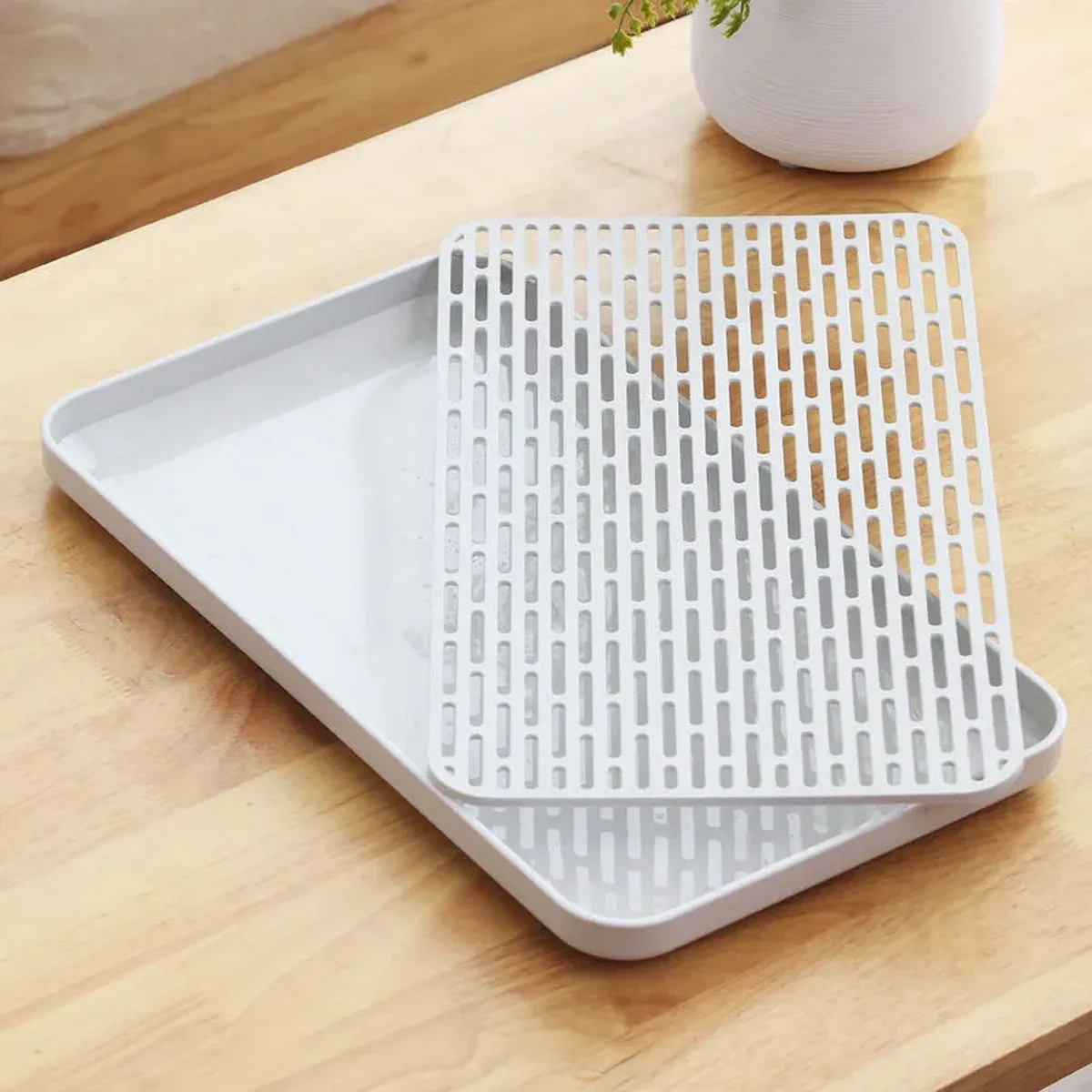
- Drain trays and drip trays — shallow flat PP trays, some with a removable grid insert, used under dishes, cups or produce. The deeper models double as serving trays that hold food directly.
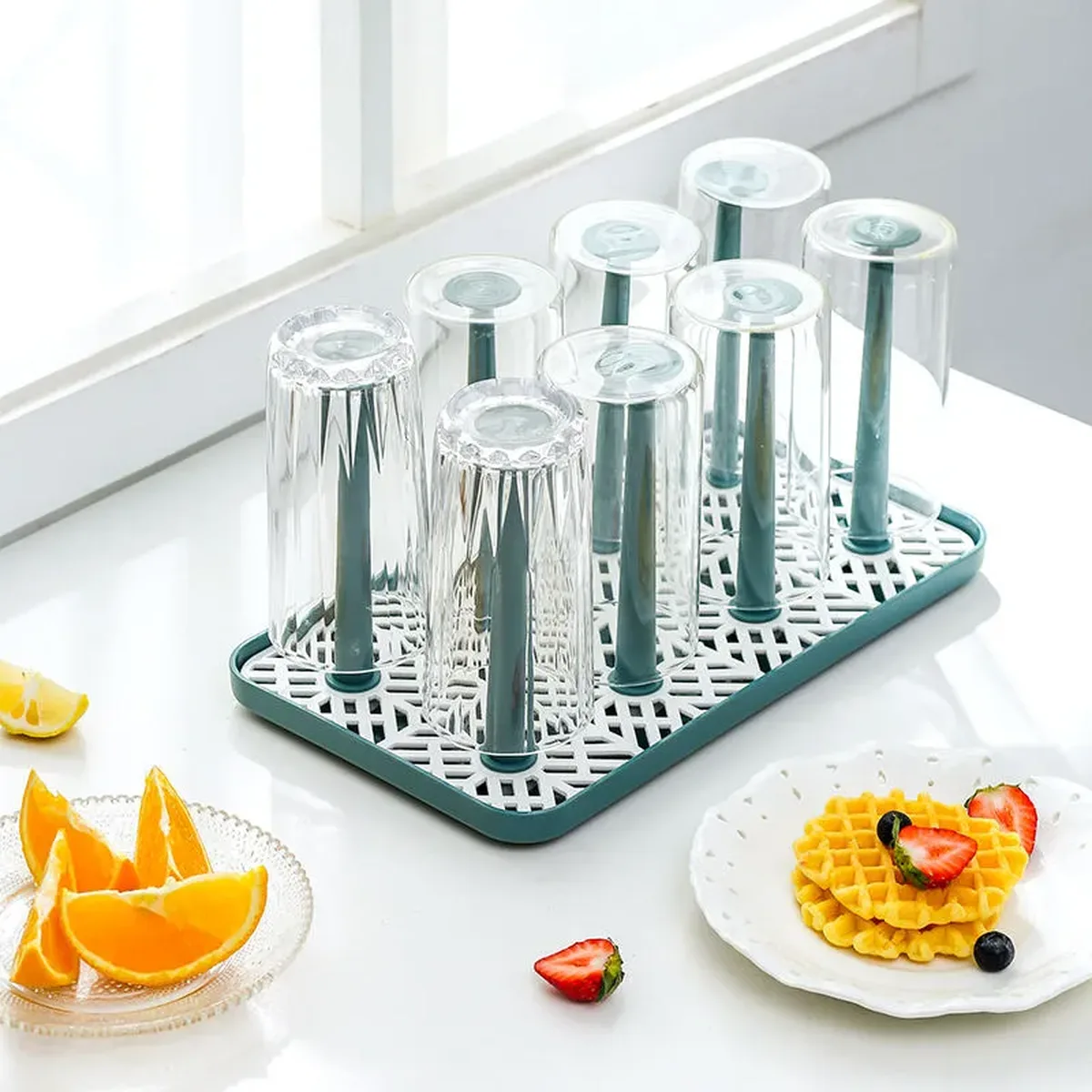
- Cup drying racks — an upright frame with pegs and, on some models, dust covers over the glasses.
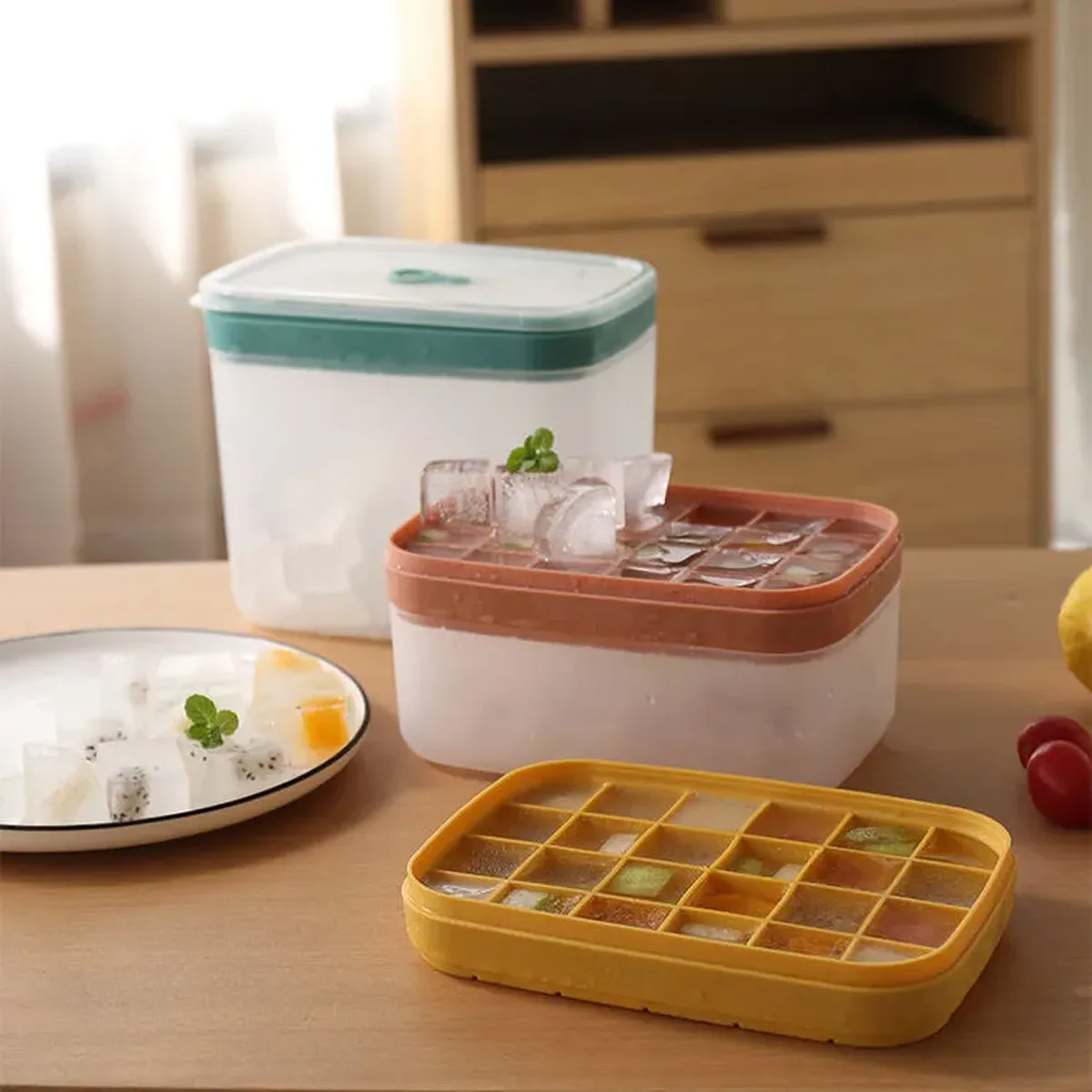
- Ice trays and ice molds — 6, 12 or 24-grid trays, sometimes sold with a lid and a storage bin.
- Desktop storage racks — two-tier countertop organizers, usually a frame plus shelves.
The published records show eleven distinct groups across those four families, from twelve product pages. The arithmetic is worth stating: two pages describe the same SN2415 to SN2417 shelf, so they count once; BH4439B appears on two pages that describe different items, so it counts twice. Model codes are model references, not a family taxonomy — the same prefixes turn up on other product families in the catalog, so SH and BX alone tell a supplier nothing about which range you mean. Quote the full code and the part size together, which is why the table above carries both.
Group | Models | Material | Part size | Carton | Gross weight | Packing |
|---|---|---|---|---|---|---|
Drain tray, large | SH3135 / SH3145 | PP | 39 × 22.5 × 2.5 cm / 31 × 17.5 × 2.2 cm | 46 × 40 × 45 cm / 54 × 38.5 × 46.5 cm | 18.5 kg / 15.8 kg | OPP bag |
Drip tray, deep | SH3147 | PP | 33 × 22 × 4 cm | 66.5 × 50.5 × 44 cm | 14.9 kg | OPP bag |
Drip tray, narrow | SH3167 | PP | 33 × 16 × 4 cm | 66.5 × 50.5 × 44 cm | 17.0 kg | OPP bag |
Food drain tray | SH3148, SH3149, SH3151, SH3152 | PP | not stated | not stated | not stated | OPP bag |
Cup drying rack | SH3155 / SH3156 | PP | not stated | not stated | not stated | OPP bag |
Desktop rack, two-tier | SH3175 | PP + ABS | 33 × 26 × 25 cm | 53 × 43 × 71 cm | 17.5 kg | 16 pcs / carton, OPP bag |
Desktop shelf | SN2415, SN2416, SN2417 | ABS + stainless steel | not stated | not stated | not stated | carton |
Ice tray, mini 6-grid | BH4439B | PP lid, PP and TPE grid, PS base | 10 × 6.8 × 3.5 cm | 52 × 28 × 33 cm | 13.2 kg | 180 pcs / carton |
Ice tray, 27 cm | BX1015 / BX1016 / BX1017 | PP + silicone | 27 × 13 cm | 55.5 × 28.5 × 66 cm | 19.5 kg | 100 pcs / carton |
Ice tray with lid and bin | BX1061 to BX1066 | PP + silicone | not stated | not stated | not stated | OPP bag |
Ice mold, 6-grid | 8121 | AB, PP, TPE, PET | 11.8 × 8 × 4 cm | 42 × 36.5 × 48 cm | 13.7 kg | 165 pcs / carton |
Read the not stated cells before you read anything else. Four of the eleven groups publish no carton data at all, and the same four publish no part dimensions. That is not a gap in the article; it is the condition of the category. Any supplier who quotes these groups from a catalog without filling those cells is quoting something other than your order. The full range, with each group's own page, is on our kitchen storage category page; if you want the food-storage side of the same factory instead, that is a different set of trays with lids.
Three procurement problems wearing one category name
The four families share a factory and nothing else. Treat them as one category and each of these three problems gets decided by accident rather than by you.
Freight is decided by the carton. A two-tier desktop rack and a 27 cm ice tray are both "kitchen storage", and one occupies roughly ten times the shipped volume of the other per piece. A mixed order that looks balanced in units is wildly unbalanced in cubic meters, and the freight quote follows cubic meters.
Cost is decided by the number of materials in the part. Five of the eleven groups are single-material PP. Four are two-material. One carries three polymers; another carries four. Each additional polymer adds a resin stream, a color match and usually a second component to inspect — costs that never appear in a unit price comparison.
Compliance is decided by which parts touch food. An ice tray is in direct contact with what people eat. A desktop rack is not a food-contact article, although its own product description has it holding snacks alongside stationery and cosmetics. Between those two sit a cup rack and a drain tray, where the contact is real but indirect. The document pack is not the same for all three, and a supplier who sends one certificate for the whole order has answered one third of the question.
Wall thickness sits underneath all three: it sets stiffness, cycle time and breakage at the same time, which is why two factories can quote the same nominal tray far apart on price. That economics is worked through in thin-wall molding and grammage.
Freight follows the carton, not the piece
Unit weight is the number buyers ask for and the number that matters least. What fills a container is the carton, and the carton is set by how the parts nest, not by how heavy they are.
Take 1,000 pieces of each group where the record publishes a packing quantity, and multiply out. Volumes below are carton dimensions multiplied through, then multiplied by the number of cartons 1,000 pieces needs.
One caveat the table cannot show. In the product records, carton size and gross weight are both labeled confirm packing scope, and the packing basis is labeled confirm unit/carton basis; pieces per carton is the only one of those fields the record states flat. The arithmetic below is therefore only as firm as the packing scope behind it — which is why the numbers here start a quotation rather than replace one.
Group | Model | pcs / carton | Cartons for 1,000 | Carton volume | Total volume | Total gross weight |
|---|---|---|---|---|---|---|
Desktop rack, two-tier | SH3175 | 16 | 62.5 | 0.162 m³ | 10.11 m³ | 1,093.8 kg |
Ice tray, 27 cm | BX1015–BX1017 | 100 | 10 | 0.104 m³ | 1.044 m³ | 195.0 kg |
Ice tray, mini 6-grid | BH4439B | 180 | 5.6 | 0.048 m³ | 0.267 m³ | 73.3 kg |
Ice mold, 6-grid | 8121 | 165 | 6.1 | 0.074 m³ | 0.446 m³ | 83.0 kg |
A thousand desktop racks take 9.7 times the cubic volume of a thousand 27 cm ice trays, and 5.6 times the gross weight. Put both in the same order and the racks decide your container, not the ice trays. That is the whole argument for costing a range by shipped volume rather than by unit price: the cheap-looking line can be the one paying for the empty space.
Now the harder observation. SH3147 and SH3167 ship in the same carton — 66.5 × 50.5 × 44 cm, 0.148 m³ — yet the records give 14.9 kg and 17.0 kg gross. Same box, 2.1 kg apart. The trays are not the same shape: 33 × 22 cm against 33 × 16 cm, both 4 cm deep. So either the packing quantities differ, or the separators differ, or one of the two records is measuring something slightly different. The record does not say which. That is exactly the question to put to a supplier before you compare their prices: two prices on the same carton with different gross weights are not comparable products.
The same tells you to distrust size as a proxy for weight. SH3135 packs into a 0.083 m³ carton at 18.5 kg; the shorter SH3145 packs into a 0.097 m³ carton at 15.8 kg. The smaller carton is the heavier one. Any landed-cost model built on "smaller tray, cheaper freight" is wrong twice.
Packing quantity is the single most valuable cell in a spec table and the one catalogs most often omit. Three of the eleven groups above publish a carton but no pieces-per-carton, and four publish no carton at all. You cannot compute freight, you cannot compute carton count, and you cannot sanity-check a supplier's claim without it. The mechanics of turning carton data into a container plan — including what a mixed load does to a flat carton — are in LCL vs FCL for a mixed order and in stacking, nesting and carton math.
Material by part: PP is the floor, the other polymers are the decision
Ten of the eleven groups start with polypropylene, and five of them stop there. The eleventh, the SN2415 to SN2417 shelf, is ABS and stainless steel with no polypropylene in it at all. PP is a polyolefin, and the polyolefin family overview from Plastics Europe describes the properties the trays inherit. The other five add a second or third polymer to solve one specific problem, and each addition moves work from the molding floor to somewhere else in the chain.
Combination | Where it appears | What it buys | What it adds |
|---|---|---|---|
PP only | SH3135/SH3145, SH3147, SH3167, SH3148, SH3149, SH3151, SH3152, SH3155/SH3156 | one resin, one color match, one material line in the document pack | nothing — and the part inherits every PP limit |
PP + ABS | SH3175 | two resins in one two-tier rack | two resins and two color matches inside one SKU, and the record does not say which part is which |
ABS + stainless steel | SN2415–SN2417 | a metal component inside a plastic rack | a bought-in part, which means a second supplier inside a single item; the record does not say which component is metal |
PP + silicone | BX1015–BX1017, BX1061–BX1066 | a soft material wherever the ice has to release | a second component whose fit and tear resistance need their own approval |
PP, TPE and PS | BH4439B | a lid, an inner grid and a separate base — three named components in three polymers | three polymers, three color matches, and a base in a different resin family from the tray |
AB, PP, TPE and PET | 8121 | four polymers in one small item | four material declarations for one low-value item |
Two consequences follow, and neither shows up on a quotation.
First, color matching multiplies. A single-polymer tray needs one masterbatch run. A two-tone rack needs the frame and the shelf to match under retail lighting, which means two resin streams pulled to one visual standard — and the record for SH3175 already lists its colors as combinations (white + green, white + gray, white + red) rather than single colors. That is a different manufacturing commitment from "white". The color methods that make this possible, and what each does to surface finish, are covered in the ten ways plastics get colored.
Second, the material mix decides which polymer questions you can answer. PP and PS behave differently at end of life and in a recycling stream; that difference is the subject of PP versus PS in reusable food containers. If a retail customer asks for a mono-material range, the single-polymer five are your range and the other six are a conversation.
Which parts touch food, and what that changes in the document pack
This is where a "kitchen storage" order stops being one order.
- Ice trays and ice molds are in direct contact with something eaten. That is the strictest case in the range and the one where the frozen condition matters as much as the material.
- Cup drying racks and drain trays hold vessels that food and drink will touch. The contact is indirect, but water carrying residue passes over the rack, so the surface still has to be declared.
- Drip trays used as serving trays move into direct contact. The record for SH3147 describes a tray for cups, bowls and dishes; the SH3148, SH3149, SH3151 and SH3152 group is listed for food-contact use on its own product page, which also asks the buyer to confirm the material documentation for the destination market.
- Desktop storage racks are not listed as food-contact articles, but the published description has them holding snacks as well as stationery and cosmetics, so the top shelf is an open question rather than a clean one. What you are buying there is finish quality — no sharp edges, no odor, stable color — and, if the tray really will hold food, a material declaration for the shelf as well.

The document pack follows that split. For the olefin parts, the US anchor is 21 CFR 177.1520 for olefin polymers; PP sits there. ABS, PS, TPE and silicone do not — they fall under other sections of the same part of the regulation, which is why a single olefin letter cannot cover a four-polymer item. TPE is the loose one in that list: it is an umbrella term rather than a single resin, so the declaration has to name the grade before it means anything.
On the EU side, the framework is Regulation 1935/2004 and the plastics measure is Regulation 10/2011, whose declaration of compliance is written material by material rather than product by product. The US regulator's own entry point for the whole subject is Packaging and Food Contact Substances. If your destination is Germany, LFGB sits on top of the EU layer, and the materials and food safety page is where this site collects the material-side questions rather than making claims.
One practical test before you accept any document pack for this range: count the polymers in the order, then count the material lines in the declaration. If the second number is smaller than the first, the paperwork does not describe what you are buying. The direct-versus-indirect distinction, and which components of a container fall on which side of it, is worked through in direct vs indirect food contact.
Cup drying racks and drain trays: the drainage geometry is the spec
Half the difficulty in this family is vocabulary. The same object is sold as a drain tray, a drip tray, a drainboard, a draining board and a drainer rack. Search any of those and you will also meet industrial spill-containment pans — thick polyethylene trays for drums and generators, a completely different product with a completely different price. In the kitchen sense, a drip tray manufacturer means a supplier of shallow PP trays that sit under washed tableware, which is the range our own drip tray line covers. A plastic drain tray in this range is the same object seen from the drainage side: a solid base, a slot field, and a rim deep enough to hold what runs off. Say "kitchen" and "PP" in your RFQ and the industrial quotes stop arriving.
Because the naming is unstable, the geometry has to carry the specification. Six numbers decide whether two quotes describe the same product:
- Footprint — the outer length and width, which decide how much counter it covers. The published pair runs 39 × 22.5 cm for the large tray and 31 × 17.5 cm for the shorter one; the two drip trays are 33 × 22 cm and 33 × 16 cm.
- Rim depth — 2.5 cm and 2.2 cm on the drain trays against 4 cm on both drip trays. Depth is not cosmetic: it sets how much water the tray holds before it spills and how tall the stack gets.
- Drainage pattern — a slotted insert sitting inside a solid tray, which is what the SH3135 and SH3145 product photos show, or a slot field molded into the tray itself. An insert can be lifted out and washed; a molded field cannot. The record for those two models does not name a grid, so ask which construction you are buying.
- Stack height — the usable height of the nested stack, which decides what fits under a shelf.
- Peg spacing and peg count on a cup rack, which decides whether a 9 cm tumbler or a 7 cm espresso cup sits on it.
- Coverage — whether the rack has dust covers over the glasses, as the cup drying rack group does on SH3155 and SH3156. Covers add parts, add packing volume and change how the rack looks on a retail shelf.
The large drain tray group is a useful example of why the record matters more than the photo: SH3135 and SH3145 look like the same product at two sizes, and their cartons confirm it — 46 × 40 × 45 cm against 54 × 38.5 × 46.5 cm — but the packing quantities are not published for either, so the per-piece freight gap between them cannot be computed from the record. Ask for it.
Ice trays: freezing is a different molding problem
An ice tray is the only family here where the product's job is to release something. The grid has to hold water when filled and let ice go when twisted, and those two requirements pull in opposite directions. That is why the material mix in this family is the most varied in the range and why the grid is almost never plain PP. It is also why any ice cube tray manufacturer worth quoting will ask about ejection before asking about your grid count.
The published records show three approaches:
- A hard tray in three polymers. BH4439B pairs a PP lid, a PP and TPE inner grid and a PS base.
- PP plus silicone. BX1015, BX1016 and BX1017 are listed as PP and silicone, 27 × 13 cm, packed 100 to a carton at 19.5 kg.
- A mixed-polymer mold. The 8121 six-grid mold combines AB, PP, TPE and PET in an item measuring 11.8 × 8 × 4 cm, packed 165 to a carton.
ABis not a standard polymer abbreviation — the record writes it, so ask for the grade before you accept a material declaration.
Grid count is the headline spec and the least interesting one. What changes your landed cost is whether the tray ships alone or with a lid and a bin. The lid-and-bin group runs six models, BX1061 to BX1066, and the record publishes no carton data for any of them. A bin is the part most likely to change the shipped volume of that family, so the freight on those six models is unknown until someone measures a carton.
One record needs flagging rather than smoothing over. The code BH4439B appears on two different product pages: one describes a 10 × 6.8 × 3.5 cm tray in PP, TPE and PS packed 180 to a carton, the other a 12 to 24-grid PP and silicone tray. Both are published, and they cannot both be the same article. If a supplier quotes you BH4439B, the model code alone will not tell you which one you are buying — get the drawing. This is the kind of thing a catalog cannot fix for you, and it is worth saying out loud because the same pattern shows up across the industry whenever one popular mold gets re-described by a second sales channel.
Where the tray sits in the freezer matters to the end user more than to the mold, but it decides the advice you put on the packaging. Freezing time by tray and grid size is covered in how long water takes to freeze in an ice cube tray.
Desktop storage racks: the only family where you buy an assembly
Every other family is a set of moldings sold as one SKU. The desktop rack is the only group that carries a bought-in metal part, and that is what makes it an assembly rather than a molding: assemblies fail at the joints.
The records show two constructions. SH3175 is PP and ABS, 33 × 26 × 25 cm, 17.5 kg gross for 16 pieces to a carton. SN2415, SN2416 and SN2417 are listed simply as ABS and stainless steel, in white and cream, packed in cartons whose dimensions the record does not publish. The PP and ABS two-tier rack and the ABS and stainless shelf look interchangeable in a catalog photo and are not the same supply chain.
The stainless version is the one to think about hardest, because the record stops at the material list and a buyer cannot price what it does not describe. A metal component inside a plastic assembly means a second supplier inside one SKU: that supplier owns a tolerance the molder does not, and if it drifts the shelves will not seat and the fault will look like a molding defect. Four things belong in the spec before you approve a sample — which component is metal, its gauge and finish, who owns the mating tolerance between the metal and the plastic, and whether the two arrive as one assembled unit or as separate parts. A seller who has never been asked those questions will answer them after the first container, not before.
Volume is the other surprise. At 16 pieces to a 53 × 43 × 71 cm carton, a single desktop rack occupies 10.1 liters of shipped volume and about 1.1 kg of gross weight. It is the least efficient item in the range to ship and the one most likely to be quoted at a price that ignores freight.
Minimums, colors and model counts on a four-family order
Here is where a range stops being a range and becomes a negotiation. Three numbers interact, and suppliers quote on whichever one suits them.
Model count. Eleven groups, and several are model families rather than single items: four food drain trays, two cup racks, three ice trays in one group, six in another. If your minimum is quoted per model, that group of six is six minimums.
Color count. The published color lists run from one entry to four. SH3147 is white. SH3167 is white or cream white. The food drain tray and cup rack groups carry white, pink and green. BX1015–BX1017 and 8121 carry four colors each. SH3175 is different again — its lists are two-tone combinations rather than colors, so each combination is a separate color match. A range built from these groups is not "one product in five colors"; it is a matrix.
Order shape. For kitchen storage containers wholesale programs, the practical shape of a first order is two families deep and two shallow: full color and full model coverage on the two lines you expect to sell weekly, single color and one model on the other two. That keeps the minimum spend concentrated where sell-through is proven and keeps the other two families in the catalog without warehousing them.
One thing the records do not publish is a minimum. All twelve kitchen storage records carry an empty MOQ field, and all twelve carry OEM/ODM: available; the commercial terms come back per model, per color and per order, which is exactly why the counting question below matters. These families are molded by Xinghui Plastic Life in Jieyang, Guangdong, whose catalog runs 63 published SKUs across six families with design, prototyping and mold building handled in house.
How minimums actually get counted — per order, per color or per model — is its own subject, worked through in is MOQ per order, per color or per model. The retail side of the same order, from OPP bag to printed sleeve, is covered in packaging tips for kitchen storage containers.
What to put in the RFQ
An inquiry that produces comparable quotes for this range asks for eight things. Each one corresponds to a cell that the published records above leave empty or ambiguous.
- Family, model and part dimensions for every line, in millimeters, with tolerance.
- Material by part — body, lid, insert, base, uprights named separately. "Food grade PP" is a family name, not a grade.
- Carton dimensions, gross weight and pieces per carton for each model. If the seller cannot give the third number, the first two cannot be used.
- Color reference — and for two-tone items, which part carries which color.
- Use conditions — frozen, dishwasher, direct food contact, or none. This decides the document pack, not the price.
- Destination market and the document pack you expect — a materials list, a declaration of compliance, or test reports per polymer.
- Retail packaging spec, including whether the OPP bag is replaced by a printed sleeve or a color box.
- Sample and approval route — which model you get as a sample, and what "approved" means in writing.
The full sequence around that list, from specification to shipment, is in how to source food storage containers from China. If the range is going out under your own brand rather than a distributor label, the labeling and packaging side is covered on the private label food containers page.
One molder for four families: what consolidation buys and what it does not
The case for buying this range from one injection molder is real, and it is narrower than most sales pages admit.
What it buys. One molding base — the same presses, the same resin purchasing, the same packing hall — so a four-family order shares a production calendar instead of four of them. One factory audit. One set of material declarations for the polymers that overlap across families, which is most of them. One container instead of four LCL bookings, and the mixed-load arithmetic that goes with it. The range logic behind that consolidation, across a wider product set, is set out in six product lines from one factory.
What it does not buy. It does not collapse the three procurement problems in section two. A single supplier still has to answer the carton question family by family, the material question part by part, and the food-contact question article by article. It also does not remove tooling from the equation: eleven groups mean at least eleven tooling sets, and the two assemblies need more than one mold each. That decision — modify, or cut steel — has its own economics, and the capability side of it sits on the manufacturing page.
So the useful way to hold this category is: one supplier, four families, three questions asked four times. That is the difference between treating a kitchen storage container manufacturer as one supplier with four production problems, and treating it as one product in four shapes — which is what the catalog layout quietly invites you to do. The buyer who asks the carton question, the material question and the food-contact question of every family separately gets comparable quotes and a landed cost they can defend. The buyer who sends one line asking a plastic kitchen storage container manufacturer for a price on "the whole range" gets four prices that cannot be compared, and usually picks the one that is cheapest for the wrong reason.
Continue reading
Related sourcing guidance
More practical context for your food storage container sourcing conversation.


Discuss your product range
Need help selecting or customising containers?
Share the product type, market and sourcing requirements with the Xinghui team.